Do Solar Shades Keep Cold Out? The Honest Winter Answer

Authored By Michael Turner -30 Years Home Improvement Expertise | Updated 2026 | BlindShades.pro
Updated on July 22, 2026By Michael Turner — 30 years in window treatments
No — the straight answer to do solar shades keep cold out is that they were never built for that job: an open mesh cannot trap air, so it cannot insulate. But “no” is not the end of the winter story. A solar shade still has a real cold-season role — mostly by being raised at the right hours, not lowered — and the numbers currently ranking for these products badly need auditing, from a fifteen-degree headline to a thirty-to-seventy-percent study claim. This guide gives the honest no, the winter playbook nobody publishes, the cold-out ladder, and the audit.
Key Takeaways
- The industry’s own answer is no. Blinds.com’s product FAQ has said it since May 14, 2020: the woven holes cannot insulate against cold — and every credible seller we reviewed lands in the same place.
- Shield, not sweater. Solar mesh is a radiation shield built for sun; winter cold is an insulation problem — a sweater problem — which belongs to trapped air, not woven holes.
- The counterintuitive winter move is UP. On sunny south-facing glass, a lowered solar shade blocks the free winter heat you want; the playbook below is about raising and lowering on schedule.
- The community already named the real winner. An r/InteriorDesign thread’s standing answer is double-celled shades that trap air — heat out in summer, cold out in winter — matching the R-value record cellular holds.
- The numbers in circulation conflict wildly. Apartment Therapy (July 14, 2026) headlines fifteen degrees of cooling; Beasen cites studies at 30–70% incoming-heat reduction; Bringnox (April 18, 2026) correctly notes it is all heat-gain reduction, not insulation. The audit table sorts every claim by what it actually measures.
⭐ Quick Answer — Do Solar Shades Keep Cold Out?
No — the honest answer to do solar shades keep cold out is that an open mesh cannot trap air, so it cannot insulate; it is a shield built for sun, not a sweater built for winter:
- The industry agrees: Blinds.com has said since 2020 that the woven holes cannot insulate against cold — no openness percentage or fabric color changes that physics.
- The winter move is UP, not down: on sunny south glass, raise the mesh and harvest free passive solar gain — North Solar Screen explains the interception that helps in July works against you in January.
- What actually blocks cold: double-cell cellular shades — trapped-air pockets with the category’s best R-values — ranked first in our cellular and honeycomb guide, with thermal drapery second.
- The numbers need auditing: the fifteen-degree cooling headline now ranking at Apartment Therapy is a summer claim — every impressive figure on this topic measures blocked sun, not held warmth; our heat guide covers the season the mesh actually wins.
- One window, both seasons: layer cellular over mesh — sweater at night, shield by day — the full trade-off lives in solar shades vs cellular shades.
Do Solar Shades Keep Cold Out?
No — and this is one of the rare questions where sellers, engineers, and the forums all align: a thin breathable mesh with open holes lets air circulate rather than trapping it, so it was never designed to keep cold out. Blinds.com’s Top 9 Questions page (May 14, 2020) said it plainly six years ago: the holes in the woven fabric do not allow the shade to insulate against cold. Blinds Plus Cincinnati (November 26, 2025) frames it as the question homeowners keep asking — can the summer product do the opposite job — and lands in the same place.
The physics is the same one that powers everything good about the product. A solar shade is engineered mesh — PVC-coated polyester or fiberglass, woven to a 1–10% openness factor — that intercepts solar radiation while passing air and view. Interception is a radiation job; insulation is an air-trapping job measured in R-value, and a fabric deliberately full of holes cannot hold an air layer any more than a screen door can. Even 1% openness is still a vented surface. That settles the yes/no. The better question is what a solar shade should be doing all winter — and the answer is not “hanging there lowered.”
What Do Solar Shades Actually Do in Winter?
Shield, Not Sweater: a solar shade is a radiation shield, not an insulating sweater — so its winter job is managing the sun, and the sweater work belongs to another layer.
| The job | Solar mesh | Cellular (honeycomb) | Thermal-lined drapes |
|---|---|---|---|
| Keep cold out / block drafts | ✖ Vented weave | ✔ Trapped-air pockets | ✔ Heavy barrier |
| Hold heat in (R-value) | ✖ None to speak of | ✔ Category’s best | Partial |
| Winter sun gain by day | ✔ When raised | ✖ Blocks it when lowered | ✖ Blocks it drawn |
| Summer heat + glare + view | ✔ The specialty | Partial, view lost | Partial, view lost |
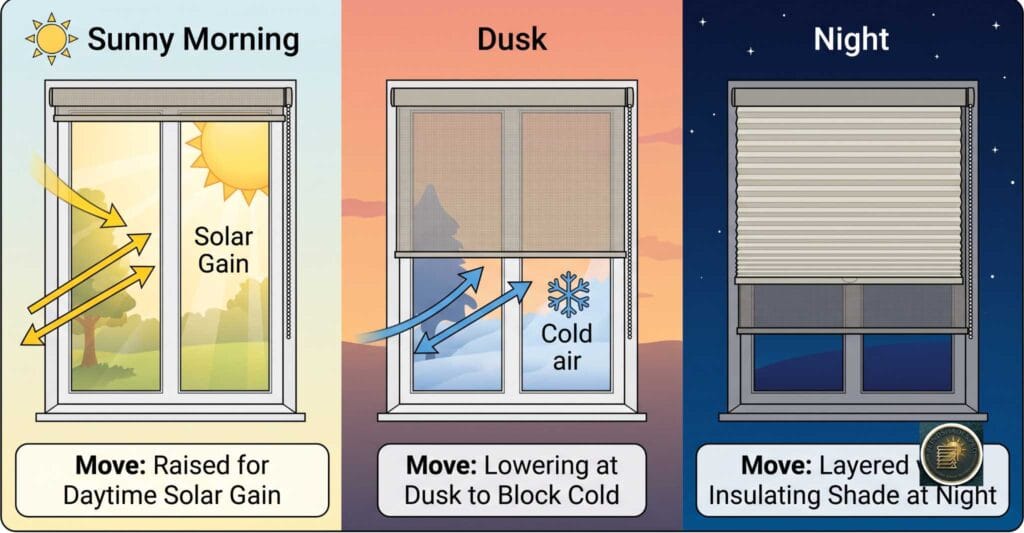
Here is what almost nobody writing about these products tells you: in winter, a lowered solar shade on sunny glass is often working against you. The same interception that cuts August heat gain also blocks the free passive solar gain a south-facing window delivers on a clear January afternoon — heat you already paid for by owning the window. North Solar Screen’s energy explainer describes the mechanism plainly: the fabric absorbs solar radiation before it passes through — exactly what you want in July and exactly what you do not want at noon in January. So the owner’s winter playbook is choreography, not removal:
| Winter moment | The move | Why |
|---|---|---|
| Sunny day, south/west glass | Raise the solar shade fully | Free passive solar gain — let the shield stand down |
| Sunny day, fading-risk furniture | Raise partially, or accept the trade | UV protection vs free heat — your call per room |
| Dusk, every window | Lower the shade | A closed layer adds a marginal still-air film at the glass — small, but not nothing |
| Overcast day | Lowered is fine | No gain to harvest; keep the glare control |
| Deep-winter night, cold climate | Lower the mesh AND close the sweater layer | The film + a real insulating layer working its shift |
| Dual-shade windows | Blackout/cellular layer takes nights, mesh takes bright days | Each layer on the shift it was built for |
One honest caution on the dusk row: the still-air film is marginal — a comfort nudge, not insulation, and no credible source quantifies it, so neither will I. In genuinely cold winters, choreography alone is not a plan — it is the opening act for the ladder below.
What Are the Best Shades to Keep Cold Out?
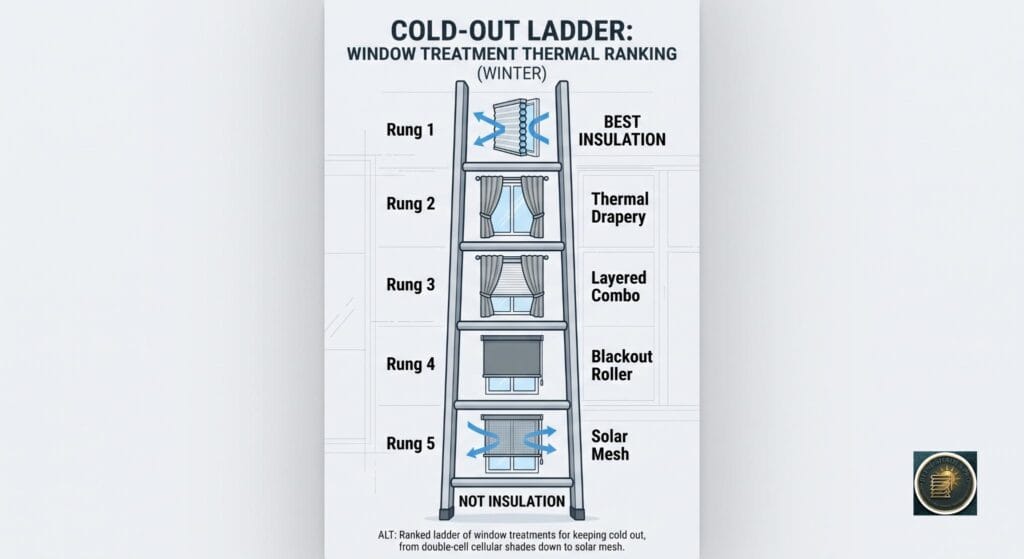
Double-cell cellular shades — and the community reached that verdict before most sellers wrote it down. The standing answer in an r/InteriorDesign thread on keeping the sun’s heat out is double-celled shades that trap air and work as a barrier — heat out in summer, cold out in winter — and the R-value record backs the crowd: honeycomb construction holds the category’s top insulation figures, with the Department of Energy crediting insulated cellular shades with cutting window heat loss by forty percent or more. The ranked ladder:
| Rank | Cold-out option | Why it works | The trade |
|---|---|---|---|
| 1 | Double- or triple-cell cellular shades | Trapped-air pockets — the genuine sweater; top R-values | View gone when lowered — the cellular guide has picks |
| 2 | Thermal-lined drapery | Heavy lined fabric blocks drafts and radiant loss — the classic cold-climate layer | Bulk; needs wall space |
| 3 | Cellular or drapery layered OVER solar mesh | Sweater at night, shield by day — the two-season answer | Two treatments, one window — the full matchup |
| 4 | Blackout roller layer | Solid fabric adds a real film; better than mesh alone | Dark room; modest R vs cellular |
| 5 | Solar mesh alone | Sun choreography + a marginal dusk film | Not insulation — the honest last place |
Adjacent but outside the shade family: weatherstripping and glass-level film treat the draft and the pane themselves — the r/HomeImprovement tint-vs-screens thread (35 posts) is really a summer conversation. If winter comfort is the driver, the ladder is the shopping list, and rung 3 is where whole-glass rooms land.
Can Solar Shades Really Cool a House by 15 Degrees?
The numbers now ranking for this product family conflict badly enough to deserve a table — and none of them, read carefully, is a winter insulation claim:
| Source + date | The claim | What it actually measures |
|---|---|---|
| Apartment Therapy (Jul 14, 2026) | “Cool your house by up to 15 degrees”; “up to 20% cooler”; “blocks up to 10% of UV rays” | A summer product roundup’s marketing figures — the “10% of UV” line alone signals garbled specs (solar fabrics block most UV; ten percent describes openness, not UV) |
| Beasen | Studies show properly installed solar screen shades reduce incoming heat by 30–70% | Summer solar-gain interception, stated as a range across fabrics and installs — the most defensible cooling figure in circulation |
| Bringnox (Apr 18, 2026) | Solar shades block heat by reducing solar heat gain, not by insulating like a winter covering | The correct frame — this page’s thesis in one sentence |
| Blindster (Sep 18, 2014) | Yes to blocking both heat and sunlight; dark fabrics absorb more | Summer again — with the color caveat our heat guide builds on |
| The industry consensus (Blinds.com and peers) | No — not designed to keep cold out | The winter answer, correctly separated |
The audit’s verdict: every impressive number in circulation is a summer number — solar-gain interception, where mesh genuinely earns 30–70%-class claims per Beasen’s cited studies. When a mainstream headline compresses that into “15 degrees cooler” beside “blocks 10% of UV,” you are reading product-page shorthand, not physics. And zero of these figures transfers to January: cooling numbers describe radiation stopped, while winter comfort is convection and conduction — the sweater’s department. Which resolves the strangest queries this page attracts.
How Long Do Solar Shades Keep Cold Out — Day vs Night?
They don’t — for any duration, at any hour; there is no timer on insulation a shade lacks, and the mesh passes air at 2 PM exactly as at 2 AM. What day versus night changes is which other job matters. Daytime is sun-management time — the raise-for-gain choreography above, because that is when there is radiation to harvest or block. Night is when a window loses the most heat and when the mesh matters least: lowering it adds only the marginal film, and the real work belongs to whatever sweater layer the window owns. So the honest translations: “during the day” — raise it on sunny glass and let the sun heat the room; “at night” — lower it, then close the layer that actually insulates; “how long” — duration was never the variable; construction is. If a seller implies a solar shade holds warmth through winter nights, that pitch has the same shape as the night-privacy pitch we adjudicated separately — a summer talent quietly resold as a winter one.
Who Should Buy Solar Shades If Winter Matters?
✔ Solar shades still belong in your winter house if: your climate’s real enemy is sun and glare (cooling-dominated regions), your cold season is mild, your south-facing rooms can run the raise-for-gain playbook, or you are building the layered rung-3 setup where mesh takes the day shift. ✖ Solar shades are the wrong purchase if: you are buying them to insulate — no weave does it; your winters are genuinely cold and the window will carry one treatment only (that is cellular’s window, per the ladder); or the room needs warmth held overnight, which is a job for trapped air and lined fabric, never mesh. Weighing the same money against a honeycomb? Solar shades vs cellular shades is the decision page, and the mesh’s other honest limits live in the disadvantages guide.
Avoid These Mistakes
- Buying solar shades as winter insulation. The industry’s own pages say no; if a pitch implies otherwise, ask for the R-value and watch the subject change.
- Leaving shades lowered on sunny south glass all winter. That blocks the free heat you most want — the raise-for-gain move is the season’s biggest lever and it costs nothing.
- Reading summer cooling numbers as year-round performance. Thirty-to-seventy percent describes intercepted summer radiation, not January comfort — the audit table is the decoder.
- Upgrading to 1% openness for warmth. Tighter weave buys glare control and UV, not insulation — a 1% mesh is still a vented surface (the openness guide covers what percentage actually buys).
- Treating dusk-lowering as the whole plan in a cold climate. The film effect is a nudge; cold climates need rung 1–3 of the ladder on the window.
- Removing the shades entirely for winter. You lose UV protection, glare control, and the choreography — re-schedule them instead.
The Bottom Line
So, do solar shades keep cold out? No — shield, not sweater, and every honest source agrees. But the winter verdict is choreography, not banishment: raise the mesh on sunny glass to harvest free heat, lower it at dusk for the marginal film, and give the sweater work to the layer built for it — double-cell cellular first, thermal drapery second, the layered combo where one window must serve both seasons. Every impressive number in the wild is a summer number; January runs on trapped air. If winter is your fight, start at the cellular and honeycomb guide; if summer is, the heat-blocking guide has the verified picks; and the full solar field lives in the complete solar shades guide.
FAQ
Do solar shades keep cold out during the day? No — but daytime is when they earn their winter keep differently: on sunny south or west glass, raise them and let free passive solar gain heat the room. Lowered, they block that gain while adding no insulation. Daytime winter use is sun management, not cold-blocking, and the schedule matters more than the fabric.
Do solar shades help with heat and cold? Half and half — heat, genuinely: they intercept solar radiation and cut summer gain, per the whole industry record. Cold, no: open weave cannot trap air, so there is no meaningful insulation. Sellers who answer the double question with only the heat half are answering the half that sells.
Are solar shades energy efficient in winter? Only through choreography — raised for free solar gain on bright days, lowered at dusk for a marginal film. The measurable winter efficiency belongs to insulated cellular shades, which the Department of Energy credits with cutting window heat loss by forty percent or more. Mesh contributes scheduling, not R-value.
What are the drawbacks of cellular shades, if they win winter? The honest ledger: the view disappears when lowered, open cells collect dust, humid rooms can bother the pockets, and internal cords cost more to repair than a roller. None of it outweighs the insulation case in cold-climate rooms — the full drawbacks table lives in our solar-vs-cellular matchup.
Can people see through solar shades at night? Yes — into any lit room, at every openness, because the daytime privacy effect is a brightness trick that reverses at lamps-on. It is the same pattern as the winter question: a summer-day talent that quietly fails after dark. Our night privacy guide covers the physics and the layered fixes.
Should I take solar shades down for winter? No — re-schedule them instead. Removal forfeits UV protection for floors and furniture, glare control on low winter sun, and the raise-lower choreography that makes the season work. Keep the mesh on the day shift, add the insulating layer for nights, and one window serves both seasons.
Related Guides
- Best Solar Shades — the complete guide
- Best Solar Shades for Blocking Heat
- Solar Shades vs Cellular Shades
- Best Cellular & Honeycomb Shades
- 5% vs 10% Solar Shades
- Disadvantages of Solar Shades
