Can You See Through Solar Shades at Night? The Privacy Truth

Authored By Michael Turner -30 Years Home Improvement Expertise | Updated 2026 | BlindShades.pro
Updated on July 22, 2026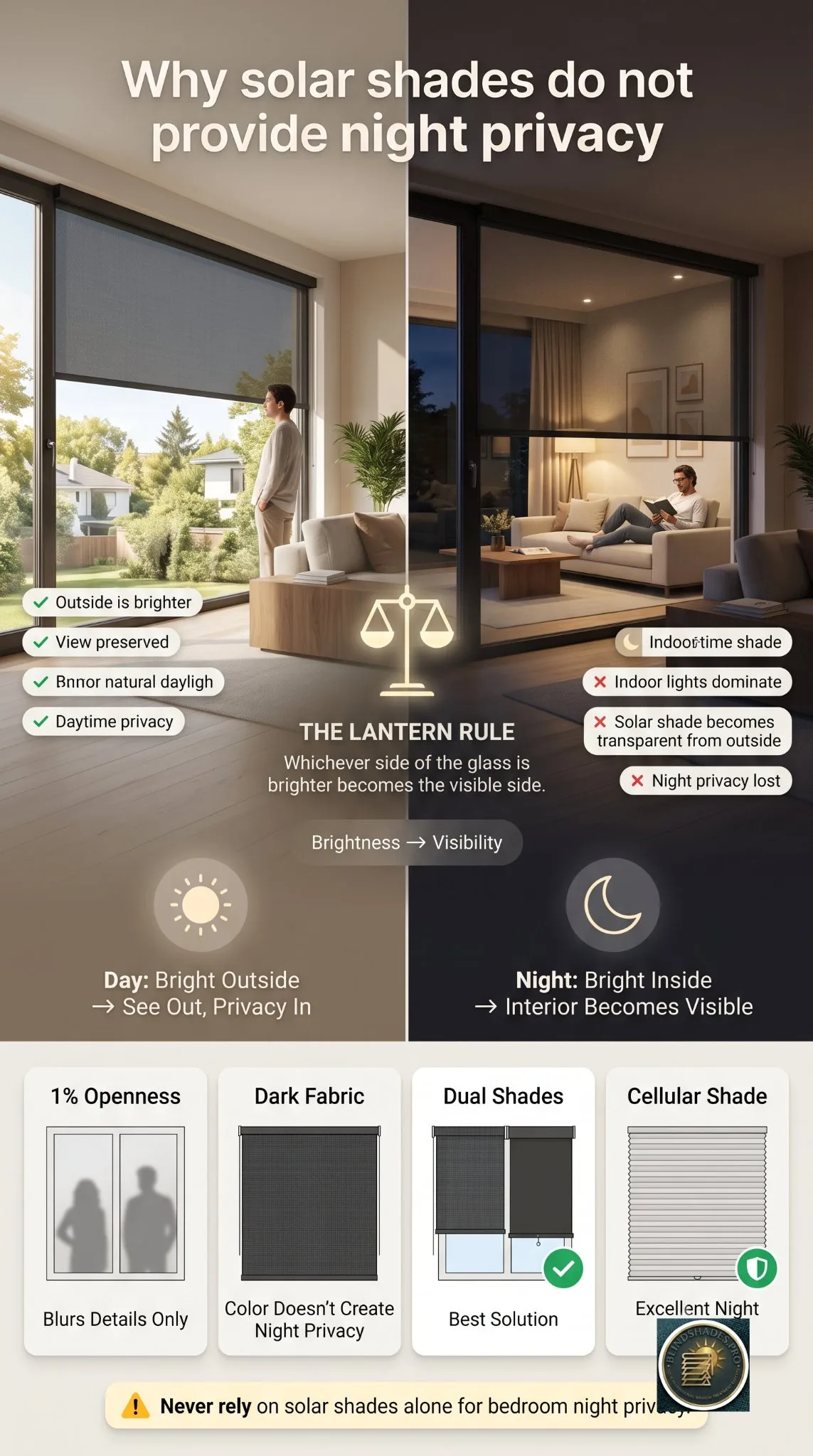
By Michael Turner — 30 years in window treatments
Yes — the honest answer to can you see through solar shades at night is that outsiders can, the moment your interior lights come on. The one-way privacy you enjoy all day reverses after dark: the mesh becomes a lit display case, and the fix is never a better solar shade — it is a second layer, a different product, or a smarter room. This guide explains the physics in one rule, times the flip, adjudicates the “just buy 1%” advice against the forum evidence, and delivers the room-by-room night verdict.
Key Takeaways
- The reversal is total. The Shade Store (December 8, 2023) says solar shades behave opposite at night — your view out disappears while the lit room becomes visible from outside.
- Openness softens the show, never cancels it. velablinds (August 29, 2025): people can see through solar shades at night even at 1 percent openness — the tightest weave sold.
- The failure starts at dusk, not dark. Once lamps outshine the fading sky, see-in begins while you can still see out — the transition window where people get caught.
- Sellers admit there is no magic shade. A Budget Blinds video answering “is there a shade I can see out of but people can’t see in” concludes no both-ways day-and-night product exists.
- The real fixes are layers and room assignment. Bali Blinds (February 8, 2019): if night privacy is a priority, solar shades alone won’t accomplish it. The fix ladder below ranks what will.
⭐ Quick Answer — Can You See Through Solar Shades at Night?
Yes — the honest answer to can you see through solar shades at night is that outsiders can, into any lit room, because the Lantern Rule never sleeps: whichever side of the glass is brighter becomes the display.
- Why it reverses: daytime privacy is a contrast trick — retailers say so themselves, with The Shade Store describing the opposite-effect flip and Bali Blinds stating plainly that solar shades alone won’t handle night privacy.
- The flip starts at dusk, not dark: once lamps outshine the fading sky there’s a twenty-to-forty-minute window where the street sees in while you still see out — close your privacy layer at lamps-on.
- The 1% verdict: the tightest weaves fabric makers like Phifer publish downgrade the show to silhouettes and shadow-play — obscurity you can buy, privacy you cannot.
- The real fixes are layered: dual shades, a blackout layer from our blackout guide, drapery, or a cellular swap — the full trade-off lives in solar shades vs cellular shades.
- Keep solar for its day job: glare, UV, and the view are what the mesh is genuinely for — verified picks with ratings live in the complete solar shades guide.
Why Do Solar Shades Reverse at Night?
The Lantern Rule (Bright · Side · Wins): whichever side of the glass is brighter becomes the display — light travels from the lit side to the dark side, and the mesh never takes sides.
Solar shades reverse at night because their privacy was never a property of the fabric — it was a property of the lighting. A solar shade is engineered mesh, typically PVC-coated polyester or fiberglass, woven to a stated openness factor: the percentage of the weave that is open hole, from 1 percent to an airy 10 — the range fabric houses like Phifer publish across their Sheerweave lines. Those holes pass light both directions, all the time; the daytime one-way effect is pure contrast — the sun-lit outdoors so outshines your interior that you read the scene beyond the mesh while a passerby sees only the fabric’s face.
After sunset the roles flip: your lamps make the interior the bright side. The ecosmartshades summary (May 5, 2026) compresses it into one sentence worth memorizing — if a shade lets you enjoy the view during the day, it will not block the view into your home at night. Glare control, UV interception, and daylighting continue around the clock; only the privacy direction obeys the light. The real question is when the flip happens — and it is earlier than most people think.
When Exactly Does the Flip Happen? The Dusk Window
The flip is a crossover, not a switch — privacy fails at two moments before you notice.
Failure one: the dusk crossover. Privacy inverts the minute interior brightness overtakes the sky — during twilight, while you can still see the yard. For perhaps twenty to forty minutes the window is partially transparent both ways: you feel hidden because you can still see out, while the street already sees in. Close your privacy layer at lamps-on, not at full dark.
Failure two: the lamp-adjacent window. What outsiders see is proportional to the light striking the mesh from your side. A floor lamp beside the glass floods the weave — the sharpest see-in of all; the same lamp moved deeper into the room, or dimmed, cuts the display dramatically. Cheap mitigations: pull lamps off the windows, dim the bulbs nearest the glass, close at lamps-on. These lower the lantern’s wattage — they do not restore privacy, which is where openness comes in.
| Openness factor | Daytime view out | Night see-in risk (lit room) | Honest role |
|---|---|---|---|
| 1% | Softened but real ★★★☆☆ | Silhouettes, motion, TV glow ★★☆☆☆ | Max glare control; obscurity, not privacy |
| 3% | Good ★★★★☆ | Clear shapes, some detail ★★★☆☆ | The common compromise weave |
| 5% | Very good ★★★★☆ | Recognizable figures and layout ★★★★☆ | View-first rooms with no night stakes |
| 10% | Panoramic ★★★★★ | Near-transparent when lit ★★★★★ | View corridors, three-season rooms |
Are Solar Shades Privacy at Night?
No — for any room lit after dark, solar shades are not a privacy product, and the industry says so on the record: Bali Blinds (February 8, 2019) states solar alone won’t accomplish night privacy; The Shade Store (December 8, 2023) describes the reversal without hedging. Sellers describing their own product’s limit — attribution against interest, which is exactly why it is trustworthy.
The community record is blunter: a Reddit r/Home thread with more than 190 comments recounts solar blinds sold for “privacy” in bathrooms — warning that at night, when the light source is inside, people can see in and you can’t see out. The anger there is not about physics; it is about a store claim that inverted the truth. If a salesperson pitches solar as evening privacy, ask what second layer they propose — the manufacturers above concede the mesh alone will not do it. The one counter-argument you will meet everywhere is the 1 percent weave — next.
Do 1% Solar Shades Give You Night Privacy?
“Just get 1 percent” deserves adjudication, because the evidence splits. In a Reddit r/HomeImprovement thread, the top answer (2 votes) reports seeing nothing inside from the street at night, and a second commenter (also 2 votes) calls 1 percent close to a privacy shade. Against that, velablinds (August 29, 2025) answers with a flat yes — people can easily see through, even at 1 percent — and a third Redditor hunting Phifer Sheerweave 1 percent evidence found a single night photo online. The visual proof is thin on both sides.
The Lantern Rule reconciles them: it depends on viewing distance and interior brightness. From across a street, a lamp-lit room reads as glow and vague shapes — the street-view Redditor is truthful. From a sidewalk a few feet away, silhouettes and screen-light are legible — velablinds is truthful too. My verdict after three decades of this exact callback: 1 percent downgrades the show from cinema to shadow-play — meaningful on a second floor, meaningless on a ground-floor bathroom. Treat 1 percent as obscurity, never privacy. Choose the weave for its daytime job — trade-offs in 5% vs 10% solar shades — then solve the night with a layer. Which raises the question every shopper eventually asks out loud.
Is There a Shade I Can See Out Of, But People Can’t See In?
At night, with one product, no — and the most credible source is a seller. A Budget Blinds video on this exact question (50-plus reactions) concludes solar shades are not “magic” shades providing privacy both day and night; no single shade is, because fabric cannot know which direction light is traveling. What works is a second element that takes the night shift:
| Night-privacy fix | Night privacy | Keeps the day view? | Effort + cost class | Best for |
|---|---|---|---|---|
| Dual solar shades (solar + blackout, one headrail) | Total when lowered ★★★★★ | Yes — raise the blackout by day | Mid; one install | Bedrooms, living rooms wanting both jobs |
| Blackout roller layered with the solar | Total ★★★★★ | Yes | Mid; second brackets | Street-facing glass — see the blackout shades guide |
| Drapery over the solar shade | Total when drawn ★★★★★ | Yes | Modest to premium by fabric | Rooms wanting softness anyway |
| Swap to cellular | Total — opaque fabric ★★★★★ | No — view goes when lowered | Mid; replaces the shade | Insulation rooms — matchup in solar shades vs cellular shades |
| Top-down/bottom-up layer | High — upper glow only ★★★★☆ | Partial sky view | Mid | Bathrooms, street-level rooms keeping daylight |
The dual-shade row is the one searchers increasingly name outright (“dual solar shades”) — the cleanest engineering answer: opposite talents, one window, each layer working its shift.
How Do Light Filtering and Other Shades Compare at Night?
Can you see through light filtering shades at night? Far less than solar mesh — light-filtering is translucency, not transparency: outsiders see a glowing panel and, at close range, at best a blurred silhouette pressed against it. One naming trap: a “99 percent light filtering” solar shade — the phrasing in a Facebook thread asking whether such shades give night privacy — is a 1 percent openness mesh described from the other direction, and it behaves like mesh. The honest ranking:
| Shade type at night (lit room) | What outsiders see | Night privacy verdict |
|---|---|---|
| Solar shade, any openness | Shapes to near-clear view, by weave and distance | Not a privacy product ★☆☆☆☆–★★☆☆☆ |
| Light-filtering roller (continuous fabric) | Glow; blurred forms only at close range | Good for most rooms ★★★★☆ |
| Cellular light-filtering (honeycomb) | Diffused glow only | Good, plus insulation ★★★★☆ |
| Blackout roller/cellular | Nothing — dark window | Total ★★★★★ |
Can You See Through a Sunshade?
Yes — “sunshade” is the casual name for the same interior solar-mesh product, so everything above applies. Listings run loose with names: solar shades, sun shades, sunshades, and solar blinds all mean the interior openness-factor mesh covered here, while solar screens usually means an exterior screen mounted outside the glass — a different product with different night behavior, covered separately. The stated openness percentage, not the name, tells you which physics you are buying.
Which Rooms Can Live With the Night Reversal?
The room, not the fabric, decides — the verdict table this guide has been building toward:
| Room | Night verdict on solar alone | The right move |
|---|---|---|
| Bathroom | Never — the r/Home betrayal is exactly this room | Cellular, TDBU, or film — see solar shades and bathroom privacy |
| Bedroom | No — see-in plus zero darkness | Dual shade or blackout layer; solar keeps the day shift |
| Street-facing living room | Risky solo — evenings on display | Add drapery or blackout, closed at lamps-on |
| Upper floor, no sightlines | Fine — distance is your privacy | Solar alone; enjoy the view |
| Home office (daytime use) | Fine — dark by night | Solar alone; glare control is the whole job |
| Three-season room / sunroom | Fine — the Reddit thread calls solar great here | Solar alone, or layer for winter evenings |
Fit Check
✔ Solar shades still fit: glare-heavy daytime rooms, offices, view windows, upper floors, sunrooms — anywhere the night audience is nobody. ✖ Solar alone does not fit: bathrooms, bedrooms, ground-floor and street-facing rooms lit after dark, or any window pitched as “privacy” without the reversal mentioned. In the second list, budget the second layer on day one — the full drawbacks list is in the disadvantages of solar shades.
Common Mistakes
- Believing the “privacy” pitch for a bathroom or bedroom. The 190-comment Reddit thread exists because this sale keeps happening; the manufacturers above contradict it in writing.
- Buying darker fabric for night privacy. Dark mesh improves daytime view-out and glare; the Lantern Rule ignores color — a lit room is a lit room.
- Confusing 1 percent openness with privacy — or with “99 percent light filtering.” Same fabric, two labels; neither makes a lit interior invisible, only blurry.
- Closing the second layer at full dark instead of lamps-on. The dusk crossover exposes the room while you can still see out; your lights are the trigger, not the sky.
- Fixing a room-assignment problem with a fabric upgrade. Tighter mesh buys obscurity, not a solution — and if winter comfort is also on the list, the mesh was wrong twice; see do solar shades keep cold out.
The Bottom Line
So, can you see through solar shades at night? Outsiders can, into any lit room, at every openness — the daytime one-way effect is a lighting trick that runs in reverse after dark. The playbook: keep solar shades for what they do (glare, UV, daylight, the view), assign them to rooms with no night audience, close a second layer at lamps-on everywhere else, and never accept a “privacy” pitch that ends at the mesh. Ready to choose the mesh side properly? Our verified picks — retail ratings with review counts, no house scores — are in the complete solar shades guide, and pair any pick with a night layer from the blackout guide.
FAQ
Can you see through solar shades at night without blinds behind them? Yes — with no second layer, a lit room is visible from outside through any solar mesh, with clarity rising with openness and falling with distance. Without blinds, drapes, or a blackout layer, your only levers are lamp placement and dimming — they soften the display, never restore privacy.
Do dual solar shades fix night privacy? Yes — dual shades pair a solar mesh and a blackout roller on one headrail, each working its shift: mesh for daytime glare and view, blackout for lit evenings. It is the cleanest single-window fix — full day view preserved, total night privacy the moment the second layer drops.
Can you see through light filtering shades at night? Mostly no — continuous light-filtering fabric has no open weave, so outsiders see a glowing panel and, at close range, only blurred forms near the fabric. Beware the label trap: a “99 percent light filtering” solar shade is a 1 percent openness mesh — it behaves like mesh, not light-filtering fabric.
Does fabric color change what neighbors see at night? No — color changes daytime performance, not night physics. Darker mesh sharpens your view out and cuts glare; lighter mesh brightens the room. After dark, the lit interior projects through the weave identically either way. Choose color for the day job; solve night privacy with a layer, never a swatch.
Can you see through solar shades from outside during the day? Generally no — daylight makes the outdoors the bright side, so passersby see the fabric face while you see out. Exceptions: close range against high-openness mesh, and interiors lit brightly enough to rival daylight. The protection is contrast — exactly why it evaporates each evening at lamps-on.
What percentage solar shade is best if night privacy matters? None — percentage buys daytime performance and, at 1 percent, nighttime obscurity; no weave provides lit-room privacy. Pick openness for glare, view, and orientation, then add the night layer. Our openness guide compares the daytime trade-offs so the percentage decision is made for the right reasons.
Related Guides
- Best Solar Shades — the complete guide
- Solar Shades vs Cellular Shades
- Disadvantages of Solar Shades
- 5% vs 10% Solar Shades
- Solar Shades and Bathroom Privacy
- Best Blackout Blinds & Shades
