Are Solar Shades Worth It for a Commercial Office? The Spec

Authored By Michael Turner -30 Years Home Improvement Expertise | Updated 2026 | BlindShades.pro
Updated on July 23, 2026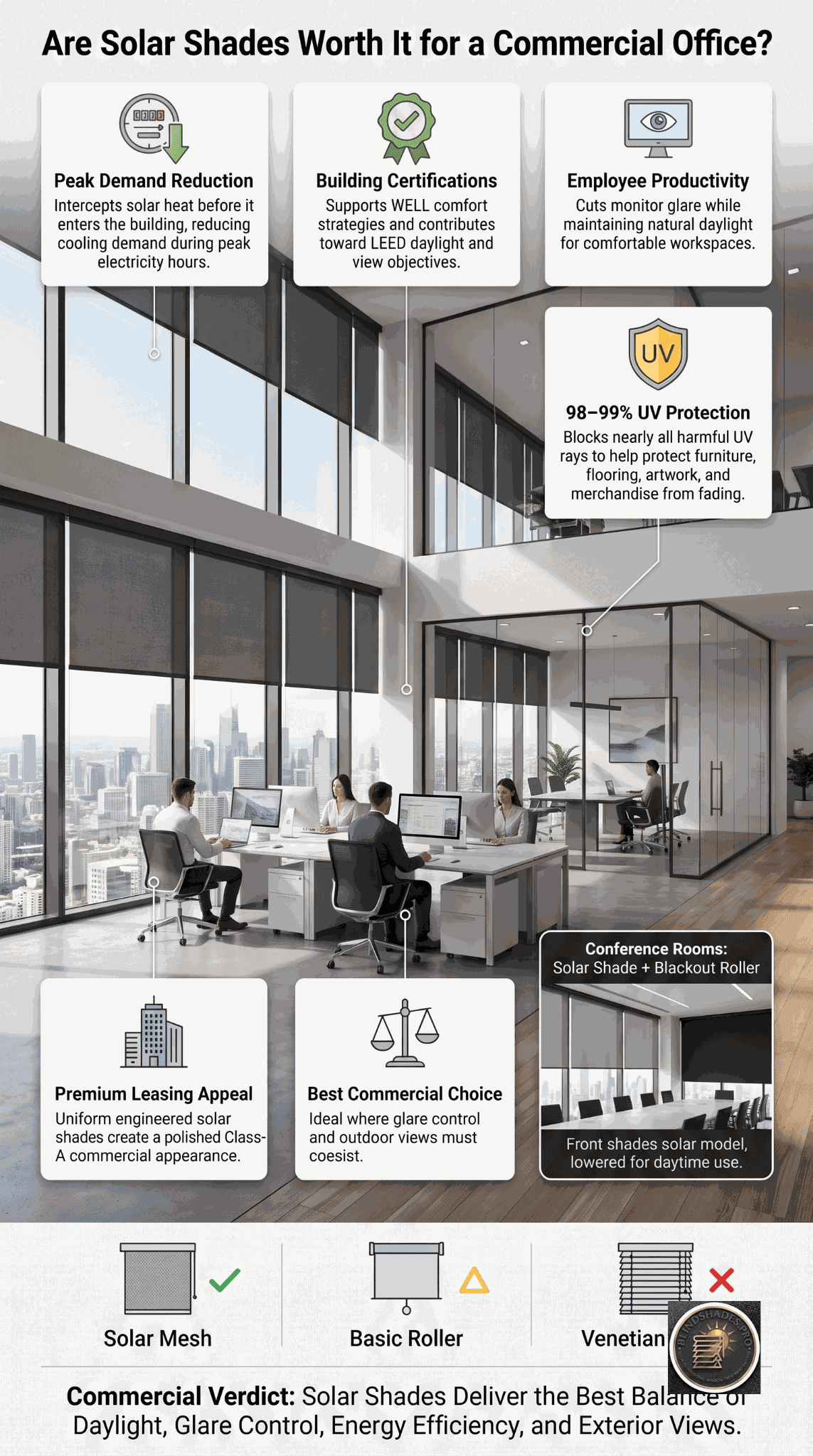
By Michael Turner — 30 years in window treatments
Yes — are solar shades worth it for a commercial office is one of the few questions in this category with a near-unconditional answer, because no other treatment simultaneously cuts screen glare, blocks UV, trims solar heat gain and peak-demand load, preserves the view walls of glass were bought for, and contributes to WELL and LEED certification. But the commercial version of this decision is not the residential one with a bigger budget: architects specify by SHGC and VLT rather than openness percentage, certified buildings make motorization mandatory rather than optional, and the fabric question has a commercial-grade answer most retail guides never mention. This guide carries the office manager’s verdict and the specifier’s framework in one place.
Key Takeaways
- The verdict is yes for every sun-facing office. Solar mesh is the only treatment covering glare, UV, heat, view, and certification credits at once — and for offices pursuing WELL certification, correctly specified shading is not optional but required for the glare-control feature.
- Commercial value runs deeper than residential guides calculate. Beyond glare and cooling, offices bank peak-demand reduction (demand charges are a major share of a commercial power bill), certification credits, and the Class-A tenant-appeal premium — line items absent from every homeowner ROI.
- The metric changes at commercial scale. Residential buyers shop openness percentage; commercial projects specify Solar Heat Gain Coefficient and Visible Light Transmittance from certified fabric data sheets — Phifer SheerWeave and Mermet both publish the optical data WELL modelling requires.
- The fabric has a commercial answer: fiberglass. PVC-coated fiberglass (Phifer SheerWeave, Mermet, Nysan, Sattler) is dimensionally stable under all-day solar load, NFPA 701 fire-documented, and ships with the certified optical data polyester retail fabrics lack.
- Certified buildings must motorize. The WELL automation feature requires shading that responds to sun without manual operation — motorized systems with scheduling qualify; manual shades do not.
⭐ Quick Answer — Are Solar Shades Worth It for a Commercial Office?
Yes — are solar shades worth it for a commercial office has a near-unconditional answer, because no other treatment covers glare, UV, heat, view, and certification at once:
- The certification stack decides the spec: WELL glare control requires Daylight Glare Probability below 0.35, its daylight feature punishes over-tight shading, and its automation feature makes motorized scheduling mandatory — manual shades do not qualify, per the IWBI standard.
- Specify by SHGC and VLT, not openness: commercial compliance runs on certified optical data sheets — Phifer SheerWeave and Mermet publish them — and VLT always runs higher than the openness label; the residential half of the decision lives in our 5% vs 10% guide.
- The fabric answer is fiberglass: dimensionally stable on floor-to-ceiling sun, NFPA 701-documented, data-sheeted — retail polyester belongs at home.
- Pricing runs per square foot of glazing: roughly eight to fifteen dollars installed for manual commercial spec, up to fifty at full automation-and-commissioning grade — commercial lines at Blindsgalore anchor the supply record, and the heat physics behind the savings is in our heat-blocking guide.
- The one carve-out: presentation rooms need a blackout partner — and the complete commercial procurement framework lives in the office and commercial blinds guide.
Are Solar Shades Worth It for a Commercial Office?
Yes — and the honest way to show it is to list what the residential calculation misses. A homeowner’s ROI counts glare relief, UV protection, cooling savings, and daytime privacy; all four transfer. The commercial ledger then adds its own lines: peak-demand reduction — commercial electricity bills carry demand charges tied to peak load, and intercepting solar gain at the glass shaves exactly that peak; certification capital — WELL features and LEED daylight and view credits, detailed below, convert shading from a furnishing into scored building performance; productivity — glare on monitors is a workplace-comfort issue the glare-geometry research treats as a first-order cost (the screen-glare mechanics have their own guide); UV interception — trusted commercial fabric lines are credited with 98–99% UV protection, the figure circulated for the Insolroll and Graber programmes, which is what stands between sun and fading furnishings, flooring, and merchandise; and leasing optics — uniform, engineered shading on a glass facade is part of the Class-A finish standard. In the commercial three-way — solar mesh versus basic rollers versus blinds — the performance case favors mesh wherever glare control and preserved views must coexist, the position the commercial-specification field itself takes; the full head-to-head lives in the commercial hub. The one narrowing context: conference and media rooms need true darkness mesh cannot produce — they take the dual-roller arrangement, mesh by day, blackout for presentations. Everywhere else on the floor plate, the verdict holds; what decides how is the certification stack.
What Do WELL and LEED Require From Office Shading?
The Certification Stack (Glare · Daylight · Automation): certified buildings score shading on three axes — glare probability held down, daylight autonomy held up, and automation making both happen without human hands. Solar shades are the one treatment that can satisfy all three.
| Requirement | The threshold | What it means for shades |
|---|---|---|
| WELL v2 L07 — Glare Control | Daylight Glare Probability below 0.35 in regularly occupied spaces, per the IWBI standard | Tight weaves in dark fabric on sun-facing glass; DGP modelled from the fabric’s published optical data |
| WELL v2 L04 — Daylight | Spatial Daylight Autonomy — 300 lux across half the floor area for half of occupied hours | Over-tight shading everywhere fails this — shades must RAISE when direct sun is absent |
| WELL v2 L05 — Automatic Glare Control | Shading that responds to solar conditions without manual operation | Motorized with scheduling or sensors qualifies; manual shades do not — motorization is mandatory in WELL projects |
| LEED v4 EQ c7 — Daylight | 300 lux across most floor area for nine hours daily, per USGBC | Automated raise-when-clear scheduling maximizes the credit |
| LEED v4 EQ c8 — Quality Views | Direct outdoor sightlines across most of the floor | Five-to-ten percent openness preserves the qualifying view |
Read the stack and its central tension appears: glare control wants the window dim, daylight autonomy wants the floor bright, and only movement reconciles them — hence orientation-tuned openness (one-to-three percent south and west, three-to-five east, seven-to-ten or open north) plus motorized scheduling that raises the shades whenever direct sun is absent. The color half of the L07 math is fabric physics: dark mesh cuts window luminance hardest, for the same reason dark wins glare everywhere. That stack is the specifier’s frame; the next section is the specifier’s language.
How Do Architects Actually Specify Solar Shades?
Not by openness percentage — by SHGC and VLT, the most useful distinction an office buyer can learn before procurement. Solar Heat Gain Coefficient is the fraction of incident solar energy ending up inside through the combined glass-plus-shade system: an unshaded double-pane window typically runs in the low-to-mid 0.30s, a three-percent shade pulls the system toward the low-to-mid 0.1s, a one-percent weave lower still — the published ranges on Phifer SheerWeave and Mermet data sheets, where a real spec gets them. ASHRAE 90.1, the commercial energy code, caps window SHGC by climate zone — hot-zone orientations commonly need 0.25 or below — and interior shading that drops the system number below the cap can rescue a building from a glazing upgrade. VLT — Visible Light Transmittance — is the daylight twin, and here is the trap the openness number sets: VLT always exceeds the openness percentage, because light also transmits through the fibers, not just the holes; a three-percent-open fabric can carry a system VLT near five. Daylight-autonomy modelling for the WELL stack must use VLT, never the openness label. The procurement rule that falls out: request the certified SHGC, VLT, and reflectance data sheet — not the retail openness number — The residential decision this replaces, the 5% vs 10% framework, remains the right tool one scale down, as the heat interception model is its residential twin.
Fiberglass or Polyester: Which Fabric Is Commercial-Grade?
| Question | Polyester (retail lines) | Fiberglass (Phifer SheerWeave, Mermet, Nysan, Sattler) |
|---|---|---|
| Dimensional stability on floor-to-ceiling sun | Can deform under sustained load | Stable — glass fiber does not creep |
| Fire documentation | NFPA 701 not guaranteed without treatment | NFPA 701-documented as standard |
| Certified optical data (SHGC/VLT) for WELL, ASHRAE | Rarely published | Published per fabric — the modelling inputs |
| Duty rating | Residential cycles | Commercial headrail systems carry published cycle ratings into the tens of thousands |
| Where it belongs | Homes, light-duty small offices | Every specified commercial project |
Two hardware notes complete the spec. Cassette headrails — enclosed housings concealing tube, motor, and wiring — are the commercial standard rather than an upgrade: enclosed-mechanism expectations, clean motor-wiring integration, and finish aesthetics all point the same way, at roughly ten to twenty-five dollars per linear foot. And contract-grade internals — metal clutches, span-sized tubes — are what separate a shade that survives commercial duty cycles from a residential lookalike that fails in year two; the full contract-grade breakdown lives in the commercial blinds hub.
What Does a Commercial Installation Cost?
Per square foot of glazing — the format facilities budgets actually use — with all figures installed and subject to project quotes:
| Specification level | Installed cost per square foot |
|---|---|
| Standard commercial manual + commercial headrail | Roughly eight to fifteen dollars |
| Motorized + cassette headrail | Fifteen to twenty-five dollars |
| Motorized + building-automation integration + WELL commissioning | Twenty-five to fifty dollars |
| Premium fiberglass + full automation compliance package | Thirty-five to sixty dollars |
Scale example in round terms: a fifty-thousand-square-foot office at a thirty-percent glazing ratio carries about fifteen thousand square feet of glass, putting the standard motorized specification in the low-to-mid six figures installed — the number a CFO budgets against, which per-window residential pricing cannot produce. Two honest riders: demand-charge savings and certification value accrue after installation and vary by utility tariff and project, so they belong in the payback model, not the sticker; and motorization’s operating case — labor eliminated, schedules captured, loose-chain compliance retired — is a scale decision with its own ROI framework. Where the building allows exterior mounting, solar screens intercept before the glass and change the math again.
Which Offices Get Which Verdict?
| The office | Worth it? | The spec |
|---|---|---|
| South / east / west-facing floors | ✅ Definitively | Fiberglass, one-to-three percent dark on the hard sun, motorized where scale or certification applies |
| North-facing floors | ✅ Usually | Looser weave for daylight; diffuse-glare and UV case carries it |
| WELL-certified building | ✅ Mandatory | The full stack: orientation-tuned openness + motorized scheduling + published optical data |
| LEED project | ✅ Contributes | Automated raise-when-clear scheduling for the daylight credit; five-to-ten percent where views score |
| Conference / media rooms | ⚠️ Mesh alone, no | Dual roller — solar day shift, blackout for presentations |
| Ground-floor, privacy-sensitive | ✅ With care | One-to-three percent, outside-mount — and the night rules still apply at office scale |
| Small low-sun office on a budget | ⚠️ Optional | Benefit is modest; spend where the sun is |
Who Should Buy Solar Shades for an Office?
✔ Buy — and specify properly — if: your glass faces the sun, screens live on the floor, the building pursues WELL or LEED, the facade is part of the leasing pitch, or peak-demand charges bite the power bill — fiberglass fabric, data sheets in the submittal, motorized where the stack or the glass height demands it. ✔ Buy the dual-roller variant if: the room is a conference or media space that needs true dark on demand. ✖ Solar mesh is the wrong solo spec if: you need presentation blackout; you expect winter insulation — an open weave cannot trap air, and that job belongs to the cellular family; you need after-hours interior privacy on lit ground floors without a plan for it; or you are tempted to fill a spec with retail polyester — the residential product in a commercial duty cycle is how facilities teams end up re-buying in year two.
Avoid These Mistakes
- Specifying by openness percentage alone. Commercial compliance runs on SHGC and VLT from certified data sheets — the openness label understates transmitted light and carries no code weight.
- Putting retail polyester on commercial glass. Thermal deformation on floor-to-ceiling sun, undocumented fire performance, and no optical data — the fabric question has a commercial answer.
- Buying manual shades for a WELL project. The automation feature disqualifies them — motorized scheduling is the compliance package, not a luxury line.
- Shading every orientation identically. Over-tight north glass fails the daylight side of the stack; the spec is orientation-tuned, then automated.
- Budgeting per window. Commercial shading prices per square foot of glazing — per-window numbers make six-figure projects look like typos.
- Ignoring the headrail line. Enclosed cassettes and contract-grade internals are where commercial and residential quietly diverge — and where year-two failures are decided.
The Bottom Line
Are solar shades worth it for a commercial office? Yes — emphatically on sun-facing glass, structurally in certified buildings, with two honest cons on the ledger (no night privacy, no winter insulation) and one carve-out for rooms needing true darkness. Weighed at commercial scale, the pros and cons resolve into a specification, not a purchase: fiberglass fabric with published optical data, SHGC and VLT doing the compliance math, orientation-tuned openness reconciled by motorized scheduling, cassettes and contract-grade hardware underneath, and pricing per square foot of glazing. The full commercial procurement framework — spaces, specs, and scale — lives in the office and commercial blinds guide, and the product family’s complete residential record is in the best solar shades guide.
FAQ
Are solar shades worth it for a commercial office? Yes — for virtually every office with direct solar exposure. They are the only treatment that cuts screen glare, blocks UV, trims solar heat gain and peak-demand load, preserves the view, and contributes to WELL and LEED certification at once. In WELL-certified buildings, correctly specified solar shading is required, not optional.
What do WELL requirements mean for office shades? Three features drive the spec: glare control (Daylight Glare Probability held below 0.35 in occupied spaces), daylight autonomy (which over-tight shading fails), and automatic glare control — which manual shades cannot satisfy. The compliant package is orientation-tuned openness plus motorized scheduling, modelled from the fabric’s published optical data.
What is the difference between openness factor and VLT? Openness is the percentage of the weave that is open hole; Visible Light Transmittance is the total light passing through the system — holes plus the light transmitted through the fibers themselves — so VLT always runs higher. Commercial daylight modelling and energy compliance use VLT and SHGC from certified data sheets, never the retail openness label.
Should commercial solar shades be fiberglass or polyester? Fiberglass — the Phifer SheerWeave and Mermet class — for any specified project: dimensionally stable under all-day sun, fire-documented to NFPA 701 as standard, and published with the SHGC, VLT, and reflectance data compliance modelling requires. Retail polyester serves homes; on commercial glass it deforms, and its documentation gaps fail submittals.
How are commercial solar shades priced? Per square foot of glazing, installed: roughly eight to fifteen dollars for standard manual commercial spec, fifteen to twenty-five motorized with cassette headrail, and twenty-five to fifty at full building-automation and WELL-commissioning grade. A mid-size office’s glazing runs the project into six figures — which is why per-window pricing has no place in a commercial budget.
Do office solar shades give privacy at night? No — the daytime one-way effect reverses at lights-on in an office exactly as in a house, and evening floors are visible from the street through any openness. Ground-floor and privacy-sensitive spaces plan a second layer or after-hours protocol; the full physics lives in our night visibility guide.
Related Guides
- Best Office & Commercial Blinds — the complete guide
- Best Solar Shades — the complete guide
- 5% vs 10% Solar Shades
- Best Solar Shades for Blocking Heat
- Motorized vs Manual Commercial Blinds: The ROI
- Can You See Through Solar Shades at Night?
