How to Choose Solar Shade Color: Dark vs Light, Decided

Authored By Michael Turner -30 Years Home Improvement Expertise | Updated 2026 | BlindShades.pro
Updated on July 24, 2026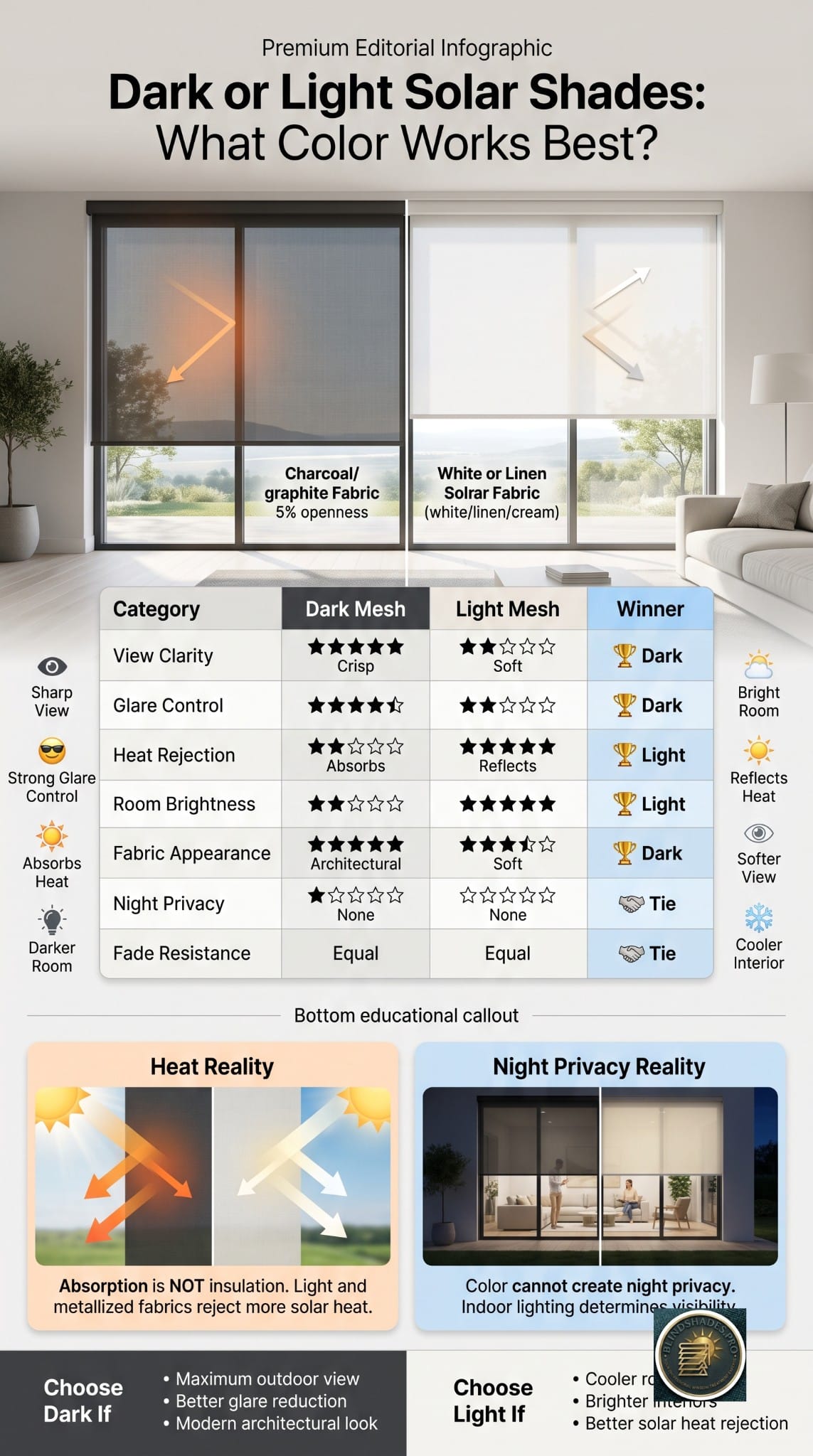
By Michael Turner — 30 years in window treatments
Choosing a solar shade color comes down to four words: dark sees, light cools. Dark mesh gives the sharpest view out, the best glare kill, and the strongest daytime fabric face; light mesh bounces solar energy back out and keeps the room bright — at the price of a hazier view. That physics decides most windows in one sentence. What it cannot decide is the conflict window — the one needing both view and heat rejection — where the middle tones, dual-sided fabrics, and the room map below earn their keep. This guide settles dark versus light, explains the haze nobody explains, corrects a heat claim now circulating, and maps color to every room.
Key Takeaways
- Dark sees, light cools — the industry agrees on the split. Hartley (May 1, 2026) states it cleanly: darker shades deliver clearer outward visibility and stronger glare control, while lighter shades reflect solar energy and keep interiors brighter.
- The haze is real and has a cause. Hunter Douglas cautions that light-colored mesh can render views hazy — light fibers scatter incoming daylight inside the weave itself, a veiling effect no openness percentage removes.
- One circulating claim needs correcting. Persilux Home (December 16, 2025) credits darker shades with better heat insulation — but dark fabric absorbs solar energy and re-radiates it into the room; for heat rejection, the crown belongs to light and reflective surfaces.
- The middle path is underrated. Blindsgalore (May 4, 2026) names charcoal, bronze, and graphite as the view-clarity workhorses — and dual-sided fabrics (dark out, light or metallized in) resolve the view-versus-heat conflict outright.
- Color is a daytime decision. No color changes what neighbors see after lamps-on, and engineered PVC-coated polyester and fiberglass resist fading in any shade — pick for the day job.
⭐ Quick Answer — How to Choose Solar Shade Color
The whole decision in four words — dark sees, light cools — and how to choose solar shade color follows from which job your window holds:
- Go dark (charcoal, bronze, graphite) for view windows, TV rooms, and glare fights — dark fibers absorb light instead of scattering it, so the scene reads crisp; Blindsgalore names these tones the view-clarity workhorses.
- Go light (white, cream, pale gray) where brightness and heat rejection lead — accepting the hazy view Hunter Douglas warns about, a veil of scattered light inside the weave itself.
- Ignore the claim that darker insulates better: dark mesh absorbs and re-radiates heat indoors — the heat crown belongs to light and metallized faces, per the physics in our heat-blocking guide.
- Conflict window? Dual-sided fabric — dark out for the view, reflective in for the heat — and pair the color with its other half, the percentage, in the 5% vs 10% decision.
- Two rules that never bend: no color buys night privacy, and one color family per facade — then shop the tones across verified picks in the complete solar shades guide, where the styling range runs from The Shade Store’s soft neutrals to big-box workhorses.
How Do You Choose Solar Shade Color?
Dark Sees, Light Cools: dark mesh wins the view, the glare fight, and the daytime fabric face; light mesh wins heat rejection and room brightness. Name the window’s job and the color names itself.
Start with what color actually controls. Openness sets how much passes through the weave; color sets what the passing light does — one decision in two halves (the percentage half lives in our openness guide). Dark fibers absorb the daylight striking them, which is why the view through dark mesh reads crisp: less light scatters inside the weave, so your eye sees the scene, not the fabric. The same absorption kills glare on screens and gives the street face a solid look by day. Light fibers do the opposite — reflecting solar energy back out before it becomes room heat and keeping ambient light high, at the cost of scatter that softens the view.
That trade is the whole framework, and the industry’s own guidance converges on it: Hartley (May 1, 2026) assigns visibility and glare control to darker weaves and reflection to lighter ones, and North Solar Screen’s openness explainer (January 21, 2026) makes the same physics legible from the weave side. So the honest first question is never “what color is popular” — it is what is this window for? A view corridor, a TV wall, a bright kitchen, and a west-facing bake each answer differently, and the sections below take them in turn — starting with the head-to-head most shoppers actually type.
Dark or Light Solar Shades: What Color Works Best?
Neither — the window’s job works best; the ledger, with per-row winners:
| Round | Dark mesh (charcoal, bronze, graphite, black) | Light mesh (white, cream, linen, pale gray) | Winner |
|---|---|---|---|
| View clarity out | Crisp — minimal in-weave scatter ★★★★★ | Softened to hazy ★★☆☆☆ | Dark |
| Glare control | Strongest ★★★★★ | Moderate ★★★☆☆ | Dark |
| Heat rejection | Absorbs, then re-radiates ★★☆☆☆ | Reflects energy back out ★★★★★ | Light |
| Room brightness | Dims the room ★★☆☆☆ | Keeps it airy ★★★★★ | Light |
| Daytime fabric face | Solid, architectural ★★★★★ | Soft, luminous ★★★★☆ | Dark, narrowly |
| Night privacy | None ★☆☆☆☆ | None ★☆☆☆☆ | Tie — a lighting problem, not a color one |
| Fade resistance | Engineered fabrics hold either way | Same | Tie |
Two rows deserve footnotes. The heat row is where a circulating claim needs correcting: Persilux Home (December 16, 2025) credits darker shades with better heat insulation and enhanced privacy — but absorption is not insulation, and a dark mesh in a baking window becomes a warm panel re-radiating indoors, which is why our heat-blocking guide crowns light and metallized fabrics for that job, and why the privacy half is daytime-only. And the night row settles the other recurring hope: color is night-blind — a lit room shows through charcoal exactly as through cream, per the physics in our night privacy guide. Which leaves the light column’s one genuine tax to explain properly.
Why Do Light Solar Shades Look Hazy?
Because the haze happens inside the weave, not on the window. Hunter Douglas puts the caveat on record — lighter meshes can render outdoor views hazy — and the mechanism is worth thirty seconds: every fiber in a light weave reflects part of the daylight striking it, and that light bounces between fibers into your eye as a faint luminous veil over the scene beyond — the same veiling effect as a dirty windshield facing the sun. Dark fibers absorb instead of scatter, so the veil never forms.
Two practical consequences. First, the haze scales with sun: a white 5% mesh looks acceptably clear on an overcast day and washes out at 2 PM on a south window — judge samples at the window’s brightest hour, never in a showroom. Second, no openness change cures it: a looser light weave admits more scene and more scatter. So the test is simple: if the window exists for its view, the veil is disqualifying — go dark or go middle path. If the room exists for its brightness — kitchens, baths, north rooms — the veil is invisible in practice because nobody is studying the horizon through it. The Shade Store’s styling case makes the point from the design side: a soft off-white weave chosen for a southwestern living room where light, not landscape, was the brief. And when a single window refuses to pick a side, the fabric industry built the answer.
What About the Middle Path — Gray, Bronze, and Dual-Sided?
The middle path is where most conflict windows should land, and it is the register almost nobody develops:
| Middle-path option | What it buys | The catch | Price class |
|---|---|---|---|
| Medium gray / greige | Splits view and brightness credibly; forgiving with most décor | Master of neither extreme | Entry–mid |
| Bronze / graphite / charcoal-brown | The view-clarity workhorses Blindsgalore names — dark performance with warmth that flatters wood tones | Runs warm in baking windows like any dark | Mid |
| Two-tone weaves (mixed fibers) | Texture + a hedge between the columns | Sample-dependent — judge at the glass | Mid |
| Dual-sided fabric (dark street side / light or metallized room side) | The conflict-solver: crisp view out, energy bounced back — both columns at once | Premium price class; fewer stock sizes | Premium |
Dual-sided deserves the emphasis because it dissolves the framework’s one hard trade: the dark face does the seeing, the reflective back does the cooling, and the window stops choosing. It is the color-world twin of the dual-shade answer to night privacy — engineering, not compromise. One inherited rule closes the section: whatever mix of tones and openness percentages the rooms demand, keep every shade visible on one facade in a single color family — the street reads uniformity while each room gets its correct spec. Now, the map that breaks the remaining ties.
Which Color for Which Room?
| Room / window | The color call | Why |
|---|---|---|
| Living room with a view | Dark — charcoal, bronze, graphite | The view is the point; crisp beats airy — the full living-room spec is its own guide |
| Living room, light-first (no view to keep) | Light or greige | Brightness is the brief; the haze costs nothing |
| Home office / TV room | Dark | Glare is the enemy; absorption wins |
| Kitchen | Light or medium gray | Brightness and a clean read; views rarely lead here |
| West-facing bake | Light, metallized, or dual-sided | Heat rejection outranks view at 4 PM |
| Bathroom | Light — with the caveat | Color is irrelevant to the real issue: privacy needs a layered plan, not a tone |
| Sunroom / three-season | Dark for the panorama | The view room par excellence |
| Bedroom | Either — color is the minor decision | Darkness and night privacy come from the second layer, never the tone |
And once the performance color is chosen, the décor question settles fast:
| Décor situation | The matching rule |
|---|---|
| Crisp, architectural rooms | Anchor to the trim — the shade reads built-in |
| Rooms where shades should recede | Anchor to the wall tone |
| In doubt | One step darker than the trim — reads intentional, never dingy |
| Wood-heavy rooms | Bronze and graphite flatter warm tones |
| Whole facade | One color family street-side, whatever each room’s percentage |
Does Color Change Heat, Privacy, or Fading?
Heat, yes — in the direction most buyers guess wrong: light rejects, dark absorbs and re-radiates, and the max-heat interior spec pairs a light or metallized face with a tight weave (the full recipe). Privacy, only by day: a darker face reads more opaque from the street while the sun is up, and then the advantage vanishes at lamps-on for every color equally. Fading, effectively no: engineered PVC-coated polyester and fiberglass are built for daily sun in any tone — the fade concern in circulation is a fabric-generation question, not a color question, and today’s solar fabrics hold their look in white and black alike (the broader durability ledger lives in the honest disadvantages guide). What color genuinely changes is the daily experience of the room — the view, the glare, the light — which is exactly why it deserves a deliberate choice instead of a default white.
Who Should Buy Dark vs Light?
✔ Buy dark (charcoal, bronze, graphite) if: the window has a view worth keeping, screens live in the room, glare is your complaint, or you want the strongest daytime fabric face — you accept a dimmer room and a warmer fabric in full sun. ✔ Buy light (white, cream, pale gray) if: brightness is the brief, the window bakes and heat rejection leads, or the room has no landscape to study — you accept the hazy view. ✔ Buy the middle path or dual-sided if: one window genuinely needs both columns, or the facade rule has your whole house in one family. ✖ Buy neither for: night privacy, insulation, or darkness — no color delivers those; they are layering questions the tone cannot touch.
Avoid These Mistakes
- Defaulting to white because it is safe. On a view window, white is the one choice that visibly costs you something every single day — the veil never leaves.
- Buying dark “for the heat.” The claim in circulation has it backwards: dark absorbs and re-radiates; heat rejection belongs to light and reflective faces.
- Judging swatches in a showroom. The haze scales with sun — hold every sample at the actual window at its brightest hour.
- Expecting color to fix privacy. A darker face helps only by day; after lamps-on, every tone is equally transparent to a lit room.
- Mixing color families across one facade. Mix openness freely, but keep the street-visible shades in a single family — uniformity outside, correct specs inside.
- Ignoring dual-sided fabrics on conflict windows. The premium is real; so is getting both columns at once on the one window that needs them.
The Bottom Line
How to choose solar shade color: dark sees, light cools — name the window’s job and most choices make themselves. Dark mesh for views, screens, and glare; light mesh for brightness and heat rejection, haze accepted; the middle tones and dual-sided fabrics for the windows that refuse to choose; one color family per facade regardless of what the percentages do room to room. Color is a daytime decision — it never buys night privacy, insulation, or darkness — and modern fabrics hold any tone you pick. Pair the color with its other half, the openness percentage, in the 5% vs 10% decision guide, and shop the tones across verified picks in the complete solar shades guide.
FAQ
What color solar shade is best for a living room? Match the room’s lead job: dark charcoal, bronze, or graphite where a view or a TV leads — crisp sightlines and glare control — and light or greige where brightness is the point and no landscape competes. The complete living-room specification, percentage included, gets its own dedicated guide.
Do dark solar shades make a room hotter? Warmer than their light twins, yes — dark fibers absorb solar energy and re-radiate part of it inward, while light and metallized faces bounce it back out. Dark remains the right call for view and glare; just pair baking windows with a lighter or dual-sided fabric when heat is the fight.
Do light solar shades fade or discolor? Modern ones hold up — engineered PVC-coated polyester and fiberglass are built for daily sun, and whites and creams resist yellowing far better than older-generation fabrics. Choose an established fabric line and color longevity is a non-issue in any tone; construction quality matters more than the shade you pick.
Does color change what people see at night? No — night visibility is a lighting problem, not a color one. Once interior lights exceed the fading daylight, a lit room shows through charcoal exactly as through cream. Daytime opacity differs by tone; after lamps-on, privacy comes from a second layer, never from the fabric’s color.
What is a dual-sided solar shade fabric? A weave with different faces: dark fibers on the street side for crisp view-through and a solid exterior look, light or metallized fibers on the room side to reflect solar energy back out. It resolves the view-versus-heat conflict on a single shade — at a premium price class and in fewer stock sizes.
Should solar shades match the wall or the trim? Anchor to the trim for a built-in read, or to the wall for shades that recede — and when in doubt, go one step darker than the trim so the mesh reads intentional, never dingy. Across the facade, keep one color family even where rooms carry different openness percentages.
Related Guides
- Best Solar Shades — the complete guide
- 5% vs 10% Solar Shades
- Best Solar Shades for Blocking Heat
- Can You See Through Solar Shades at Night?
- What Are the Disadvantages of Solar Shades?
- What Percentage Solar Shade for a Living Room?
