How to Measure for Venetian Blinds: An Easy Step-by-Step Guide

Authored By Michael Turner -30 Years Home Improvement Expertise | Updated 2026 | BlindShades.pro
Updated on June 20, 2026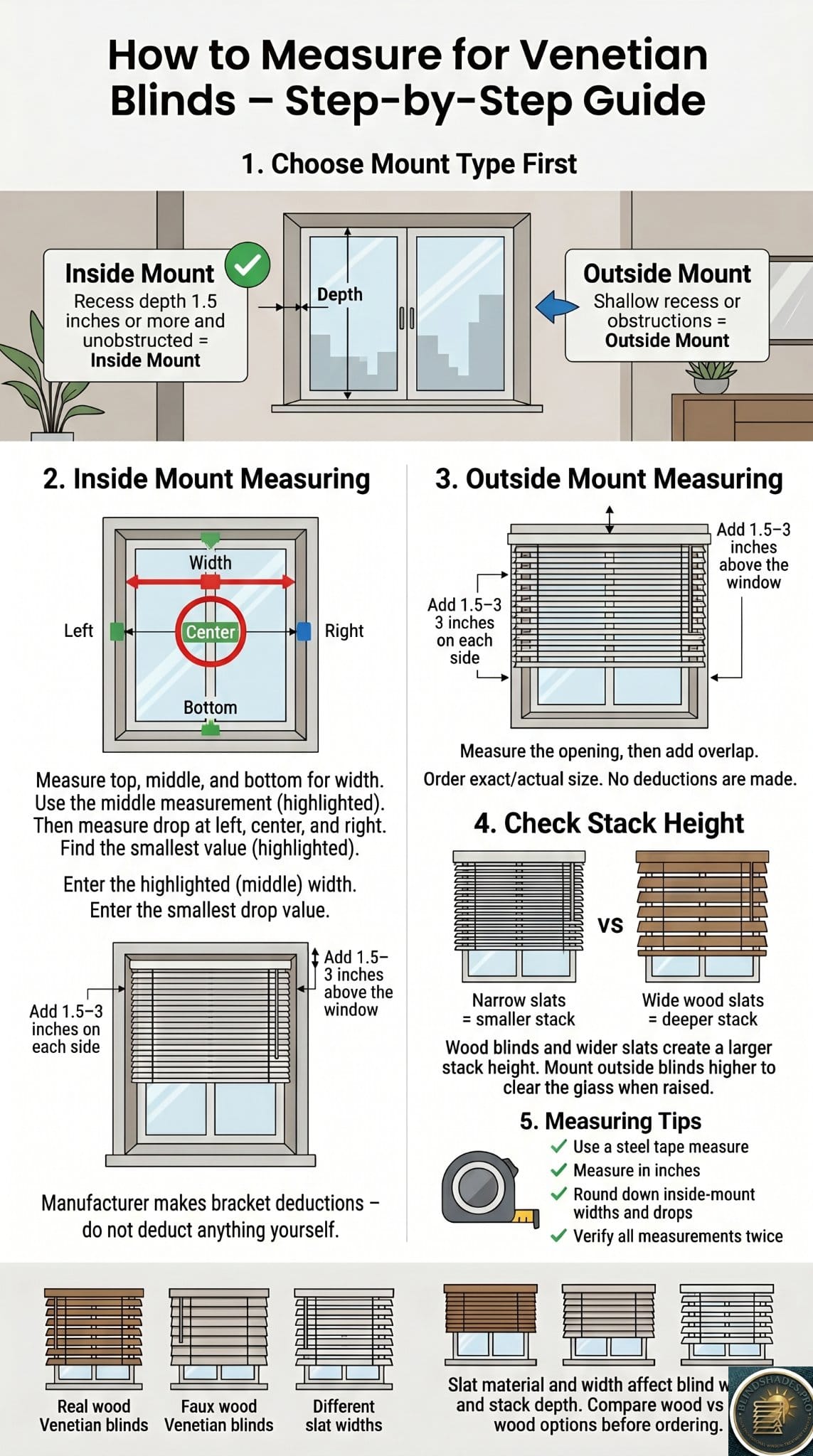
Authored by Michael Turner — 30 Years of Home Improvement Expertise | BlindShades.pro
To measure for Venetian blinds, first decide the mount by checking your window depth: if the recess is deep enough (about 1.5 inches minimum), measure for an inside mount; if not, measure for an outside mount. For an inside mount, measure the width and drop in three places each and use the smallest figure, then enter those exact recess sizes and let the manufacturer make the bracket deductions — never deduct yourself. For an outside mount, add 1.5 to 3 inches of overlap on every side. Get the mount and the ordering mode right and your blind will fit the first time.
Key Takeaways
- The mount decision comes before the tape measure, and depth decides it. An inside mount needs roughly 1.5 inches of unobstructed recess depth to fix the brackets, and about 2.75 inches for the blind to sit fully recessed. If your recess is shallower than that, or is blocked by handles or tile, measure for an outside mount instead.
- For an inside mount, measure width and drop in three places each and use the smallest. Windows are never perfectly square, so measure the width at top, middle, and bottom and the height at left, center, and right, and order to the narrowest width and shortest drop so the blind clears the frame everywhere.
- Never make deductions yourself on an inside mount — this is the single biggest ordering mistake. When you select a recess or inside fit, the manufacturer automatically deducts roughly half an inch for the bracket clearance. If you deduct too, the blind comes out far too small. Give the exact recess size and let them do the math.
- Outside mount is the opposite: nothing is deducted, so you must add the overlap. Selecting exact or actual size means the blind is made to the dimensions you give, with no allowance, so add 1.5 to 3 inches on every side yourself for proper coverage and light control.
- Plan for stack height, which is unique to slatted blinds. When raised, the slats stack at the top of the window, and wood and wider slats stack deeper. On a tall blind that stack can be several inches, so on an outside mount, fit the blind higher to keep the stack off the glass.
⭐ Quick Answer
How to measure for Venetian blinds: decide the mount by depth first, then measure width and drop in three places — and let the maker do the deductions, not you.
- Decide the mount by depth. About 1.5 inches of unobstructed recess depth (2.75 inches to sit flush) means an inside mount works; shallower or obstructed means outside mount, as Lowe’s advises.
- Inside mount: measure width at top, middle, and bottom and drop at left, center, and right. Use the smallest of each, enter the exact recess size, and select recess fit — do not deduct anything yourself, the factory takes off about half an inch for the brackets.
- Outside mount: measure the opening and add 1.5 to 3 inches of overlap on every side, then select exact or actual size. No deduction is made, so the overlap is on you.
- Plan for stack height. Wood and wider slats stack deeper at the top when raised — per DotcomBlinds, a tall blind can stack several inches, so mount an outside blind higher to clear the glass.
- Use a steel tape, measure in inches, round down. For very wide windows, consider splitting into two blinds, as The Shade Store recommends. Then choose your blind in our best Venetian blinds guide, compare materials in wood vs faux wood, and see bathroom mounting.
Inside or Outside Mount? Decide by Depth First
Measure the recess depth before anything else — it decides which mount, and therefore how you measure.
Every measurement that follows depends on whether the blind sits inside the window recess or on the wall above it, so settle the mount first by checking the depth of your recess.
An inside mount sits inside the window reveal for a clean, built-in look that pairs well with curtains. It needs depth: about 1.5 inches of unobstructed depth to fix the brackets at all, and roughly 2.75 inches for the blind to sit fully recessed without the headrail projecting past the frame. As Lowe’s advises, if your window depth is less than about 2-3/4 inches, you should plan on an outside mount.
An outside mount fixes to the wall or trim above and around the opening. Choose it when the recess is too shallow, when handles, cranks, or tile obstruct the reveal, or when the window is out of square. It also covers the frame edges, which helps reduce the side-light gap and can make a window look larger.
Measure your depth, pick the mount, then follow the matching section below. This table summarizes how the two mounts differ:
| Factor | Inside (recess) mount | Outside mount |
|---|---|---|
| Depth needed | About 1.5 in to mount, 2.75 in to sit flush | None |
| Width/drop rule | Measure ×3, use the smallest | Measure opening, add overlap |
| Overlap | None | 1.5 to 3 in on every side |
| Ordering mode | Recess/inside fit | Exact/actual size |
| Who deducts | The factory deducts ~1/2 in | No deduction — you add overlap |
| Best when | Deep, square, unobstructed recess | Shallow, obstructed, or out-of-square recess |
How Do You Measure for an Inside-Mount Venetian Blind?
Measure width and drop in three places each, use the smallest figure, and give the exact recess size.
For an inside (recess) mount, accuracy and the smallest-measurement rule are everything:
- Measure the width in three places — across the top, middle, and bottom of the recess, from one inside edge to the other (not the outer trim). Note the narrowest of the three.
- Measure the drop in three places — down the left, center, and right of the recess, from where the top of the blind will sit to the sill. Note the shortest of the three.
- Use the smallest width and the shortest drop as your figures, because no window is perfectly square and you need the blind to clear the frame everywhere.
- Measure the depth one more time to confirm the headrail will fit within the reveal.
- Enter these exact recess sizes and select recess or inside fit when ordering. Do not subtract anything — the next section explains why.
Round inside-mount measurements down to the nearest 1/8 inch, never up, so the blind never ends up too wide or too long for the recess.
How Do You Measure for an Outside-Mount Venetian Blind?
Measure the opening, then add 1.5 to 3 inches of overlap on every side, and decide how high to mount.
An outside mount is more forgiving, but you do the coverage math yourself:
- Measure the width of the area you want to cover, from outside edge to outside edge. If there is architrave or trim, measure to its outer edges.
- Add overlap to the width — generally 1.5 to 3 inches on each side beyond the opening for proper coverage and to block side light. Add more if you prefer.
- Decide the top mounting point. Mounting 2 to 3 inches above the window, as The Shade Store suggests, both gives the stack somewhere to sit and creates an illusion of height. Measure your drop from that point down to where you want the blind to finish, usually just below the sill.
- Add overlap top and bottom in the same 1.5 to 3 inch range so the blind covers fully when closed.
- Select exact or actual size when ordering — and remember no deduction is made, so the size you give is the size you get.
Why You Must Not Deduct Anything Yourself
On an inside fit the factory deducts for you; on an exact size it deducts nothing. Mixing these up is the number one ordering mistake.
This is where most fit disasters happen, and it is worth being precise about both directions:
- Inside or recess fit: do not deduct. When you select a recess fit, the manufacturer automatically takes off roughly half an inch from your figures to create the small clearance the brackets and slats need to operate smoothly inside the reveal. Retailers from DotcomBlinds to Swift Direct Blinds stress this single point because it is the most common error: if you helpfully subtract your own clearance and the factory subtracts theirs as well, the blind arrives far too small. Give the exact recess size and let them make the deduction.
- Exact or actual size: you must add the overlap. The inverse trap catches outside-mount buyers. When you select exact or actual size, the blind is made precisely to the numbers you enter, with no deduction at all. If you simply measure the window opening and select exact size, the finished blind will be the same size as the opening and will not cover it. For an outside mount, build your overlap into the figures yourself.
Get the ordering mode right for your mount and the size takes care of itself.
How Much Depth Does an Inside Mount Need?
About 1.5 inches to mount the brackets, and roughly 2.75 inches for the blind to sit fully flush.
Depth is the make-or-break factor for an inside mount, and there are really two thresholds:
- The minimum to mount at all is around 1.5 inches of unobstructed depth, enough to fix the brackets and let the slats operate. Below this, an inside mount is not possible.
- The depth to sit fully recessed is around 2.75 inches, so the headrail sits flush within the reveal rather than projecting. The Shade Store describes this as the narrowest your frame can be, from the glass to the front edge, for a secure inside mount.
If your recess falls between these, the blind will mount but the headrail may protrude slightly; below the minimum, switch to an outside mount.
Don’t Forget Stack Height
When raised, the slats stack at the top of the window, and wood and wider slats stack deeper — plan the mount around it.
This is the factor generic measuring guides skip and the one that is unique to slatted blinds. When you raise a Venetian blind, the slats gather into a stack at the top, and that stack covers part of the glass even when the blind is fully open. Wood slats are thicker than aluminum, and wider slats stack deeper than narrow ones, so the stack grows with both material and slat size. As DotcomBlinds illustrates, a roughly 1500mm (about 59 inch) drop blind with 50mm (2 inch) slats can stack approximately 150 to 200mm — around 6 to 8 inches — at the top.
What to do about it:
- On an outside mount, fit the headrail higher above the window so the stack sits above the glass rather than covering the view.
- On an inside mount, accept that the stack will cover the top of the window when raised, and if preserving the view matters, lean toward narrower slats or a lighter material. The trade-offs between slat materials and weight are covered in wood vs faux wood blinds.
How Do You Measure Around Obstructions?
Measure to clear handles, cranks, tile, and protruding sills before you commit to an inside mount.
Recesses are rarely empty boxes, and a blind that fouls an obstruction is as bad as one that is the wrong size. Run this checklist:
- Window handles and cranks: measure the depth to the front of the handle, not the glass. If the handle sits within the recess and the blind would catch on it, either mount outside or choose a headrail that clears it.
- Tiles or sills inside the recess: measure within any tile lip or ledge that reduces the working width, and use that reduced figure.
- A protruding sill: if the sill juts out more than a couple of inches from the recess, the blind may have to stop at sill level rather than dropping below it, since dropping past a protruding sill obstructs operation.
- Out-of-square reveals: if your three measurements vary widely, an outside mount hides the unevenness better than an inside mount.
Very Wide Windows: Should You Split the Blind?
On wide windows, two blinds on a split often beat one — and for Venetians the reason is structural, not just aesthetic.
For a very wide window, a single large Venetian blind is heavy, harder to raise evenly, and more prone to sagging across the span. Splitting the width into two independent blinds on one headrail, or two separate blinds, keeps each one lighter and easier to operate. To measure for a split, take the overall width as normal, then divide it at your chosen split point and measure each section. The Shade Store recommends dividing the overall width in two for very wide windows for exactly this reason. Because real wood is lighter than faux wood, material also affects how wide you can go before splitting — see wood vs faux wood blinds.
What Tools Do You Need, and How Do You Round?
Use a steel tape, measure in inches, and round inside-mount figures down.
Get these basics right and the rest follows:
- Use a steel tape measure, never a cloth or fabric tape, which stretches and gives inaccurate readings.
- Measure in inches to the nearest 1/8 inch for U.S. ordering (or to the nearest 0.1 cm if ordering in metric).
- Round inside-mount widths and drops down, so the blind never comes out too large for the recess. For outside mounts, your overlap already provides the margin.
- Record each figure clearly as width or drop as you go, and label which window it belongs to if you are measuring several.
Once you have your figures and your mount type, you are ready to choose the blind itself. Our best Venetian blinds guide walks through material, slat width, and operation, and the best Venetian blinds for bathrooms guide covers mounting in wet rooms.
Best Sources
- Lowe’s — on the roughly 2-3/4 inch depth threshold below which an inside mount is not advised, and rounding to the nearest 1/8 inch.
- The Shade Store — on the inside-mount depth requirement, mounting 2 to 3 inches above for outside mounts, and splitting very wide windows.
- DotcomBlinds — on the automatic recess deduction and on Venetian stack height (a 1500mm drop with 50mm slats stacking roughly 150 to 200mm).
- Swift Direct Blinds — on the three-place, smallest-measurement method and not making deductions yourself.
Related Guides
Frequently Asked Questions
How do you measure for Venetian blinds?
First decide the mount by checking the recess depth: about 1.5 inches or more of unobstructed depth allows an inside mount, less means an outside mount. For an inside mount, measure the width at top, middle, and bottom and the drop at left, center, and right, use the smallest of each, and enter those exact recess sizes without deducting anything. For an outside mount, measure the opening and add 1.5 to 3 inches of overlap on every side.
Do I deduct anything when measuring Venetian blinds for a recess?
No. When you select a recess or inside fit, the manufacturer automatically deducts roughly half an inch to create the clearance the brackets and slats need. If you deduct as well, the blind will come out far too small. Always give the exact recess size and let the maker make the deduction. Only on an exact or actual size order do you handle the sizing yourself, by adding overlap for an outside mount.
How much depth do you need to fit Venetian blinds inside a recess?
You need about 1.5 inches of unobstructed depth to mount the brackets at all, and roughly 2.75 inches for the blind to sit fully recessed without the headrail projecting. If your recess is shallower than about 2-3/4 inches, or is obstructed by handles or tile, an outside mount is the better choice.
What is stack height and why does it matter when measuring?
Stack height is how much space the slats take up when gathered at the top of a raised blind, and it matters because that stack covers part of the window. Wood and wider slats stack deeper, and a tall blind can stack several inches. For outside mounts, fit the blind higher above the window so the stack clears the glass and preserves the view.
Should I measure for one blind or two on a wide window?
On a very wide window, two blinds on a split are usually better than one, because a single large Venetian blind is heavy, sags more, and is harder to raise evenly. Take the overall width, divide it at your split point, and measure each section. Lighter materials like real wood can span wider before a split becomes necessary.
