Best Venetian Blinds for Bathrooms: Top Moisture-Proof Picks.

Authored By Michael Turner -30 Years Home Improvement Expertise | Updated 2026 | BlindShades.pro
Updated on July 14, 2026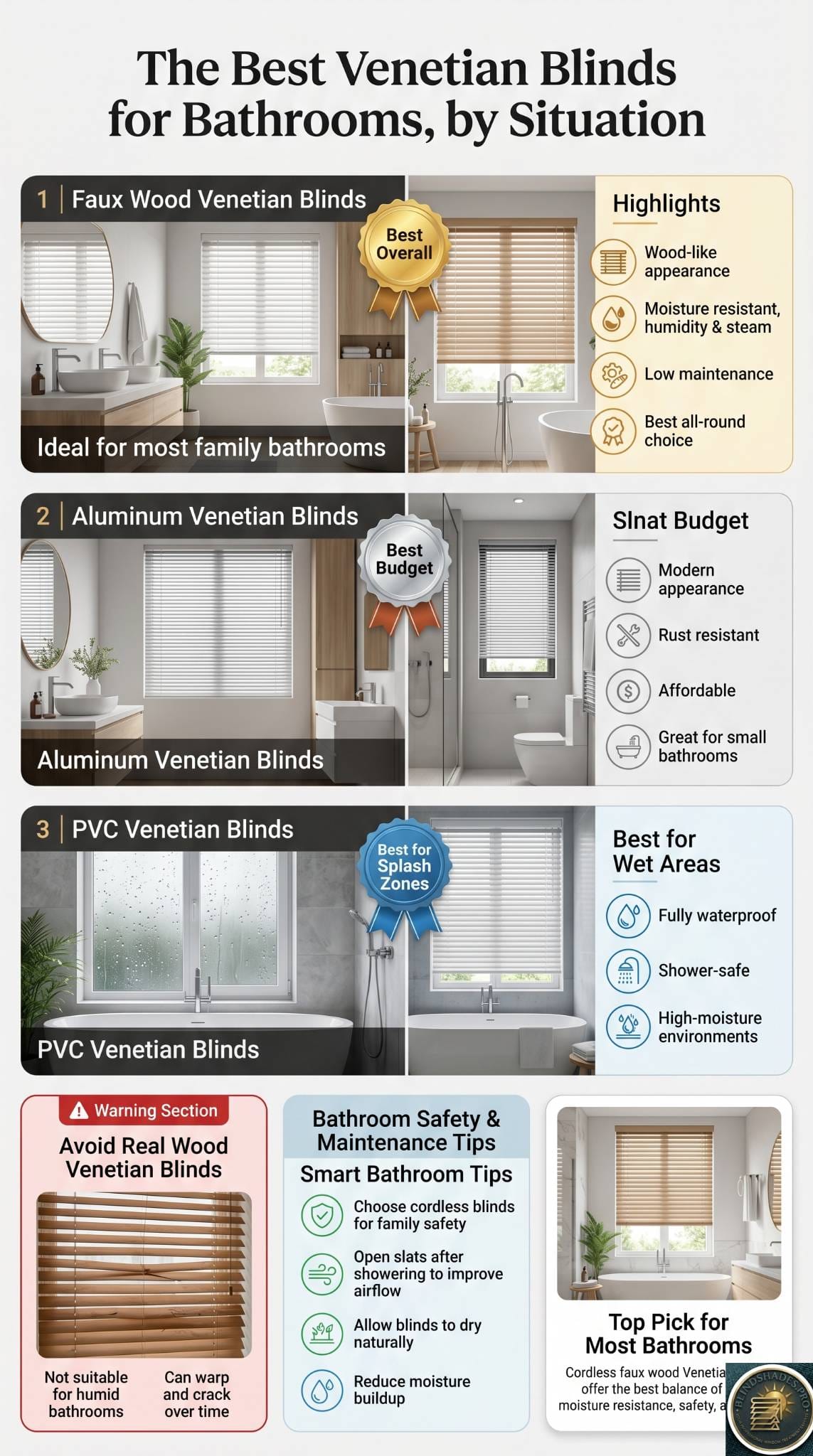
Authored by Michael Turner — 30 Years of Home Improvement Expertise | BlindShades.pro
The best Venetian blinds for bathrooms are faux wood, aluminum, or PVC, because all three resist the moisture that warps real wood. Faux wood gives a warm, wood-like look for humid bathrooms; aluminum gives a slim, modern, rust-proof slat for small or contemporary bathrooms; and PVC is fully waterproof for windows in the direct splash zone over a tub or shower. Match the material to where the window sits and how wet it gets, choose a cordless option for safety, and you get a blind that controls light and privacy without warping, cracking, or growing mould.
Key Takeaways
- Real wood is out; faux wood, aluminum, and PVC are in. The single rule for bathroom blinds is moisture resistance, and real wood fails it by warping and cracking in humidity. Faux wood, aluminum, and PVC all withstand steam and splashes, so your choice is between those three.
- Where the window sits decides the material. A window in the direct splash zone over a tub or shower needs fully waterproof aluminum or PVC; a window across the room that only sees humidity and steam can take faux wood, which gives the warmest look.
- Faux wood is the best all-rounder, aluminum the modern budget pick, PVC the most waterproof. Faux wood balances looks and moisture resistance for most bathrooms; aluminum is the slim, cheap, contemporary choice; PVC is the fully waterproof option for the wettest windows.
- Choose cordless for a wet, family room. Bathrooms are damp and often used by children, so a cordless faux wood or aluminum blind is both safer and one less cord to trap moisture.
- A Venetian is not always the best bathroom blind. For a window that gets directly soaked over a shower, a single-surface PVC roller blind can be easier to maintain than a slatted Venetian, so it is worth knowing when to switch.
⭐ Quick Answer
The best Venetian blinds for bathrooms are faux wood, aluminum, or PVC — the three materials that resist the moisture that warps real wood. Match the material to where the window sits.
- Faux wood — the best all-rounder: a warm, wood-like look that fully resists humidity and steam. Ideal for most bathrooms, per DotcomBlinds.
- Aluminum — slim, modern, rust-proof, and the cheapest. Best for small, contemporary, or budget bathrooms, as Factory Direct Blinds notes.
- PVC — fully waterproof, for windows in the direct splash zone over a tub or shower. For the wettest windows, a PVC roller can even beat a Venetian, per VelaBlinds.
- Avoid real wood — it warps and cracks in humidity. See are wooden Venetian blinds worth it.
- Go cordless for safety in a wet, family room, and tilt the slats open after showering to dry — see how to clean Venetian blinds. For the full decision and picks, see our best Venetian blinds guide.
What Are the Best Venetian Blinds for Bathrooms?
Faux wood, aluminum, and PVC — the three materials that shrug off moisture.
Bathrooms are the hardest room for a blind because of constant humidity, steam, and the risk of splashes, and the one quality that matters above all is moisture resistance. That rules real wood straight out: it absorbs moisture, swells, warps, and can develop mould, so however good it looks, it does not belong in a bathroom. The three Venetian materials that do belong are:
- Faux wood — composite or PVC slats that look like wood but are impervious to moisture. The best blend of warm looks and bathroom-proof durability.
- Aluminum — lightweight metal slats that are rust-proof, slim, and easy to wipe clean, with a modern feel.
- PVC — fully waterproof plastic slats, the most water-tolerant of all and the cheapest, if the most utilitarian.
All three resist the warping, cracking, and mould that humidity causes, which is exactly why they dominate every list of bathroom-safe blinds. The next question is which one, and that depends on your window.
Splash Zone or Steam Zone: Where Is the Window?
A window over the tub needs full waterproofing; a window across the room only needs humidity resistance.
Here is the distinction most guides miss: a bathroom is not uniformly wet, and where the window sits changes what the blind has to survive.
- Splash zone — a window directly above or beside a tub or shower gets hit with liquid water, not just steam. This calls for the most waterproof options: aluminum or PVC, which can take direct wetting and wipe dry without harm. A faux wood blind will survive humidity here but is happier away from direct spray.
- Steam zone — a window across the room from the shower, or in a powder room or half-bath, only deals with ambient humidity and steam. Faux wood is perfect here, giving the warmest, most wood-like look with no real risk, since it handles humidity easily even though it is not meant to be soaked.
Work out which zone your window is in first, then pick the material that matches.
Which Moisture-Proof Material Is Best for a Bathroom?
Faux wood for looks, aluminum for modern budget, PVC for the wettest windows.
All three resist moisture, but they are not interchangeable. This matrix sorts them for bathroom use:
| Factor | Faux wood | Aluminum | PVC |
|---|---|---|---|
| Look | Warm, wood-like | Slim, modern | Utilitarian |
| Moisture resistance | Excellent (humidity) | Excellent (rust-proof) | Best (fully waterproof) |
| Best zone | Steam zone | Splash or steam | Splash zone |
| Cost | Mid | Low | Lowest |
| Weight | Heavier | Light | Light |
| Cleaning | Wipe clean | Wipe clean | Wipe or rinse |
| Best bathroom | Most bathrooms | Small or modern | Wettest windows |
For most bathrooms, faux wood is the all-rounder. For a small, modern, or budget bathroom, aluminum is the slim and inexpensive pick. For a window that takes direct spray, PVC is the most waterproof. The detailed material comparisons are in wood vs faux wood blinds and aluminum vs wood Venetian blinds.
Best Venetian Blinds for Bathrooms: Our Picks
Real, widely available brands chosen for moisture resistance, value, and availability — not lab-tested by us.
These are category picks based on material suitability for bathrooms, brand reputation, and how widely available each is in the U.S. market. They are real products; we have not run independent lab tests, and you should confirm current pricing, sizes, and finishes with the retailer before buying, as these change.
Best Overall: Levolor Custom Classic Value 2-inch Cordless Faux Wood
A cordless faux wood Venetian in a standard 2-inch slat, widely available through major retailers like Lowe’s, Home Depot, and Walmart. It hits the sweet spot for most bathrooms: a warm wood-like look, full humidity resistance, cordless safety, and a value price. Real buyers report using these as bathroom replacements with good results. Indicative price: value to mid-range. [affiliate link]
Best Budget: Select Blinds Faux Wood
A DIY-friendly faux wood line that often runs well below premium brands, making it a strong choice for rentals, secondary bathrooms, or fitting out several windows at once. You measure and install yourself, which is where the savings come from. Indicative price: budget. [affiliate link]
Best Premium: Hunter Douglas EverWood
Hunter Douglas’s faux wood line, with UV protection to resist fading, a wide color range, multiple control options including motorization, and a lifetime warranty. It is the premium choice for a bathroom you want to do once and forget, at a premium price (Hunter Douglas blinds typically run from around 300 to 800 dollars per window depending on options). Indicative price: premium. [affiliate link]
Best Aluminum (Modern): Bali or Levolor Aluminum Mini Blinds
For a slim, contemporary, rust-proof look, a 1-inch aluminum mini blind from Bali or Levolor is the modern bathroom pick, especially for small or splash-zone windows. Light, inexpensive, and wipe-clean, with a wide range of finishes. Indicative price: low to budget. [affiliate link]
Best Mid-Range Value: Bali Composite & Faux Wood
Bali’s composite and faux wood blinds, available in 2-inch and 2.5-inch slats through Costco, Home Depot, and Amazon, offer durable, wood-look styling at a mid-range price with strong retailer ratings. A dependable middle ground between budget DIY and premium custom. Indicative price: mid-range. [affiliate link]
Bathroom Picks at a Glance
| Pick | Brand / Line | Material | Best for |
|---|---|---|---|
| Best Overall | Levolor Classic Value Cordless | Faux wood | Most bathrooms |
| Best Budget | Select Blinds Faux Wood | Faux wood | Rentals, extra baths |
| Best Premium | Hunter Douglas EverWood | Faux wood | Do-it-once quality |
| Best Aluminum | Bali / Levolor Aluminum | Aluminum | Small, modern, splash zone |
| Best Mid-Range | Bali Composite & Faux Wood | Faux wood | Balanced value |
Disclosure: this section contains affiliate links. Prices are indicative tiers, not quotes, and vary by size, finish, and retailer. We never publish fabricated prices, specifications, or testing claims.
How Do You Get Privacy and Light in a Bathroom?
Tilt the slats for privacy without losing daylight, and mind the nighttime silhouette.
Bathrooms need privacy and light at the same time, which is exactly what a Venetian does well: tilting the slats lets you admit soft daylight while blocking the sightline from outside. For daytime, angling the slats upward lets light bounce off the ceiling while keeping the view blocked. The one thing to watch is nighttime: with a light on inside and thin slats, a silhouette can read from outside, so close the slats fully at night, and consider pairing the blind with frosted or obscured window glass for a belt-and-braces approach. Solid faux wood slats block more than thin aluminum at night, a point covered in aluminum vs wood Venetian blinds.
How Do You Prevent Mould on Bathroom Blinds?
Ventilate, wipe condensation, and tilt the slats open to dry after showering.
Moisture-resistant materials will not grow mould the way fabric or real wood can, but a damp bathroom still needs good habits, and reducing dampness matters for health: prolonged indoor dampness is associated with mould growth and respiratory issues, as research cited by industry sources from the National Center for Biotechnology Information notes. To keep bathroom blinds clean and mould-free: run an extractor fan or open a window to clear steam, wipe any condensation off the slats, and tilt the slats open after a shower so they dry rather than sitting wet and closed. Keep moisture off the lift cords too, since cords are not fully waterproof even when the slats are. The full material-by-material cleaning method is in how to clean Venetian blinds.
When Is a Venetian Not the Best Bathroom Blind?
For a window that gets directly soaked over a shower, a PVC roller can be easier to live with.
It is worth being honest, because most bathroom-blind guides will not tell you this: a Venetian is not always the best choice for the wettest windows. For a window that takes direct spray over a tub or shower, a single-surface PVC roller blind has real advantages over any slatted Venetian: there are no slats to trap water or dust, no cords to stay damp, and the one waterproof surface wipes clean in seconds, which is why specialists like VelaBlinds rate PVC rollers as the most durable, lowest-maintenance bathroom option. Choose a Venetian when you want the precise light-and-privacy control and the style that tilting slats give; choose a PVC roller when the window is in the splash zone and easy maintenance matters most. Knowing the difference saves you a blind that fights its room.
How Do You Measure a Bathroom Window?
Measure for the mount as usual, but watch for tiles, sills, and tight recesses.
Bathroom windows are often small, set in tiled recesses, or sited over a sink or sill, which adds a few measuring wrinkles. Measure the recess depth first to decide inside or outside mount, then measure width and drop in three places and use the smallest, exactly as for any Venetian. The bathroom-specific points: measure within any tile lip that reduces the working width, check the blind will clear taps and window catches, and remember that a window over a basin may need an outside mount if the recess is too shallow or obstructed. The complete method is in how to measure for Venetian blinds.
Are Bathroom Blinds Child-Safe?
Choose cordless, which is both safer and better suited to a wet room.
Bathrooms are frequently used by children, so the usual cord-safety rules apply with extra force. The simplest answer is a cordless blind, which removes the strangulation hazard entirely and, as a bonus, removes a cord that would otherwise stay damp in a humid room. If you do choose a corded blind, follow the ANSI/WCMA A100.1 safety standard: keep lift cords short, fit the safety devices, and use a cleat to wind cords out of reach. For a bathroom, cordless faux wood or aluminum is the safest, most practical choice.
Related guides: slatted metal is one answer of six — the full pick set and the mold-risk matrix live in our bathroom window treatment guide.
Best Sources
- VelaBlinds — on PVC roller blinds being the most durable, lowest-maintenance bathroom option, and faux wood and aluminum being the Venetian choices for bathrooms.
- Factory Direct Blinds — on faux wood, vinyl, aluminum, and PVC resisting bathroom moisture better than real wood or fabric.
- DotcomBlinds — on aluminum being rust-resistant and faux wood withstanding moisture without cracking, warping, or developing mould.
- Pugerudes — on moisture-resistant materials being a health-conscious choice, citing NCBI research linking indoor dampness to mould and respiratory issues.
- Hunter Douglas (via ConsumersAdvocate) — on the EverWood faux wood line’s UV protection, control options, and lifetime warranty.
Related Guides
- Best Venetian Blinds Buying Guide
- Wood vs Faux Wood Blinds
- Aluminum vs Wood Venetian Blinds
- How to Clean Venetian Blinds
Frequently Asked Questions
What are the best Venetian blinds for bathrooms?
The best Venetian blinds for bathrooms are faux wood, aluminum, or PVC, because all three resist the moisture that warps and cracks real wood. Faux wood is the best all-rounder for most bathrooms, aluminum is the slim, modern, budget choice, and PVC is fully waterproof for windows in the direct splash zone over a tub or shower. A cordless version is safest in a wet, family room.
Can you put wooden Venetian blinds in a bathroom?
It is not recommended. Real wood absorbs moisture and will warp, swell, crack, or develop mould in the humidity and steam of a bathroom. Faux wood gives the same warm, wood-like look while fully resisting moisture, so it is the right choice when you want the wood aesthetic in a bathroom.
Are aluminum or faux wood blinds better for a bathroom?
Both work well. Aluminum is slimmer, more modern, cheaper, and fully rust-proof, making it ideal for small, contemporary, or splash-zone windows. Faux wood gives a warmer, wood-like look and handles humidity easily, making it the better all-rounder for most bathrooms away from direct spray. For a window over a tub or shower, aluminum or PVC handles direct water better.
How do you stop bathroom blinds going mouldy?
Use a moisture-resistant material like faux wood, aluminum, or PVC, then keep the room ventilated with an extractor fan or open window, wipe any condensation off the slats, and tilt the slats open after showering so they dry. Keep moisture off the lift cords, which are not fully waterproof. These habits prevent the dampness that leads to mould.
Are Venetian blinds or roller blinds better for bathrooms?
Venetian blinds give better light and privacy control through their tilting slats and suit most bathrooms in faux wood or aluminum. For a window in the direct splash zone over a tub or shower, a single-surface PVC roller blind can be easier to maintain, since it has no slats to trap water and wipes clean in seconds. Choose by how wet the window gets and whether you want slat-level light control.
