Are Wooden Venetian Blinds Worth It? An Honest Take

Authored By Michael Turner -30 Years Home Improvement Expertise | Updated 2026 | BlindShades.pro
Updated on July 16, 2026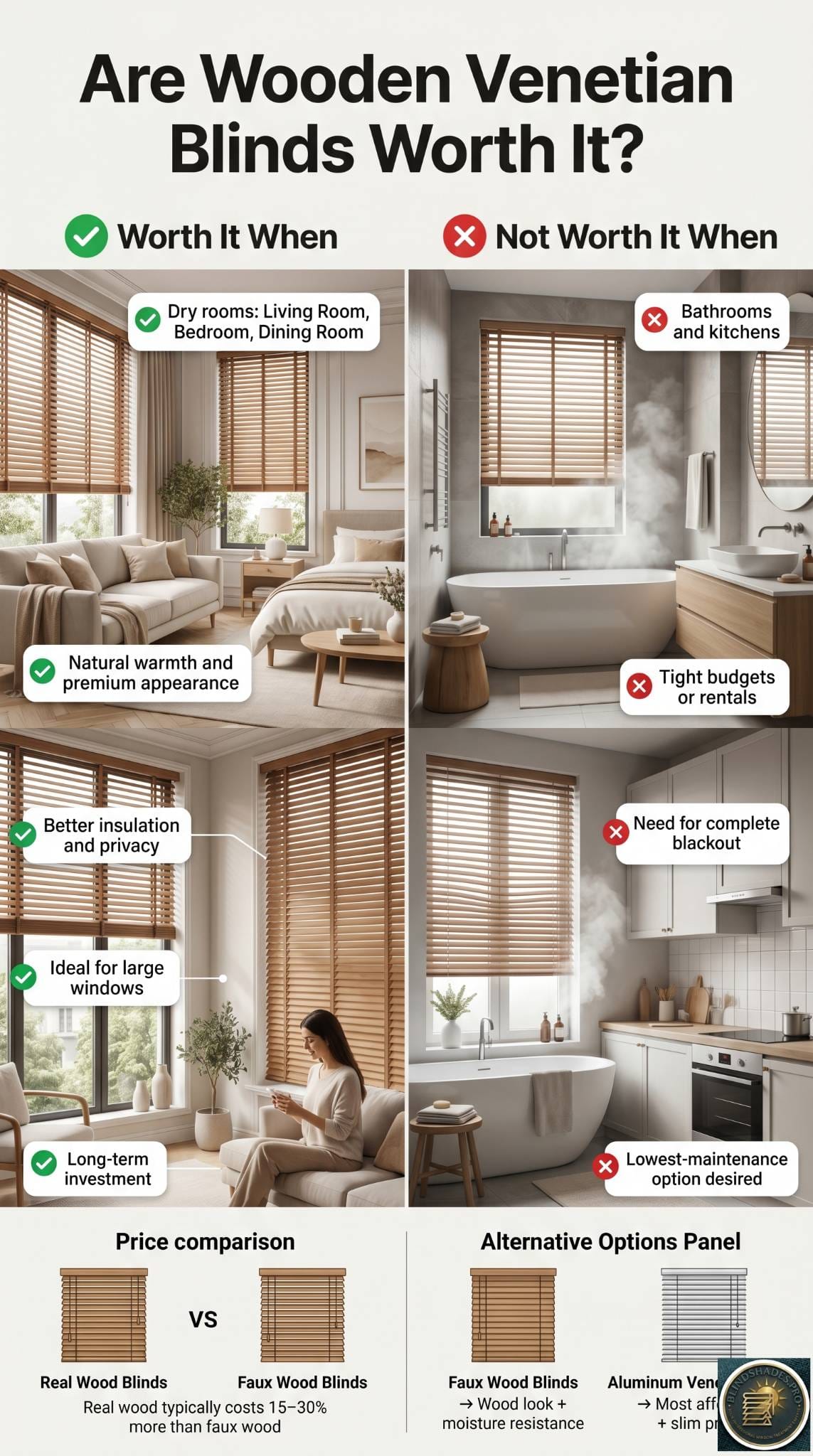
Authored by Michael Turner — 30 Years of Home Improvement Expertise | BlindShades.pro
Wooden Venetian blinds are worth it for dry living spaces, bedrooms, and dining rooms where you want genuine warmth, the best insulation, tight privacy, and a premium look you will keep for a decade or more. They are not worth it for bathrooms and kitchens (humidity warps them), for tight budgets or rental fit-outs (faux wood or aluminum cost less), or if you need total blackout or the lowest-maintenance option. In short, real wood earns its roughly 15 to 30 percent premium over faux when the room is dry and the look matters; otherwise faux wood or aluminum is the smarter buy.
Key Takeaways
- The honest answer is “it depends on the room and what you value.” Real wood is worth the premium in dry rooms where warmth, insulation, and an authentic look matter and where you will keep the blinds for years. It is not worth it where moisture, budget, blackout, or low maintenance are the priority.
- You are really deciding wood versus faux, and the premium is roughly 15 to 30 percent. Faux wood imitates the look for less and survives moisture, so the worth-it question comes down to whether real wood’s authenticity, lighter weight, and better insulation justify paying more in a room that stays dry.
- Real wood is genuinely lighter than faux, which makes it worth it on large windows. This is the practical advantage people overlook: lighter basswood sags less and operates more smoothly across a wide span, so on big windows wood is the better buy on function, not just looks.
- They add perceived quality more than measurable resale dollars. Wooden blinds read as a premium, built-in feature that helps a home show well, but treat that as showing appeal rather than a line-item return on investment.
- If wood is not worth it for your case, faux wood or aluminum usually is. Faux wood gives most of the look with moisture resistance for less; aluminum gives the cheapest, slimmest, most modern slat. The right answer depends entirely on the room.
Related guides: if the worth-it verdict lands on yes, choose the wood with the complete guide to real wood blinds.
⭐ Quick Answer
Are wooden Venetian blinds worth it? Yes in the right room — here is the honest test.
- Worth it when: the room is dry (living room, bedroom, dining room), you want genuine warmth, the best insulation, and tight privacy, the window is large (real wood is lighter and sags less), and you will keep and maintain them for years.
- Not worth it when: the room is humid (bathroom, kitchen) where wood warps, the budget is tight or it is a rental, you need total blackout, or you want the lowest-maintenance option — Barlow Blinds is candid on these limits.
- The real comparison is wood vs faux. Real wood costs roughly 15 to 30 percent more, and Surrey Blinds notes it is lighter and better for large windows — see wood vs faux wood blinds.
- Resale: wood blinds add showing appeal and perceived quality, as DoItYourself notes on their touch of class — more than a measurable resale return.
- If wood is not your fit: faux wood (look plus moisture resistance) or aluminum (cheapest, slimmest) — see aluminum vs wood Venetian blinds. For the full decision and picks, see our best Venetian blinds guide.
So, Are Wooden Venetian Blinds Worth It?
Yes — in dry rooms where you value warmth, insulation, and an authentic look, and will keep them for years. Otherwise, no.
Most guides on this question list the pros and cons of wooden blinds and leave you to do the math. Here is the verdict they skip. Real wood Venetian blinds are worth their premium when three things line up: the room stays dry, you genuinely value the authentic warmth and better insulation that only real wood gives, and you plan to keep and care for them long enough to enjoy that quality. In a dry living room or bedroom where the window is on show, real wood is worth it.
They stop being worth it the moment any of those conditions break. Put them in a steamy bathroom and the humidity warps them, so faux wood is the better buy. Fit out a rental or a tight budget and the premium is hard to justify against faux or aluminum. Need a fully dark room and their unavoidable slat gaps mean they cannot deliver. The rest of this guide is really about working out which side of that line your situation falls on.
What Does the Wood Premium Actually Buy?
Authentic grain, the best insulation, lighter weight, and tighter privacy — the things faux and aluminum cannot fully match.
When you pay the roughly 15 to 30 percent premium for real wood over faux, here is what you are buying:
- Genuine warmth and grain. Real basswood, oak, or bamboo has authentic grain and a premium feel that printed faux grain imitates but does not match up close. In a room that is on show, this is the core of the value.
- The best insulation. Wood’s natural cellular structure slows heat transfer better than solid faux or metal, helping hold warmth in winter, which adds comfort and can trim energy use.
- Lighter weight. Real wood is lighter than faux, so it operates more smoothly and sags less, which matters on large windows.
- Tighter privacy. Solid wood slats block sightlines and shadows more completely than thin aluminum.
- A timeless, high-end look that reads as a quality, built-in feature and suits both traditional and modern rooms.
If those qualities matter to you in the room in question, the premium is justified. If they do not, you are paying for benefits you will not use.
When Are Wooden Venetian Blinds Worth It?
In dry, on-show rooms, on large windows, and when you will keep and maintain them.
Real wood is the right buy when your situation matches these green lights:
- The room is dry — living rooms, bedrooms, dining rooms, studies, and hallways, away from steam and splashes.
- The look matters — the window is a feature, and you want genuine warmth rather than a convincing imitation.
- The window is large or wide — real wood’s lighter weight makes it sag less and operate better than heavier faux across a span.
- You value insulation — in a room where you are managing winter heat loss, wood’s natural insulation earns its keep.
- You will keep and care for them — a quality wood blind rewards a buyer who will dust it and keep it dry for a decade or more.
When most of these are true, wooden Venetian blinds are worth every cent of the premium.
When Are They Not Worth It?
In damp rooms, on tight budgets, in rentals, when you need blackout, or when low maintenance is the priority.
Be honest about the disqualifiers, because in these cases the premium buys you nothing useful:
- Humid rooms. In bathrooms, kitchens, and laundries, real wood warps, swells, and cracks. Faux wood gives the same look without the moisture problem, so wood is simply the wrong buy here — see best Venetian blinds for bathrooms.
- Tight budgets and rentals. If cost is the priority or the blinds are for a property you will not keep, faux wood or aluminum delivers most of the function for less.
- You need total darkness. Like all Venetians, wood blinds have small gaps between the slats and at the cord holes, so they cannot fully black out a room. If blackout is the goal, a blackout roller, cellular, or roman shade is the answer, not wood.
- You want the lowest maintenance. Wood is a dust magnet that must be dusted regularly and kept dry, cleaned only with a wood-appropriate method. Faux wipes clean with water and is more forgiving — see how to clean Venetian blinds.
If your situation lands here, save the premium and choose faux or aluminum.
Are Real Wood Blinds Worth It Over Faux Wood?
Only in dry rooms where authenticity, weight, and insulation matter — otherwise faux usually wins on value.
This is the comparison the worth-it question really turns on, because faux wood is the cheaper look-alike. Real wood is worth choosing over faux when the room is dry and you want the genuine grain, the lighter weight for a large window, or the better insulation. Faux wood is the better value when the room is damp, the budget is tighter, or you simply cannot tell the difference across the room and would rather save the money. Faux has closed much of the appearance gap, so for many buyers the honest answer is that real wood is worth it only where its specific advantages actually apply. The full side-by-side is in wood vs faux wood blinds.
Do Wooden Blinds Add Value to a Home?
They add showing appeal and perceived quality more than measurable resale dollars — treat that as the honest ROI.
Wooden Venetian blinds are often described as adding value to a home, and there is truth to it, but it is worth being precise. Quality wood blinds read as a premium, built-in, intentional feature that helps a home present well to buyers, which can support a sale and the impression of a well-maintained home. What they are not is a line-item investment that returns a measurable percentage at resale the way a kitchen or bathroom upgrade might. So the value case is real but qualitative: they make a dry, on-show room look considered and high-end, which is part of why they are worth it for owners who care how their home reads, and less relevant for a pure cost calculation.
How Long Do Wooden Venetian Blinds Last?
Well over a decade with care — which is a real part of the value case.
Durability is the quiet half of the worth-it equation. A quality wooden Venetian blind, kept dry and dusted, comfortably lasts well over ten years, often far longer, because solid hardwood is robust and does not degrade the way cheap plastic can. Spread over that lifespan, the premium over a cheaper blind that might be replaced sooner looks more reasonable. The catch is the condition: that longevity assumes a dry room and basic maintenance. Put the same blind in a humid bathroom and moisture will shorten its life dramatically, which is exactly why the room decides whether the premium pays off.
If Wooden Blinds Are Not Worth It, What Is?
Faux wood for the look with moisture resistance, or aluminum for the cheapest, slimmest, most modern slat.
If your situation lands on the “not worth it” side, you have two strong alternatives:
- Faux wood gives you most of the wood appearance with full moisture resistance and a lower price, which makes it the better buy for damp rooms, tighter budgets, and rentals. It is the natural fallback when you wanted wood but the room or budget says otherwise.
- Aluminum gives the cheapest, slimmest, most modern slat, moisture-proof and available in many colors, ideal for kitchens, bathrooms, offices, and contemporary rooms. See aluminum vs wood Venetian blinds.
The right choice is entirely situational, which is the whole point: wooden Venetian blinds are worth it when their specific strengths match your room, and a smarter saving when they do not. For the complete decision and our real-brand picks across all three materials, see the best Venetian blinds guide.
Best Sources
- Surrey Blinds and Shutters — on wood being lightweight and easier to operate than faux (suiting larger windows), customizable in stains, and not ideal for total blackout or high-moisture areas.
- Barlow Blinds — on the honest disadvantages of wooden blinds: harder to clean, heavy, and unsuited to bathrooms and kitchens, where faux is recommended instead.
- DoItYourself.com — on wooden Venetian blinds offering strong light control and a touch of class that plastic blinds can cheapen.
- VelaBlinds — on Venetian blinds’ timeless, architectural quality that resists looking dated as trends change.
Related guides: For complete buying advice, see our real wood blinds buying guide.
Related Guides
- Best Venetian Blinds Buying Guide
- Wood vs Faux Wood Blinds
- Aluminum vs Wood Venetian Blinds
- Best Venetian Blinds for Bathrooms
Frequently Asked Questions
Are wooden Venetian blinds worth the money?
Yes, in the right room. Real wood is worth its premium in dry living rooms, bedrooms, and dining rooms where you want genuine warmth, the best insulation, tight privacy, and a premium look you will keep for a decade or more. It is not worth it in humid bathrooms or kitchens, on tight budgets or rentals, when you need total blackout, or when low maintenance is the priority, where faux wood or aluminum is the smarter buy.
Are real wood blinds worth it over faux wood?
Only where their specific advantages apply. Real wood is worth choosing over faux in dry rooms when you want authentic grain, lighter weight for a large window, or better insulation. In damp rooms, on tighter budgets, or where you cannot tell the difference across the room, faux wood gives most of the look with moisture resistance for around 15 to 30 percent less and is the better value.
Do wooden Venetian blinds add value to a home?
They add showing appeal and perceived quality more than measurable resale dollars. Quality wood blinds read as a premium, built-in feature that helps a home present well, but they are not a line-item investment that returns a set percentage at resale. The value is real but qualitative, which matters most to owners who care how an on-show room reads.
Why are wooden blinds so expensive?
Wooden Venetian blinds cost more because they are milled from real hardwood like basswood or oak and finished with stains or paints, which is more expensive to source and craft than the man-made materials in faux wood or aluminum. The premium is roughly 15 to 30 percent over comparable faux wood, and it buys authentic grain, better insulation, lighter weight, and a higher-end look.
How long do wooden Venetian blinds last?
A quality wooden Venetian blind that is kept dry and dusted comfortably lasts well over ten years, often far longer, because solid hardwood is robust. That longevity assumes a dry room and basic care; in a humid bathroom or kitchen, moisture warps the wood and shortens its life significantly, which is why wood is not worth it in damp rooms.
