How to Clean Venetian Blinds: The Fast, Safe Way

Authored By Michael Turner -30 Years Home Improvement Expertise | Updated 2026 | BlindShades.pro
Updated on June 19, 2026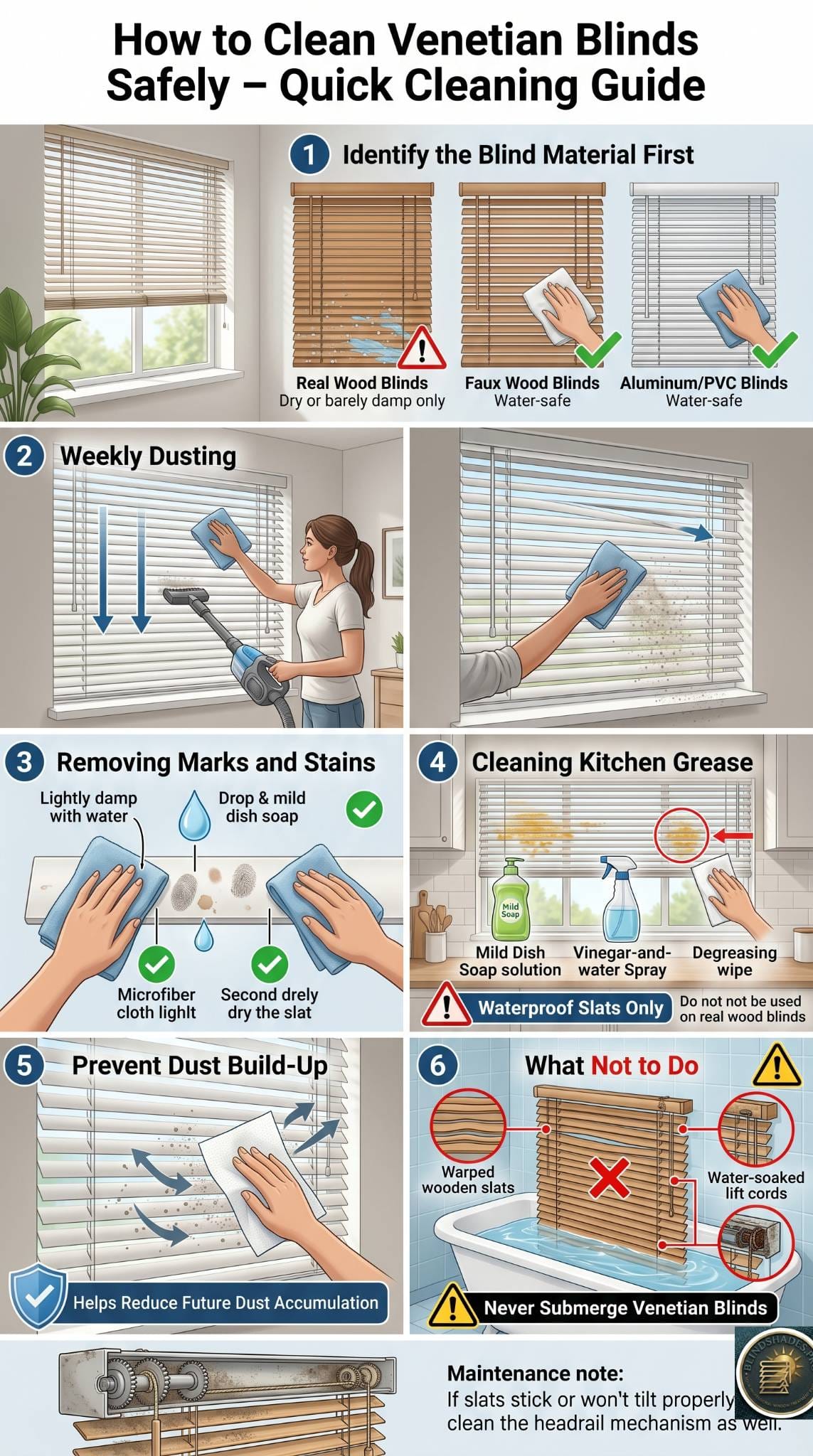
Authored by Michael Turner — 30 Years of Home Improvement Expertise | BlindShades.pro
To clean Venetian blinds, check the slat material first, because it decides everything: real wood must stay dry, while faux wood, PVC, and aluminum can take water. For a fast weekly clean, close the slats, wipe or vacuum from top to bottom with a microfiber cloth or soft brush, then flip the slats and do the other side. Match the method to how dirty they are, and prevent dust with an anti-static wipe so you clean less often. The one mistake to avoid above all is submerging a blind in water.
Key Takeaways
- Identify the slat material before you reach for water, because it is the difference between a clean blind and a ruined one. Real wood warps and stains if it gets wet, so it must be cleaned dry or barely damp; faux wood, PVC, and aluminum are waterproof and can handle a damp cloth or mild cleaning solution. Getting this wrong is the most common and most expensive cleaning mistake.
- The fast weekly method is the same for everyone: close, wipe top to bottom, flip, repeat. Close the slats so they lie flat, run a microfiber cloth or a vacuum’s soft brush attachment down each slat from top to bottom, then tilt the slats the other way and do the reverse side. Working top-down means falling dust never lands on a slat you have already cleaned.
- Match the method to the mess. Light dust needs only a duster or the tongs trick; marks need a barely damp cloth with a little mild soap; a thick greasy film, especially in kitchens, needs a degreasing wipe; and only a heavy build-up justifies a full deep clean. Reaching for water on light dust just makes streaky mud.
- Prevention beats cleaning. Slats are flat horizontal shelves that attract and hold dust, and a quick anti-static wipe with a dryer sheet after dusting leaves a faint charge that repels dust and can cut build-up by around 30 percent over the following weeks, so you clean far less often.
- Never submerge a Venetian blind in water. It is the single biggest cleaning mistake: it can warp wood, soak the not-fully-waterproof lift cords, and damage the headrail mechanism. Clean the slats in place instead.
⭐ Quick Answer
The fast, safe way to clean Venetian blinds: check the slat material first, then wipe top to bottom and flip. Real wood must stay dry; faux wood, PVC, and aluminum can take water.
- Check the material first. Real wood: clean dry or barely damp, never wet — as VelaBlinds notes, water warps wood. Faux wood, PVC, and aluminum: a damp cloth and mild cleaner are fine.
- Weekly method: close the slats, wipe top to bottom with a microfiber cloth or vacuum soft-brush, flip the slats, repeat. Working top to bottom stops falling dust resettling. To do both sides at once, use the kitchen-tongs trick.
- Marks and kitchen grease: a barely damp cloth with a drop of dish soap, or a vinegar-and-water mix to cut grease — on waterproof slats only, dry-only on wood.
- Prevent build-up: wipe each slat with a dryer sheet after dusting. The anti-static charge repels dust and can cut build-up by around 30 percent, so you clean less often.
- Never submerge the blind in water — it warps wood, soaks the cords, and harms the mechanism. If dust has jammed the headrail and the slats stick, see slats won’t close; if cleaning reveals frayed cords, see how to restring, and choose by material in our best Venetian blinds guide.
What Is the Fastest Way to Clean Venetian Blinds?
Close the slats, wipe or vacuum from top to bottom, then flip and repeat — and clean little but often.
The quickest reliable method needs nothing you do not already own. Close the slats so they lie flat against each other, then run a microfiber cloth or your vacuum’s soft brush attachment down the face of the blind from the top slat to the bottom. Tilt the slats the opposite way and clean the reverse side the same way. That is the whole weekly routine, and it takes a couple of minutes per blind.
Two details make it faster and better. First, always work top to bottom, because dust falls — start at the bottom and you will redust slats you have already done. Good Housekeeping makes the same point: starting from the top means you never clean the same slat twice. Second, to clean both sides of a slat at once, use the tongs trick popularized by Blindsgalore: wrap a microfiber cloth or an old sock around each arm of a pair of kitchen tongs, secure with rubber bands, then clamp a slat and slide. It cleans the top and bottom of each slat in one pass and roughly halves the time.
But before you add any moisture to that routine, you need to know what your slats are made of.
Does the Slat Material Change How You Clean?
Yes — and it is the first thing to settle, because real wood cannot get wet.
This is the decision the cleaning guides bury, and it matters more than any technique. What your slats are made of determines whether water is allowed at all:
- Real wood: clean dry. Dust with a microfiber cloth, duster, or vacuum brush, and at most use a barely damp cloth with a dedicated wood cleaner — never water or a wet solution. As VelaBlinds puts it, water is the enemy of wood: moisture warps, swells, and stains real-wood slats. This is non-negotiable.
- Faux wood and PVC: fully waterproof. A damp cloth with mild dish soap, or a vinegar-and-water mix, is fine, and these slats can take a proper wet wipe for grime.
- Aluminum: waterproof and durable, though the thin slats bend if you press too hard, so support each slat as you wipe. Water and mild cleaner are fine.
Swift Direct Blinds and other specialists are explicit that wet cleaning methods are suitable only for aluminum, PVC, and synthetic blinds, and that wooden blinds should be cleaned with methods that avoid moisture. Settle this first, then choose your method by how dirty the blind is.
How Do You Clean Venetian Blinds by Dirt Level?
Match the method to the mess — light dust, marks, kitchen grease, and heavy build-up each call for a different approach.
Reaching straight for soapy water on a lightly dusty blind just smears dust into streaks. Work up the scale only as far as you need:
| Dirt level | Method |
|---|---|
| Light dust (weekly) | Dry microfiber, duster, vacuum soft-brush, or the tongs trick |
| Marks and fingerprints | Barely damp microfiber with a drop of mild dish soap, then dry the slat (waterproof slats; dry-only on wood) |
| Kitchen grease | Degreasing wipe: dish soap or vinegar-and-water on faux, PVC, or aluminum only |
| Heavy, sticky build-up | Deep clean: dry-dust first, then a vinegar-and-water sock over the hand, wipe each slat, let dry |
A rule that sits behind all of this: dry-dust before you ever go wet. As cleaning guides like The Spruce note, you should not add water to dust, because water plus dust makes a smear of mud that streaks the slat and works into the cord holes. Always lift the loose dust off dry first, then deal with any remaining marks with a barely damp cloth.
Kitchen grease deserves its own note, because it is the one case plain dusting cannot fix. Cooking releases a fine aerosol that settles as a sticky film, and a dry cloth just slides over it. On waterproof faux, PVC, or aluminum slats, cut it with a degreaser — a few drops of dish soap in warm water, or a vinegar-and-water mix — wiping gently and drying after. On real-wood kitchen slats, use a wood cleaner sparingly on a barely damp cloth, never a wet wash.
How Do You Clean the Cords and Ladder Areas?
Get into the cord holes and ladder tapes with a cloth-covered finger or sock, but keep the cords from getting soaked.
The dustiest, most-missed spots on a Venetian blind are around the lift cords and the ladder tapes that hold the slats, and the holes punched through each slat for the cords. A flat cloth skips them. Pull a clean sock over your hand, or wrap a cloth around a finger, and run it along the ladder tapes and around the cord holes to lift the trapped dust the wider wipe misses.
One caution that the cleaning guides overlook: the lift cords are not fully waterproof, even on waterproof slats. Soaking them leaves them damp inside the slats where they cannot dry, which over time encourages grime and weakens the cord. Keep any moisture to a barely damp cloth around the cords rather than a wet one, and let everything dry fully before raising the blind.
How Do You Keep Venetian Blinds From Getting Dusty So Fast?
Use an anti-static wipe — it repels dust and can cut build-up by around 30 percent, so you clean far less often.
The smartest cleaning strategy is to clean less by preventing the dust in the first place. Slats are essentially rows of flat horizontal shelves, and they hold a static charge that pulls dust in and grips it. You can turn that against the dust: after your normal dusting, wipe each slat with a dryer sheet. The sheet leaves a faint static charge that repels dust rather than attracting it, and VelaBlinds reports this can reduce the dust that collects over the following couple of weeks by around 30 percent. It adds about a minute to the routine and pays for itself by stretching the time between real cleans.
The other half of prevention is simply consistency: a light weekly dust stops grime from settling and bonding, which is far easier than removing a thick layer every few months.
What Should You Never Do When Cleaning Venetian Blinds?
Avoid the moves that warp slats, soak cords, or damage the mechanism.
- Never submerge the whole blind in water. Blindsgalore calls this the biggest cleaning mistake, and it is — it warps wood, soaks the cords, and can damage the headrail mechanism. Clean in place.
- Never use water or wet solutions on real wood. Dry or barely damp only.
- Do not oversaturate the cords or ladder tapes, which hold moisture where it cannot dry.
- Do not use harsh chemicals or abrasive scourers, which strip finishes and scratch slats. Mild dish soap or vinegar-and-water is all a waterproof slat needs.
- Do not force or press hard on aluminum slats, which bend easily — support each slat as you wipe.
Should You Clean the Mechanism Too?
Yes — dust in the headrail is what jams the tilt and lift, so clear it while you clean.
Cleaning the slats and ignoring the headrail is why so many blinds end up sticking. The same dust that settles on the slats works into the cord lock and tilt gear inside the headrail, and over time that build-up is a leading cause of a blind that will not raise, lower, or tilt. While you have the blind down for a deep clean, vacuum the headrail to clear loose dust. If the mechanism is already stiff, use a dry silicone or PTFE spray rather than water or oil near the gears.
If the slats have started sticking or will not tilt despite a clean, the mechanism may need more than dusting — see Venetian blind slats won’t close and Venetian blinds won’t go up or down. And if cleaning reveals frayed or fraying lift cords, repair them before they snap — see how to restring Venetian blinds.
Best Sources
- VelaBlinds — on the dryer-sheet anti-static trick reducing dust by around 30 percent, and on water being the enemy of real wood.
- Blindsgalore — on the kitchen-tongs method for cleaning both sides of a slat at once, and on submerging blinds being the biggest mistake.
- Swift Direct Blinds — on wet methods being suitable only for aluminum, PVC, and synthetic blinds, and dry methods for wood.
- Good Housekeeping — on cleaning top to bottom so falling dust never lands on a cleaned slat.
Related Guides
Frequently Asked Questions
What is the fastest way to clean Venetian blinds?
Close the slats so they lie flat, then wipe from the top slat to the bottom with a microfiber cloth or a vacuum’s soft brush attachment, flip the slats the other way, and repeat on the reverse side. To clean both sides of each slat at once, wrap microfiber cloths around the arms of kitchen tongs and slide them along each slat. Always work top to bottom so falling dust does not resettle.
Can you clean Venetian blinds with water?
It depends on the material. Faux wood, PVC, and aluminum slats are waterproof and can take a damp cloth with mild dish soap or a vinegar-and-water mix. Real wood cannot — water warps and stains it, so clean wood slats dry or with a barely damp cloth and a wood cleaner only. Never submerge any Venetian blind in water.
How do you clean greasy Venetian blinds in a kitchen?
Kitchen grease is a sticky film that plain dusting will not remove. On waterproof faux wood, PVC, or aluminum slats, cut it with a degreaser: a few drops of dish soap in warm water or a vinegar-and-water mix, wiped gently and dried afterward. On real-wood slats, use a wood cleaner sparingly on a barely damp cloth rather than a wet wash.
How do I stop my Venetian blinds getting dusty so quickly?
After your normal dusting, wipe each slat with a dryer sheet. It leaves a faint static charge that repels dust instead of attracting it, which can cut the dust that builds up over the following weeks by around 30 percent. Combined with a quick weekly dust, this keeps grime from settling and means you deep clean far less often.
How often should you clean Venetian blinds?
A light dust once a week keeps grime from settling and makes everything easier, with a deeper clean every couple of months or whenever you spot marks. Blinds in kitchens and bathrooms collect grease and moisture faster and usually need more frequent attention than those in living rooms or bedrooms.
