Venetian Blind Slats Won’t Close? Diagnose and Fix It

Authored By Michael Turner -30 Years Home Improvement Expertise | Updated 2026 | BlindShades.pro
Updated on June 19, 2026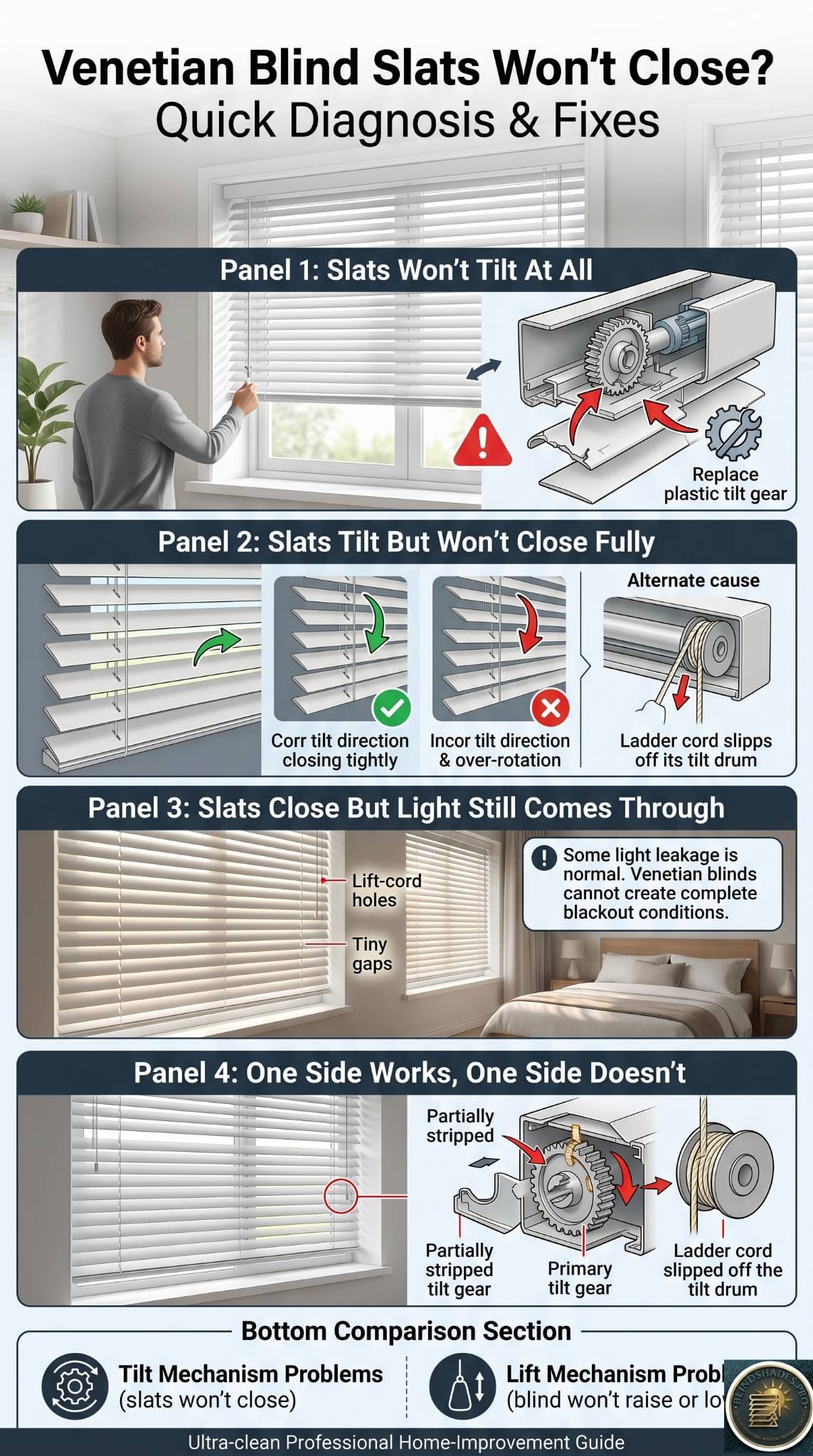
Authored by Michael Turner — 30 Years of Home Improvement Expertise | BlindShades.pro
When Venetian blind slats won’t close, first work out which of three problems you have: the slats won’t tilt at all (a broken tilt gear), they tilt but won’t close fully and leave a light gap (slat direction, over-rotation, or a ladder cord off its drum), or they do close but light still leaks (which is not a fault — it is the normal gap between slats). Each has a different fix, and the most common mistake is treating a normal light gap as a breakage. Diagnose first, then use the matching fix below.
Key Takeaways
- “Slats won’t close” actually describes three different situations — diagnose before you fix. Either the slats will not tilt at all (the tilt mechanism), they tilt but will not close tightly (slat direction or a ladder cord problem), or they close but light still sneaks through (the normal, unavoidable gap between slats). Spending an hour on the wrong fix is the usual outcome of skipping this step.
- If the slats will not tilt at all when you turn the wand or pull the cord, the geared tilt mechanism in the headrail has failed. As Fix My Blinds confirms, a wand or cord that turns freely while the slats stay put points to a stripped or broken tilt gear, which is an inexpensive part to replace.
- If the slats tilt but leave a gap when “closed,” check the close direction and stop over-rotating. Slats close in two directions, and one seals against the window better than the other; turning the wand too far actually reopens the gap on the other side. This simple rotation habit fixes a surprising number of “won’t close” complaints with no parts at all.
- Lopsided slats that will not line up usually mean a ladder cord or cloth tape has slipped off its drum inside the headrail. This is a reconnection job, not a replacement, though badly frayed ladders need restringing.
- Do not reach for WD-40. A lot of guides recommend it, but oily lubricants attract dust and gum up the tilt gear over time. Use a dry silicone or PTFE spray instead, exactly as you would for the lift mechanism.
⭐ Quick Answer
When Venetian blind slats won’t close, you have one of three problems — diagnose which before you fix anything.
- Slats won’t tilt at all (wand or cord turns, nothing moves): the geared tilt mechanism in the headrail is stripped. Replace the inexpensive tilt gear — the diagnosis the repair pros at Fix My Blinds confirm.
- Slats tilt but won’t close fully (a light gap remains): you are likely closing them the less-effective direction or over-rotating the wand. Close them the other way and stop once they meet — usually no parts needed.
- Slats hang lopsided: a ladder cord has slipped off its drum inside the headrail. Reseat it, or restring the blind if the cords are frayed.
- Slats close but light still leaks: nothing is broken. The gaps between slats and the lift-cord holes always leak some light, as English Blinds explains — Venetians cannot fully black out a room. Choose a darker option in our best Venetian blinds guide.
- Stiff mechanism? Use dry silicone or PTFE spray, never WD-40, which gums up the gear with dust. If the slats raise and lower poorly instead of tilting, that is the lift mechanism — see Venetian blinds won’t go up or down. For child-safe replacements, the Window Covering Safety Council recommends cordless.
Why Won’t Your Venetian Blind Slats Close?
There are three separate causes, and they are easy to tell apart once you know what to look for.
A Venetian blind tilts its slats using a geared mechanism in the headrail that you drive with either a twist wand or a tilt cord. That mechanism turns a rod, the rod turns small drums, and the drums raise one side of the ladder cords while lowering the other, which rotates every slat at once. When slats won’t close, the fault is somewhere in that chain — or there is no fault at all and you are seeing the normal gap that every Venetian leaves.
The reason diagnosis matters so much here is that the three causes look similar but need completely different responses. A broken tilt gear needs a part. A closing-direction or ladder problem needs an adjustment. And a normal light gap needs nothing but the right expectation. The repair blogs that rank for this query tend to jump straight to “realign the slats” or “lubricate the mechanism” without first asking which problem you actually have, which is why people end up lubricating a gear when their real issue was simply over-rotating the wand.
Diagnose Before You Twist: The Two-Question Tilt Check
Answer two questions and you will know which of the three fixes you need.
Question 1: Do the slats tilt AT ALL when you operate the control?
- If you turn the wand or pull the cord and the slats do not move at all, go to Fix A — the tilt mechanism.
- If the slats do tilt but will not close tightly, go to Fix B — closing direction and ladder cords.
- If the slats close as far as they physically can but light still leaks through, that is not a fault — see the “closes but light still leaks” section.
Question 2: Is the tilt control a WAND or a CORD?
- A twist wand drives a gearbox directly; a stripped gear is the usual failure.
- A tilt cord turns the same mechanism by a different route; a broken, uneven, or slipped cord is the usual failure.
Hold your answers and go to the matching fix. This table maps each symptom to its cause and fix:
| Symptom | Most likely cause | Fix |
|---|---|---|
| Wand or cord turns, slats do not move | Stripped or broken tilt gear | Replace the tilt mechanism |
| Slats tilt but leave a gap when closed | Wrong close direction or over-rotation | Close the other way; stop at the meeting point |
| Slats hang lopsided, will not line up | Ladder cord or tape off its drum | Reconnect the ladder to the drum |
| Tilt one direction but not the other | Partially stripped gear or cord off one drum | Replace gear or reseat the cord |
| Slats close fully but light still leaks | Normal gap between slats and cord holes | Not a fault; no repair needed |
Fix A: The Slats Won’t Tilt at All
A control that turns while the slats stay still means the tilt gear has failed — replace the inexpensive mechanism.
This is the clearest diagnosis. If you twist the wand or pull the tilt cord and the slats do not rotate at all, the geared tilt mechanism inside the headrail has stripped or broken. Fix My Blinds is blunt about it: when the wand or cord turns but the slats do not, the tilt mechanism is broken and needs to be replaced. Work through it like this:
- Confirm it is the gear, not the wand or cord. If you have a wand, check that it is still hooked onto the shaft sticking out of the headrail; a wand that has simply slipped off the hook only needs rehooking, not a new gear. If you have a tilt cord, check that it is not snapped or jumped off its pulley.
- If the control is intact but the slats still will not move, the gear inside is stripped. Take the blind down and open the headrail to access the tilt mechanism.
- Match and replace the tilt mechanism. These are inexpensive, blind-specific parts; take the old one out and match it before ordering. Fix My Blinds and other parts suppliers carry them by type.
A partial version of this — the slats tilt one way but not the other — usually means the gear is only partly stripped, or a tilt cord has come off one of the drums. Reseating the cord or replacing the gear fixes it.
Fix B: The Slats Tilt but Won’t Close Fully
Before assuming anything is broken, check the close direction and stop over-rotating — then look at the ladder cords.
This is the most common version of the problem and the one competitors rarely fix correctly, because the cause is usually not a broken part at all.
Check the closing direction first. Slats can close two ways: rotated so the front edges tilt down and toward you, or so they tilt down and away. One direction overlaps the slats more tightly against the window and seals out far more light than the other. If your slats leave an obvious gap when closed, try closing them the opposite way and see if the gap shrinks. Many “won’t close” complaints are simply the slats being closed the less-effective direction.
Stop over-rotating the wand. Slats reach their tightest closed position at a specific point of rotation. If you keep twisting past that point, the slats start to reopen on the other edge, leaving a gap that looks like a fault but is just too much rotation. Turn the wand until the slats just meet, then stop.
If the slats hang lopsided and will not line up evenly, a ladder cord or cloth tape has slipped off one of the drums inside the headrail. As Fix My Blinds notes, lopsided slats almost always mean the string ladder or tape has become disconnected from the drums. To fix it:
- Take the blind down and open the headrail.
- Locate the drum where the ladder cord has slipped off.
- Reseat the ladder cord or tape onto the drum so both sides sit evenly, then test the tilt.
If the ladder cords themselves are frayed or stretched rather than just slipped, the blind needs restringing — the full method is in how to restring Venetian blinds.
What If the Slats Close but Light Still Leaks?
That is not a fault — it is the normal gap every Venetian blind leaves, and no repair will close it.
If your slats rotate fully and meet as tightly as they can but light still comes through, stop looking for something to fix. Venetian blinds are made of separate slats with small holes punched through them for the lift cords, so even fully closed they leak light through the hairline gaps between slats and through every cord hole. This is structural to the design, not a defect, and no adjustment, part, or technique eliminates it.
Knowing this saves you from chasing a repair that does not exist. If the issue is that the room simply is not dark enough rather than that the mechanism is faulty, the answer is a different window covering, not a fix — our best Venetian blinds guide explains the blackout limitation in full and points to blackout roller, cellular, and roman options for rooms that need true darkness.
How Should You Lubricate the Tilt Mechanism?
Use dry silicone or PTFE spray — never WD-40 or any oily lubricant.
If the slats tilt but the mechanism is stiff or sticky, a light lubrication can free it up. But this is where a lot of popular guides give actively bad advice: several recommend WD-40, and one of the top-ranking pages for this exact problem tells you to spray WD-40 into the mechanism. Do not. Oily lubricants attract dust and, over months, build up into a sticky paste that jams the gear worse than before. Use a dry silicone or PTFE spray instead — a light shot into the tilt gear frees it without trapping grit. Before lubricating, check for an obvious blockage, since dust and debris clogging the mechanism is a frequent cause of stiffness on a frequently used blind, and a quick clean often solves it without any lubricant at all.
What Should You Never Do to Stuck Slats?
Avoid the moves that turn an adjustment into a replacement.
- Do not force the slats into position. As Blinds Hut warns, forcing a misaligned slat usually snaps it; rotate slats gently, one at a time, by flipping the misaligned slat over so it sits the right way on the cord.
- Do not use WD-40 or oil in the tilt mechanism — dry silicone or PTFE only.
- Do not keep twisting the wand against resistance. If it will not turn, you are likely stripping the gear further; diagnose before you force it.
- Do not pull the tilt cord sideways or yank it. That can pull the cord off its drum and create the lopsided problem you were trying to avoid.
- Do not cut or remove slats. You will damage the ladder cords that hold the whole blind together.
Should You Repair or Replace?
Match the fix to the cause: a tilt gear or ladder reseat is cheap, a frayed ladder means a restring, and a worn-out budget blind is often better replaced.
- Stripped tilt gear: an inexpensive, blind-specific part. Match the old mechanism and swap it. This is the cheapest common repair.
- Ladder cord off its drum: a free fix — reseat it. Frayed or stretched ladders need restringing instead; see how to restring Venetian blinds.
- A cheap blind with several worn parts: if the gear, cords, and slats are all tired on a low-cost blind, a new blind usually costs less than the parts and effort. For a quality blind, order the headrail parts from the maker.
- An old corded blind in a home with children: if you are repairing it anyway, this is a good moment to upgrade to a cordless model for safety, in line with the ANSI/WCMA A100.1 standard. Our best Venetian blinds guide covers the options.
(Prices vary by brand and part — confirm the current cost before ordering. We never publish fabricated figures.)
If the slats tilt and close correctly but the whole blind will not raise or lower, the tilt is fine and the lift mechanism is the issue — that is covered in Venetian blinds won’t go up or down.
Best Sources
- Fix My Blinds — on the geared tilt mechanism, the wand-turns-but-slats-do-not diagnosis, tilt-cord replacement, and lopsided slats meaning the ladder or tape is off the drums.
- Blinds Hut — on realigning slats by flipping them and the risk of forcing a misaligned slat.
- Window Covering Safety Council / ANSI-WCMA A100.1 — on cordless blinds as the child-safe standard when replacing an old corded blind.
Related Guides
Frequently Asked Questions
Why won’t my Venetian blind slats close all the way?
If the slats tilt but leave a gap, you are most likely closing them the less-effective direction or over-rotating the wand past the point where they meet. Slats seal better in one closing direction than the other, and turning the wand too far reopens the gap on the opposite edge. If the slats hang lopsided instead, a ladder cord has slipped off its drum inside the headrail and needs reseating.
Why won’t my Venetian blinds tilt at all?
When the wand or cord turns but the slats do not move, the geared tilt mechanism in the headrail has stripped or broken and needs replacing. First confirm the wand is still hooked onto its shaft and the tilt cord is intact, since a slipped wand or broken cord is a simpler fix than the gear itself.
Why do my Venetian blinds still let light in when closed?
Even fully closed, Venetian slats leak light through the small gaps between them and through the holes punched in each slat for the lift cords. This is normal and structural, not a fault. No adjustment closes it completely; for true darkness you need a blackout roller, cellular, or roman shade instead.
Can I use WD-40 on a stiff Venetian blind tilt mechanism?
No. WD-40 and other oily lubricants attract dust and build up into a sticky residue that jams the tilt gear over time. Use a dry silicone or PTFE spray instead, and clean out any dust blockage first, since debris in the mechanism is a common cause of stiffness.
How do I fix lopsided Venetian blind slats?
Lopsided slats usually mean a ladder cord or cloth tape has come off one of the drums inside the headrail. Take the blind down, open the headrail, find the drum where the cord has slipped, and reseat it so both sides sit evenly. If the ladder cords are frayed or stretched rather than just slipped, the blind needs restringing.
