Venetian Blinds Won’t Go Up or Down? Diagnose and Fix It

Authored By Michael Turner -30 Years Home Improvement Expertise | Updated 2026 | BlindShades.pro
Updated on June 19, 2026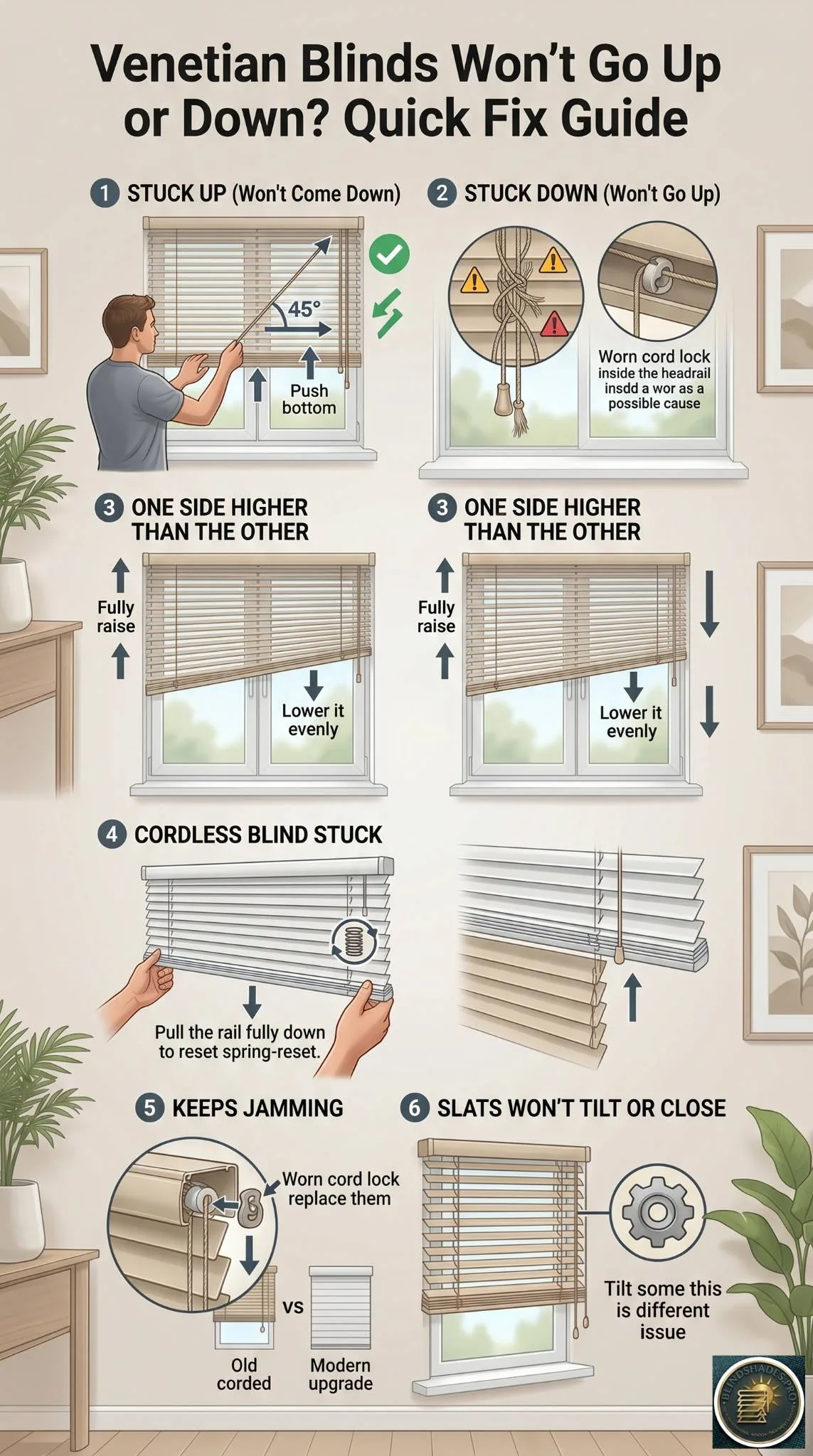
Authored by Michael Turner — 30 Years of Home Improvement Expertise | BlindShades.pro
When Venetian blinds won’t go up or down, the cause is almost always the cord lock inside the headrail jamming — not a broken blind. The fix for a blind stuck up is to pull the lift cord toward the center of the window at about a 45-degree angle to release the lock; the fix for a blind stuck down is usually a tangled cord or a worn lock. Before you pull anything, run the three-question diagnosis below, because “won’t go up” and “won’t go down” are two different problems with two different fixes — and forcing the wrong one is how cords snap.
Key Takeaways
- Nine times out of ten, a corded Venetian blind that will not move is a jammed cord lock, not a broken mechanism. The lock is a small pin inside the headrail that pinches the cord to hold the blind in place, and it most often jams right after you raise the blind all the way up to open a window. The blind is not broken; the lock is simply stuck under load.
- “Won’t go up” and “won’t go down” are different failures — diagnose first. A blind stuck in the up position is almost always the cord lock refusing to release; a blind stuck down is more often a tangled, frayed, or stretched cord, or a lock that no longer engages. Pulling hard on the wrong one snaps cords and strips the clutch.
- The release trick is an angle, not brute force. Pull the cord toward the middle of the window at roughly 45 degrees while gently pushing the bottom rail up half an inch to take the weight off the lock. The lock disengages when the cord lifts off its locking pin — which is why angling works and yanking straight down does not.
- Cordless blinds have no cord to pull, so the fix is completely different. If a cordless Venetian will not move, the problem is the spring or clutch in the headrail, not a cord lock. The reset is to pull the bottom rail fully down, then let it rise — not to hunt for a cord that is not there.
- A blind that jams over and over is telling you something. Repeated jams usually mean a worn lock or a cord fraying against a sharp edge inside the headrail. At that point the honest fix is to replace the inexpensive lock part or restring the blind — and if it is an old corded blind in a home with children, to upgrade to a cordless model for safety.
⭐ Quick Answer
When Venetian blinds won’t go up or down, the cause is almost always a jammed cord lock in the headrail — not a broken blind. Diagnose which way it is stuck, then use the matching fix below.
- Stuck up (will not come down): pull the lift cord toward the center of the window at about 45 degrees while pushing the bottom rail up half an inch. The lock releases by angle, not by force — the same method the repair pros at Fix My Blinds recommend.
- Stuck down (will not go up): check the cord for tangles and fraying first, then raise the blind a few inches and try to lock it. If it locks, the cord is the problem; if it will not, the cord lock is worn.
- Cordless and stuck: there is no cord lock — pull the bottom rail fully down to reset the spring. A spring that will not hold needs the headrail mechanism replaced.
- Keeps jamming or cords are frayed: replace the inexpensive lock part or restring the blind. For an old corded blind in a home with children, upgrade to a cordless model, which the Window Covering Safety Council and the U.S. CPSC recommend.
- Slats raise fine but will not tilt or close? That is a different mechanism — see Venetian blind slats won’t close, and choose a replacement in our best Venetian blinds guide.
Why Won’t Your Venetian Blinds Go Up or Down?
In the large majority of cases the lift cord lock has jammed — a cheap, fixable part, not a dead blind.
A corded Venetian blind has a small mechanism inside the headrail called the cord lock. It is a metal or plastic pin (sometimes called a pawl) that pinches the lift cord against the headrail to hold the blind at whatever height you set. When you want to move the blind, angling the cord lifts it off that pin and frees it. Most “venetian blinds won’t go up or down” problems are simply that pin staying engaged when it should release, or grit inside the lock stopping it from moving smoothly.
As the repair specialists at Fix My Blinds explain, the lock jams most often after a blind is raised all the way to the top — exactly what happens when someone lifts the blinds fully to open or clean a window. The cords bunch and pull slightly off-angle, the pin bites down, and the blind refuses to lower. BlindQuest notes the same pattern and adds the other common trigger: years of dust and debris building up inside the headrail, which stops the lock moving freely. Neither is a broken blind, and neither needs a professional.
The reason it is worth diagnosing before you pull is that a smaller share of cases are not the lock at all — they are a frayed or stretched cord, an obstruction, or, on a cordless blind, a tired spring. Each of those has a different fix, and the single most damaging mistake is to yank hard on a blind that is actually snagged, which snaps cords and turns a five-minute fix into a restring.
Diagnose Before You Pull: The Three-Question Triage
Answer three questions first and you will know which fix you need before you touch the cord.
This is the step every competing guide skips, and it is the one that saves you from breaking the blind. Run through it in order.
Question 1: Is the blind stuck UP or stuck DOWN?
- Stuck up (raised and will not come down) points to a jammed cord lock that will not release. This is the most common case and the easiest fix.
- Stuck down (lowered and will not raise) points more often to a tangled or frayed cord, an obstruction, or a lock that no longer grips.
Question 2: Is the blind CORDED or CORDLESS?
- If you operate it with a cord or wand and there are lift cords hanging down, it is corded — the cord-lock fixes below apply.
- If you raise and lower it by pushing the bottom rail with no cords, it is cordless — skip to the cordless section, because there is no cord lock to release.
Question 3: Is it stuck on ONE side or evenly across?
- Evenly stuck points to the cord lock or the spring.
- One side higher than the other points to uneven cord tension, which has its own quick reset.
Hold your answers in mind and go to the matching section below. This table maps each symptom to its likely cause and fix:
| Symptom | Most likely cause | Fix |
|---|---|---|
| Stuck up, will not come down | Jammed cord lock | Pull cord to center at 45 degrees, push bottom rail up |
| Stuck down, will not go up | Tangled or frayed cord, or worn lock | Inspect cord; test the raise-and-lock diagnostic |
| One side higher than the other | Uneven cord tension | Raise fully, then lower slowly to re-balance |
| Cordless blind will not move | Spring or clutch in headrail | Pull bottom rail fully down to reset the spring |
| Jams repeatedly | Worn lock or cord fraying on a sharp edge | Replace the lock part or restring |
| Raises but will not stay up | Cord lock no longer engages | Replace the cord lock |
How Do You Fix Venetian Blinds That Won’t Go Down?
Pull the cord toward the center at about 45 degrees while easing the bottom rail up — the lock releases by angle, not by force.
This is the classic “stuck up” fix, and it works because of how the lock is built. Follow it in this order:
- Stand directly in front of the blind and take the lift cord (or all the cords together if there are several) in one hand.
- With your other hand, push the bottom rail up about half an inch. You are not lifting the blind — you are taking the weight off the cord lock so the pin can move. Fix My Blinds calls this the single trick that frees most stuck blinds.
- Pull the cord toward the middle of the window at roughly a 45-degree angle and hold it there. Angling the cord inward lifts it off the locking pin; this is why pulling straight down keeps it locked while angling releases it.
- While holding that angle, slowly let the blind lower. Ease it down gently rather than letting it drop.
- If it still will not budge, gently wiggle the cords left and right while keeping the inward angle and the slight upward push on the bottom rail.
Once it releases, raise and lower the blind a few times to reset the mechanism and clear any grit. If you have pulled at the angle, pushed the rail, and wiggled the cords and nothing moves at all, the lock is jammed internally — take the blind down, open the hinged front of the headrail, and free or reset the lock by hand, which Fix My Blinds covers in their headrail teardown.
How Do You Fix Venetian Blinds That Won’t Go Up?
Check the cord for tangles and fraying first; if the cord is sound but the blind will not lock when raised, the lock is worn.
When venetian blinds won’t go up, resist the urge to pull harder — that is what snaps cords. Work through this instead:
- Inspect the visible cord for knots, tangles, or fraying where it enters the headrail. A frayed cord catching in the route holes punched through the slats is a frequent cause of a blind that will not raise smoothly.
- Clear any obstruction around the bottom rail and the window frame — a warped slat or something resting on the sill can stop the lift.
- Try to raise the blind a few inches and lock it. This is the key diagnostic from Fix My Blinds: if it locks at the new height, the lock is fine and your problem is the cord; if it will not lock at all, the locking mechanism itself is worn and needs replacing.
- If the cord is frayed or stretched, it needs replacing. Cord that is crushed from being locked in the same spot day after day loses its grip and has to be restrung — the full method is in how to restring Venetian blinds.
A blind that raises but will not hold its height has the opposite problem — a lock that no longer engages — and that points to a lock replacement rather than a cord.
What If One Side Is Higher Than the Other?
Uneven cords are the cause — raise the blind fully, then lower it slowly and evenly to re-balance the tension.
When one side sits higher, the lift cords have pulled unevenly through the headrail, putting uneven tension on the mechanism. The reset is simple: raise the blind all the way to the top, which equalizes the cords at the headrail, then lower it slowly and evenly with steady pressure rather than tugging one cord. On most blinds this re-balances the lift in one cycle. If it drifts uneven again within a few uses, a cord is catching or fraying inside the headrail and should be inspected, because persistent unevenness is an early sign of a cord on its way to failing.
What About Cordless Venetian Blinds That Won’t Move?
A cordless blind has no cord lock — the fix is a spring reset, and a spring that will not hold needs replacing, not pulling.
Cordless Venetian blinds are increasingly common because they are the child-safe standard, but when they stick, none of the cord tricks above apply — there is no cord and no cord lock. A cordless blind raises and lowers using a spring-and-clutch system inside the headrail, so the failure is mechanical:
- To reset it, pull the bottom rail all the way down to the sill, then release it and let the spring take the weight. This re-tensions the spring and clears most sticking.
- If it rises but will not stay put, the spring has lost tension and the headrail mechanism needs replacing — it is not adjustable from outside.
- If it will not move at all, check for a warped bottom rail or an obstruction first, then suspect a seized clutch, which again is a headrail part replacement.
Because a cordless headrail mechanism is an integrated part, the practical decision on a budget blind is often to replace the whole blind rather than the mechanism. On a quality blind, the manufacturer can usually supply the headrail part.
What Should You Never Do to a Stuck Venetian Blind?
Avoid the five moves that turn a quick fix into a replacement.
Every competing guide says “do not force it” and stops there. Here is the specific list of what actually causes damage:
- Do not yank the cord hard or repeatedly. Force snaps lift cords and can strip the clutch on a cordless blind. The fixes above use angle and gentle pressure for a reason.
- Do not pull the cord straight down to release a stuck lock — that keeps the pin engaged. Angle it toward the center instead.
- Do not cut a tangled cord. Once cut, the blind has to be fully restrung; almost every tangle can be worked free by hand.
- Do not remove or bend slats to reach the mechanism. You will damage the ladder cords that hold them.
- Do not spray WD-40 or any oily lubricant into the headrail. Oil attracts dust and gums up the lock over time. If you lubricate, use a dry silicone or PTFE spray only.
Should You Repair, Restring, or Replace?
Match the fix to the failure: a worn lock is a cheap part swap, frayed cords mean a restring, and a tired cordless mechanism on a budget blind usually means a new blind.
Once you have diagnosed the cause, the decision is straightforward, and the cost differences are real:
- Jammed or worn cord lock: a replacement cord lock is an inexpensive part, typically only a few dollars to around fifteen depending on the type. Take the old one down and match it before ordering. This is the cheapest and most common repair.
- Frayed, stretched, or snapped cords: the blind needs restringing — an inexpensive cord kit and an hour of patience. Walk through it in how to restring Venetian blinds.
- Worn cordless spring or seized clutch: on a low-cost blind, a new blind is usually cheaper than the part and the effort; on a premium blind, order the headrail mechanism from the maker.
- An old corded blind that jams repeatedly: if it keeps failing and there are children or pets in the home, the better move is to replace it with a cordless model. Corded blinds are a recognized strangulation hazard, which is why the ANSI/WCMA A100.1 standard and the Window Covering Safety Council recommend cordless or motorized blinds in homes with children. Our best Venetian blinds guide covers cordless and motorized options.
(Prices are indicative U.S. ranges and vary by brand and part — confirm the current cost before ordering. We never publish fabricated figures.)
How Do You Stop It From Happening Again?
Lubricate the lock correctly, keep the headrail clean, and avoid the habit that jams it most.
Most repeat jams are preventable. Three habits keep a Venetian blind moving smoothly for years:
- Lubricate with dry silicone or PTFE spray, never oil. A light shot into the cord lock once or twice a year keeps the pin moving freely; oily lubricants do the opposite by trapping dust.
- Keep the headrail clean. The dust and debris BlindQuest cites as a top cause builds up slowly; a periodic vacuum of the headrail and cords prevents the grit that seizes the lock.
- Vary where you lock the blind, and lower it before raising fully. Locking in the exact same spot every day crushes the cord there over time. Releasing the lock before you fully raise the blind avoids the off-angle bunching that jams it in the up position in the first place.
If you have worked through all of this and the slats raise and lower correctly but will not tilt open or closed, the lift mechanism is fine and the tilt mechanism is the issue — that is covered separately in Venetian blind slats won’t close.
Best Sources
- Fix My Blinds — on the cord-lock jam after full raise, the bottom-rail-push release, the raise-and-lock diagnostic test, and manual headrail disengagement.
- BlindQuest — on dust and debris in the headrail as a top cause, and uneven-cord diagnosis.
- Window Covering Safety Council / ANSI-WCMA A100.1 — on cordless and motorized blinds as the child-safe standard for corded-blind replacement.
Related Guides
Frequently Asked Questions
Why won’t my Venetian blinds go up?
When Venetian blinds won’t go up, check the lift cord first for tangles, knots, or fraying where it enters the headrail, and clear any obstruction at the bottom rail. If the cord is sound, try raising the blind a few inches and locking it: if it locks, the cord is the problem; if it will not lock, the cord-lock mechanism is worn and needs replacing. Never pull harder, as that snaps the cords.
How do I release a stuck Venetian blind cord lock?
Pull the lift cord toward the center of the window at about a 45-degree angle while pushing the bottom rail up half an inch to take the weight off the lock. The lock releases when the cord lifts off its internal pin, which is why angling works and pulling straight down does not. If it still will not move, gently wiggle the cords side to side while holding the angle.
Why are my Venetian blinds stuck in the up position?
A blind stuck up is almost always a jammed cord lock, which most often happens right after the blind is raised all the way to open a window. The cords bunch and pull off-angle, and the locking pin bites down. Free it by angling the cord toward the center and pushing the bottom rail up slightly, rather than pulling straight down.
How do you fix cordless Venetian blinds that won’t move?
Cordless blinds have no cord lock, so the cord tricks do not apply. Reset the spring by pulling the bottom rail all the way down to the sill and then releasing it. If the blind rises but will not stay in place, the spring has lost tension and the headrail mechanism needs replacing. Check first for a warped bottom rail or an obstruction.
Should I repair or replace blinds that keep getting stuck?
If the cord lock is worn, replacing that inexpensive part is the cheapest fix. If the cords are frayed, restring the blind. If a cordless mechanism is failing on a low-cost blind, a new blind is usually cheaper than the part. And if an old corded blind keeps jamming in a home with children, replacing it with a cordless model is the safest choice.
