What Are the Best Blinds for a Shift Worker Bedroom — Total Blackout Guide

Authored By Michael Turner -30 Years Home Improvement Expertise | Updated 2026 | BlindShades.pro
Updated on July 12, 2026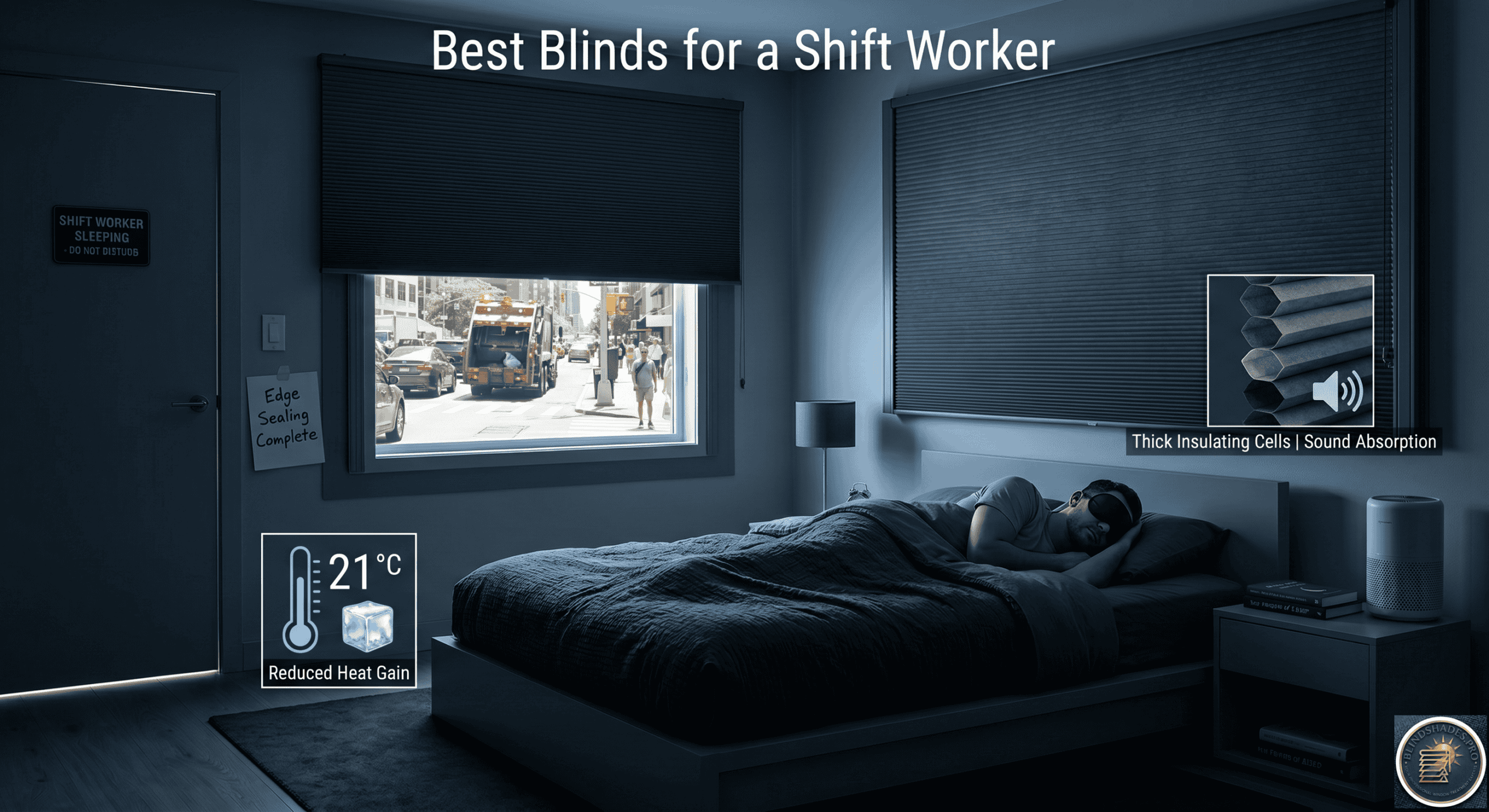
⭐ Quick Answer — Best Blackout Blinds for Shift Workers
- The Health Case First: Blackout blinds for shift workers are not just a comfort choice — the IARC (International Agency for Research on Cancer) classified shift work involving circadian disruption as a probable human carcinogen (Group 2A) in 2007. Davis et al. (2001, JNCI) found nurses working night shifts for 14+ years had a 1.79× higher risk of breast cancer. Adequate daytime darkness is a health intervention, not a lifestyle upgrade
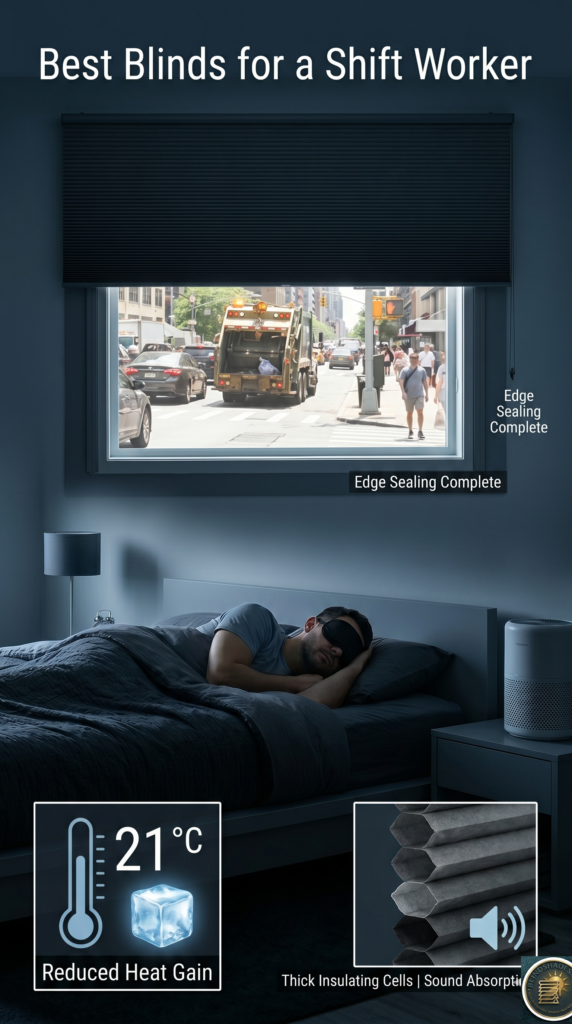
- The Complete Specification: Double-cell blackout cellular shade (outside mount, 3–4 inch overlap per side) + ceiling-mounted blackout curtain = 0–3 lux total. The dual layer addresses all three shift worker problems: afternoon heat gain (R-3.5–5.0 vs roller R-0.8), impulsive daytime noise (garbage trucks, school buses — NRC 0.15–0.35), and edge light gaps from bright midday sun
- Orientation Priority: North-facing = best for shift workers (5,000–20,000 lux diffuse vs 100,000 lux direct) · East-facing = worst for night shift workers arriving home at 7am (direct morning sun immediately on arrival) · South/West = most demanding for afternoon sleepers — peak heat AND peak light coincide with deepest sleep (2–6pm)
- The Professional Safety Issue (Van Dongen 2003): Research in Sleep showed that 6 hours of sleep per night for 14 days produces cognitive impairment equivalent to 2 days of total sleep deprivation — yet subjects were largely unaware. For nurses, pilots, and first responders: the specification gap between 50 lux and 5 lux in the bedroom directly affects professional performance and safety
- Motorized Specification for Circadian Management: Programme a motorized blackout shade to lower at 5am (before arriving home) and rise at 1pm (2 hours before 3pm wake). This supports gradual circadian adaptation to daytime sleeping rather than abrupt alarm-from-darkness wake. Hunter Douglas PowerView and Lutron Serena support alarm-time scheduling for this application
- Best Sources: Complete specification → Hunter Douglas Duette LightLock + PowerView · Mid-range → Blindsgalore Blackout Cellular + side channels · Roller alternative → SelectBlinds Premier Blackout outside mount
⚠️ The Commute Home — The Missing Step Every Blackout Blinds Guide Ignores: For blackout blinds for shift workers to work properly, the transition from work to bedroom matters as much as the blind specification itself. Morning sunlight on the commute home from a night shift is the most powerful circadian advancement signal available — it tells the body clock to “wake up and stay up.” Fix: wear orange-tinted (blue-light-blocking) sunglasses on the commute home to block the 480nm short-wavelength light that drives the circadian wake signal. Research by Sasseville et al. (2006) documented improved daytime sleep timing in shift workers who wore blue-blocking goggles. Then go straight into the darkened bedroom — don’t stop in a brightly lit kitchen or check your phone in a lit room. The blackout blind only maintains darkness once you’re inside. The commute manages the light received before you enter. See the full commute home protocol below.
💡 Rental Specification for Nurses, Airline Crew and Military Personnel: Many shift workers in rental accommodation cannot drill. For daily-use blackout blinds for shift workers in rental properties: specify no-drill bracket systems (EasyFit, Perfect Fit) that clip to the window bead frame — reliable for daily use, unlike suction cups which lose grip within weeks of temperature cycling. Suction cup portable blinds (Gro, Tommee Tippee) are reliable only for travel and hotel stays, not permanent shift worker bedroom use. For windows where raising/lowering is not needed — blackout window film applied directly to the glass provides permanent grade blackout without wall fixings and peels off cleanly at the end of a tenancy. See the SelectBlinds Canada shift worker guide for compatible product options. See the full rental specification below.
📖 Read the complete guide below for: the specific health risk data (IARC Group 2A, Davis 2001 breast cancer, Knutsson cardiovascular, Van Dongen 2003 professional safety), the daytime temperature challenge and why double-cell cellular beats roller for afternoon sleepers, impulsive vs sustained daytime noise types, the window orientation guide for shift workers (north vs east vs south/west), the motorized shade circadian management protocol, the commute home blue-blocking strategy, the rental no-drill specification, and the complete total blackout specification by bedroom type.
Related guides: the full format scorecard and tested picks live in the blackout blinds & shades buying guide.
Why Blackout Blinds for Shift Workers Matter Beyond Sleep Quality
Most blackout blind guides frame the benefit as “better sleep.” For shift workers, the stakes are significantly higher.
The IARC classification: In 2007 the International Agency for Research on Cancer (IARC) classified shift work involving circadian disruption as a probable human carcinogen (Group 2A) — the same classification as lead and DDT. This classification was based on compelling animal evidence and limited human evidence of elevated cancer risk from long-term circadian disruption.
The specific health risk data no blind guide cites: Research by Davis and colleagues published in the Journal of the National Cancer Institute (2001) found that nurses who worked night shifts for more than 14 years had a 1.79 times higher risk of breast cancer than day-shift nurses. Research by Pan and colleagues in the American Journal of Epidemiology found that rotating shift workers had significantly higher rates of type 2 diabetes. Research compiled by Knutsson and colleagues documents approximately a 40 percent higher cardiovascular risk in long-term shift workers.
The mechanism — and where blackout blinds intervene: The health risks of shift work are driven by circadian rhythm disruption, and circadian disruption is driven substantially by inappropriate light exposure. A shift worker who sleeps with ambient light entering the bedroom — from dawn, morning sun, or street lighting — is receiving a systematic circadian advancement signal that keeps the body clock misaligned with the sleep schedule. The blackout blind is not just a sleep comfort tool. For long-term shift workers, it is a health risk reduction intervention.
What to Look For in Blackout Blinds for Shift Workers
When choosing blackout blinds for shift workers, three requirements are more demanding than for typical bedroom applications.
Requirement 1 — True blackout fabric (0.1% transmittance or less): Standard “room-darkening” shades blocking 95–99% of light are inadequate for shift workers sleeping in full daylight. Summer midday sun produces 100,000 lux externally. At 98% blockage, approximately 2,000 lux enters the bedroom — still 2,000 times brighter than the AASM’s recommended 1 lux for optimal sleep. For shift workers, specify true blackout fabric with light transmittance at or below 0.1%.
Requirement 2 — Edge gap elimination (side channels or outside mount with 3–4″ overlap): The edge gap problem is more severe for shift workers than for nighttime sleepers because the external light pressure is so much greater. A standard 1/4 inch edge gap during night conditions may admit 50–100 lux. The same gap during direct midday summer sunlight admits 250–500 lux. Shift workers require either a cassette headrail with integrated side channels, or outside mount installation extending 3–4 inches beyond the window casing on all sides.
Requirement 3 — Thermal performance for afternoon sleep: This is the requirement absent from every blackout blind guide written for general bedroom users. Shift workers sleeping in the afternoon face external temperatures of 85–95°F during peak summer heat (2–6pm). Unlike nighttime sleepers who benefit from natural overnight cooling, afternoon-sleeping shift workers must fight against the thermal peak that coincides with their deepest sleep period. A double-cell blackout cellular shade providing R-3.5 to R-5.0 meaningfully reduces solar heat gain through the window during the afternoon peak period. A blackout roller shade providing R-0.5 to R-0.8 does not.
The Shift Worker Daytime Noise Challenge
For most bedroom applications, outside noise is an occasional nuisance. For shift workers, daytime noise has a specific profile that makes it more disruptive than the traffic noise of nighttime sleepers.
Impulsive vs sustained noise: Research in sleep science distinguishes between two types of noise:
- Sustained background noise (traffic hum, HVAC) — the brain adapts partially and arousals per hour are moderate
- Impulsive noise events (garbage truck hydraulics, school bus air brakes, construction impact, delivery vehicle reversing alarms) — brief, intense, unpredictable events that trigger full arousal from sleep at lower average dB levels than sustained noise
Shift workers sleeping between 7am and 3pm face a peak schedule of impulsive daytime noise events: garbage collection (6–9am), school bus routes (7–8:30am and 2:30–4pm), construction (7am–5pm), delivery vehicles (8am–5pm). These are the sources most likely to cause premature waking.
The acoustic specification: For shift workers — double-cell blackout cellular shade paired with blackout curtains on a ceiling-mounted track provides the best combined acoustic response:
- Double-cell cellular: NRC 0.15–0.25 per window
- Heavy blackout curtain (lined, ceiling-to-floor): NRC 0.20–0.35
Together these add meaningful absorption to the room’s total acoustic environment — reducing the reverberation that amplifies impulsive noise events into prolonged disturbances.
Window Orientation Guide for Shift Workers
This is the shift worker-specific orientation guide that no blackout blind guide provides.
East-Facing Bedroom — The Night Shift Problem Window
The specific problem: Night shift workers typically arrive home between 7–8am. An east-facing bedroom receives direct morning sun from approximately 5:30am (summer) through 10am — entering the room at a near-horizontal angle that penetrates deep into the space. A worker arriving home at 7:30am immediately faces bright morning light in an east-facing room.
The solution: Outside mount blackout cellular or roller shade extending 3–4 inches beyond the north side of the frame (summer northeast sunrise). Programme a motorized shade to lower at 5am and remain down until 10am. On returning home — enter the room and lower the shade before attempting to sleep. See What Is the Best Window Treatment for a Bedroom That Faces East for the complete east-facing specification.
South and West-Facing Bedroom — The Afternoon Shift Problem Window
The specific problem: Shift workers sleeping from 7am to 3pm face direct south or west-facing sun during peak afternoon heat (2–6pm). This is the highest-stress combination for any bedroom: maximum external temperature + maximum light pressure + deepest sleep period coinciding.
The solution: Double-cell blackout cellular shade for thermal performance + side channels for edge gap + blackout curtains for redundant coverage. Motorized specification with afternoon lowering scheduled from noon to 5pm. This is the highest-priority specification for any shift worker.
North-Facing Bedroom — The Best Shift Worker Orientation
The advantage: North-facing bedrooms receive no direct sun year-round. Diffuse light from sky is significantly lower than direct sunlight — a north-facing room in summer midday has external light levels of approximately 5,000–20,000 lux rather than 100,000 lux. A quality blackout shade in a north-facing room achieves near-complete darkness with less demanding specification.
If you have a choice of bedrooms — a shift worker in a multi-bedroom home should take the north-facing bedroom regardless of size or other factors. The quality of sleep environment it provides is the primary quality of life variable for shift workers.
The Motorized Shade as Circadian Health Management
Every guide recommends motorized shades for shift workers as a convenience — “operate without getting out of bed.” Research by Eastman, Crowley, and colleagues on circadian rhythm management for shift workers identifies a more specific clinical application.
Strategic light exposure for shift workers: The human circadian clock can be deliberately advanced or delayed by controlling the timing of light exposure. For shift workers whose sleep period is 7am–3pm:
- Maintaining darkness for the full 8 hours (7am–3pm): Supports the circadian clock gradually shifting to accommodate the daytime sleep schedule
- Allowing light entry 1–2 hours before the desired wake time (1–3pm): Provides a natural circadian wake signal that produces more natural waking than an alarm from deep sleep
The motorized schedule for circadian management: Programme the blackout shade to lower at 5am (before the worker arrives home) and rise at 1pm — providing 2 hours of natural light before the 3pm wake time. This schedule supports gradual circadian adaptation to daytime sleeping rather than fighting the body clock every day with a blackout-then-alarm approach.
Available with sunrise-tracking automation in Hunter Douglas PowerView and Lutron Serena — programme by wake time rather than clock time for automatic seasonal adjustment.
The Commute Home — The Missing Step in Every Shift Worker Guide
The critical transition that no blackout blind guide covers: Night shift workers finishing at 6–8am face an immediate biological problem: morning sunlight on the commute home is the most powerful circadian advancement signal available. Every minute of morning sun exposure on the journey home pushes the circadian clock to “wake up and be alert” — directly opposing the goal of sleeping until early afternoon.
The protocol before you even get home:
- Wear orange-tinted (blue-blocking) sunglasses on the commute home — these block the short-wavelength light (blue/green, 480nm) that most strongly drives the circadian clock’s morning wake signal
- Arrive home and immediately enter the darkened bedroom — do not stop in the kitchen under bright LED lighting or check your phone in a lit room
- The blackout bedroom allows immediate sleep onset — only effective if the bedroom is already dark before you enter
The blackout blind specification is the last part of this protocol — it maintains darkness once you are in the room. But the blue-blocking transition minimises the light already received on the commute. Research by Sasseville et al. (2006) documented that wearing blue-light-blocking goggles during the night shift helped workers maintain better daytime sleep timing.
The Sleep Debt Professional Safety Issue
This is the most important context no blind guide provides for shift workers in safety-critical roles:
Research by Van Dongen and colleagues published in the journal Sleep (2003) demonstrated that subjects restricted to 6 hours of sleep per night for 14 days showed cognitive impairment equivalent to 2 days of total sleep deprivation — yet subjects were largely unaware of this impairment.
The professional safety implications: For shift workers in safety-critical occupations — nurses, pilots, truck drivers, air traffic controllers, first responders — inadequate daytime sleep from insufficient blackout creates a documented safety risk:
- Increased medication administration errors (nurses)
- Impaired decision-making under time pressure (pilots, first responders)
- Reduced reaction time (truck drivers)
- Elevated accident risk at the end of long shifts
The specification implication: For shift workers in safety-critical roles — blackout blind specification is not a lifestyle improvement. It is a professional obligation. The specification that achieves 0–5 lux (true blackout fabric + edge gap elimination) is worth the cost premium over the specification that achieves 20–50 lux (standard blackout blind). The cognitive difference between 6 hours at 50 lux and 8 hours at 5 lux is measurable and professionally significant.
The Complete Shift Worker Blackout Specification
For Maximum Performance (South, West, or East-Facing Bedroom)
Layer 1 — Double-cell blackout cellular shade: Outside mount, 3–4 inches beyond casing on all sides, 3–4 inches below sill. Provides blackout, R-3.5–5.0 thermal resistance, NRC 0.15–0.25 acoustic absorption. GREENGUARD Gold certification if household includes children.
Layer 2 — Blackout curtain on ceiling-mounted track: Heavy lined blackout curtain on ceiling-mounted track covering the full wall area including casing. Provides redundant light blockage, additional acoustic absorption (NRC 0.20–0.35), and covers any gaps between the cellular shade and wall surface.
Motorized specification: Programme to lower at 5am, rise at 1pm (for 7am–3pm sleep schedule). Use sunrise-tracking automation for seasonal adjustment.
Total darkness achieved: 0–3 lux at peak summer daylight ✅
For Good Performance (North-Facing or Moderate Light Bedroom)
Single layer — Blackout roller shade with side channels: Outside mount, 3–4 inches beyond casing. Side channels with integrated brush seal. No curtain layer required for north-facing.
Manual or motorized: Motorized recommended for consistency; manual acceptable for moderate-sensitivity shift workers.
Total darkness achieved: 3–10 lux ✅
For Rental Accommodation (No-Drill Specification)
Option 1 — No-drill bracket systems (EasyFit, Perfect Fit): Clip to window bead without drilling. Reliable for daily shift worker use. Available in blackout cellular specification. Most reliable no-drill permanent solution.
Option 2 — Blackout window film: Applied to glass surface. Provides permanent-grade blackout without wall fixings. Cannot be raised and lowered — use for windows that don’t need daily operation, or secondary windows where full permanent blackout is acceptable.
NOT recommended: Suction cup portable blackout panels. These lose grip over days to weeks of thermal cycling and humidity variation. Unreliable for daily shift worker use. Suitable for travel only.
Where to Order — Shift Worker Specification
For maximum performance specification (south/west-facing): Hunter Douglas Duette LightLock + PowerView — factory-integrated U-shaped channels, GREENGUARD Gold, PowerView motorization with alarm-time scheduling. The complete specification.
Blindsgalore Blackout Cellular with outside mount — double-cell, side channels available as add-on. Motorized option with app scheduling.
For good performance specification (north-facing, moderate light): SelectBlinds Premier Blackout Roller Shade — outside mount, add side channel kit. Cordless or motorized.
SmartWings Blackout Roller + Side Rail Tracks — dual-layer blackout fabric with aluminum channel tracks. The SmartWings shift worker specification reviewed at smartwingshome.com.
For rental accommodation: EasyFit or Perfect Fit no-drill blackout cellular bracket systems. Available through specialist UK window treatment retailers and select US suppliers.
Related guides: For complete buying advice, see our blackout blinds and shades buying guide and motorized curtains buying guide.
Frequently Asked Questions
What are the best blackout blinds for shift workers? The best blackout blinds for shift workers are double-cell blackout cellular shades on outside mount with 3 to 4 inch overlap per side, combined with a ceiling-mounted blackout curtain layer. This combination addresses the three shift worker-specific problems: midday afternoon heat gain (R-3.5 to R-5.0 cellular thermal resistance), impulsive daytime noise from garbage trucks and construction (NRC 0.15 to 0.25 cellular plus NRC 0.20 to 0.35 curtain), and the high-pressure light entry from bright summer daytime sun requiring edge gap elimination. See the SelectBlinds Canada shift worker guide for a compatible product-by-product comparison.
Why is inadequate blackout a professional safety issue for shift workers? Research by Van Dongen and colleagues published in Sleep (2003) demonstrated that 14 days of sleeping only 6 hours per night — as commonly results from daytime light intrusion — produces cognitive impairment equivalent to 2 days of total sleep deprivation. For shift workers in safety-critical roles including nurses, pilots, truck drivers, air traffic controllers, and first responders, this cognitive deficit directly increases the risk of errors, accidents, and delayed emergency response. Inadequate blackout for shift workers is not a comfort issue — it is a measurable professional safety issue.
Should shift worker blackout blinds be motorized? Yes, with a specific programming approach. Beyond the convenience argument, research on circadian rhythm management for shift workers documents that strategic light exposure timing can help the body clock gradually adapt to daytime sleeping. Programme a motorized blackout shade to lower 2 hours before the shift worker arrives home (typically 5am for a night shift ending at 7am) and rise 2 hours before the desired wake time. This provides natural light exposure that supports a gentle circadian wake signal rather than an abrupt alarm-from-darkness wake. Hunter Douglas PowerView and Lutron Serena support alarm-time scheduling for this application.
What window orientation is best for a shift worker bedroom? North-facing bedrooms are best for shift workers. North-facing windows receive no direct sun year-round, so external light levels are 5,000 to 20,000 lux rather than the 100,000 lux of direct summer sunlight. A quality blackout shade in a north-facing room achieves near-complete darkness with less demanding specification. East-facing bedrooms are the worst for night shift workers arriving home at 7am — direct morning sun is at peak intensity immediately at the start of the sleep period. South and west-facing bedrooms combine maximum heat gain with maximum afternoon light pressure exactly when afternoon-sleeping shift workers are in their deepest sleep cycle.
Do shift workers need to manage light before entering the blackout bedroom? Yes — the commute home is the critical step most blackout blind guides ignore. Morning sunlight on the commute home from a night shift drives the circadian clock toward waking, directly opposing the goal of sleeping until early afternoon. Shift workers should wear orange-tinted blue-light-blocking sunglasses on the commute home to reduce the circadian wake signal. Research by Sasseville and colleagues (2006) documented improved daytime sleep timing in shift workers who wore blue-blocking goggles during night shift work. The blackout bedroom is effective only when the commute light exposure is also managed.
Related Guides on BlindShades.pro
- The Best Bedroom Blinds & Shades Buying Guide
- Are Blackout Blinds Worth It for Better Sleep — The Science and the Specification — the full sleep science including AASM lux threshold
- Why Is Light Coming Through the Sides of My Blackout Blinds — edge gap elimination
- What Are the Best Blinds for a Nursery — Blackout, Cordless and Safety Guide — parallel high-stakes blackout specification
- What Is the Best Window Treatment for a Bedroom That Faces East — east-facing orientation guide for night shift workers arriving home at dawn
By Michael Turner | 30 Years Home Improvement Expertise | Updated 2026 | BlindShades.pro
