




What Are the Best Panel Track Blinds for Sliding Glass Doors?

Authored By Michael Turner -30 Years Home Improvement Expertise | Updated 2026 | BlindShades.pro
Updated on June 13, 2026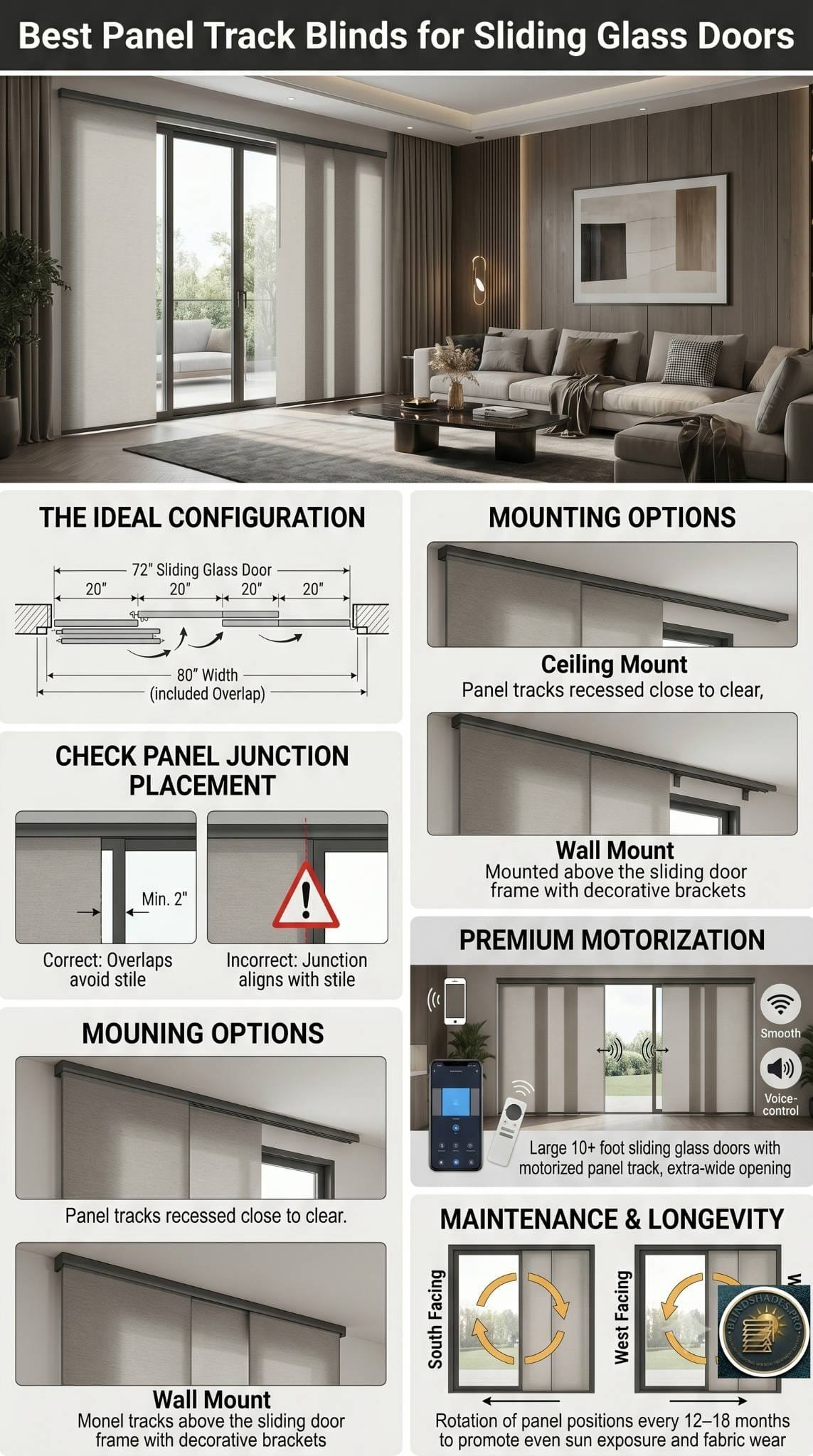
Key Takeaways:
- The panel width calculation for panel track blinds on sliding glass doors starts with the total outside-mount blind width (door opening + 3 to 4 inches each side); divide this total by candidate panel counts until you find the count that produces panel widths in the 18 to 24-inch optimal range; for a standard 72-inch sliding glass door with 4 inches of wall overlap on each side (80-inch total width): 80 ÷ 3 panels = 26.7 inches (too wide); 80 ÷ 4 panels = 20 inches (correct range ✅); 80 ÷ 5 panels = 16 inches (too narrow); 4 panels is the correct specification for a standard sliding glass door; Blindsgalore (March 2026) confirms panels are “usually 18 to 24 inches each, gliding smoothly along a sleek track”
- Before confirming the panel count, verify that no panel junction falls within 2 inches of the sliding door’s center stile; for a 72-inch door with 4-inch wall overlap each side (total blind width 80 inches): the door stile sits at 36 inches + 4-inch overlap = 40 inches from the left headrail edge; for 4 panels at 20 inches each, junctions fall at 20, 40, and 60 inches — the 40-inch junction lands exactly at the door stile; when the sliding door panel opens, its edge contacts this junction as the door travels; adjust panel count to shift junctions away from the stile position
- Panel track blinds stack more wall space than vertical blinds despite having fewer components: a 4-panel 80-inch panel track system stacks approximately 20 to 22 inches when fully stacked to one side; vertical blinds on the same 80-inch opening stack approximately 16 inches; buyers choosing panel track for its cleaner appearance often discover the treatment requires more lateral wall space than the vertical blinds they are replacing
- The panel track wand control is practical up to approximately 96 to 108 inches (8 to 9 feet) of opening width; at 120 inches (10 feet) and wider, the operator must walk with the panels during traversal rather than pulling from one fixed position; motorization becomes the practical default for panel track blinds on sliding glass doors wider than 10 feet; Graywind motorized panel track covers openings up to 177 inches
- The leading panel on a sliding glass door panel track fades faster than the trailing panels because it is the first panel traversed and sits in the direct sun path during the brightest part of the day; after 2 to 4 years of daily use on a south or west-facing patio door, the leading panel can be visibly different in shade from the trailing panels; rotating panel positions every 12 to 18 months equalises UV exposure and extends the period of visual uniformity; at initial purchase, order 1 to 2 spare panels from the same production run and store them flat
⭐ Quick Answer — What Are the Best Panel Track Blinds for Sliding Glass Doors?
- The Panel Width Calculation Formula — How to Determine the Correct Panel Count for Any Door Width: The most important specification decision for panel track blinds for sliding glass doors is the panel count, which determines individual panel width. Blindsgalore (March 2026) confirms panels are “usually 18 to 24 inches each, gliding smoothly along a sleek track.” The formula: calculate the total outside-mount blind width (door opening + 3 to 4 inches each side), then divide by candidate panel counts until you find the count that produces panel widths in the 18 to 24-inch target range. Results by standard door width: 60-inch door (68-inch total) = 3 panels × 22.7 inches (correct ✅); 72-inch door (80-inch total) = 4 panels × 20 inches (correct ✅) — 3 panels = 26.7 inches (too wide) and 5 panels = 16 inches (too narrow); 84-inch door (92-inch total) = 4 panels × 23 inches (correct ✅); 96-inch door (104-inch total) = 5 panels × 20.8 inches (correct ✅); 108-inch door (116-inch total) = 5 panels × 23.2 inches (correct ✅); 120-inch door (128-inch total) = 6 panels (motorized required). Below 16 inches, panels look too narrow and similar to wide vertical vanes; above 26 inches, panels become operationally heavy for manual wand traversal. Top brands: Blindsgalore (custom Envision light-filtering panels, 5 to 7 day ship); Graywind (motorized up to 177 inches, Alexa/Google Home compatible); SelectBlinds (MeasureSafe measurement guarantee); Chicology (adjustable 45.8 to 86 inches, available at Home Depot)
- The Panel Junction vs Sliding Door Stile Check — Run Before Confirming Panel Count: Before finalising a panel count for sliding glass door panel track blinds, calculate where each panel junction falls along the headrail and confirm no junction lands within 2 inches of the sliding door’s center stile. For a standard 72-inch door with 4-inch wall overlap each side (80-inch total blind width): the door stile sits 36 inches from the door edge plus 4 inches of left overlap = 40 inches from the left headrail edge. For 4 panels at 20 inches each: junctions fall at 20, 40, and 60 inches — the 40-inch junction lands exactly at the door stile position. When the sliding door panel opens, its edge travels laterally and contacts this panel junction as it passes. Resolution options: (1) accept the stile junction — the door stile’s shadow and thickness visually hide the junction and minor contact does not cause operational problems; (2) adjust to 5 panels at 16 inches each, shifting junctions to 16, 32, 48, and 64 inches — none within 2 inches of the 40-inch stile; (3) adjust the wall overlap from 4 inches to 3 inches per side, shifting the stile position to 39 inches — the junction at 40 inches is now only 1 inch away (still marginal). For the full measurement protocol, see [How Do You Measure Sliding Glass Door Blinds](/guide/how-to-measure-sliding-glass-door-blinds/)
- The Counter-Intuitive Stack Finding — Panel Track Blinds Use MORE Wall Space Than Vertical Blinds: Most buyers choose panel track blinds for sliding glass doors over vertical blinds for a cleaner appearance and expect the wider panels to stack more compactly. The reality is the opposite. Vertical blinds on an 80-inch sliding glass door (approximately 22 vanes of 3.5 inches each) stack approximately 13 to 16 inches when fully retracted. Panel track blinds on the same 80-inch door (4 panels of 20 inches each) stack approximately 20 to 22 inches. Panel track stacks 4 to 6 inches more than vertical blinds. The reason: each individual panel track panel is 20 inches wide and approximately 0.5 inches thick when folded; 4 stacked panels create a larger total footprint than 22 vanes of 0.05 inches each. The implication for installation planning: buyers replacing vertical blinds with panel track must confirm at least 20 to 22 inches of clear wall space beside the door frame on the stack side — 4 to 6 inches more than they needed for the vertical blinds being replaced. If the available wall space is less than 20 inches, specify split draw center-open, which divides the stack equally (approximately 10 to 11 inches per side)
- Two-Channel vs Three-Channel Track and Wall vs Ceiling Mount — Two Specification Decisions No Guide Covers: Two panel track sliding glass door specifications absent from all competitor guides. (1) Track channel count: The Shade Store confirms “panels typically run on two to three channels in the same track system so they overlap for best coverage.” Single-channel track = all panels traverse in sequence from one channel; two-channel track = panels distributed between front and back channels, allowing front and back panels to nest behind each other when stacked, reducing the stack footprint by approximately 20 to 30% compared to single-channel; three-channel track = panels in three depth rows for extra-wide installations where even two-channel stack is impractical. GoDear Design’s 4-rail track system uses a multi-depth approach that achieves more compact stacking than conventional panel tracks. (2) Wall vs ceiling mount: GoDear Design confirms minimum 2.5 inches for ceiling mount versus 2.25 inches for wall mount; wall mount is simpler and most common — headrail visible below the ceiling; ceiling mount provides a built-in look with the headrail flush with or recessed into the ceiling; ceiling mount is the mandatory specification for doors below a structural steel lintel that projects from the ceiling and prevents wall mounting above the door frame
- The Wand Reach Threshold and the Leading Panel Fading Problem: Two panel track blind operational specifications for sliding glass doors absent from all guides. (1) Wand reach threshold: standard panel track wands are 36 to 48 inches long; for openings under 96 to 108 inches (8 to 9 feet), the operator pulls from one fixed position and the panels traverse the full opening; at 120 inches (10 feet), the operator must walk with the panels across the opening — a routine that becomes inconvenient at 10 or more daily door cycles; at 144+ inches (12 feet), manual traversal is impractical; motorization becomes the practical default at 120 inches and wider; Graywind motorized panel track spans 58 to 177 inches with Alexa, Google Home, and Apple HomeKit compatibility. (2) Leading panel fading: the foremost panel in the traversal direction receives more direct UV exposure than trailing panels because it sits in the direct sun path during traversal and covers the most sun-exposed area when the blind is closed; on south and west-facing patio doors, the leading panel can be visibly lighter in colour than trailing panels within 2 to 4 years of daily use; rotate panel positions every 12 to 18 months to equalise UV exposure; at initial purchase, order 1 to 2 spare panels from the same production run (same batch = guaranteed colour match) and store flat; replacement panels ordered later may have slight colour variation even with the same colour code
- Best Sources: “Wide fabric panels, usually 18 to 24 inches each, gliding smoothly along a sleek track”; Envision light-filtering panels; panel track top recommendation for modern sliding glass doors → Blindsgalore panel track vs vertical vs horizontal for patio doors (March 2026) · Inside mount requires more depth than most blinds; check minimum depth requirements; solar shade and wood materials withstand frequent use; individual panel replacement available → Blinds.com sliding panel track product page · Panel track for patio doors; guided metal track system; inside mount depth requirements; DIY installation guide → SelectBlinds panel track patio door upgrade guide (February 2025)
⚠️ Panel Track Headrail Sagging on Wide Sliding Glass Doors — The Structural Issue at 10+ Feet: Panel track blinds for sliding glass doors wider than 96 to 120 inches experience the same headrail sagging problem as vertical blind headrails at wide spans. At 10 feet (120 inches), the weight of 5 or more fabric panels — each weighing approximately 0.8 to 1.5 pounds — creates a distributed downward load on the aluminum panel track headrail. The headrail flexes 0.25 to 0.5 inches at the center of the span. The carrier sliders at the center tilt slightly forward, causing the center panels to hang at a slightly lower position than the end panels. When all panels are in the closed position, the bottom edge of the panel row is not perfectly horizontal — the center panels terminate 0.25 to 0.5 inches lower than the end panels. The fix: a center support bracket mounted at the headrail midpoint, identical to the solution established for vertical blind headrails; alternatively, specify ceiling mount, which eliminates headrail sagging entirely by supporting the headrail along its full length rather than cantilevering it from wall brackets at each end. For any panel track installation on a sliding glass door wider than 96 inches (8 feet), add a center support bracket to the installation plan. Blinds.com confirms that inside-mount panel track requires checking minimum depth — the same depth consideration applies to center support bracket mounting on outside-mount installations over wide spans. See the full headrail sag section below.
💡 The Complete Panel Track vs Vertical Blind Comparison for Sliding Glass Doors — Full Decision Table: Buyers choosing between panel track blinds and vertical blinds for sliding glass doors should compare on four dimensions. Aesthetic: panel track = contemporary, architectural; Blindsgalore confirms “no individual slats clicking together, just smooth quiet panels creating clean lines”; vertical blinds = classic, traditional; appropriate for different interior styles. Stack space required: panel track = 20 to 22 inches for an 80-inch system; vertical blinds = 13 to 16 inches for the same opening; panel track requires 4 to 6 more inches of clear wall space than most buyers expect. Noise: panel track = silent traversal (fabric panels on bearing sliders); vertical blinds = vane-to-vane clacking without a bottom chain; panel track clearly wins for noise-sensitive environments. Repairability: vertical blinds = individual vane replacement at $5 to $25 each, widely available, easily sourced; panel track = individual panel replacement at $20 to $60 per panel from custom retailers, with colour run variation risk if the original fabric is discontinued — order spare panels at initial purchase. Motorization compatibility: both systems support motorization; Graywind panel track motorized up to 177 inches; Bali vertical blind motorized traverse headrail available; for 10-foot and wider openings, motorization is the practical default for both systems. Energy efficiency: both fabric panel track and vinyl vertical blinds add approximately R-1.0 to R-1.5 to a double-pane sliding glass door; the treatment type does not create a meaningful energy difference unless cellular fabric is chosen (vertical cellular shades = R-3.5). For the complete installation guide including bracket placement and center support bracket installation for wide sliding glass doors, see How Do You Install Blinds on Sliding Glass Doors. See the full panel track vs vertical blind stack comparison below.
📖 Read the complete guide below for: the panel width calculation formula by door size (table: 60/72/84/96/108/120-inch door to correct panel count and width), panel junction vs door stile position check (80-inch blind = junction at 40 = stile; resolution options), two-channel vs three-channel track (single = sequential; two-channel = 20-30% more compact stack), wall vs ceiling mount decision (2.5″ vs 2.25″ minimum; structural lintel; built-in look), leading panel fading and rotation strategy (2-4 years; rotate every 12-18 months; spare panels from same production run), panel track headrail sagging at 10+ feet (0.25-0.5″ sag; bottom rail not horizontal; center support bracket or ceiling mount), wand reach threshold (comfortable under 96-108″; motorization at 120+”), and the counter-intuitive stack finding (panel track stacks 20-22″ vs vertical blinds at 13-16″ on same opening).
Best Panel Track Blinds for Sliding Glass Doors — The Panel Width Calculation
The formula absent from every panel track guide — how to calculate the correct panel count for any sliding glass door width.
<strong>Panel track blinds for sliding glass doors</strong> are available in custom widths (from major retailers) and in adjustable-range systems (from retail products like Chicology, GoDear, and VEVOR that span 45.8 to 86 inches with 4 pre-set panels of approximately 23 inches each). For custom-sized systems, the panel width is a specification decision the buyer controls.
Blindsgalore (March 2026) confirms: “wide fabric panels, usually 18 to 24 inches each, gliding smoothly along a sleek track. No individual slats clicking together. Just smooth, quiet panels creating clean lines.”
The panel width calculation formula:
Step 1: Measure the door opening and calculate total outside-mount blind width:
Total width = door opening + (3 to 4 inches × 2 sides)
Step 2: Divide by candidate panel counts:
| Door Opening | Total Blind Width | ÷ 3 panels | ÷ 4 panels | ÷ 5 panels | Correct Count |
|---|---|---|---|---|---|
| 60 inches (5 ft) | 68 inches | 22.7 in ✅ | 17 in ⚠️ | 13.6 in ❌ | 3 panels |
| 72 inches (6 ft) | 80 inches | 26.7 in ❌ | 20 in ✅ | 16 in ⚠️ | 4 panels |
| 84 inches (7 ft) | 92 inches | 30.7 in ❌ | 23 in ✅ | 18.4 in ✅ | 4 panels |
| 96 inches (8 ft) | 104 inches | 34.7 in ❌ | 26 in ❌ | 20.8 in ✅ | 5 panels |
| 108 inches (9 ft) | 116 inches | 38.7 in ❌ | 29 in ❌ | 23.2 in ✅ | 5 panels |
| 120 inches (10 ft) | 128 inches | — | 32 in ❌ | 25.6 in ❌ | 6 panels (motorized) |
The target range: 18 to 24 inches per panel. Below 16 inches begins to look too narrow and vertical-blind-like. Above 26 inches becomes operationally heavy for manual wand traversal of each panel.
Step 3: Verify the panel count is achievable on the headrail: Most standard panel track systems support 3 to 5 panels. Six-panel configurations typically require a motorized system. Graywind motorized panel track supports up to 10 panels for center-open configurations (even panel counts only for center-open).
The Panel Junction vs Sliding Door Stile — The Position Check Before Ordering
The junction calculation that prevents a panel from snagging the sliding door panel every time it opens.
Panel track panels overlap each adjacent panel by approximately 0.5 to 1 inch when closed. The junction between two panels — where the overlap occurs — is a slightly thicker point in the panel array.
When the sliding glass door is opened, the door panel travels laterally across the opening. If the door panel’s edge contacts a panel track junction as it slides, it can deflect the panel slightly outward, creating a catching or dragging sensation. Over time, repeated contact at a junction stresses the carrier slider for that panel.
The calculation:
For a 72-inch sliding glass door with 4-inch wall overlap each side:
- Total blind width = 80 inches
- Left-side wall overlap = 4 inches
- Door stile position from blind left edge = 36 (door half) + 4 (left overlap) = 40 inches
For 4 panels at 20 inches each: junctions at 20, 40, and 60 inches. The junction at 40 inches lands exactly at the door stile position.
The resolution options:
- Accept the stile junction: position the 40-inch junction intentionally at the 40-inch door stile; the door stile’s shadow and thickness actually hide the panel junction visually; the contact is minor and does not cause operational problems if the junction is a simple overlap (not a thick frame)
- Adjust the panel count: switch to 5 panels at 16 inches each; junctions at 16, 32, 48, and 64 inches; the 32-inch junction is 8 inches from the stile, and the 48-inch junction is 8 inches past the stile — no contact
- Adjust the wall overlap: instead of 4 inches per side, use 3 inches; total blind width = 78 inches; 4 panels × 19.5 inches; stile at 36 + 3 = 39 inches; junctions at 19.5, 39, and 58.5 inches; the 39-inch junction is 1 inch from the stile — marginal
The most practical resolution for most buyers is option 1 — the stile actually hides the junction effectively. The junction-at-stile alignment is visually neutral and operationally acceptable.
See How Do You Measure Sliding Glass Door Blinds for the complete measurement protocol before ordering.
Two-Channel vs Three-Channel Track — What It Means for Your Sliding Door
The track channel system that determines stack compactness — absent from all panel track guides.
The Shade Store confirms: “The panels typically run on two to three channels, or lanes, in the same track system so that they overlap with each other for the best coverage.”
Single-channel track: All panels run in the same track lane. When stacking to one side, all panels stack flat in a single column. The stack width equals the total of all stacked panels overlapping each other — approximately 20 to 25% of the total blind width.
Two-channel track: The panels are distributed between a front channel and a back channel. Front-channel panels and back-channel panels can nest behind each other when stacked, reducing the total stack footprint by approximately 20 to 30% compared to a single-channel system.
Three-channel track: Panels are in three depth-wise rows. Suitable for extra-wide openings where the single-channel stack footprint would be impractically wide. A 10-panel system in a three-channel track stacks approximately 35% more compactly than a single-channel system.
For sliding glass doors specifically:
A standard 72-inch sliding glass door (80-inch total blind width) with 4 panels needs:
- Single-channel: stack approximately 20 to 22 inches
- Two-channel: stack approximately 14 to 16 inches (panels from both channels nest behind each other)
For buyers with limited wall space beside the sliding glass door frame, a two-channel panel track system is the specification that makes panel track viable in a tight installation.
GoDear Design’s 4-rail adjustable track system (45.8 to 86 inches, 4 panels of 23 inches) uses a multi-channel approach where the panel sliders are positioned at different depths in the rail, allowing more compact stacking.
Wall Mount vs Ceiling Mount for Sliding Glass Door Panel Track
The installation decision guide absent from all panel track product pages.
Panel track blinds for sliding glass doors mount on either the wall above the door frame or directly on the ceiling. GoDear Design confirms: “Minimum depth of 2.5 inches for ceiling mount and 2.25 inches for wall mount.”
Wall mount (most common): The headrail brackets mount to the wall surface above the door frame, typically 2 to 4 inches above the door frame top. The headrail projects from the wall face at the bracket depth. The headrail is visible from the room when looking up at the treatment from below.
Best for: Most standard residential sliding glass door installations; simpler installation requiring only wall anchors; no ceiling modifications.
Ceiling mount: The headrail mounts directly to the ceiling inside a soffit, recessed box, or directly to a flat ceiling above the door. The headrail is flush with or recessed into the ceiling. The panels appear to flow directly from the ceiling, creating an integrated, built-in appearance.
Best for: Sliding glass doors with a built-in soffit or architectural recess above; homes where the ceiling treatment aesthetic is the priority; installations with structural constraints that prevent wall mounting.
The sliding glass door-specific ceiling mount consideration: Some sliding glass doors are located below a structural steel beam or concrete lintel that runs parallel to the door at ceiling height. This lintel may project from the ceiling by 2 to 4 inches, making wall mounting above the door impractical (the headrail would not sit flush against the wall). In these homes, ceiling mounting from the ceiling surface above the lintel is the correct specification.
The ceiling depth check: Before specifying ceiling mount, confirm the ceiling depth is sufficient for the headrail bracket. GoDear Design requires 2.5 inches of ceiling depth (the distance from the ceiling surface to the underside of any overhead obstacle). Most standard residential ceilings provide adequate depth for ceiling mount if the track is mounted directly to the ceiling.
The Leading Panel Fading Problem — Rotation and Spare Panel Strategy
The panel track maintenance insight absent from all guides.
Every panel track blind for sliding glass doors has a leading panel — the foremost panel in the traversal direction, which is pulled across the opening first every time the blind is operated. On a south or west-facing patio door with direct afternoon sun exposure:
Why the leading panel fades differently:
- The leading panel is the outermost panel when the blind is in the closed position; it faces the room and receives the most interior light reflection, but also the most direct UV from the glass it partially covers
- The leading panel is traversed first, spending time in direct sun during traversal before the adjacent panels move into position
- Over 2 to 4 years of daily use, the leading panel may be 5 to 10% lighter in colour than the trailing panels — a visible difference in the closed position
The rotation solution: Every 12 to 18 months, remove all panels from their carriers and reinstall them in a rotated order — the leading panel becomes the trailing panel, and vice versa. This equalises UV exposure across all panels and extends the period of visual uniformity.
The spare panel strategy: At initial purchase, order 1 to 2 extra panels in the same fabric, colour code, and dimensions from the same production run. Store them flat (not rolled). If a panel is damaged or fades significantly, the spare panel replaces it with a guaranteed colour match. Replacement panels ordered separately months or years later carry a colour variation risk if the fabric has been through multiple production runs. This is the same advice as for French door panel tracks — see Are Vertical Blinds Still Good for Sliding Glass Doors for the vane replacement equivalent.
Blinds.com confirms individual panel replacement is available on their sliding panel product line.
Panel Track Headrail Sagging on Wide Sliding Glass Doors
The structural failure mode for 10+ foot panel track installations — absent from all guides.
Panel track headrails are aluminum extrusions designed to span their rated width. However, at 10 feet (120 inches) and wider, the weight of 5 or more fabric panels — each weighing approximately 0.8 to 1.5 pounds — creates a distributed downward load that causes the headrail to flex at the center of the span.
The visible consequence: When the headrail sags 0.25 to 0.5 inches at the center, the carrier sliders at the center of the span tilt slightly forward. The panels attached to tilted carriers hang at a slightly different angle than the panels at the headrail ends. When all panels are in the closed position, the center panels terminate at a slightly lower point than the end panels — the bottom edge of the panel row is not perfectly horizontal.
The fix: Center support bracket at 10-foot and wider installations — identical to the solution for vertical blind headrails described in What Are the Best Blinds for Large Sliding Glass Doors.
Ceiling mount eliminates headrail sagging entirely on wide installations because the headrail is supported along its full length by the ceiling, not cantilevered from wall brackets at each end.
Installation rule: For any panel track installation on a sliding glass door wider than 96 inches (8 feet), add a center support bracket to the installation plan.
The Wand Reach Threshold — When Manual Panel Track Becomes Impractical
The width at which manual wand traversal of panel track on a sliding glass door transitions from convenient to inconvenient to impractical.
A standard panel track wand is approximately 36 to 48 inches long. The operator stands at one side of the door, grasps the leading panel’s wand hook, and walks the panels across the opening.
By opening width:
| Opening Width | Wand Traversal | Assessment |
|---|---|---|
| Under 72 inches (6 ft) | Pull from one side, panels reach other side | ✅ Comfortable |
| 72–96 inches (6–8 ft) | Short walk with panels during traversal | ✅ Manageable |
| 96–120 inches (8–10 ft) | Medium walk; operator leaves door frame during traversal | ⚠️ Acceptable but noticeable effort |
| 120–144 inches (10–12 ft) | Full-width walk required; operator at far wall when traversal complete | ⚠️ Inconvenient daily |
| 144+ inches (12+ ft) | Walk-across impractical for 10+ daily door cycles | ❌ Motorization required |
The practical threshold: Panel track wand control is comfortable and natural up to approximately 96 to 108 inches. At 120 inches and above, the daily traversal requires the operator to physically walk with the panels — a routine that works initially but becomes inconvenient over months of use. Motorization at 120+ inches is the practical default for sliding glass doors, not just a luxury upgrade.
Graywind motorized panel track covers 58 to 177 inches in motorized configuration; Alexa, Google Home, and Apple HomeKit compatible.
Panel Track vs Vertical Blinds — The Stack Width Comparison
The counter-intuitive finding that surprises buyers who chose panel track for its cleaner look.
Most buyers choose panel track blinds over vertical blinds to get a cleaner, more modern appearance. They expect the wider panels to produce a more compact stack. The reality is the opposite.
The stack width comparison for an 80-inch wide installation:
Vertical blinds (89mm vanes, 80-inch blind):
- Vane count: approximately 22 vanes
- Stack-back: approximately 16% of blind width = 13 to 16 inches
Panel track (4 panels at 20 inches each, 80-inch blind):
- Panel count: 4 panels
- Stack-back: panels are wider and thicker than vanes; each 20-inch panel folds behind the adjacent panel in a two-channel system; total stack = approximately 20 to 22 inches
Panel track stacks 4 to 6 inches more than vertical blinds on the same opening.
The reason: Each individual panel track panel is 20 inches wide and approximately 0.5 inches thick when folded. Four stacked panels = 4 × panel thickness + the overlap allowances between panels. Vertical blind vanes (3.5 inches wide, 0.05 inches thick) stack far more compactly — 22 vanes nest into approximately 13 inches.
The implication for installation planning: Buyers who need to replace vertical blinds with panel track must confirm they have at least 20 to 22 inches of available wall space beside the sliding glass door frame on the stack side — more than the 16 inches needed for the vertical blinds being replaced.
For buyers with less than 20 inches of wall space, specify split draw center-open configuration, which divides the stack between both sides (approximately 10 to 11 inches per side).
For the full installation protocol including bracket placement and center support bracket installation, see How Do You Install Blinds on Sliding Glass Doors.
Top Panel Track Blinds for Sliding Glass Doors
Blindsgalore Envision Light Filtering Sliding Panels — Best Custom for Standard Sliding Glass Doors
Custom-built to exact specifications; Envision light-filtering fabric creates a soft, diffused glow; available in multiple panel widths; split draw and single-stack configurations; wand or motorized; correct specification for 4-panel 80-inch standard sliding glass door installation. Blindsgalore ships custom panel track in 5 to 7 business days. Blindsgalore (March 2026) recommends these as a top panel track pick for sliding glass doors.
Graywind Motorized Panel Track — Best for 10+ Foot Openings
Motorized panel track from 58 to 177 inches; Alexa, Google Home, Apple HomeKit compatible; remote and app control; even panel counts (6 to 10 panels) for center-open motorized configuration; rechargeable battery or hardwired motor. The motorization eliminates the wand reach problem on wide sliding glass doors and removes the daily walk-with-panels traversal at 10+ feet.
SelectBlinds Panel Track with MeasureSafe — Best Value with Measurement Guarantee
Custom panel track with SelectBlinds MeasureSafe measurement guarantee (free remake for sizing errors); available in multiple opacity levels including light-filtering, solar, and room-darkening; wand control standard; correct specification for 3 to 5 panel sliding glass door installations. SelectBlinds (February 2025) has a dedicated panel track patio door installation guide.
Chicology Adjustable Panel Track — Best Retail Ready-to-Install
Adjustable 45.8 to 86-inch track with 4 pre-set 23-inch panels; available at Home Depot; light-filtering and blackout fabric options; trimmable height; no custom order wait; correct specification for standard 72-inch and 84-inch sliding glass doors within the adjustable range.
Frequently Asked Questions
What are the best panel track blinds for sliding glass doors? The best panel track blinds for sliding glass doors are 4-panel systems at 20-inch panel widths for a standard 72-inch opening, producing an 80-inch total outside-mount blind. Top brands include Blindsgalore (custom Envision light-filtering panels), Graywind (motorized for 10+ foot openings up to 177 inches), SelectBlinds (MeasureSafe measurement guarantee), and Chicology (adjustable retail system for standard door widths). Verify no panel junction falls within 2 inches of the sliding door stile before ordering.
How wide should panel track panels be for a sliding glass door? Panel track panels for sliding glass doors should be 18 to 24 inches wide each. Below 18 inches, the panels begin to look too narrow and similar to wide vertical blind vanes. Above 24 inches, the panels become operationally heavy for manual wand traversal. For a standard 72-inch sliding glass door with 4 inches of wall overlap each side (80 inches total), 4 panels at 20 inches each is the correct specification.
Do panel track blinds require more wall space than vertical blinds for a sliding glass door? Yes. Panel track blinds stack 20 to 22 inches when fully retracted on an 80-inch sliding glass door installation, compared to approximately 13 to 16 inches for vertical blinds. The wider individual panels result in a larger stack footprint. For split draw center-open configurations, each side stacks approximately 10 to 11 inches.
Can I install panel track blinds on a sliding glass door without custom ordering? Yes, with adjustable retail systems. Chicology, GoDear Design, and VEVOR all offer adjustable panel track systems at 45.8 to 86 inches wide with 4 pre-set panels of approximately 23 inches each. These systems are available at Home Depot and Walmart and ship ready to install. The trade-off is limited fabric options compared to custom systems from Blindsgalore or SelectBlinds.
When should I choose motorized panel track for a sliding glass door? Motorize panel track when the opening is 120 inches (10 feet) or wider, or when daily traversal convenience is a priority. At 120+ inches, manual wand traversal requires the operator to physically walk with the panels across the opening, which becomes inconvenient at 10 or more daily door cycles. Graywind motorized panel track covers openings from 58 to 177 inches with Alexa, Google Home, and Apple HomeKit compatibility.
Related Guides on BlindShades.pro
- The Best Sliding Glass Door Blinds & Shades Buying Guide
- What Are the Best Blinds for Large Sliding Glass Doors
- Are Vertical Blinds Still Good for Sliding Glass Doors
- How Do You Measure Sliding Glass Door Blinds
- Are Roller Shades Good for Sliding Glass Doors
- How Do You Install Blinds on Sliding Glass Doors
By Michael Turner | 30 Years Home Improvement Expertise | Updated 2026 | BlindShades.pro
