Can You Put Blinds Inside a Sliding Glass Door?

Authored By Michael Turner -30 Years Home Improvement Expertise | Updated 2026 | BlindShades.pro
Updated on July 15, 2026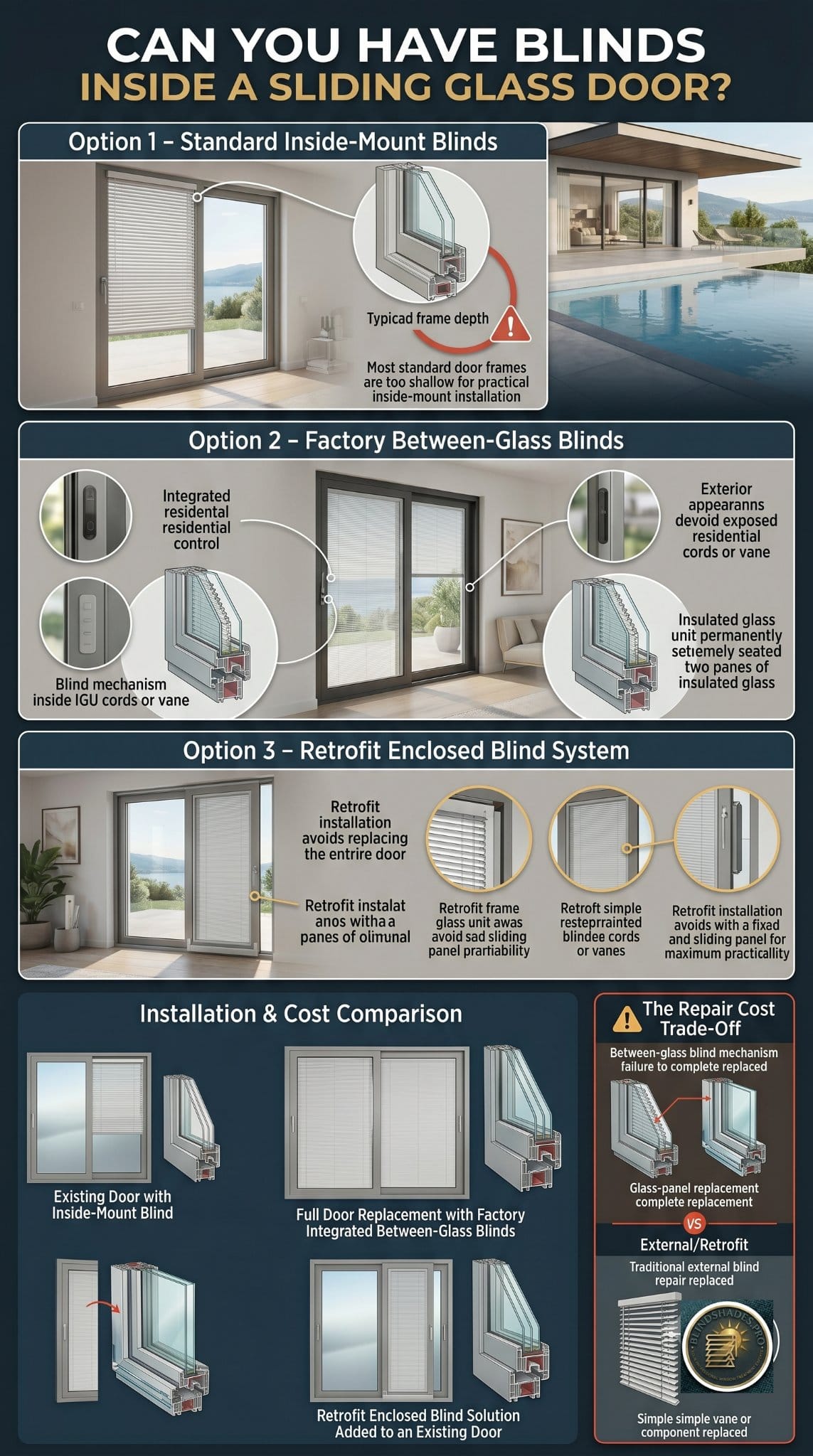
Key Takeaways:
- “Blinds inside a sliding glass door” means three different things: (a) standard blinds mounted within the door frame channel as an inside mount, which is almost never practical on a standard residential sliding glass door because the frame is typically only 1 to 2 inches deep and the minimum required for even a minimal inside mount is 2.5 inches per Linen Avenue, with a full inside mount requiring 3.125 inches; (b) factory-installed between-glass blinds built into the door unit, available from Andersen (Perma-Shield and Frenchwood gliding patio doors), Pella, and Provia, requiring full door replacement at $2,900 to $4,000 or more for the complete door with between-glass blinds; and (c) the ODL Add-On Blinds retrofit, which adds a layer of enclosed aluminum blinds between the existing door glass and a new tempered safety glass panel without requiring door replacement — the most practical “blinds inside” solution for an existing functioning sliding glass door
- The ODL Add-On Blinds retrofit (available at Home Depot) is the most frequently overlooked solution for buyers who want blinds inside a sliding glass door without replacing the door; it installs over the existing door glass with a screwdriver in approximately one to two hours; it is available for standard door lite panel sizes (typically 20 to 24 inches wide by 64 to 66 inches tall) at $239 to $264 per panel; it works best on the fixed panel of a two-panel sliding glass door, which has a static glass panel that accepts the add-on unit without weight concerns for the door rollers; for the sliding panel, confirm the door’s roller weight capacity before adding the unit
- The single most important limitation of between-glass blinds on a sliding glass door is the repair cost when the mechanism fails: standard external blinds — a failed vane can be replaced for $5 to $25, or the full system replaced for $30 to $150; between-glass blinds with a failed tilt mechanism or seal — the full insulated glass unit must be replaced; JDM Sliding Doors Blog confirms “if the tilt mechanism or lift cord fails, you need to replace the full insulated glass unit — not just the blinds”; ODL Blinds+Glass replacement panel = $418 at Home Depot for a 20×64 inch panel; Andersen replacement patio door glass panels = approximately $800 to $1,500 or more
- Between-glass blind systems have two additional failure modes absent from all standard guides: glass seal failure and magnetic control demagnetisation; glass seal failure (which can happen to any double-pane unit over 10 to 20 years) produces fogging between the panes AND condensation around the aluminum blind slats inside, which can cause corrosion on the slats and jam the mechanism; the magnetic control mechanism — the external sliding handle that moves internal blinds through magnetic coupling without penetrating the glass — can fail if the adhesive holding the internal magnet weakens or if the external handle magnet demagnetises; neither failure can be repaired without replacing the sealed glass unit
- Between-glass blinds on a sliding glass door are worth the cost and trade-offs in three specific scenarios: new door purchase where the $500 to $1,500 premium over a standard sliding glass door is justified for the lifetime of maintenance savings; homes with children or large dogs who regularly bend, break, or tangle external blind vanes in a high-traffic patio door; and minimalist interiors where no headrail, valance, cord, or wand is acceptable above or beside the door; in all other scenarios — existing functioning door, budget priority, maximum light control, repair simplicity — outside mount external blinds are the better specification
⭐ Quick Answer — Can You Put Blinds Inside a Sliding Glass Door?
- The Three Ways to Have Blinds Inside a Sliding Glass Door — and Which One Actually Fits Your Situation: “Blinds inside sliding glass door” means three different things, and the correct answer depends entirely on which interpretation applies. Option 1 — Inside mount standard blinds within the door frame: a standard blind (mini-blind, faux wood, roller shade) mounted within the sliding glass door frame channel, with the headrail sitting inside the top of the frame. This requires a minimum of 2.5 inches of flat frame depth for a flush installation (Linen Avenue confirmed) and 3.125 inches for a full inside mount with valance. Standard residential sliding glass door frames are 1 to 2 inches deep — this option is not practical for the vast majority of residential sliding glass doors; Bali confirms “3/4 inch is the minimum depth required for inside mount blinds” and most frames only barely meet even this minimum. IDSystems (March 2026) confirms: “when it comes to sliding doors, the large panes of glass and the mechanics mean integrated blinds aren’t a practical solution.” Option 2 — Factory between-glass blinds built into the door unit: aluminum mini-blinds permanently sealed inside the insulated glass unit; available from Andersen (Perma-Shield gliding patio doors), Pella, and Provia; requires full door replacement at $2,900 to $4,000 or more (Houzz confirmed). Option 3 — ODL Add-On Blinds retrofit: adds enclosed aluminum blinds between the existing door glass and a new tempered safety glass panel without replacing the door; $239.99 to $263.74 at Home Depot; installs with a screwdriver; the most practical “blinds inside” solution for an existing functioning sliding glass door
- The ODL Add-On Blinds Retrofit — The Solution Most Guides Miss: For buyers who want blinds inside a sliding glass door without replacing the door, the ODL Add-On Blinds system is the correct specification. ODL confirms: “Our Add-On Blinds give you all the benefits of blinds-between-glass by adding a layer of blinds enclosed between your existing doorglass and a pane of tempered safety glass. Once installed, the blinds are protected behind glass and your window treatment is maintenance-free — with no dusting required.” Available at Home Depot in two standard sizes: 21-3/4 × 65-3/4 inches at $239.99 and 23-3/4 × 65-3/4 inches at $263.74. The ODL Add-On unit works best on the fixed panel of a two-panel sliding glass door — the fixed panel’s glass insert can often be replaced with the ODL unit in the same way a door lite panel would be fitted; the installation is straightforward with a screwdriver. For the sliding panel, the added weight of the ODL unit (glass + blind assembly) must be compatible with the door’s roller weight capacity before installation — confirm the door roller weight rating in the door manual or with the door manufacturer before adding the unit to the sliding panel. The ODL Add-On sizes are designed for door lite panel dimensions and may not cover the full glass area of a sliding panel, which is typically 36 or more inches wide
- The Repair Cost Reality — The Most Important Factor When Choosing Between-Glass Blinds for a Sliding Glass Door: The single most critical financial consideration for blinds inside a sliding glass door is the repair cost when the mechanism fails. External blinds repair cost: failed vane on vertical blinds = $5 to $25 for a replacement vane; failed carrier stem = $5 to $15; full external blind system replacement = $30 to $150 for standard vertical blinds. Between-glass blinds repair cost: when the tilt mechanism, magnetic control, or internal mechanism jams on any between-glass system, the entire insulated glass unit must be replaced — there is no way to service the internal mechanism without unsealing the glass. JDM Sliding Doors Blog (April 2025) confirms: “if the tilt mechanism or lift cord fails, you need to replace the full insulated glass unit — not just the blinds.” ODL Blinds+Glass replacement panel at Home Depot = $418 (20×64 inch panel). Andersen Perma-Shield replacement glass panels = approximately $800 to $1,500. Full Pella sliding glass door with between-glass blinds replacement = $2,900 to $4,000 (Houzz confirmed). Professional glass panel installation labor = $200 to $500 additional. Factory Direct Blinds (January 2026) confirms: “potentially costly repairs requiring full-window replacement.” This repair cost comparison — a $5 vane vs a $418 to $1,500 glass unit — is the primary reason to consider external blinds rather than between-glass for most residential sliding glass doors
- The Two Failure Modes of Between-Glass Blinds That No Buying Guide Covers: Between-glass blinds on a sliding glass door have two failure modes absent from all standard guides. (1) Magnetic control failure: the between-glass mechanism is operated by a magnetic sliding handle — an external handle containing a magnet attracts a corresponding magnet inside the sealed glass unit; moving the external handle moves the internal blinds through magnetic coupling without penetrating the glass seal; Andersen confirms this is the “low-profile magnetic control” method. The coupling fails when the adhesive holding the internal magnet weakens from daily use (typical lifespan 5 to 15 years of daily operation); or when the external handle magnet demagnetises under prolonged high-temperature exposure (west-facing sliding glass doors can heat the glass surface to 140°F or more on summer afternoons, accelerating demagnetisation). When the magnetic coupling fails, the blinds are stuck permanently in their last position and cannot be raised, lowered, or tilted from outside the glass. (2) Glass seal failure with internal condensation: when the perimeter seal of the insulated glass unit fails (which can happen to any double-pane unit over 10 to 20 years), moisture intrudes between the panes; for standard double-pane glass without blinds, this produces visible fogging; for between-glass blinds, it also deposits condensation directly on the aluminum blind slats inside the sealed unit; over months, this condensation causes corrosion on the aluminum slat surfaces and the blind mechanism may jam permanently; the only resolution is glass unit replacement
- The Worth-It Verdict — When Blinds Inside a Sliding Glass Door Make Sense and When They Do Not: Blinds inside a sliding glass door are worth the premium in three specific scenarios. (1) New door replacement + children or pets: if a sliding glass door replacement is already planned, the incremental premium for between-glass blinds ($500 to $1,500 over a standard door) is justified for households where children or large dogs regularly bend, break, or tangle external vertical blind vanes in a high-traffic patio door; the lifetime maintenance savings from never replacing vanes or carrier stems offset the premium. (2) Minimalist aesthetic: when no headrail, valance, cord, wand, or visible blind hardware is acceptable; between-glass blinds require no external hardware — the door glass IS the treatment. (3) Maintenance reduction: ODL confirms “maintenance-free — no dusting required”; for homeowners who find external blind maintenance burdensome, the sealed system eliminates it. Between-glass blinds are NOT worth it for: existing functioning doors where full replacement is not warranted; maximum light control precision (external vertical blinds provide finer tilt angle control than between-glass mini-blinds); blackout performance required (between-glass mini-blind slats do not achieve true blackout; specify external blackout roller shade instead); and repair simplicity priority (external blind = $5 vane; between-glass = $418 to $1,500 glass unit)
- Best Sources: “If tilt mechanism or lift cord fails, replace the full insulated glass unit — not just the blinds”; between-glass sealed; magnetic or track control; higher initial cost; long-term convenience → JDM Sliding Doors Blog — sliding glass doors with built-in blinds (April 2025) · “All the benefits of blinds-between-glass; enclosed between existing doorglass and tempered safety glass; maintenance-free; no dusting; easy fingertip adjustment; install yourself” → ODL Add-On Blinds product page · “Integrated blinds permanently fixed; limited customisation; potentially costly repairs requiring full-window replacement; absence of air gap can lead to heat transfer” → Factory Direct Blinds — windows with blinds inside (January 2026)
⚠️ Thermal Impact of Between-Glass Blinds on a Sliding Glass Door — and the Glass Seal Failure Risk: Two specifications for blinds inside a sliding glass door absent from all competitor guides. (1) Thermal impact: Factory Direct Blinds (January 2026) confirms “the absence of an air gap and proper insulation between the blinds and the window panes can lead to heat transfer, potentially impacting energy efficiency.” The mechanism: standard double-pane glass has an air gap of approximately 0.5 to 1 inch that provides the majority of its thermal resistance; aluminum blind slats fill 20 to 30 percent of this air gap when lowered; the aluminum slats have very high thermal conductivity and create thermal bridging between the two glass panes when in contact with both; the net effect is slightly reduced thermal resistance compared to the same glass without blinds, adding approximately R-0.2 to R-0.5 to the glass (much less than external cellular shades at R-3.0 to R-4.5). When the blinds are lowered and closed, they do provide solar heat gain control (blocking solar radiation from heating the interior glass pane), which is a meaningful summer benefit. But for buyers seeking maximum energy performance from their sliding glass door treatment, external double-cell blackout cellular shades provide R-4.0 to R-4.5 — far more than between-glass mini-blinds. (2) Glass seal failure risk: between-glass blind systems are particularly vulnerable to glass seal failure damage; when the perimeter seal fails, moisture enters and deposits condensation on the aluminum blind slats; corrosion on aluminum slat surfaces and mechanism jamming follows over months of moisture exposure; a standard double-pane window IGU seal failure = $200 to $500 for a standard-size replacement; a between-glass blind sliding door panel seal failure = $418 to $1,500 for the combined glass-and-blind assembly replacement. See the full failure mode section below.
💡 The Honest Cost Comparison — Between-Glass vs External Blinds Over 15 Years on a Sliding Glass Door: The true lifetime cost of blinds inside a sliding glass door vs external blinds is rarely calculated by buyers. Between-glass option: standard sliding glass door = approximately $800 to $1,200; upgrade to between-glass door = $2,900 to $4,000 (Houzz confirmed for Pella); difference = $1,700 to $2,800 premium at installation; if the mechanism fails at year 10 = $418 to $1,500 for glass panel replacement + $200 to $500 labor; total 15-year cost = $3,318 to $5,500. External blinds option: same standard sliding glass door = $800 to $1,200; external vertical blinds = $30 to $150; replacement at year 10 = $30 to $150 again; total 15-year cost = $860 to $1,500. The premium for between-glass over 15 years = $2,458 to $4,000. The correct buyer question is not “is this possible?” but “is this premium worth the maintenance savings and aesthetic benefit for my specific household?” For households with children and pets who damage external vanes several times per year ($25 to $75 in annual vane replacement) and value the minimalist aesthetic, the calculus improves — but even at $75/year in replacement vanes, it takes more than 30 years to break even on the between-glass premium. The ODL Add-On retrofit at $239 to $264 per panel applied to the fixed panel of an existing door produces “blinds inside” on the fixed panel at a fraction of the cost, without touching the door or the sliding panel. For most existing sliding glass doors in good working condition, the ODL Add-On on the fixed panel is the correct specification when “blinds inside” is the goal. See the full worth-it verdict below.
📖 Read the complete guide below for: the three interpretations of “blinds inside a sliding glass door” (inside mount in frame — most frames too shallow at 1-2 inches vs 2.5-inch minimum required; factory between-glass — Andersen/Pella/Provia; ODL Add-On retrofit — $239-$264, fixed panel application), the repair cost reality (external vane $5-$25 vs glass unit $418-$1,500; full Pella door $2,900-$4,000; JDM Sliding Doors Blog confirmed), two failure modes (magnetic control — adhesive weakens or demagnetises at 140°F, blinds stuck permanently; glass seal failure — condensation on slats, corrosion, mechanism jam), thermal impact (R-0.2-0.5 only; solar control benefit when closed; Factory Direct Blinds heat transfer confirmed), and the full worth-it verdict (3 scenarios BETTER: new door + children/pets, minimalist aesthetic, maintenance reduction; 4 scenarios NOT BETTER: existing door, light control precision, blackout, repair simplicity).
Blinds Inside a Sliding Glass Door — The Three Interpretations and Which One You Actually Need
The answer to this question depends entirely on which of the three distinct interpretations applies.
The phrase “<strong>blinds inside a sliding glass door</strong>” is searched by three different buyers with three completely different needs. Most guides address only one interpretation and then redirect buyers to outside mount. Here are all three — and which is most likely to be the right one for your situation.
Interpretation 1 — Inside Mount Standard Blinds Within the Door Frame
What it is: A standard blind (faux wood, aluminum mini-blind, roller shade) mounted within the channel of the sliding glass door frame — between the door frame sides, with the headrail sitting inside the top of the frame channel.
The problem: This requires sufficient frame depth. Bali confirms: “3/4 inch is the minimum depth required for inside mount blinds.” Linen Avenue confirms: “2.5 inches of flat mounting depth inside your window frame is necessary for a fully flush installation” and “3-1/8 inches for a full inside mount with valance.”
Standard residential sliding glass door frames have channel depths of approximately 1 to 2 inches. This means:
- The 0.75-inch minimum: barely met on some doors; the headrail sits flush in the channel but the treatment is shallow and operationally constrained
- The 2.5-inch flush depth: not available on most standard sliding glass door frames
- The 3.125-inch full inside mount: not available on standard residential sliding glass door frames
Who can use interpretation 1: Buyers with premium deep-frame sliding glass doors — some Marvin, Andersen, Pella, and European-style sliding door systems have 3+ inch frame depths. For the vast majority of standard residential sliding glass doors: inside mount standard blinds are not practical.
IDSystems (March 2026) confirms: “when it comes to sliding doors, the large panes of glass and the mechanics of how the systems work mean that integrated blinds aren’t a practical solution.”
Interpretation 2 — Factory Between-Glass Blinds (Built Into the Door Unit)
What it is: Horizontal aluminum mini-blinds permanently sealed between two panes of glass in the door unit itself. The blinds never require cleaning — they are inside the sealed glass. Controlled via a low-profile magnetic slider (external handle moves internal blinds through magnetic coupling without penetrating the seal) or a pull-down mechanism.
Who makes them:
- Andersen Windows: “Blinds between the glass; tilted and raised or lowered with low-profile magnetic controls; durable aluminum; available for Perma-Shield gliding patio door units made after June 2000 as replacement or upgrade”
- Pella: Full sliding glass door with between-glass blinds; Houzz confirms $2,900 to $4,000 for a complete door with between-glass option
- MMI Door (Home Depot): “Clear Low-E glass internal blinds; primed fiberglass; prehung full lite stationary patio door; $418”
The critical limitation: If the tilt mechanism or raise/lower mechanism fails, the entire insulated glass unit must be replaced. JDM Sliding Doors Blog (April 2025) confirms: “if the tilt mechanism or lift cord fails, you need to replace the full insulated glass unit — not just the blinds.”
Interpretation 3 — ODL Add-On Blinds Retrofit
What it is: The most practical “blinds inside” solution for an existing sliding glass door that does not need to be replaced.
ODL (odl.com) describes it: “Our Add-On Blinds give you all the benefits of blinds-between-glass by adding a layer of blinds enclosed between your existing doorglass and a pane of tempered safety glass. Once installed, the blinds are protected behind glass and your window treatment is maintenance-free — with no dusting required.”
How it works: A self-contained unit (aluminum blinds inside a glass-and-frame sandwich) mounts over the existing door glass with a screwdriver. The existing door glass becomes the “outer” pane; the ODL unit’s tempered glass becomes the “inner” pane; the blinds are sealed between them.
Available sizes and pricing (Home Depot):
- 21-3/4 inches × 65-3/4 inches: $239.99
- 23-3/4 inches × 65-3/4 inches: $263.74
The constraint: Standard ODL Add-On sizes match typical door lite panel dimensions (the glass inserts in door panels), not the full glass panel of a large sliding glass door. This makes the ODL Add-On most appropriate for the fixed panel of a two-panel sliding glass door, where the fixed glass panel is similar in configuration to a door panel — the fixed glass insert can sometimes be replaced with the ODL unit. For the sliding panel, the added weight of the ODL unit must be compatible with the door’s roller weight capacity.
The Repair Cost Reality — What No Guide Tells You About Between-Glass Blinds
The lifetime cost comparison absent from every buying guide.
The single most important financial consideration for between-glass blinds on a sliding glass door is the cost of repair when the mechanism fails — and fail it eventually will.
External blinds repair cost:
- Failed vane on vertical blinds: $5 to $25 for a replacement vane
- Failed carrier stem: $5 to $15 replacement part
- Full external blind system replacement: $30 to $150 for standard vertical blinds
Between-glass blinds repair cost:
- Failed tilt mechanism or internal blind jam: full insulated glass unit replacement required
- ODL Blinds+Glass replacement panel (20×64 inches): $418 at Home Depot
- Andersen Perma-Shield replacement glass panel: approximately $800 to $1,500
- Full Pella sliding door with between-glass blinds replacement: $2,900 to $4,000 (Houzz forum confirmed)
- Professional labor for glass panel replacement: $200 to $500 additional
JDM Sliding Doors Blog (April 2025) confirms: “repairs are trickier than on external blinds. The blinds are sealed between glass panes, so if the tilt mechanism or lift cord fails, you’ll need to replace the full insulated glass unit — not just the blinds.”
Factory Direct Blinds (January 2026) confirms: “potentially costly repairs requiring full-window replacement.”
The honest arithmetic: A $2,900 sliding glass door with between-glass blinds vs a $500 standard door + $150 external vertical blinds ($650 total) = $2,250 premium for between-glass at installation. If the between-glass mechanism fails after 10 years and costs $800 to replace the glass unit, the total lifetime cost over 15 years is $3,700 vs $800 ($650 initial + $150 for a second set of external blinds at year 10). The premium for between-glass blinds is real and sustained.
The Two Failure Modes No Guide Addresses
Failure Mode 1 — Magnetic Control Demagnetisation
Andersen confirms: “blinds can be tilted and raised or lowered with the use of low-profile magnetic controls.”
The magnetic control mechanism works through glass: an external sliding handle contains a magnet that attracts a corresponding magnet inside the sealed glass unit. Moving the external handle causes the internal control piece to move via magnetic coupling — no penetration of the glass seal is required.
What fails:
- The adhesive holding the internal magnet to the internal control piece may weaken over years of daily use; the internal magnet detaches; the coupling is lost; the blinds can no longer be raised, lowered, or tilted from the external handle
- The external handle magnet may demagnetise over time, particularly in high-temperature environments (west-facing sliding glass doors with direct afternoon sun heating the glass surface to 140°F or more)
- The internal tilt/traverse mechanism itself may jam due to accumulated debris, thermal expansion, or bent slats
What happens when it fails: The blinds are stuck in their last position — permanently lowered or permanently raised — and cannot be adjusted without replacing the sealed glass unit.
Failure Mode 2 — Glass Seal Failure with Internal Condensation
Standard double-pane insulated glass units can fail at the perimeter seal, allowing moisture to intrude between the panes. This produces fogging that cannot be cleaned.
For between-glass blind systems, seal failure produces fogging AND condensation around the aluminum blind slats inside the unit. The condensation:
- Creates visible moisture droplets on the blind slats
- Leads to corrosion on aluminum slat surfaces over months of exposure
- As the corrosion progresses, slats may jam or warp within the sealed unit
Factory Direct Blinds (January 2026) addresses the thermal concern: “the absence of an air gap and proper insulation between the blinds and the window panes can lead to heat transfer, potentially impacting a home’s overall energy efficiency.”
Seal failure on a standard double-pane window = $200 to $500 for IGU replacement. Seal failure on a between-glass blind sliding glass door panel = $418 to $1,500+ for the replacement unit because the glass, blinds, and frame are a single sealed assembly.
The Thermal Impact of Between-Glass Blinds
Does having blinds inside the glass improve or hurt energy efficiency?
Factory Direct Blinds identifies the trade-off: “the absence of an air gap and proper insulation between the blinds and window panes can lead to heat transfer.”
When blinds are raised: The aluminum slats stack at the top of the air gap space. The effective air gap is slightly reduced in the stack zone, but across most of the glass area the air gap is unimpeded. Thermal impact: minimal reduction in overall insulation value.
When blinds are lowered and closed: The aluminum slats create a partial barrier across the air gap. Two competing effects:
- Solar heat gain reduction: the closed slats block some solar radiation before it can heat the interior glass pane and radiate into the room — a summer benefit
- Thermal resistance reduction: the aluminum slats have very high thermal conductivity; their presence fills some of the air gap and creates thermal bridging between the two glass panes — a winter negative
The net effect: Between-glass blinds provide meaningful solar heat gain control when lowered (similar to solar shades for windows) but provide no additional thermal insulation compared to the same glass without blinds — and potentially slightly less, due to the thermal conductivity of the aluminum slats within the air gap.
For buyers seeking maximum thermal insulation from their sliding glass door treatment, external double-cell blackout cellular shades (R-4.0 to R-4.5 added) far outperform between-glass aluminum blinds, which add approximately R-0.2 to R-0.5 at best.
For the full thermal R-value comparison of all sliding glass door treatment options, see What Are the Best Blackout Blinds for Sliding Glass Doors.
The Worth-It Verdict — When Blinds Inside a Sliding Glass Door Make Sense
✅ Between-Glass Blinds Are Worth It
Scenario 1 — New door purchase with children or pets: If a sliding glass door replacement is already planned (old seal failure, outdated hardware, damage), the incremental cost of upgrading to between-glass blinds at installation is approximately $500 to $1,500 over a standard door. For households with children or large dogs who regularly bend, break, or tangle external vertical blind vanes in a high-traffic patio door, this premium is quickly justified in avoided replacement costs.
Scenario 2 — Minimalist aesthetic priority: When no headrail, valance, cord, wand, or visible blind hardware above or beside the door is acceptable. Between-glass blinds require no visible external hardware — the door glass IS the window treatment. The result is a completely clean door appearance that no external blind system can match.
Scenario 3 — High-traffic door, maintenance reduction: External vertical blind vanes on a high-traffic patio door accumulate dust, require occasional cleaning, and are physically handled by people moving through the door. Between-glass blinds require no maintenance and are completely protected. ODL confirms: “maintenance-free — with no dusting required.”
❌ Between-Glass Blinds Are NOT Worth It
Scenario 4 — Existing functional sliding glass door: If the current door functions well and only the window treatment needs replacing, full door replacement for between-glass blinds is not justified. The ODL Add-On retrofit is the correct intermediate option.
Scenario 5 — Maximum light control precision: External vertical blinds allow infinitely variable vane angle adjustment from 0 to 90 degrees, allowing the homeowner to block a specific sun angle while maintaining light elsewhere. Between-glass aluminum mini-blinds have limited tilt range and less precise angle control. For rooms where daily sun angle management is the primary use case, external vertical blinds are the better specification. See Are Vertical Blinds Still Good for Sliding Glass Doors.
Scenario 6 — Blackout performance required: Between-glass aluminum mini-blind slats do not provide genuine blackout — light passes through the slat edges even when closed. For bedroom patio doors requiring blackout conditions, external blackout roller shades with side channels remain the correct specification. See What Are the Best Blackout Blinds for Sliding Glass Doors.
Scenario 7 — Repair simplicity is a priority: Any buyer who values simple, low-cost repairs should choose external blinds. A failed external vane costs $5 to $25. A failed between-glass mechanism costs $418 to $1,500 or more.
Related guides: For complete buying advice, see our no-drill, tension and magnetic blinds guide.
Frequently Asked Questions
Can you put blinds inside a sliding glass door? Yes, in three ways: (1) inside mount standard blinds within the door frame — only practical on premium deep-frame sliding doors with at least 2.5 inches of frame depth; most standard residential sliding glass door frames are 1 to 2 inches deep, which is insufficient; (2) factory between-glass blinds built into the door unit from Andersen, Pella, or Provia — requires full door replacement at $2,900 to $4,000 or more; (3) ODL Add-On Blinds retrofit — adds enclosed aluminum blinds between the existing door glass and a new tempered safety glass panel without replacing the door, available at Home Depot for $239 to $264.
How do between-glass blinds work on a sliding glass door? Blinds-between-glass sliding glass doors have aluminum mini-blind slats sealed inside the insulated glass unit. They are controlled via a low-profile magnetic slider — an external handle containing a magnet attracts a corresponding magnet inside the sealed glass, allowing the internal blinds to be raised, lowered, and tilted without penetrating the glass seal. Andersen Windows confirms: “blinds can be tilted and raised or lowered with the use of low-profile magnetic controls.”
What happens when between-glass blinds break on a sliding glass door? When the between-glass blind mechanism fails — whether from magnetic control demagnetisation, internal tilt mechanism jamming, or glass seal failure — the full insulated glass unit must be replaced. There is no way to repair the internal mechanism without unsealing and remanufacturing the glass unit. JDM Sliding Doors Blog confirms: “if the tilt mechanism or lift cord fails, you need to replace the full insulated glass unit — not just the blinds.” ODL replacement glass panel: $418. Andersen replacement panels: approximately $800 to $1,500.
Is it worth getting blinds inside the glass on a sliding glass door? For a new door replacement in a home with children or pets who damage external blind vanes, or for a minimalist aesthetic where no visible blind hardware is acceptable, the premium for between-glass blinds is justified. For an existing functional door, the cost of replacement ($2,900 to $4,000+) far exceeds the cost of external blinds ($30 to $150). The ODL Add-On retrofit ($239 to $264) is the best intermediate option. The repair cost trade-off is critical: external blind repair = $5 to $25 per vane; between-glass repair = $418 to $1,500 per glass unit.
Related guides: between-glass is one answer among many — the hung, tracked and motorized alternatives live in the sliding glass door window treatment guide.
Related Guides on BlindShades.pro
- The Best Sliding Glass Door Blinds & Shades Buying Guide
- Are Vertical Blinds Still Good for Sliding Glass Doors
- Are Roller Shades Good for Sliding Glass Doors
- What Are the Best Blackout Blinds for Sliding Glass Doors
- How Do You Keep Sliding Glass Door Blinds From Sliding
- What Window Treatments Give Sliding Glass Doors the Most Privacy
By Michael Turner | 30 Years Home Improvement Expertise | Updated 2026 | BlindShades.pro
