How Do You Keep Sliding Glass Door Blinds From Sliding?

Authored By Michael Turner -30 Years Home Improvement Expertise | Updated 2026 | BlindShades.pro
Updated on June 13, 2026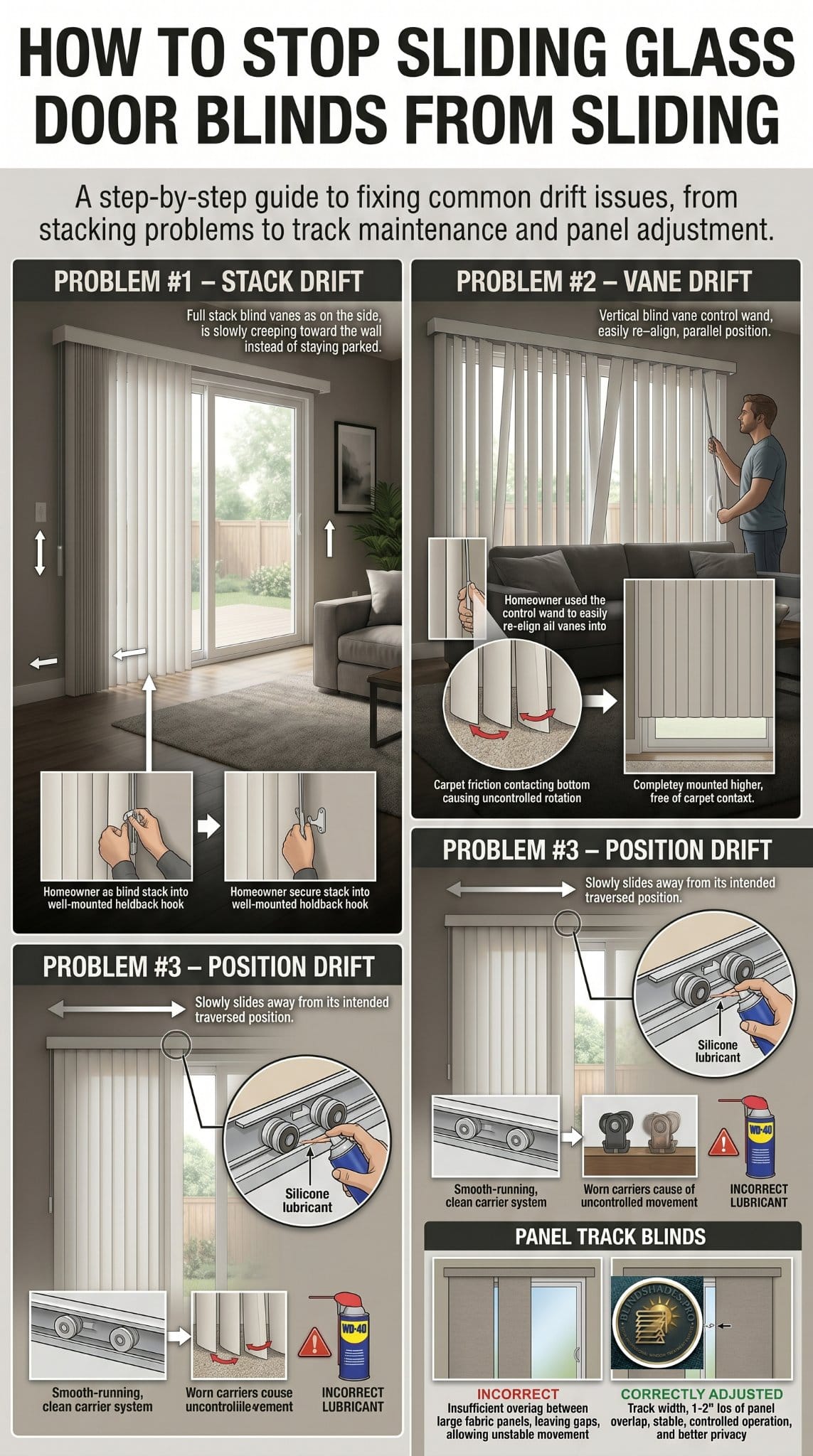
Key Takeaways:
- There are three distinct types of “sliding glass door blinds from sliding” problem, each with a different cause and fix: (a) stack drift — the entire stacked pile of vanes or panels creeps laterally toward the wall over days and weeks of use, caused by the repeated horizontal air pressure from the door opening pushing the stack further toward the wall each time; (b) vane drift — individual vanes rotate out of parallel alignment from accidental contact with a person walking through or the door panel grazing the outermost vane; (c) position drift — the blind doesn’t hold at its intended traversal position and slowly slides back toward the stacked position due to carrier friction loss in the headrail; identifying which type is occurring leads directly to the correct fix
- The most effective and overlooked fix for stack drift on vertical blinds is the holdback hook: a small wall-mounted hook or bracket installed at approximately 60 to 70 percent of the vane height from the floor (a natural balance point for the hanging vane weight) near the wall where the stack rests; the outermost vane of the stack is hooked into the holdback; the hook physically prevents the stack from drifting further from the wall regardless of how many times the door is opened and regardless of air pressure magnitude; this is the same principle as a curtain tie-back but applied to a vertical blind stack position
- The correct stack direction for a sliding glass door blind is the direction opposite to the door travel — this is also the direction that minimises stack drift; when the blind is stacked on the opposite side from the door travel, the door’s horizontal air displacement moves away from the stack rather than toward it; every time the door opens, the air pushes parallel to the door (in the direction the door moves) and the stack is out of that air’s direct path; by contrast, a stack positioned in the same direction as door travel sits directly in the air path and drifts the most; the correct stack direction for both operational access and drift prevention is always opposite to the door travel
- When lubrication is needed to fix stiff carrier traversal that causes position drift on sliding glass door vertical blinds: always use silicone spray (PTFE or pure silicone) inside the headrail track — never WD-40; Fix My Blinds explicitly states “do not use WD-40 on your vertical blind headrail”; the mechanism: WD-40 is a petroleum-based solvent that dissolves existing lubricant and loosens stuck parts in the short term, but its residue attracts dust and lint from the adjacent carpet and air; within weeks of a WD-40 application, the attracted dust mixes with the residue and creates a gummy paste that increases friction more than the original dry track; silicone spray does not attract dust and maintains lubrication for months without residue buildup
- For panel track blinds on sliding glass doors, the anti-drift solution is the panel overlap adjustment: GoDear Design (Amazon) confirms that at maximum track width the panel overlap is approximately 2 inches and at minimum track width the overlap increases to approximately 15 inches; when the track is set too wide for the number of panels ordered, the overlap approaches zero and panels can shift laterally in their individual track lanes — this is experienced as panels that “drift apart” revealing gaps between them; the fix is to reduce the track width setting so that adjacent panels overlap by at least 1 to 2 inches; this overlap physically constrains each panel’s lateral movement and prevents gap formation between panels during door operation
⭐ Quick Answer — How Do You Keep Sliding Glass Door Blinds From Sliding?
- Diagnose Which of the Three Types of “Sliding” You Have First — Each Has a Different Fix: To keep sliding glass door blinds from sliding, start by identifying which of three distinct drift types is occurring. Type 1 — Stack drift: the entire stacked pile of vanes or panels creeps laterally toward the wall over days and weeks of daily door use; the blind must be repositioned every few days; caused by repeated horizontal air displacement from the door opening pushing the stack incrementally toward the wall. Type 2 — Vane drift: individual vanes rotate out of parallel alignment and face a different direction from the rest; typically the outermost vanes nearest the door that receive the most physical contact; Angi (February 2026) confirms: “it’s easy for one of the slats to become misaligned if you brush past it when you’re trying to open the door.” Type 3 — Position drift: the blind is traversed to a specific partial-open position and slowly slides back toward the stacked end within hours; caused by insufficient carrier friction in the headrail track or worn carrier trucks; Engineer Fix (December 2025) confirms: “traversing issues are often caused by misaligned carrier trucks or general friction build-up.” The diagnostic table: whole stack creeps toward wall over days = Type 1; one or two vanes face wrong direction = Type 2; blind slides back from traversal position within hours = Type 3. Each type requires its own fix — treating the wrong type wastes time and does not solve the problem
- The Physics of Stack Drift and the Correct Stack Direction for Minimum Drift: The specific mechanism of Type 1 stack drift on sliding glass door blinds is absent from all competitor guides. When the sliding door panel opens, it displaces a significant volume of air — the door panel is approximately 20 square feet of moving surface that creates a horizontal pressure wave parallel to the hanging vanes. Each door opening pushes the stacked vane column approximately 0.1 to 0.3 inches further toward the wall. Over 20 to 30 daily door openings, the stack can drift 2 to 6 inches from its intended position, eventually encroaching on the door opening zone. The correct stack direction minimises this drift: position the blind stack on the opposite side from the direction the door travels. Home To Sight (3 weeks ago) confirms: “The stacking side must match the direction your door slides open — if the door slides right and the blind stacks right, you cannot access the door without first moving the blind; this is the most common installation error.” The drift prevention benefit: when the stack is on the opposite side from door travel, the door’s air displacement travels in the direction the door moves — away from the stack; the stack is out of the direct air path and receives far less pressure per opening; correct operational position and minimum-drift position are identical
- The Holdback Hook Fix for Stack Drift — The Solution No Guide Covers: The most effective permanent fix for sliding glass door blind stack drift is a holdback hook — a small wall-mounted hook or plastic bracket that physically prevents the stack from moving beyond its intended position. Installation: with the blind fully stacked to one side, identify the outermost vane of the stack; mark the wall at approximately 60 to 70 percent of the vane height from the floor (this is the natural balance point where the hanging vane weight is distributed most evenly); install a small cup hook, adhesive hook, or curtain tie-back bracket at this mark; loop or hook the outermost vane over the holdback. The holdback creates a mechanical stop at the desired stack position regardless of how many times the door is opened and regardless of air pressure magnitude — it is the equivalent of a curtain tie-back applied to a vertical blind stack. For installations where no existing holdback is in place, a simple 3M Command hook rated for 2 to 3 pounds applied to the wall at the correct height provides an adhesive option that avoids drilling. For the full installation protocol for any wall hardware in the blind system, see [How Do You Install Blinds on Sliding Glass Doors](/guide/install-sliding-glass-door-blinds/)
- The Headrail End Stop Adjustment for Position Drift and the Vane Re-Alignment for Vane Drift: Two Type 2 and Type 3 fixes for sliding glass door blinds from sliding absent from all guides. (1) Headrail end stop for position drift: most headrails have an end stop — a small clip or screw inside the headrail that limits how far the leading carrier can traverse; from the factory the end stop is at maximum travel; for position drift (the blind slides back from a partial-open traversal position), adjusting the end stop to the desired termination point creates a mechanical stop that prevents the blind sliding back past that position; access the end stop by removing the headrail end cap (usually a plastic cap that pulls straight off) and repositioning the stop clip inside the track. (2) Vane re-alignment sequence for vane drift: when individual vanes are rotated out of parallel from contact, Hunter Douglas (May 2026) confirms the re-synchronisation sequence: tilt the vanes back to the fully open position using the wand; traverse all carriers fully to the closed position so all vanes are stacked tightly together; then attempt to tilt all vanes to the closed position; this traversal-then-tilt sequence re-synchronises the tilt mechanism with the vane alignment and corrects individual vane angular drift across the full blind. Angi confirms: “you can usually grab the slat and gently twist it back into place from the stem” for minor individual vane misalignment without a full re-synchronisation
- The WD-40 vs Silicone Contradiction Resolved — and the Carpet Pile Problem: Two sliding glass door blind sliding fixes that divide sources and are absent from all standard guides. (1) WD-40 vs silicone for carrier lubrication: Angi (February 2026) recommends “spray a lubricant like WD-40 on the carrier body.” Fix My Blinds explicitly states: “Do not use WD-40 on your vertical blind headrail.” The mechanism behind why Fix My Blinds is correct: WD-40 is a petroleum-based solvent that loosens stuck carriers effectively in the short term, but its petroleum residue attracts airborne dust and lint from adjacent carpeting and air movement; within weeks, accumulated dust mixes with the WD-40 residue inside the headrail track and forms a gummy paste that increases friction more than the original dry track condition; the blind becomes harder to traverse than before the WD-40 application. Silicone spray (PTFE or pure silicone aerosol) leaves a dry slick film that does not attract dust and maintains lubrication for months without residue buildup. Always use silicone; never WD-40. (2) Carpet pile friction: Fix My Blinds confirms “the pile of carpet can affect the traversing of vertical blinds”; on carpeted floors, vane tips enter the carpet pile during traversal and drag; lagging vanes create uneven spacing; the blind array misaligns and the stack does not compress tightly; fix = remount the headrail 0.5 to 1 inch higher; or trim vane tips by 0.5 to 0.75 inch with sharp scissors
- Best Sources: “Check mounting brackets; vacuum headrail track; vanes should be in open position when not in use; make sure vanes aren’t catching on carpet or weatherstripping; adjust height or trim vanes if needed” → Blindsgalore — how to fix vertical blinds that keep falling (March 2026) · “Traversing issues often caused by misaligned carrier trucks or friction build-up; carrier trucks are small wheeled mechanisms that can become jammed if pushed out of alignment” → Engineer Fix — how to fix blinds on a sliding glass door (December 2025) · “Spraying silicone spray on inside edges of headrail may solve traversal problem; do not use WD-40 on your vertical blind headrail; carpet pile can affect traversing; remount higher to correct” → Fix My Blinds vertical blind troubleshooter
⚠️ The Panel Track Overlap Adjustment — Fixing Gap Formation Between Panels on Sliding Glass Door Panel Track Blinds: Panel track blinds on sliding glass doors have a different drift mechanism from vertical blinds and a different fix. Panel track panels are designed to overlap each adjacent panel by 1 to 2 inches when the track width is correctly set. GoDear Design (Amazon product specifications) confirms: “With the track extended to its maximum of 86 inches, the overlap is 2 inches. When the track is set to its minimum length of 45.8 inches, the overlap increases to 15.4 inches.” When the track is set too wide for the number of panels ordered, the overlap between adjacent panels decreases toward zero; each panel can then shift independently in its individual track lane in response to air pressure from the door opening; the result is visible gaps forming between panels when the blind is in the closed position — which buyers experience as panels that have “drifted apart.” The fix: reduce the track width setting until adjacent panels overlap by at least 1 to 2 inches; this overlap physically constrains each panel’s lateral movement and prevents gap formation during door operation; on adjustable-width panel track systems (such as the GoDear Design 45.8 to 86-inch adjustable system), the width can be reduced in small increments by telescoping the track inward; re-check the overlap after each adjustment by closing all panels and measuring the gap; stop when gaps are eliminated and 1 to 2 inches of overlap are present. For the full panel count formula and panel width calculation for sliding glass doors, see [What Are the Best Panel Track Blinds for Sliding Glass Doors](/guide/panel-track-blinds-sliding-glass-doors/). See the full panel track anti-drift section below.
💡 The Complete Diagnostic Table — Match Your Symptom to the Correct Fix for Sliding Glass Door Blinds From Sliding: Use this table to identify the correct fix for your specific problem. Whole blind stack creeps toward the wall over days: Type 1 stack drift; install holdback hook at 60 to 70 percent of vane height on stack-side wall; confirm stack is on opposite side from door travel direction. Whole blind stack needs repositioning every day: Type 1 stack drift (severe); move stack to opposite side from door travel; add holdback hook; reduce door opening speed if possible. One or two vanes face the wrong direction after door use: Type 2 vane drift; run wand re-alignment sequence (fully open, traverse to stack, tilt closed, traverse back); check door clearance — headrail should be at least 3 to 4 inches in front of door face so door edge does not contact outermost vanes; see [How Do You Measure Sliding Glass Door Blinds](/guide/how-to-measure-sliding-glass-door-blinds/) for correct headrail projection. Blind slides back from traversal position within hours: Type 3 position drift; apply silicone spray inside headrail track; adjust headrail end stop to desired traversal termination position. Traversal was smooth, got stiff after applying WD-40: WD-40 dust residue problem; clean inside headrail track with damp cloth and allow to dry fully; apply silicone spray only. Vanes misalign during traversal on carpeted floor: carpet pile friction; remount headrail 0.5 to 1 inch higher; or trim vane tips by 0.5 inch. Panel track gaps appear between panels: panel track drift from insufficient overlap; reduce track width until 1 to 2 inch panel overlap restored. See the full diagnostic table below.
📖 Read the complete guide below for: three drift type diagnosis (stack drift — whole pile creeps from air pressure; vane drift — individual vanes rotate from contact; position drift — blind slides back from carrier friction loss), air displacement physics (door panel 20 sq ft creates 0.1-0.3 inch drift per opening; 2-6 inch total over 20-30 openings), correct stack direction for minimum drift (opposite from door travel = air pushes away from stack; same direction = maximum drift), holdback hook installation (60-70% vane height; outermost vane hooked; prevents drift regardless of air pressure), headrail end stop adjustment (move to desired traversal termination; prevents position drift), WD-40 vs silicone spray resolved (WD-40 attracts dust → gummy paste → worse friction; silicone = dry film, no dust attraction, months of lubrication), carpet pile friction fix (remount 0.5-1 inch higher or trim vane tips 0.5-0.75 inch), and panel track overlap adjustment (reduce track width until 1-2 inch overlap restored; constrains lateral panel shift).
Keep Sliding Glass Door Blinds From Sliding — Diagnosing Which of the Three Problems You Have
The fix depends entirely on which of three distinct problems is actually occurring.
<strong>Keeping sliding glass door blinds from sliding</strong> means different things to different buyers. The term “sliding” in this context is doing significant work — it can describe the whole stack drifting, individual vanes moving, or the blind refusing to hold its set position. The three problems look similar from the buyer’s perspective but have entirely different causes and fixes.
Type 1 — Stack Drift (The Whole Stack Creeps Toward the Wall)
Cause: Repeated horizontal air displacement from door opening.
When a sliding glass door opens and closes, it displaces a significant volume of air — the entire door panel (typically 36 to 40 inches wide × 80 inches tall = approximately 20 square feet of moving surface) creates a horizontal air pressure wave parallel to the wall and parallel to the hanging vanes.
The stacked vane column acts as a sail: the air pressure hits the face of the outermost vane, and each door opening pushes the stack approximately 0.1 to 0.3 inches further toward the wall. Over 20 to 30 door openings per day, the stack can drift 2 to 6 inches from its intended position.
The stack that started neatly against the wall — out of the door’s path — gradually creeps into the door opening zone. After a week, the blind must be re-stacked daily. After a month, the outermost vanes are catching on the door frame as the door opens.
Fix 1 — The Correct Stack Direction (Prevention):
Position the blind stack on the opposite side from the direction the door travels. Home To Sight (3 weeks ago) confirms: “The stacking side must match the direction your door slides open. If the door slides right and the blind stacks right, you cannot access the door without first moving the blind. This is the most common installation error.”
But the stack direction also has a drift-prevention dimension that no guide covers:
- Stack on the same side as door travel = air pressure from door opening pushes toward the stack = maximum drift
- Stack on the opposite side from door travel = air pressure from door opening pushes away from the stack = minimum drift
For a door that slides right to open: stack the blind on the LEFT. The air displacement travels right; the stack on the left is out of the air’s direct path. This is both the correct operational position AND the minimal-drift position — they are the same answer.
Fix 2 — The Holdback Hook (Active Prevention):
A holdback is a small wall-mounted hook or bracket installed at the desired stack terminal position. The outermost vane of the stacked blind hooks onto it.
Installation:
- With the blind fully stacked to one side, note the position of the outermost vane
- Mark the wall at approximately 60 to 70% of the vane height from the floor (a natural balance point for the hanging weight)
- Install a small hook, cup hook, or plastic tie-back holder at this mark
- Loop or hook the outermost vane over the holdback
The holdback physically prevents the stack from drifting beyond the hook position regardless of air pressure magnitude or number of door openings. The same principle as a curtain tie-back but applied to a vertical blind stack.
For proper installation of any additional wall hardware related to your blind system, see How Do You Install Blinds on Sliding Glass Doors.
Type 2 — Vane Drift (Individual Vanes Rotate Out of Parallel)
Cause: Contact with passing people or the door panel grazing outermost vanes.
Individual vane drift is the second most common “sliding” complaint on sliding glass door blinds. One or two vanes face a different direction from the rest — typically the outermost vanes nearest the door opening, which receive the most physical contact from people walking through.
Angi (February 2026) describes the symptom: “It’s easy for one of the slats to become misaligned if you brush past it when you’re trying to open the door. You’ll be able to see one slat facing a different direction than the rest.”
The tilt-traversal order failure: Hunter Douglas (May 2026) explains: “If vanes were bumped out of alignment: tilt the vanes back to the open position. Then, traverse the carriers fully to the closed position so the vanes are stacked tightly together. After that, attempt to tilt them closed again. This step helps re-synchronize the tilt mechanism with the vane alignment.”
Fix 1 — The Wand Re-Alignment: When vanes drift out of parallel from contact:
- Pull the wand to fully open position (stems perpendicular to glass — all vanes face room)
- Traverse all vanes to the fully closed stack position
- Pull the wand to fully close all vanes (parallel to glass)
- Traverse back to desired open position
- All vanes should now be in proper parallel alignment
This re-synchronisation with the tilt rod corrects the angular drift.
Fix 2 — Door Clearance Check: If the door panel is grazing the outermost vane as it opens, the headrail is mounted too close to the door face. The vane closest to the door receives rotational force from the door edge contact, twisting it out of alignment repeatedly.
Fix: confirm the bracket depth positions the headrail at least 3 to 4 inches in front of the door face — further than the door handle projection. For the correct measurement and bracket depth selection, see How Do You Measure Sliding Glass Door Blinds.
Type 3 — Position Drift (The Blind Slides Back From Its Set Traversal Position)
Cause: Carrier friction loss; worn headrail track; gravity on sloped installation.
Position drift is the most mechanically complex of the three types. The blind is traversed to a specific position — covering half the door, for example — and over hours or days it gradually slides back toward the stacked position. The blind must be re-positioned repeatedly.
Cause A — Insufficient carrier friction: The carrier trucks (the small wheeled or sliding mechanisms inside the headrail track) are designed to hold their position through mild friction against the track walls. When the track becomes smooth from years of use or when the carriers are worn, this holding friction is insufficient — the weight of the hanging vanes creates a downward-and-lateral force that causes the leading carrier to slide back toward the stacked end.
Fix: Headrail End Stop Adjustment
Most headrails have an end stop — a small clip or screw inside the headrail that limits how far the leading carrier can traverse in the open direction. From the factory, the end stop is at maximum travel (fully open). Adjusting it:
- Remove the headrail end cap (usually a plastic cap that pulls straight off)
- Locate the end stop inside the track — typically a small nylon clip that slides along the track
- Move the end stop to the desired closed position (where the blind should terminate when fully covering the door)
- Replace the end cap
The end stop physically prevents position drift by creating a mechanical stop at the desired termination point. It does not prevent the blind from being manually pushed further toward the stack, but it prevents gravity-assisted or air-assisted sliding back from the set position.
Cause B — Dry or contaminated headrail track:
A dry or dusty headrail track increases traversal resistance in one direction (pushing open) while reducing it in the other (sliding closed). The blind can be pushed open with moderate force but slides partially closed under the weight of vanes.
Fix: Silicone Spray Lubrication (Not WD-40)
Fix My Blinds is explicit: “Spraying silicone spray on the inside edges of the headrail may solve this problem. Do not use WD-40 on your vertical blind headrail.“
Angi (February 2026) incorrectly recommends: “Spray a lubricant like WD-40 on the carrier body.”
The mechanism behind why WD-40 is wrong: WD-40 is a petroleum-based solvent and light lubricant that effectively dissolves existing residue and loosens stuck carriers immediately. However, its petroleum base attracts airborne dust and lint from adjacent carpeting, furniture, and air movement. Within weeks of application:
- Dust accumulates on the WD-40 residue inside the headrail track
- The dust and residue mix to form a gummy paste
- This paste increases friction more than the original dry track
- The blind becomes harder to traverse than before the WD-40 application
Silicone spray (PTFE or pure silicone aerosol) leaves a dry, slick film that does not attract dust. It maintains lubrication for months without residue buildup. Apply silicone spray inside the headrail track with the carriers in place, then traverse several times to distribute the lubricant across all carrier surfaces.
Engineer Fix (December 2025) confirms: “traversing issues are often caused by misaligned carrier trucks or general friction build-up.”
The Carpet Pile Problem — Why Vertical Blinds Drift More on Carpeted Floors
The floor surface cause of drift absent from all sliding glass door blind guides.
Fix My Blinds identifies this: “The pile of carpet can affect the traversing of vertical blinds. To correct this, you can remount your blinds higher up on the wall.”
The mechanism:
Standard vertical blind vanes hang to within 0.5 inches of the floor surface. On carpeted floors with pile heights of 0.25 to 1.25 inches:
- As the vanes traverse across the opening, the vane tips enter the carpet pile and drag through the fibers
- This dragging creates uneven resistance — vanes that encounter higher pile drag more and lag behind the carrier train
- The lagging vanes create uneven spacing across the headrail, and the entire carrier train may stall or produce “S-curve” misalignment through the vane array
- After traversal, the misaligned vanes don’t close as uniformly as they should, and the blind appears to have “drifted” out of its intended position
The fix:
- Remount the headrail 0.5 to 1 inch higher than the current position; the vane tips will now hang 1.0 to 1.5 inches above the floor surface, clearing the highest carpet pile
- Trim the vane tips by 0.5 to 0.75 inch if remounting is not practical; use sharp scissors and cut in a straight line across the vane bottom
- For new installations on carpeted floors: specify the vane length as the distance from headrail to floor MINUS the carpet pile height MINUS 0.5 inch; if the carpet is 0.75 inch pile, the total floor deduction = 0.75 + 0.5 = 1.25 inches from the floor-to-headrail measurement (see How Do You Measure Sliding Glass Door Blinds for the full measurement protocol)
Blindsgalore (March 18, 2026) confirms: “For sliding doors, make sure vanes aren’t catching on carpet or weatherstripping. Adjust the height or trim vanes if needed.”
Panel Track Anti-Drift — The Panel Overlap Adjustment
The specific fix for panel tracks that develop visible gaps between panels during door operation.
Panel track blinds on sliding glass doors have a different drift mechanism from vertical blinds. Panel track panels are designed to overlap each adjacent panel by 1 to 2 inches when the track is properly set. This overlap is the key to preventing panel drift.
GoDear Design (Amazon product specifications) confirms: “With the track extended to its maximum of 86 inches, the overlap is 2 inches. When the track is set to its minimum length of 45.8 inches, the overlap increases to 15.4 inches.”
Why panels drift:
When the track is set wider than the optimal width for the number of panels ordered, the overlap between adjacent panels decreases below 1 inch. At zero overlap, each panel can shift laterally in its individual track lane independently of adjacent panels. The air pressure from the sliding door opening creates differential force on each panel, and panels drift to slightly different positions — producing visible gaps between panels when the blind is in the closed position.
The fix — reduce track width until overlap is restored:
- With all panels in the closed position, measure the visible gap between the edge of one panel and the edge of the adjacent panel
- If the gap is larger than 0 inches, the track is too wide
- Reduce the track width by the measured gap amount + 1 inch (to produce at least 1-inch overlap)
- Most adjustable panel track systems allow width adjustment without removing the panels
For the full panel count and panel width calculation for sliding glass doors, see What Are the Best Panel Track Blinds for Sliding Glass Doors.
Quick Diagnostic Guide — Which Fix Applies to Your Situation
| Symptom | Type | Most Likely Cause | Primary Fix |
|---|---|---|---|
| Whole blind stack creeps toward the wall over days | Stack drift | Air displacement from door opening | Holdback hook + correct stack direction (opposite from door travel) |
| Whole blind stack needs to be re-positioned every day | Stack drift (severe) | High door-open frequency + wrong stack direction | Move stack to opposite side from door travel; add holdback hook |
| One or two vanes face the wrong direction after door use | Vane drift | Contact from person or door panel edge | Wand re-alignment sequence; check door clearance |
| Blind slides back from position within hours | Position drift | Worn carriers or dry headrail track | Silicone spray in headrail; check end stop position |
| Traversal gets stiffer over time (after previous lubrication) | Position drift | WD-40 residue attracting dust | Clean headrail with damp cloth; re-apply silicone spray only |
| Vanes misalign during traversal on carpeted floor | Carpet pile friction | Vane tips dragging in carpet | Remount headrail 0.5-1 inch higher; or trim vane tips |
| Panel track gaps appear between panels | Panel drift | Track set too wide (insufficient overlap) | Reduce track width until 1-2 inch panel overlap restored |
Frequently Asked Questions
How do you keep sliding glass door blinds from sliding? Start by identifying which of three types of sliding is occurring. For stack drift (the whole stacked pile creeps toward the wall from repeated door opening): install a holdback hook on the wall where the stack should rest, and confirm the stack is on the opposite side from the door travel direction. For vane drift (individual vanes rotate out of parallel): use the wand to traverse fully open then fully closed, resynchronising with the tilt rod. For position drift (the blind slides back from its traversal position): apply silicone spray inside the headrail track and adjust the end stop.
Why do my sliding glass door vertical blinds keep moving? The most common cause is stack drift from horizontal air displacement when the door opens. The door panel (approximately 20 square feet of moving surface) creates a pressure wave that pushes the stacked vane column slightly toward the wall with each opening. Over 20 to 30 daily door openings, the stack may drift 2 to 6 inches from its original position. The primary fix is a holdback hook that physically prevents the stack from moving beyond its intended position. A secondary fix is confirming the stack is on the opposite side from the door travel direction, which minimises the air pressure the stack receives.
Should I use WD-40 or silicone spray on my sliding glass door blind headrail? Use silicone spray only. Fix My Blinds explicitly states do not use WD-40 on your vertical blind headrail. WD-40 is a petroleum-based solvent that loosens stuck carriers initially, but its residue attracts dust and lint from adjacent carpeting and air movement. Within weeks, the accumulated dust and WD-40 residue form a gummy paste that increases friction more than the original dry track. Silicone spray (PTFE or pure silicone aerosol) does not attract dust and maintains lubrication for months without residue buildup.
Why do my panel track blinds develop gaps between panels on my sliding glass door? Panel track gaps appear when the track is set too wide for the number of panels, reducing the panel overlap below 1 inch. When adjacent panels no longer overlap, each panel can shift independently in its track lane. GoDear Design confirms the panel overlap decreases as track width increases, reaching as little as 2 inches at maximum track extension. Fix: reduce the track width until adjacent panels overlap by 1 to 2 inches; this overlap physically constrains each panel’s lateral shift and eliminates gap formation.
Related Guides on BlindShades.pro
- The Best Sliding Glass Door Blinds & Shades Buying Guide
- Are Vertical Blinds Still Good for Sliding Glass Doors
- What Are the Best Panel Track Blinds for Sliding Glass Doors
- How Do You Install Blinds on Sliding Glass Doors
- How Do You Measure Sliding Glass Door Blinds
- What Window Treatments Give Sliding Glass Doors the Most Privacy
By Michael Turner | 30 Years Home Improvement Expertise | Updated 2026 | BlindShades.pro
