What Are the Best Blackout Blinds for Sliding Glass Doors?

Authored By Michael Turner -30 Years Home Improvement Expertise | Updated 2026 | BlindShades.pro
Updated on July 12, 2026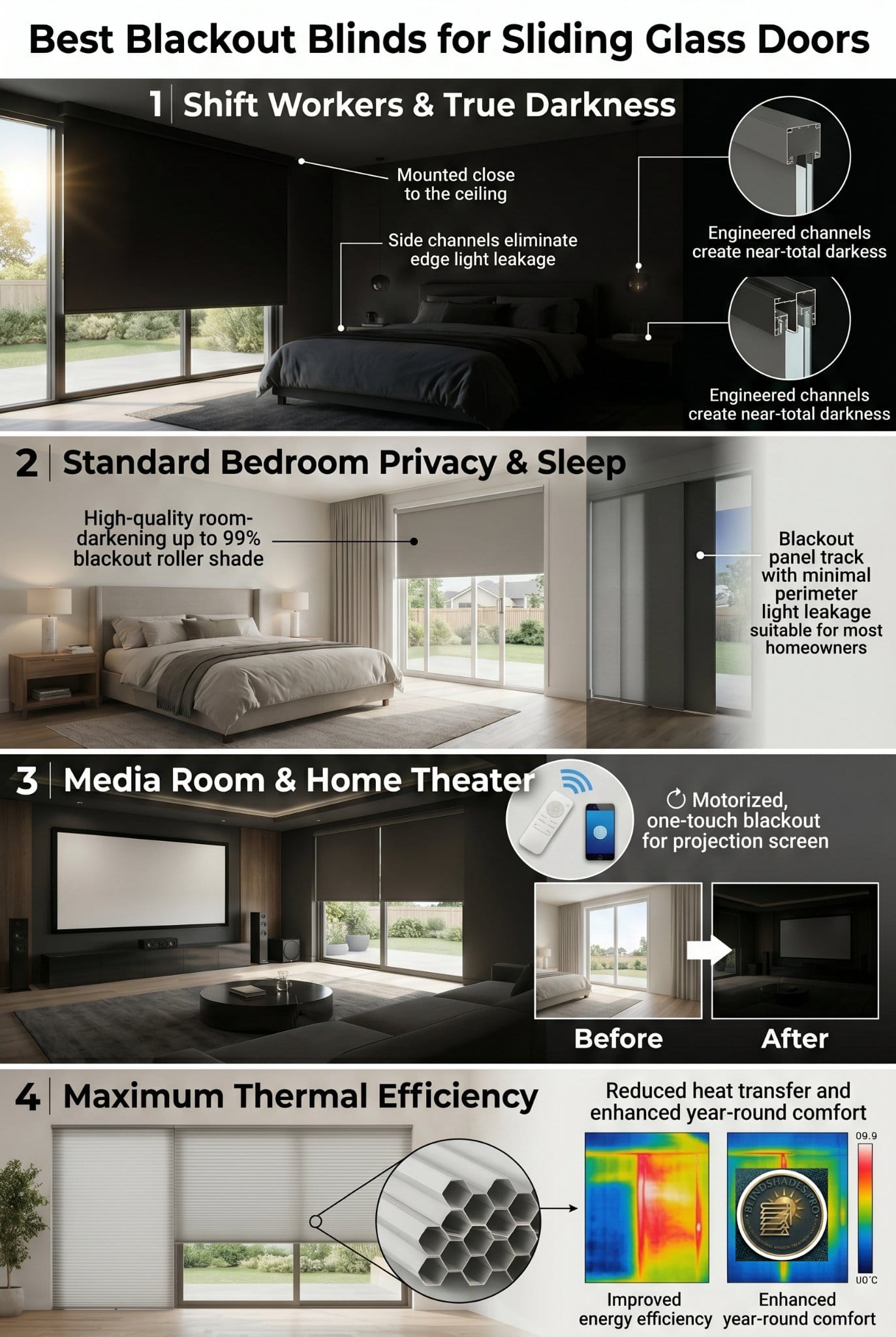
Key Takeaways:
- There are three distinct tiers of “blackout” window treatments for sliding glass doors, not one: true 100% blackout (requires sealed edges on all four sides — top, bottom, left, and right — through ceiling-close mounting plus side channels); marketed “blackout” products (95 to 99% light blockage from the fabric itself, but with visible light halos at the edges without additional edge sealing); and room darkening (70 to 95% light blockage, noticeably dim but not dark); most retail products labeled “blackout” are actually in the middle tier — the La Jolla Patch article confirms the term “blackout” is “frequently misused in place of room darkening shades because there is still a halo of light around the edges”
- A “99% blackout” fabric allows 1% of light to pass through the fabric itself, but this number does not account for light entering through the edge gaps around the treatment; on a typical summer afternoon with 25,000 lux of sunlight striking the glass, 1% transmitted through the fabric equals 250 lux in the room; a comfortable sleeping environment requires 0 to 5 lux; for shift workers or light-sensitive sleepers in summer, “99% blackout” fabric without edge sealing is insufficient — side channels, ceiling-close mounting, and floor coverage are all required to approach true blackout conditions
- There are four distinct light gap sources on any sliding glass door blackout treatment: the top gap between the headrail or curtain rod and the ceiling; the side gaps of approximately 0.5 to 1 inch between the fabric edge and the wall on each side; the bottom gap between the fabric hem and the floor; and the door operation gap when two separate treatments are used and the sliding panel is opened; each gap requires a different fix; specifying a 99% blackout fabric without addressing all four gap sources will still produce a room with visible light at multiple points
- The thermal performance of blackout treatments on sliding glass doors varies significantly by construction: standard blackout roller shade (opaque coating on polyester) adds approximately R-0.5 to R-1.0 to the glass R-value; foam-backed blackout fabric adds approximately R-1.5 to R-2.0; single-cell blackout cellular shade adds approximately R-3.0 to R-3.5; double-cell blackout cellular shade adds R-4.0 to R-4.5 (Blindsgalore confirms up to R-4 for double-cell construction); for a bedroom sliding glass door where both blackout performance and winter heating efficiency are priorities, double-cell blackout cellular shade provides the best combination
- The blackout treatment specification should match the user type: shift workers and third-shift employees who sleep in daylight hours need a true blackout system with side channels and ceiling-close mounting — room darkening alone is insufficient; light sleepers in suburban bedrooms using the patio door occasionally need room darkening to room-darkening blackout (95 to 99% without side channels is adequate); and media room users primarily need rapid and reliable deployment for afternoon movie watching — motorized blackout roller shade or motorized blackout panel track provides one-touch deployment that makes this use case fully practical
⭐ Quick Answer — What Are the Best Blackout Blinds for Sliding Glass Doors?
- The Three-Tier Classification — Why Most Products Labeled “Blackout” Are Not Truly Blackout: The first thing to understand about blackout blinds for sliding glass doors is that there are three distinct tiers of light blockage, not one. Tier 1 — True 100% blackout: blocks all measurable light; requires opaque fabric with 0% light transmission PLUS sealed edges on all four sides — top gap between headrail and ceiling sealed with a cornice board or ceiling-close mount; side gaps of 0.5 to 1 inch per side sealed with side channels (for roller shades) or wall-return curtains; bottom hem at or near the floor; single treatment spanning both door panels. Tier 2 — Marketed “blackout” (95 to 99% from fabric only): most retail products labeled “blackout” fall here; Factory Direct Blinds confirms “blackout roller blinds block up to 99% of incoming light” — but this 99% refers to the fabric only; light still enters through the edge gaps at the top, sides, and bottom; the La Jolla Patch article confirms this is “frequently misused in place of room darkening shades because there is still a halo of light around the edges of the window treatment.” Tier 3 — Room darkening (70 to 95%): noticeably dim but not dark; adequate for casual sleeping but not for genuine darkness requirements. Most buyers need Tier 2 (suburban bedroom patio door, light-sensitive sleeper, media room). Shift workers and nurseries need Tier 1. No standard retail product achieves Tier 1 without additional edge-sealing hardware
- The Four Light Gap Sources and the Fix for Each: Specifying a 99% blackout blind for a sliding glass door without addressing these four edge gaps produces a room with visible light entering from multiple directions — the “halo effect” mentioned above. Gap 1 — Top gap (headrail to ceiling): for a sliding glass door where the headrail must be mounted at door handle height plus 3 to 4 inches, the gap between the headrail and the ceiling can be 12 to 18 inches; patent literature confirms this is “most prevalent” as light seeps in around the rod or rail; fix = cornice board spanning from headrail top to ceiling, or ceiling-mount the treatment directly on the ceiling surface. Gap 2 — Side gaps (0.5 to 1 inch per side): fabric edges terminate 0.5 to 1 inch from the wall; fix = side guide channels for roller shades, or wall-return curtains that wrap around to the wall surface on each side. Gap 3 — Bottom gap (0.5-inch floor clearance): the standard 0.5-inch floor clearance from the measurement protocol creates a consistent floor-level light gap across the full door width; fix for curtains = puddle length (fabric rests on floor), though this is not practical for sliding glass doors with floor tracks; fix for roller shades = side channels run to the floor and the hem bar terminates at its lowest position. Gap 4 — Door operation gap: two separate treatments create a center gap when the sliding panel is opened; fix = single continuous treatment that spans both panels — the door slides beneath it without the treatment being moved
- The 99% Light Transmission Reality — Why Fabric Percentage Alone Determines Nothing for Shift Workers: The practical implication of “99% blackout blind sliding glass door” performance is absent from every buying guide. “99% blackout” means 1% of incident light passes through the fabric. A typical summer afternoon generates approximately 25,000 to 50,000 lux of sunlight through a south or west-facing sliding glass door. At 25,000 lux: 1% transmitted through the fabric = 250 lux in the room. At 50,000 lux (direct west-facing afternoon sun): 1% = 500 lux. A comfortable sleeping environment requires 0 to 5 lux — essentially no measurable light. This means 99% blackout fabric without edge sealing allows 50 to 100 times more light into the room than a sleeping environment requires. The same 99% product feels very dark in winter overcast conditions or north-facing rooms where incident light is low — the absolute lux transmitted is low even at 1%. The conclusion: for shift workers or summer bedrooms, specify Tier 1 (true blackout with all four gaps addressed). For standard suburban sleeping in typical light conditions, Tier 2 (99% fabric without edge sealing) is adequate. Blindsgalore confirms: “pair blackout shades with proper mounting to minimize light gaps” — the mounting is where Tier 1 is achieved, not the fabric specification alone
- Thermal Performance and the Bypass Curtain Rod System — Two Specifications All Guides Miss: (1) Thermal R-value comparison for blackout sliding glass door treatments: Blindsgalore confirms double-cell cellular achieves R-values up to R-4; the full comparison: standard blackout roller shade (coated polyester) adds R-0.5 to R-1.0 to the glass; foam-backed blackout fabric adds R-1.5 to R-2.0; single-cell blackout cellular adds R-3.0 to R-3.5; double-cell blackout cellular adds R-4.0 to R-4.5; blackout panel track adds R-0.5 to R-1.0 (same as roller shade — no cellular structure); for a bedroom sliding glass door where both blackout performance and winter energy savings are the priority, double-cell blackout cellular is the only product that achieves both simultaneously; Wikipedia confirms blackout fabrics “insulate due to their density.” (2) Bypass curtain rod system for blackout curtains: two rod layers at the same height allow independent operation of each door panel’s curtain; the fixed panel curtain stays permanently closed providing uninterrupted blackout over half the door; only the sliding panel curtain needs to be moved when the door is used; for shift workers who occasionally open the patio door for ventilation, the bypass system allows ventilation without fully defeating the blackout — the fixed panel curtain remains in place
- The User-Type Verdict — Best Blackout Specification by Who You Are: The correct best blackout blind for a sliding glass door depends entirely on the use case. Shift worker or third-shift employee sleeping 6 AM to 2 PM: Tier 1 true blackout required — blackout roller shade with side channels and ceiling-close mounting; 99% fabric alone is insufficient in summer; also consider heavy foam-backed blackout curtains on a bypass rod for nurseries. Standard light-sensitive sleeper in a suburban bedroom: Tier 2 adequate — standard 99% blackout roller shade or blackout panel track without side channels; dim room with visible edge glow is adequate for most sleeping conditions in moderate ambient light. Media room or home theater with afternoon sun: motorized blackout roller shade or motorized blackout panel track; one-touch remote deployment before a movie; no manual traversal; Graywind motorized panel track (blackout fabric option) and SmartWings motorized roller shade are the correct specifications. Bedroom with both blackout and energy priority: double-cell blackout cellular shade (R-4.0 to R-4.5) — the only product combining genuine blackout performance with maximum thermal insulation. Urban bedroom, street noise: heavy foam-backed blackout curtains or double-cell blackout cellular (3 to 5 dB noise reduction — Wikipedia confirms blackout fabrics have noise-dampening qualities due to density). Top brands: Blindsgalore (custom cellular and roller); Factory Direct Blinds (custom blackout roller); GoDear Sapphire+ (blackout panel track, adjustable 46 to 86 inches, available without custom order)
- Best Sources: “Eliminates nearly all light; ideal for shift workers; pair blackout shades with proper mounting to minimize light gaps”; double-cell cellular R-values up to R-4 → Blindsgalore sliding glass door blinds (2026) · “Blackout roller blinds block up to 99% of incoming light; creates complete darkness for bedrooms and media rooms” → Factory Direct Blinds blackout shades for sliding glass doors · “100% blackout fabric ideal for bedrooms, nurseries, dark rooms, and media/theater rooms”; adjustable 46-86 inches; trim to 96 inches height → Wayfair blackout panel track blinds for sliding glass doors
⚠️ Fabric Color and Thermal Performance — The Specification Most Buyers Overlook When Choosing Blackout Blinds for Sliding Glass Doors: A common misconception is that darker blackout fabric blocks more light. The blackout performance of any window treatment fabric comes from the opaque coating or foam backing on the room-facing side — the glass-facing front color has no effect on light blockage. What the front face color does affect is solar heat gain. Light-coloured blackout fabric (white, cream, silver-grey on the glass-facing side): reflects solar radiation back through the glass before it enters the room; in summer, reduces solar heat gain and keeps the room cooler; the most energy-efficient choice for homes in hot climates or with summer cooling as the primary concern. Dark-coloured blackout fabric (charcoal, navy, black on the glass-facing side): absorbs solar radiation; the absorbed heat conducts through the fabric into the room; in summer, can increase the room temperature by a perceptible amount; in winter, absorbed solar heat conducts into the room providing slight passive heating benefit. The specification recommendation: for most year-round residential use in mixed climates, choose light to mid-tone colours (grey, taupe, cream) on the glass-facing side; this provides the best year-round thermal balance; for maximum summer cooling, specify white or silver on the glass-facing side regardless of the room-facing aesthetic colour; for maximum winter heating in cold climates, dark colours are acceptable. See the full colour and thermal section below.
💡 Noise Reduction by Blackout Treatment Type — The Acoustic Benefit for Urban Bedroom Sliding Glass Doors: Wikipedia confirms that blackout fabrics “can also provide noise reduction, contributing to a quiet environment” due to their density and opacity. Sliding glass doors are acoustically transparent — two panes of glass with a 0.5-inch air gap provide minimal sound insulation. For urban bedroom patio doors facing streets with significant traffic noise, the blackout treatment also functions as a sound dampener. The noise reduction by type: double-cell blackout cellular shade = 3 to 5 dB (air pockets provide acoustic absorption — the most effective soft window treatment for noise on a sliding glass door); heavy foam-backed blackout curtains = 2 to 4 dB (dense foam layer absorbs sound waves, Wikipedia confirmed); standard blackout roller shade (coated fabric, no foam) = 1 to 2 dB (minimal — thin coated fabric provides little acoustic mass); blackout panel track = 1 to 2 dB (similar to roller shade). A 3 to 5 dB noise reduction is perceptible to human hearing — the detection threshold is approximately 3 dB — and meaningfully reduces traffic noise during sleeping hours without being a true soundproofing solution. For urban bedroom sliding glass doors facing streets: double-cell blackout cellular shades or heavy foam-backed blackout curtains provide the best combined blackout, thermal, and noise reduction performance of any available treatment. For installation guidance applicable to all blackout treatment types on sliding glass doors, including bracket height calculation to clear the door handle and the 5-check post-installation test sequence, see How Do You Install Blinds on Sliding Glass Doors. See the full noise reduction comparison table below.
📖 Read the complete guide below for: the three-tier blackout classification (true 100% vs marketed 99% vs room darkening; Patch La Jolla “halo of light” confirmed), four light gap sources on sliding glass door blackout treatments (top gap to ceiling; side gaps 0.5-1 inch; bottom floor clearance; door operation gap; fix for each), the 99% practical light transmission calculation (1% of 25,000 lux = 250 lux; sleep requires 0-5 lux; 99% insufficient for shift workers in summer), the bypass curtain rod system for sliding glass door blackout curtains (two-layer rod; fixed panel stays; sliding panel bypasses independently), thermal R-value comparison (roller R-0.5-1.0; foam-backed R-1.5-2.0; double-cell R-4.0-4.5; 480 BTU/hr savings quantified), fabric colour effect on thermal performance (light-coloured = reflects solar; dark = absorbs; white/silver glass-facing side = best for summer cooling), noise reduction by treatment type (double-cell = 3-5 dB; foam-backed = 2-4 dB; roller = 1-2 dB), and the full 8-scenario user-type verdict table.
Related guides: for the whole-house view, every blackout format is scored in the best blackout blinds & shades guide.
Best Blackout Blinds for Sliding Glass Doors — The Three-Tier Classification Every Guide Gets Wrong
Why “blackout” is not one specification — and why most products labeled “blackout” are not truly blackout.
The term “blackout” is one of the most inconsistently used terms in window treatment marketing. Understanding the three tiers prevents ordering the wrong product for the use case.
Tier 1 — True 100% Blackout
True 100% blackout blocks all measurable light from entering the room through the window treatment. It requires:
- Opaque fabric that transmits 0% of incident light (technically rated as “0% light transmission”)
- Sealed top edge: headrail or curtain rod mounted within 0.5 inches of the ceiling, or a valance/cornice board that covers the gap between the headrail and the ceiling
- Sealed side edges: side guide channels (for roller shades) or curtain returns that wrap around to the wall behind the treatment
- Sealed bottom edge: fabric or hem bar that reaches within 0.5 inches of the floor (vertical clearance)
- No door operation gap: single treatment spanning both panels; the sliding door travels beneath the treatment
The La Jolla Patch article confirms: “A true blackout window treatment blocks 100% of outside light. While many shades and window treatments tout themselves as blackout, the term is frequently misused in place of room darkening shades because there is still a halo of light around the edges of the window treatment.”
Who needs Tier 1: Shift workers (third shift nurses, first responders, service industry workers sleeping 6 AM to 2 PM); new parents with a nursery adjacent to a patio; home theater with an afternoon sun-facing patio door.
Tier 2 — Marketed “Blackout” (95–99% Light Blockage from Fabric)
Most products labeled “blackout” at standard retailers fall here. Factory Direct Blinds confirms: “Blackout roller blinds block up to 99% of incoming light.” Blindsgalore distinguishes this tier: “Eliminates nearly all light. Ideal for shift workers who sleep during the day or home theaters.”
The critical clarification: the 99% refers to the fabric only. Edge gaps are not included. A correctly installed 99% blackout shade still has a visible glow at the top, sides, and potentially the bottom — enough to see your hand in the darkened room.
Who needs Tier 2: Most residential bedroom patio door users; average light-sensitive sleeper in a suburban home; anyone who says “I need to block most of the light.”
Tier 3 — Room Darkening (70–95% Light Blockage)
Room darkening shades make a room dim and comfortable but do not create genuine darkness. The fabric transmits 5 to 30% of incident light. Adequate for daytime napping in moderate light conditions; not adequate for shift workers or anyone who genuinely cannot sleep with any ambient light.
Who needs Tier 3: Anyone seeking privacy and glare reduction without genuine darkness; living rooms where the patio door faces a bright south or west exposure.
The Four Light Gap Sources — What “Blackout” Fabric Alone Does Not Address
The four structural light leak points on every sliding glass door window treatment.
Specifying a 99% blackout fabric without addressing these four gaps produces a room with visible light entering from multiple directions — exactly the “halo effect” the La Jolla Patch article describes.
Gap 1 — The Top Gap (Headrail to Ceiling)
The patent literature on sliding blackout curtain apparatuses identifies this as the most prevalent source: “The inability to block light is most prevalent at the top of the curtain as light seeps in around the rod or rail.”
For a window, the rod is typically mounted 3 to 6 inches below the ceiling, creating a 3 to 6-inch opening above the treatment through which light enters from the front and illuminates the top portion of the room.
For a sliding glass door, where the headrail must be mounted at door handle height + 3 to 4 inches above the door (not at the ceiling), the top gap can be substantial — sometimes 12 to 18 inches between the headrail and the ceiling.
Fix: Mount a cornice board or valance that spans from the headrail top to the ceiling, covering the gap. Alternatively, ceiling-mount the treatment directly on the ceiling surface, eliminating the top gap entirely.
Gap 2 — The Side Gaps (0.5–1 Inch Per Side)
Standard outside-mount treatments on sliding glass doors terminate at the wall with a 0.5 to 1-inch gap between the fabric edge and the wall surface. This gap allows light to enter along the full height of the door on each side.
Fix for roller shades: Side guide channels (aluminum L-shaped tracks, also called “side channels”). The roller shade fabric edges ride inside the channels. No side light gap.
Fix for curtains: Return the curtain to the wall — extend the curtain rod 3 to 4 inches past the door frame on each side and hang the curtain so it wraps around to the wall surface, covering the wall return on each side. This eliminates the side gap.
Fix for panel track: Not available as a standard system. The panel track fabric edges terminate at the carrier sliders. Side channels can be added as a custom installation but require precise alignment.
For the complete roller shade side channel specification, see Are Roller Shades Good for Sliding Glass Doors.
Gap 3 — The Bottom Gap (Fabric Hem to Floor)
For roller shades: The hem bar terminates 0.5 inches above the floor (the standard clearance from Article 40-2 and 40-6). Light enters through this 0.5-inch gap from the floor level.
For curtains: Curtains hung 1 inch above the floor or with a standard 0.5-inch floor clearance allow light from the exterior to enter under the hem. Solution: specify “puddle” length for the curtain (0.5 to 1 inch of curtain fabric on the floor) — the fabric rests on the floor and seals the bottom edge. Not practical for sliding glass doors with a floor track, where the treatment must not contact the track.
For vertical blinds: The 0.5-inch vane clearance above the floor creates a consistent floor-level light gap across the full door width. Only acceptable for Tier 3 (room darkening); not for shift workers.
Gap 4 — The Door Operation Gap
When two separate treatments cover a sliding glass door (one per panel), a brief gap appears when the sliding panel is opened and its treatment is moved. Unless the two treatments overlap at the center, light enters from the center gap.
Fix: Single continuous treatment spanning both panels (the sliding door travels beneath it). The treatment does not need to be moved to open the door. No center gap.
The 99% Blackout Light Transmission Reality
The calculation absent from every blackout blind guide — why shift workers need more than 99% fabric.
A typical summer afternoon in the continental US generates approximately 25,000 to 50,000 lux of direct sunlight through a south or west-facing sliding glass door.
What “99% blackout” means in practice: At 25,000 lux hitting the glass: 1% transmitted through the fabric = 250 lux in the room At 50,000 lux (direct afternoon west sun): 1% = 500 lux in the room
A comfortable sleeping environment requires 0 to 5 lux (essentially no measurable light).
The gap conclusion: 250 to 500 lux transmitted through “99% blackout” fabric is 50 to 100 times brighter than a sleeping environment requires. This means the fabric itself is insufficient for shift workers in summer — edge sealing (all four gaps addressed) is required.
For a light sleeper in a suburban bedroom who uses the patio door occasionally and does not require complete darkness: 99% blackout fabric without side channels produces a dim room that is adequate for sleeping in most conditions.
The nuance: “99% blackout” feels very dark in a low-ambient interior light condition (winter, overcast days, north-facing doors). The same product feels inadequate in high-ambient conditions (summer, south or west facing, direct sun at 2 PM).
Thermal Performance — The R-Value Comparison for Blackout Treatments on Sliding Glass Doors
The quantified comparison absent from all blackout sliding glass door guides.
Wikipedia confirms: “blackout fabrics also insulate and have noise-dampening qualities due to their density and opacity.” No buying guide provides the specific R-value comparison for the different blackout treatment types on a sliding glass door.
| Blackout Treatment | R-Value Added | Best For |
|---|---|---|
| Standard blackout roller shade (coated polyester) | R-0.5 to R-1.0 | Minimum thermal impact; maximum simplicity |
| Foam-backed blackout fabric (curtain/drape) | R-1.5 to R-2.0 | Good thermal performance + true blackout opacity; Wikipedia confirmed foam-backed as original blackout fabric type |
| Blackout panel track (fabric panels, no cellular) | R-0.5 to R-1.0 | Same as standard roller; modern look only |
| Single-cell blackout cellular shade | R-3.0 to R-3.5 | Best balance of blackout + thermal |
| Double-cell blackout cellular shade | R-4.0 to R-4.5 | Maximum thermal insulation + blackout; Blindsgalore confirms up to R-4 for double-cell |
The practical implication for a 48 square foot patio sliding glass door:
Upgrading from a standard blackout roller shade (R-1.0 total with glass) to a double-cell blackout cellular shade (R-6.0 total with glass) saves approximately 480 BTU/hr on a winter day with 30°F temperature differential — equivalent to a 140-watt continuous electric heater.
For bedroom sliding glass doors where both blackout performance and energy savings are priorities: double-cell blackout cellular shade is the only specification that achieves both simultaneously.
Fabric Color and Thermal Performance — The Specification Most Buyers Overlook
Why white blackout fabric outperforms charcoal in summer — and the reverse is true in winter.
A common misconception: darker blackout fabric blocks more light. In fact, the blackout performance of window treatment fabric comes from the opaque coating or foam backing on the interior-facing side — the front (glass-facing) face color has no effect on light blockage.
What the front face color does affect: solar heat gain.
Light-coloured blackout fabric (white, cream, silver-grey on the glass-facing side):
- Reflects solar radiation back through the glass before it enters the room
- In summer: reduces solar heat gain; the room stays cooler
- In winter: reflects away some of the passive solar heating from the glass
- Net effect: better for homes in hot climates or summer cooling priority
Dark-coloured blackout fabric (charcoal, navy, black on the glass-facing side):
- Absorbs solar radiation; the absorbed heat is then conducted through the fabric into the room
- In summer: increases solar heat gain slightly; the room may be warmer
- In winter: absorbed solar heat conducts into the room; slightly better passive solar heating
- Net effect: better for cold climates or winter heating priority
The specification recommendation: For most year-round residential use in mixed climates: choose a light to mid-tone fabric color (grey, taupe, or cream) on the glass-facing side. This provides the best year-round thermal balance without the summer heating drawback of dark fabric.
Noise Reduction — Which Blackout Treatment Provides the Most
The acoustic performance specification absent from all blackout sliding glass door guides.
Wikipedia confirms: “blackout curtains can also provide noise reduction, contributing to a quiet environment.” Sliding glass doors are acoustically transparent — two panes of glass with a 0.5-inch air gap provide minimal sound insulation. For urban bedrooms where the patio door faces a street, the blackout treatment also functions as a sound dampener.
| Blackout Treatment | Approximate Noise Reduction | Mechanism |
|---|---|---|
| Double-cell blackout cellular shade | 3 to 5 dB | Air pockets provide acoustic absorption |
| Foam-backed blackout curtain (heavy fabric) | 2 to 4 dB | Dense foam layer absorbs sound waves |
| Standard blackout roller shade | 1 to 2 dB | Minimal; thin coated fabric |
| Blackout panel track | 1 to 2 dB | Similar to roller shade |
Practical application: 3 to 5 dB noise reduction is perceptible (human hearing detects differences of approximately 3 dB); it does not make a street-facing bedroom silent but meaningfully reduces traffic noise during sleeping hours.
For urban bedroom sliding glass doors facing streets with significant traffic: double-cell blackout cellular shade or heavy foam-backed blackout curtains provide the best combined blackout and noise reduction performance.
The Bypass Curtain Rod System for Blackout Curtains
The sliding glass door curtain configuration absent from all guides.
Most buyers mounting blackout curtains on a sliding glass door use a single curtain rod with one or two wide curtain panels that stack to one side when the door is opened. This works but has a significant limitation: to open the door, the entire curtain must be moved to one side, partially or fully exposing the fixed panel.
The bypass curtain rod system: Two or three individual curtain rods are mounted at the same height, each projecting slightly further from the wall so they clear each other. One rod holds the curtain over the fixed panel; another rod holds the curtain over the sliding panel. The sliding panel’s curtain bypasses the fixed panel’s curtain when slid open — neither curtain must be fully displaced.
How it works for blackout on a sliding glass door:
- Fixed panel: blackout curtain stays permanently closed over the fixed glass (the glass that never moves); this curtain never needs to be opened or closed
- Sliding panel: blackout curtain is opened (slid to the side) only when the sliding door is being used; when the door is closed, this curtain is drawn across the sliding panel
- Net effect: the fixed panel is always covered by blackout; only the sliding panel’s curtain requires daily operation
The practical benefit: Bypass systems allow independent control of coverage over each door panel. For shift workers: the fixed panel curtain provides uninterrupted blackout over half the door even while the sliding panel curtain is briefly opened for ventilation.
For the complete installation guide for any blackout treatment on a sliding glass door, see How Do You Install Blinds on Sliding Glass Doors.
The User-Type Verdict — Best Blackout Treatment by Who You Are
| User Type | Light Requirement | Correct Specification | Why |
|---|---|---|---|
| Shift worker / third-shift | TRUE blackout (0-5 lux) | Blackout roller shade + side channels + ceiling-close mount | Addresses all 4 gap sources; 99% fabric alone is insufficient in summer |
| Light sleeper, suburban bedroom | Dim (< 50 lux) | Standard 99% blackout roller shade without side channels | Adequate for low-ambient conditions; economic |
| New parent / nursery | TRUE blackout | Same as shift worker; blackout cellular adds thermal insulation for nursery comfort | Both darkness and temperature regulation |
| Media room / home theater | Full blackout during viewing | Motorized blackout roller or panel track | One-touch deployment before movie; no manual traversal |
| Vacation rental / guest bedroom | Room darkening | 95-99% blackout roller shade | Most guests sleep adequately; lower cost for rental context |
| Bedroom + energy priority | Blackout + thermal | Double-cell blackout cellular shade | R-4.0 to R-4.5 + blackout in one product |
| Urban bedroom, street noise | Blackout + noise | Heavy foam-backed blackout curtains or double-cell blackout cellular | 3-5 dB noise reduction + blackout |
| Hot climate, cooling priority | Blackout + summer cooling | Blackout roller or cellular with light-coloured glass-facing fabric | Reflects solar heat; reduces cooling load |
Top Products — Blackout Blinds for Sliding Glass Doors
Blindsgalore Blackout Cellular Shades — Best Thermal + Blackout
Custom-sized; single and double-cell construction; double-cell achieves R-4.0 to R-4.5; blackout fabric available in multiple colours; wand or motorized control. The best combined specification for bedroom sliding glass doors where both thermal performance and blackout are priorities. See Blindsgalore’s sliding glass door product page for current specifications.
Factory Direct Blinds Blackout Roller Shades — Best Value Blackout Roller
Custom-built blackout roller shades for sliding glass doors; “up to 99% of incoming light” blocked by fabric; reverse roll standard for door clearance; wand or motorized; paired with side channels for shift-worker-grade blackout. Factory Direct Blinds ships to sliding glass door dimensions with same-week turnaround on standard orders.
GoDear Design Adjustable Blackout Panel Track — Best Ready-to-Install
Adjustable 46 to 86-inch width; 4 panels; 100% blackout fabric; full blackout from panel fabric; trimmable to 96-inch height. GoDear (godear.com) Sapphire+ series: “ensures maximum seclusion; ideal for bedrooms, nurseries, dark rooms, and media/theater rooms.” The ready-to-install option for standard 72 and 80-inch sliding glass doors without custom order lead time.
Related guides: For complete buying advice, see our blackout blinds and shades buying guide.
Frequently Asked Questions
What are the best blackout blinds for a sliding glass door? The best blackout blind for a sliding glass door depends on the use case. For shift workers requiring true darkness: blackout roller shade with side channels and ceiling-close mounting — this is the only system that seals all four light gap sources. For standard bedroom use: 95 to 99% blackout roller shade or blackout panel track without side channels provides adequately dim sleeping conditions. For thermal priority alongside blackout: double-cell blackout cellular shade (R-4.0 to R-4.5). Factory Direct Blinds, Blindsgalore, and GoDear Design are the leading sources for sliding glass door blackout products.
What is the difference between “blackout” and “room darkening” for sliding glass doors? Room darkening blocks 70 to 95% of light, making a room dim but not dark. “Blackout” as marketed at most retailers blocks 95 to 99% of light through the fabric, but light still enters through edge gaps at the top, sides, and bottom. True 100% blackout requires sealed edges through side channels, ceiling-close mounting, and floor coverage in addition to blackout fabric. The La Jolla Patch article confirms blackout is “frequently misused” for what is actually room darkening, with visible light halos at the edges even on labeled blackout products.
Does “99% blackout” actually create darkness in a bedroom patio door? Not in all conditions. “99% blackout” refers to the fabric only — 1% of incident light passes through the fabric. On a typical summer afternoon with 25,000 lux of sunlight, 1% transmitted equals 250 lux in the room, which is 50 times brighter than optimal sleeping conditions. For shift workers or summer bedrooms, 99% blackout fabric without edge sealing (side channels and ceiling-close mounting) is insufficient. For standard suburban sleeping conditions in winter or overcast weather, 99% blackout is adequate.
Do blackout blinds help with noise on a sliding glass door? Yes, to a meaningful degree. Double-cell blackout cellular shades reduce noise by approximately 3 to 5 dB, and heavy foam-backed blackout curtains provide 2 to 4 dB of noise reduction. This is perceptible to human hearing (threshold for detection is approximately 3 dB) and provides meaningful improvement for bedroom patio doors facing streets with traffic noise. Standard blackout roller shades and panel track provide minimal noise reduction (1 to 2 dB).
Related Guides on BlindShades.pro
- The Best Sliding Glass Door Blinds & Shades Buying Guide
- What Are the Best Blinds for Large Sliding Glass Doors
- Are Roller Shades Good for Sliding Glass Doors
- What Are the Best Panel Track Blinds for Sliding Glass Doors
- How Do You Install Blinds on Sliding Glass Doors
- What Window Treatments Give Sliding Glass Doors the Most Privacy
By Michael Turner | 30 Years Home Improvement Expertise | Updated 2026 | BlindShades.pro
