What Window Treatments Give Sliding Glass Doors the Most Privacy?

Authored By Michael Turner -30 Years Home Improvement Expertise | Updated 2026 | BlindShades.pro
Updated on June 14, 2026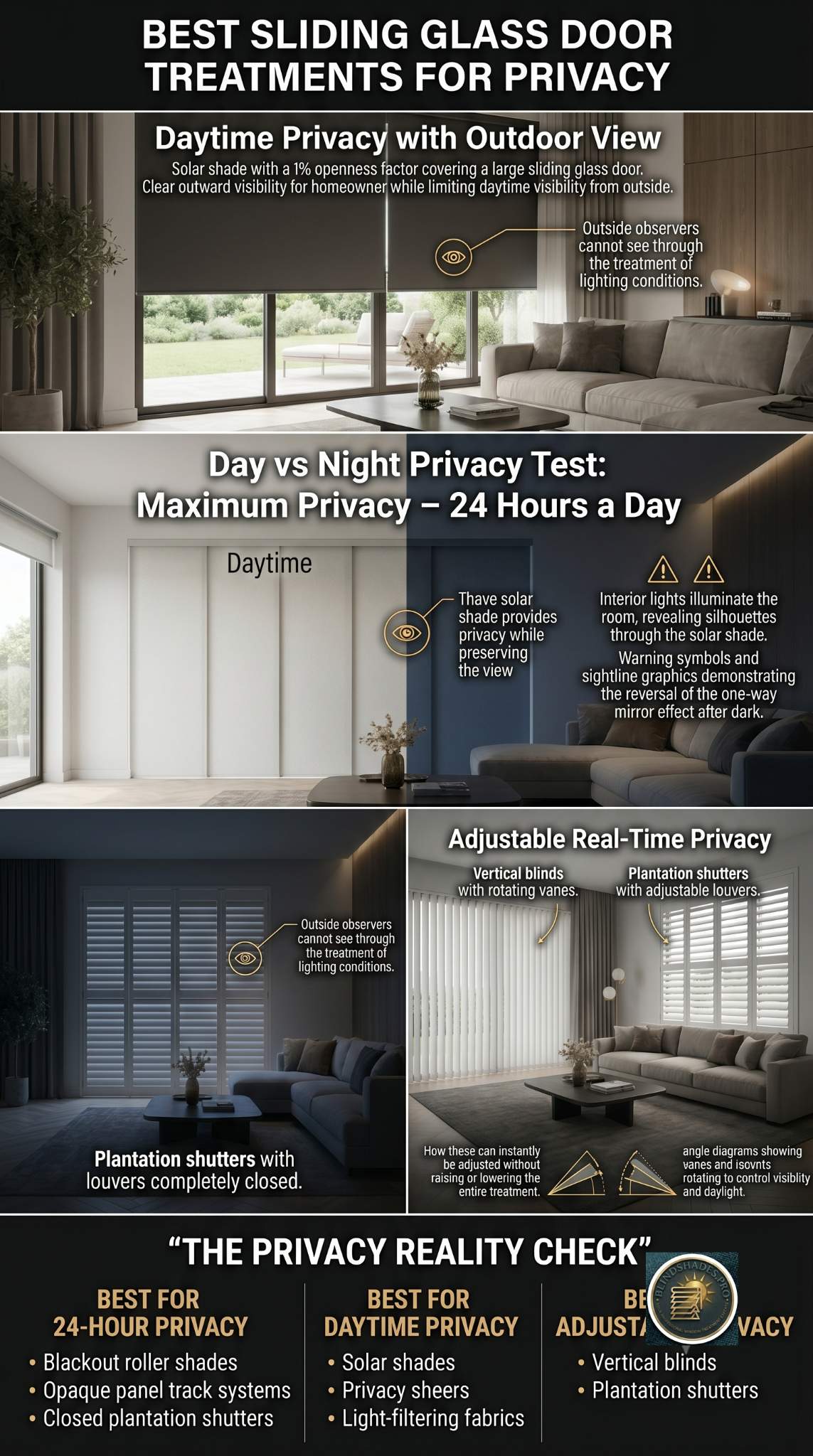
Key Takeaways:
- Every solar shade and sheer window treatment for a sliding glass door provides good daytime privacy through the one-way mirror effect — when exterior light is brighter than interior light, the treatment is reflective from the outside and you can see out from inside; however, at night when interior lighting is brighter than the dark exterior, this effect fully reverses — the solar shade or sheer becomes transparent from the outside, interior silhouettes are clearly visible, and anyone looking toward the door sees the room’s occupants; Walmart one-way mirror window film listings confirm this directly: “at night when indoor lighting is brighter than outdoor lighting, the mirror effect reverses, making the interior visible from outside; closing curtains at night is recommended”; the only window treatments that provide consistent 24-hour privacy on sliding glass doors are opaque treatments: blackout or room-darkening roller shades, opaque panel track fabric, vertical blinds in the closed position, or plantation shutters with louvers closed
- Ground-floor sliding glass doors facing a street, neighbour’s window, or public walkway require a different privacy specification than elevated or private-facing doors; an observer at eye level 5 to 30 feet from a ground-floor patio door can see the full interior through any partially transparent treatment at night; a door facing a private yard, elevated deck, or low-foot-traffic area with the nearest observer 50+ feet away receives dramatically less privacy exposure; Fabric Works (January 2026) confirms: “a ground-floor patio door demands different privacy solutions than a second-story balcony entrance”; buyers with ground-floor doors facing public or semi-public views should specify opaque or near-opaque fabric; buyers with elevated or private-facing doors can use solar shades, sheers, or light-filtering fabrics effectively
- Vertical blinds and plantation shutters with rotating louvers are the only sliding glass door window treatments that provide continuously variable privacy — from fully open (0% privacy, full view) to fully closed (95 to 98% privacy) in stepless real-time adjustment; panel track blinds and roller shades are binary treatments — they are either open (0% privacy) or closed (99-100% privacy) with no intermediate position; for south and west-facing sliding glass doors where the sun angle changes from morning to afternoon, the continuous vane angle adjustment of vertical blinds allows real-time privacy tuning without raising or lowering the treatment; this is vertical blinds’ most significant and consistently overlooked advantage for rooms with changing sun exposure throughout the day
- The privacy film plus nighttime shade combination is the most cost-effective way to achieve full day-and-night privacy on a sliding glass door: one-way mirror window film applied to the door glass provides genuine daytime privacy at $7 to $20 at Walmart (exterior sees mirror reflection; interior sees outside clearly); a lightweight blackout roller shade mounted above provides nighttime privacy when lowered after dark; the total cost of the combination is $40 to $80 compared to $100 to $400 for a single treatment system that provides comparable day-and-night performance; this combination eliminates the day/night reversal problem of solar shades and sheers without the cost of a premium opaque treatment system
- The Hunter Douglas Luminette Privacy Sheer is the most sophisticated sliding glass door privacy treatment most buyers have never encountered: it consists of a sheer fabric backing with rotating fabric vanes attached; when the vanes are fully open the sheer provides minimal obstruction with gentle light diffusion; when the vanes are rotated 90 degrees they face the glass and create a soft diffused privacy screen; when the vanes are fully closed at 180 degrees of rotation the overlapping fabric vanes create an opaque layer for complete privacy; Coeur Window Coverings (March 2026) confirms the Luminette gives “180 degrees of light control”; it provides the full privacy spectrum from transparent to opaque in a single system without being raised or lowered
⭐ Quick Answer — What Window Treatments Give Sliding Glass Doors the Most Privacy?
- The Day/Night Privacy Reversal — Why Most Sliding Glass Door Privacy Treatments Fail at Night: The most critical and consistently overlooked fact about sliding glass door window treatments for privacy is the day/night reversal effect. Solar shades, privacy sheers, and light-filtering curtains achieve daytime privacy through the one-way mirror effect: when exterior daylight is brighter than interior lighting, the treatment surface is reflective from the outside and occupants can see out clearly while exterior observers cannot see in. However, at night when interior lights (lamps, overhead lighting, screen glow) are brighter than the dark exterior, this effect fully reverses — the treatment becomes transparent and interior silhouettes are clearly visible from outside. Walmart one-way mirror window film product listings confirm this directly: “at night when indoor lighting is brighter than outdoor lighting, the mirror effect reverses, making the interior visible from outside; closing curtains at night is recommended.” The only sliding glass door window treatments that provide consistent 24-hour privacy are opaque treatments: blackout or room-darkening roller shades (100% and 90-95% respectively), opaque panel track fabric (99%), plantation shutters with louvers closed (98%), vertical blinds with vanes fully closed (95%), and opaque cellular shades (98%). Solar shades, privacy sheers, and sheer curtains all reverse at night and cannot be relied upon for evening or nighttime privacy in rooms with interior lighting
- Ground Floor vs Elevated — How Door Position Determines the Required Privacy Level: The required privacy level for sliding glass door window treatments depends fundamentally on the door’s position, orientation, and the distance to the nearest likely observer. Fabric Works (January 2026) confirms: “a ground-floor patio door demands different privacy solutions than a second-story balcony entrance.” Ground floor door facing a public street or neighbour’s window (observer at 10 to 30 feet, at eye level): any partially transparent treatment — solar shade, sheer curtain — transmits interior light and silhouettes at night; the specification must be opaque or near-opaque for genuine 24-hour privacy. Ground floor door facing a private yard (nearest observer 40+ feet): a 3% openness factor solar shade provides sufficient visual obstruction at typical viewing distances in daylight; nighttime reversal may still be visible to a close observer at dusk. Elevated door (second floor, raised deck): street-level observers look upward and see ceiling and upper walls rather than the full room interior; privacy requirement is substantially reduced; solar shades and sheers provide adequate privacy for most elevated-door situations. The specification rule: the closer and more directly the nearest observer’s sightline meets the glass, the more opaque the treatment must be
- The Privacy Score Comparison Table and the $40–$80 Film Plus Shade Combination: Two sliding glass door privacy window treatment frameworks absent from all competitor guides. (1) Privacy score by treatment (daytime / nighttime): blackout roller shade = 100% / 100%; opaque panel track fabric = 99% / 99%; plantation shutters with louvers closed = 98% / 98%; opaque cellular shade = 98% / 98%; vertical blinds with vanes closed = 95% / 95%; room darkening roller = 90-95% / 90-95%; Hunter Douglas Luminette Privacy Sheer with vanes closed = 70-80% / 40-60%; solar shade 1% openness factor = 85-90% / 30-50%; privacy sheer curtain = 60-70% / 30-50%; solar shade 3% openness factor = 75-85% / 20-40%. (2) The privacy film plus roller shade combination: one-way mirror window film applied to the door glass provides genuine daytime privacy for $7 to $20 at Walmart (exterior sees mirror reflection; interior sees outside clearly); a lightweight blackout roller shade mounted above provides nighttime privacy when lowered after dark; total cost: $40 to $80 for full day-and-night privacy on a standard 72-inch door — compared to $60 to $180 for a single solar shade system (daytime only) or $50 to $150 for a single blackout roller shade (daytime view blocked); the combination preserves the daytime outdoor view while adding nighttime coverage without the cost of a premium opaque system
- The Hunter Douglas Luminette Privacy Sheer — The 180-Degree Privacy Spectrum in One System: The most sophisticated sliding glass door window treatment for privacy that most buyers have never encountered. Coeur Window Coverings (March 2026) confirms: “the Luminette Privacy Sheers have rotating fabric vanes which give 180 degrees of light control.” The mechanism: the Luminette has a sheer fabric backing with a series of fabric vanes that rotate through 180 degrees. At 0 degrees (fully open), the vanes lie flat against the sheer — minimal visual obstruction, gentle light diffusion, view largely maintained. At 90 degrees (vanes perpendicular to glass), the vanes face the glass and create a soft diffused privacy screen. At 180 degrees (vanes fully closed, parallel position with maximum overlap), the overlapping fabric creates an opaque layer with privacy equivalent to a room-darkening treatment. The Luminette can also be retracted entirely to one side, fully exposing the door glass for maximum view. This 180-degree vane rotation means the homeowner can fine-tune privacy and light diffusion in real time without raising or lowering the treatment — the same stepless adjustability as vertical blinds, with a substantially more sophisticated fabric appearance that suits modern interiors where vertical vinyl vanes would conflict aesthetically
- The Adjustable Privacy Spectrum and the Scenario Verdict: The most functionally important distinction between sliding glass door window treatments for privacy is binary vs stepless adjustment. Binary treatments (open or closed, no intermediate): panel track blinds and roller shades — when raised or open, privacy is 0%; when lowered or closed, privacy is 99-100%; there is no intermediate position. Stepless treatments (continuously variable privacy angle): vertical blinds and plantation shutters with rotating louvers — the vane or louver angle can be set anywhere from 0 degrees (fully open, 0% privacy) to 90 degrees (fully closed, 95-98% privacy), in fine increments; for south and west-facing rooms where the sun angle changes from morning to afternoon, this means real-time privacy adjustment without raising or lowering the treatment; a vane at 60 degrees blocks direct afternoon sun from a specific angle while maintaining a partial view. The scenario verdict: for bedroom or ground floor public-facing door (24-hour opaque): blackout roller or opaque panel track. For daytime view with nighttime privacy: privacy film + lightweight shade ($40-$80). For south/west room with changing sun: vertical blinds or plantation shutters. For modern aesthetic with good daytime privacy: panel track with room-darkening fabric. For premium built-in architectural look: Buy Home Blinds (March 2026) confirms plantation shutters “appear built into the home.” For child safety plus daytime privacy: Coeur Window Coverings confirms solar shades are “the most child-safe — up and out of reach when open.” For the full 10-scenario verdict table, see the complete guide below
- Best Sources: “Solar shades most child-safe: up and out of reach when open; Luminette Privacy Sheers rotating vanes give 180 degrees of light control; draperies add sophistication for formal spaces; Smart Drape = newest product for sliding doors” → Coeur Window Coverings — window coverings for sliding glass doors (March 2026) · “Hunter Douglas Skyline panel track; Duette Vertiglide vertical cellular; ground-floor patio door demands different privacy solutions than second-story balcony entrance” → Fabric Works — 2026 window treatments for sliding glass doors (January 2026) · “Plantation shutters most expensive but most dramatic visual enhancement; bypass or bi-fold; appear built into the home; amazing architectural element” → Buy Home Blinds — best window treatments for sliding glass doors (March 2026)
⚠️ The Fishbowl Effect — Which Homes Are Most Vulnerable to Nighttime Privacy Loss Through Sliding Glass Door Window Treatments: The “fishbowl effect” is the nighttime reversal of solar shades and sheers that makes a lit interior room visible from outside like an illuminated aquarium. Its severity varies dramatically by location. Most vulnerable: suburban and rural ground-floor patio doors with no adjacent streetlights. In these environments the exterior is 10 to 100 times darker than the lit interior at night; even a 1% openness factor solar shade transmits clear interior silhouettes to anyone within 20 to 30 feet of the door; the reversal is complete and severe from dusk until the interior lights are extinguished. Moderately vulnerable: urban ground-floor patio doors with bright streetlights adjacent to the door. The streetlights reduce the light differential between interior and exterior; the one-way mirror effect is partially maintained into the evening hours; a 1% OF solar shade provides meaningful privacy until the streetlights are brighter than the interior, at which point the effect stabilises rather than fully reversing. Least vulnerable: elevated doors (second floor or raised deck) or doors facing dark, unoccupied areas. No observer at eye level within 30 feet; privacy reversal is academic. The treatment implication: for suburban and rural ground-floor doors, solar shades and sheers are inadequate for nighttime privacy in any openness factor; specify opaque roller shade, blackout panel track, or combine privacy film with a nighttime shade. For urban ground-floor doors with streetlight mitigation: 1% OF solar shade provides acceptable privacy in most practical scenarios. See the full fishbowl effect analysis below.
💡 The 10-Scenario Privacy Verdict — Complete Decision Table for Sliding Glass Door Window Treatments for Privacy: (1) Ground floor, facing public street or neighbour: opaque blackout roller shade or cellular — only treatment with 100% nighttime privacy; no reversal risk. (2) Bedroom patio door, sleep-grade darkness: blackout roller shade — 100% day and night; side channels for genuine blackout (see blackout guide). (3) Daytime outdoor view + nighttime privacy: privacy film ($7-$20) + lightweight shade ($30-$60) = $40-$80 total — film provides daytime mirror effect; shade covers nighttime reversal. (4) South or west-facing room, changing sun angle throughout day: vertical blinds or plantation shutters with rotating louvers — only stepless 0-to-90-degree real-time adjustment. (5) Modern aesthetic + good daytime privacy: panel track with room-darkening fabric — clean look; near-opaque; binary operation. (6) Premium built-in architectural look: plantation shutters on bypass track — Buy Home Blinds confirmed “appear built into the home.” (7) Child safety priority + daytime privacy: solar shade at 1% or 3% openness factor — Coeur Window Coverings confirmed “most child-safe: up and out of reach when raised.” (8) Full privacy spectrum in one system without raising/lowering: Hunter Douglas Luminette Privacy Sheer — 180-degree vane rotation from transparent to near-opaque. (9) Walk-through access frequency + privacy when needed: roller shade — zero lateral stack; raise fully for access in seconds; lower for instant near-blackout coverage. (10) Budget privacy for rental or temporary: blackout roller shade at $30-$80 — full daytime and nighttime coverage; installs in 30 minutes. For the complete measurement guide to ensure any privacy treatment fits your door correctly before ordering, see How Do You Measure Sliding Glass Door Blinds. See the full verdict table below.
📖 Read the complete guide below for: the day/night privacy reversal mechanism (solar shades and sheers work by one-way mirror effect during day; interior-brighter-than-exterior at night = full reversal; Walmart film listings confirmed; only opaque treatments provide 24-hour privacy), ground floor vs elevated analysis (ground floor facing street = opaque required; elevated or private yard = solar shade adequate; proximity and sightline determine specification), privacy score comparison table (all treatment types rated daytime vs nighttime), Hunter Douglas Luminette detail (180-degree vane rotation; 0°=transparent; 90°=diffused; 180°=near-opaque; stepless real-time adjustment), privacy film plus roller shade combination ($7-$20 film + $30-$60 shade = $40-$80 total for full day-and-night coverage), the fishbowl effect and which homes are most vulnerable (suburban/rural no streetlights = most vulnerable; urban streetlights = moderate; elevated = least), the adjustable privacy spectrum (vertical blinds and plantation shutters = stepless 0-90° real-time; panel track and roller = binary open or closed), and the complete 10-scenario privacy verdict table.
Sliding Glass Door Window Treatments for Privacy — The Day/Night Reversal Most Guides Miss
Why the most common sliding glass door privacy treatments fail exactly when privacy is needed most.
The search for the best <strong>sliding glass door window treatments for privacy</strong> is complicated by one fact that no standard guide addresses: most window treatments that provide excellent daytime privacy provide much less nighttime privacy — and for ground-floor sliding glass doors in dark suburban or rural environments, some treatments provide almost no nighttime privacy at all.
The Day/Night Privacy Reversal — What Solar Shades and Sheers Don’t Tell You
The mechanism behind “daytime privacy” and why it reverses after dark.
Solar shades, privacy sheers, and light-filtering fabrics achieve daytime privacy through the one-way mirror effect. When exterior light (daylight, overcast sky) is brighter than interior light, the treatment surface is more reflective from the outside — an exterior observer sees their own reflection rather than the room’s interior. The interior observer can see outside clearly.
The reversal condition: At night, interior lighting (lamps, overhead lights, screen glow) is brighter than the dark exterior. The one-way mirror effect reverses — the interior is now the illuminated side. The solar shade or sheer becomes translucent, transmitting the interior’s light and silhouettes outward.
One-way mirror window film product listings at Walmart confirm this directly: “at night when indoor lighting is brighter than outdoor lighting, the mirror effect reverses, making the interior visible from outside. It is recommended to use curtains at night.”
The practical implication for sliding glass door privacy:
| Treatment | Daytime Privacy | Nighttime Privacy |
|---|---|---|
| Blackout roller shade (closed) | 100% | 100% |
| Opaque panel track fabric (closed) | 99% | 99% |
| Plantation shutters (louvers closed) | 98% | 98% |
| Vertical blinds (vanes closed) | 95% | 95% |
| Opaque cellular shade (closed) | 98% | 98% |
| Room darkening roller shade | 90–95% | 90–95% |
| Solar shade 1% OF (closed) | 85–90% | 30–50% |
| Solar shade 3% OF (closed) | 75–85% | 20–40% |
| Privacy sheer / Luminette (vanes closed) | 70–80% | 40–60% |
| Sheer curtain (closed) | 60–70% | 30–50% |
| Solar shade 10% OF (closed) | 40–60% | 10–20% |
The only treatments with consistent privacy at night are those with opaque fabric: no exterior light transmission regardless of the interior-to-exterior light differential.
For buyers for whom nighttime privacy is critical, the specification must be an opaque treatment. See What Are the Best Blackout Blinds for Sliding Glass Doors for the full blackout treatment comparison.
Ground Floor vs Elevated — How Door Position Determines Privacy Requirements
Why the same treatment can be adequate in one home and inadequate in another.
Fabric Works (January 2026) confirms the critical factor: “A ground-floor patio door demands different privacy solutions than a second-story balcony entrance, while eastern morning sun requires different light control than a completely shaded back yard.”
No guide explains what this means for treatment selection:
Ground floor sliding glass door, facing street or neighbour (highest privacy demand): An observer at eye level — walking on a public pavement at 10 to 20 feet, or at a neighbour’s window at 20 to 40 feet — sees the full interior of a ground-floor room directly through the door glass. Any partially transparent treatment (solar shade, sheer) that transmits nighttime light produces clearly visible silhouettes to this observer. The treatment specification must be opaque or near-opaque for 24-hour privacy.
Ground floor door, facing private yard (moderate privacy demand): The nearest observer is typically across the garden at 30 to 50 feet or more. At this distance, even a 3% OF solar shade creates sufficient visual obstruction that interior details are not clearly visible in daylight. Nighttime reversal is less severe because the observer is further away. Solar shades or light-filtering treatments adequate.
Elevated door (second floor or raised deck): A street-level observer looking upward at an elevated patio door sees the room at an upward angle — the upper walls and ceiling, not the floor and seating areas. Privacy requirements are substantially lower. Solar shades or even sheer panels provide adequate privacy for most elevated doors.
The proximity rule: The closer the nearest likely observer, the more opaque the treatment must be. Specify treatments based on actual sightline analysis, not generic “patio door privacy” guidelines.
The Privacy Score Comparison — All Treatments Rated
The unified privacy comparison table absent from every sliding glass door window treatment guide.
| Treatment | Daytime | Night | Adjustable? | Light Control | Cost Range |
|---|---|---|---|---|---|
| Blackout roller shade | 100% | 100% | Binary (up/down) | Full blackout | $50–$150 |
| Opaque panel track | 99% | 99% | Binary (open/close) | Full blackout | $80–$250 |
| Plantation shutters | 98% | 98% | Stepless (louver angle) | Full to open | $400–$1,200 |
| Opaque cellular shade | 98% | 98% | Binary | Full blackout | $100–$300 |
| Vertical blinds (closed) | 95% | 95% | Stepless (vane angle) | Full to open | $30–$120 |
| Room darkening roller | 90–95% | 90–95% | Binary | Near-blackout | $40–$130 |
| Luminette Privacy Sheer | 70–80% | 40–60% | Stepless (vane 180°) | Diffused to opaque | $300–$800 |
| Solar shade 1% OF | 85–90% | 30–50% | Binary | Maximum solar filter | $60–$180 |
| Privacy sheer curtain | 60–70% | 30–50% | Binary (open/close) | Soft diffusion | $30–$100 |
The Hunter Douglas Luminette Privacy Sheer — The 180-Degree Privacy Spectrum
The most sophisticated privacy option for sliding glass doors that most buyers have never considered.
Coeur Window Coverings (March 2026) mentions it: “the Luminette Privacy Sheers softly diffuse the sunlight; these sheers also have rotating fabric vanes which give 180 degrees of light control.”
No standard buying guide explains the mechanism:
How the Luminette achieves 180-degree light control: The Luminette is a sheer fabric backing with a series of fabric vanes attached horizontally. These vanes rotate through 180 degrees:
- 0 degrees (fully open): Vanes lie flat against the sheer backing; you have a clear view through the sheer fabric with gentle ambient diffusion; minimal visual obstruction; the treatment provides privacy equivalent to a standard sheer curtain
- 90 degrees (perpendicular to glass): Vanes face toward the glass; the treatment creates a soft diffused privacy screen that blocks the view from outside while allowing diffused light in; similar to a standard sheer in privacy performance
- 180 degrees (fully closed / parallel): Vanes rotate until they overlap each adjacent vane; the overlapping fabric creates an opaque layer that blocks the view in both directions; privacy performance similar to a room-darkening treatment
The Luminette can also be retracted entirely (stacked to one side) to fully expose the door glass — maximum view, zero treatment coverage.
The practical advantage on a sliding glass door: The Luminette provides the full range from fully open view to near-opaque privacy without raising or lowering the treatment — only rotating the vane angle. For south or west-facing living rooms where the sun changes angle throughout the day, this continuous adjustment eliminates the need for multiple treatments or repeated raising/lowering.
The Privacy Film + Nighttime Shade Combination
The lowest-cost solution for full day-and-night privacy on a sliding glass door.
Every one-way mirror window film product at Walmart confirms: “at night, it is recommended to use curtains.” This recommendation implicitly describes the combination approach that no buying guide articulates explicitly:
The combination:
- Apply one-way mirror window film to the sliding glass door glass (Walmart: $7 to $20 for a 17.7 × 78.7 inch strip; multiple strips cover a standard door)
- Mount a lightweight blackout or room-darkening roller shade above the door (standard range: $30 to $60)
- In daylight: the window film provides the one-way mirror effect (exterior sees reflection; interior sees outdoors); the roller shade is raised and out of sight
- After dark: lower the roller shade to restore privacy; the shade covers the film’s nighttime reversal vulnerability
Total cost: $40 to $80 for full day-and-night privacy on a standard 72-inch sliding glass door
Compared to alternatives:
- Single solar shade system: $60 to $180 (daytime privacy only; nighttime reversal not addressed)
- Blackout roller shade alone: $50 to $150 (full privacy but blocks daytime view entirely)
- Film + shade combination: $40 to $80 (daytime view maintained; nighttime covered)
The combination is the most cost-effective solution for buyers who want to see outside during the day while maintaining full privacy at night — without investing in a premium opaque treatment that blocks the daytime view entirely.
The Fishbowl Effect — Which Homes Are Most Vulnerable
Why the same solar shade provides adequate nighttime privacy in one home and none in another.
The “fishbowl effect” is the colloquial name for the nighttime privacy reversal that makes a room with interior lighting visible through a solar shade or sheer — like an illuminated aquarium visible in the dark.
Vulnerability factors:
Exterior darkness level: The privacy reversal depends on the ratio of interior to exterior light. In urban environments with bright streetlights, the exterior is not significantly darker than the interior at night — the one-way effect is partially maintained even after dark. In suburban or rural homes with no streetlights adjacent to the patio door, the exterior can be 10 to 100 times darker than the lit interior at night — the reversal is complete and severe.
Distance to observer: At 50 feet, a 3% OF solar shade is sufficient to obscure interior details from most observers even at night. At 15 feet (a neighbour’s window or a public path), interior silhouettes are clearly visible through a 3% OF solar shade in a dark exterior.
Interior light level: A bright kitchen behind the patio door at night transmits a much more visible light through a solar shade than a dimly lit bedroom. For bright-interior rooms: specify opaque treatment for nighttime. For dimly lit rooms: solar shade provides adequate nighttime cover in most situations.
The suburban/rural night privacy specification rule: For ground-floor patio doors in suburban or rural homes with no adjacent streetlights, facing any direction with an observer at less than 30 feet: specify an opaque or room-darkening treatment for 24-hour privacy. Solar shades are inadequate for nighttime privacy in this context regardless of openness factor.
The Adjustable Privacy Spectrum — Vertical Blinds’ Most Overlooked Advantage
The continuous real-time privacy adjustment that panel track and roller shades cannot provide.
Most sliding glass door treatment comparisons discuss vertical blinds as a dated, maintenance-heavy option. The comparison consistently misses their functionally unique advantage:
Stepless real-time privacy adjustment:
Vertical blinds rotate the vane angle continuously from 0 to 90 degrees (flat-open to flat-closed) using the traversal wand. At any point in this range, the vane angle creates a specific privacy level and a specific light blockage level:
- Vane at 0 degrees (open, perpendicular to glass): full view; 0% privacy
- Vane at 30 degrees: partial view obstruction; approximately 30% privacy
- Vane at 60 degrees: moderate obstruction; approximately 65% privacy
- Vane at 90 degrees (closed, parallel to glass): full vane overlap; approximately 95% privacy
For a south-facing living room with changing sun angles from morning to afternoon: the vertical blind can be angled to block direct sun from the west at 3 PM while maintaining a partial view — an intermediate vane position that no other treatment type achieves without raising or lowering the treatment.
Plantation shutters offer the same stepless adjustment through louver rotation. Both are the correct specification when real-time privacy tuning throughout the day is the primary function.
For the full vertical blind specification and installation guide, see Are Vertical Blinds Still Good for Sliding Glass Doors.
The Privacy Treatment Verdict by Scenario
| Scenario | Best Treatment | Why |
|---|---|---|
| Ground floor, facing public street or neighbour | Opaque blackout roller or cellular shade | Only treatment with 100% nighttime privacy; no reversal risk |
| Bedroom patio door (nighttime only) | Blackout roller shade | Sleep-grade darkness day and night |
| Daytime privacy + unobstructed outdoor view | Privacy film (day) + lightweight shade (night) | $40-$80 total; daytime mirror effect + nighttime coverage |
| South/west room, changing sun angle all day | Vertical blinds or plantation shutters | Only treatments with stepless real-time angle adjustment |
| Modern aesthetic + good daytime privacy | Panel track with room-darkening fabric | Clean look; near-opaque daytime and nighttime |
| Premium built-in architectural look | Plantation shutters (bypass track) | Buy Home Blinds confirms “appear built into the home” |
| Child safety + daytime privacy | Solar shade (1% OF) | Coeur Window Coverings confirms “most child-safe; up and out of reach when open” |
| Full privacy spectrum in one system | Hunter Douglas Luminette | 180-degree vane rotation from clear to opaque without raising/lowering |
| Walk-through access + privacy when needed | Roller shade | Zero lateral stack; raise fully for access; lower for instant opaque privacy |
| Budget privacy (rental or temporary) | Blackout roller shade | $30-$80; full daytime and nighttime privacy; simple installation |
Frequently Asked Questions
What window treatment gives a sliding glass door the most privacy? For consistent 24-hour privacy, the treatments that provide the most privacy on a sliding glass door are: opaque blackout roller shades (100% day and night), opaque panel track fabric (99%), and plantation shutters with louvers closed (98%). Solar shades and privacy sheers provide excellent daytime privacy through the one-way mirror effect but reverse at night when interior lights are brighter than the dark exterior — silhouettes become visible from outside. For guaranteed nighttime privacy, specify opaque fabric.
Do solar shades provide privacy at night on sliding glass doors? Not reliably. Solar shades achieve daytime privacy through the one-way mirror effect — exterior light is brighter than interior, making the shade reflective from outside. At night when interior lighting is brighter than the dark exterior, this effect reverses: the solar shade becomes transparent and interior silhouettes are visible from outside. Walmart one-way mirror window film listings confirm this directly, recommending “closing curtains at night.” The day/night reversal is most severe for ground-floor doors in suburban and rural homes with dark exteriors.
Which sliding glass door window treatment is best for daytime privacy while keeping a view outside? The best daytime privacy option that maintains an outdoor view is a solar shade at 1 to 3 percent openness factor — the low openness creates a one-way mirror effect during daylight, preventing exterior observers from seeing in while allowing the interior occupant to see outside clearly. For a complete day-and-night solution without losing the daytime view, combine window privacy film (daytime) with a lightweight roller shade (nighttime only). Total cost approximately $40 to $80 for a standard sliding glass door.
Do vertical blinds provide good privacy on a sliding glass door? Vertical blinds provide approximately 95% privacy when vanes are fully closed — adequate for most residential applications. Their unique advantage over panel track and roller shades is continuous real-time adjustability: vane angle can be rotated steplessly from fully open to fully closed, allowing the homeowner to tune privacy level and light blockage without raising or lowering the treatment. For south and west-facing rooms where the sun angle changes throughout the day, this adjustability is the correct specification for real-time privacy management.
Related Guides on BlindShades.pro
- The Best Sliding Glass Door Blinds & Shades Buying Guide
- What Are the Best Blinds for Large Sliding Glass Doors
- Are Roller Shades Good for Sliding Glass Doors
- What Are the Best Panel Track Blinds for Sliding Glass Doors
- What Are the Best Blackout Blinds for Sliding Glass Doors
- Are Vertical Blinds Still Good for Sliding Glass Doors
By Michael Turner | 30 Years Home Improvement Expertise | Updated 2026 | BlindShades.pro
