How to Shorten Mini Blinds the Right Way.

Authored By Michael Turner -30 Years Home Improvement Expertise | Updated 2026 | BlindShades.pro
Updated on June 25, 2026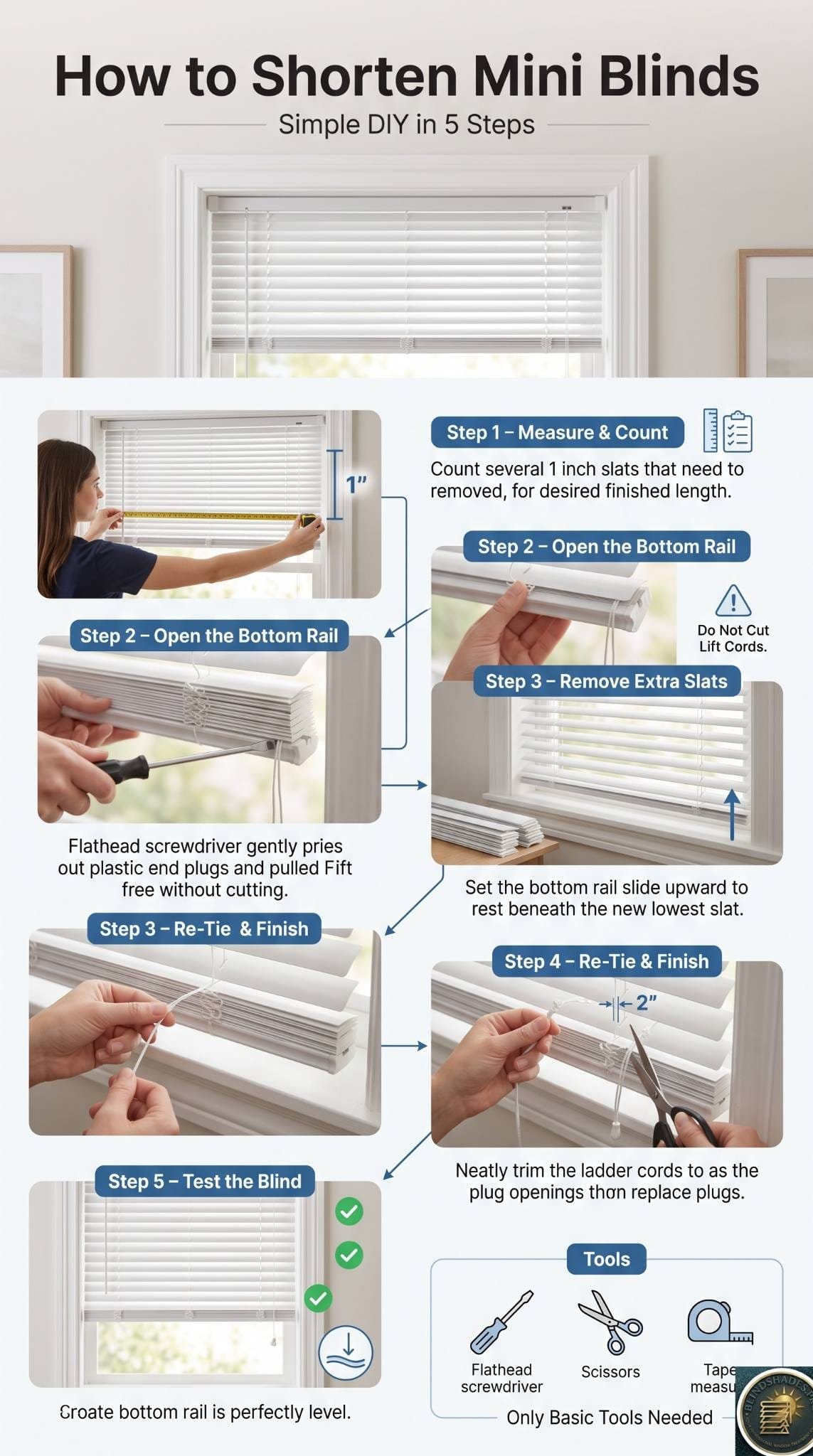
Authored by Michael Turner — 30 Years of Home Improvement Expertise | BlindShades.pro
To shorten mini blinds that are too long, you remove whole slats from the bottom rather than cutting the slats themselves. Lower the blind fully, measure to where you want it to end, and work out how many 1-inch slats to take out. Then pry the plugs from the bottom rail, free the lift cords without cutting them, slide off the excess slats, move the bottom rail up so it rests on the ladder rung just below the new bottom slat, re-tie the lift cords, and trim the ladder cords. The whole job needs only a screwdriver and scissors, takes about 20 minutes, and is permanent, so measure carefully first. This guide walks through each step, including the cordless version and how to cut blinds narrower.
Key Takeaways
- Shortening the length means removing slats, not cutting them. You take whole slats off the bottom and reposition the bottom rail; no saw is needed for the slats. Cutting only comes into it when you make a blind narrower, which is a different job.
- Cut the ladder cords, not the lift cord. The lift cord runs up through the slats and raises the blind, so you preserve it and re-tie it; the ladder cords hold the slats at spacing and are the ones you trim. Cutting the lift cord by mistake means restringing the blind.
- The bottom rail sits on the rung below the new bottom slat. Resting it on the same rung as the bottom slat makes the blind hang wrong, so always move it down one rung.
- Measure and count carefully, because it is permanent. Work out how many slats to remove before touching anything; you can always take out one more, but you cannot put a slat back once the blind is reassembled.
- Keep the removed slats as spares. Store them flat; if a slat bends later, you will have an exact-match replacement ready, saving a future repair.
⭐ Quick Answer
Learning how to shorten mini blinds is easier than it sounds: you remove whole slats from the bottom rather than cutting them, using just a screwdriver and scissors.
- Measure and count: lower the blind fully, measure from the headrail to where you want it to end, and divide by the slat spacing to find how many 1-inch slats to remove. See how to measure for mini blinds.
- Open the bottom rail: pry off the plugs with a flathead screwdriver, then free the cords — cut the ladder cords, never the lift cord, as Family Handyman advises.
- Remove the excess slats below your mark, then move the bottom rail up so it rests on the ladder rung just below the new bottom slat, a detail Fix My Blinds stresses.
- Re-tie and finish: re-thread and knot the lift cords, trim the ladder cords to about two inches, seal nylon ends, and press the plugs back in, per Smart Blinds Hub.
- Test by raising and lowering fully and checking the rail is level. If you accidentally cut the lift cord, see how to restring mini blinds, or choose a new set in our best mini blinds guide.
Shortening the Length vs the Width: Two Different Jobs
Length means removing slats; width means cutting them — do not confuse the two.
The word “shorten” causes most of the confusion here, so settle it first. Making a blind shorter from top to bottom, the usual need, means removing whole slats from the bottom and repositioning the bottom rail. You do not cut the slats at all, and you need no saw. Making a blind narrower, from side to side, is a separate and harder job that does involve cutting the slats and the headrail to width with the right tools. This guide focuses on shortening the length, which most people want, and covers width-cutting briefly near the end.
| Job | What you do | Tools | Difficulty |
|---|---|---|---|
| Shorten length | Remove whole slats from the bottom | Screwdriver, scissors | Easy |
| Cut to width | Trim slats and rail narrower | Tin snips, utility knife, hacksaw | Harder |
What You’ll Need
A short tool list for shortening the length.
For a standard length-shortening you need very little: a flathead screwdriver to pry the plugs from the bottom rail, scissors to trim the ladder cords, a tape measure, a pencil, and optionally a lighter to seal nylon cord ends. That is it; no power tools, and no cutting of the slats themselves.
Step 1: Measure and Count the Slats to Remove
Work out the length first, then how many slats that equals.
Lower the blind fully with the slats open flat, and measure from the top of the headrail to where you want the bottom rail to sit, usually at the windowsill or about a quarter inch above it. Subtract that target from the blind’s current length to get the amount to remove, then divide by the slat spacing to find how many slats come out. On 1-inch mini blinds the slats sit roughly an inch apart, so the inches to remove and the number of slats are close to the same:
| Amount to remove | Approximate slats to remove (1-inch minis) |
|---|---|
| 2 inches | 2 slats |
| 4 inches | 4 slats |
| 6 inches | 6 slats |
| 8 inches | 8 slats |
Treat these as a guide and confirm by counting on your actual blind, since exact spacing varies slightly. Mark the slat that will become your new bottom slat. Stock blinds often come in lengths like 48, 64, 72, or 84 inches, which is why they so often need trimming to a specific window.
Step 2: Open the Bottom Rail
Pry off the plugs and identify the two kinds of cord.
On the underside of the bottom rail you will find small plastic plugs or buttons, usually two to four depending on the width. Pry them out gently with a flathead screwdriver and set them aside for reuse. Underneath, you will see where the cords meet the rail, and this is the critical part to understand, because there are two different cords and you treat them very differently:
| Cord | Where it is | What it does | Cut it? |
|---|---|---|---|
| Lift cord | Runs up through holes in the slats | Raises and lowers the blind | No, preserve and re-tie it |
| Ladder cord | The ladder of strings on each side | Holds the slats at even spacing | Yes, trim below the rail |
Free the lift cords from the bottom rail by untying or unhooking them, taking care not to cut them, since you need their full length to re-tie the rail. If you do accidentally cut a lift cord too short, you will need to restring the blind, covered in how to restring mini blinds.
Step 3: Remove the Excess Slats
Slide off the slats below your mark and reposition the rail.
With the lift cords freed and the rail off, slide out all the slats below your marked bottom slat; on the removed slats, cut the ladder cords to release them, leaving the lift cord intact. Then move the bottom rail up to its new home. The key detail that trips people up: the bottom rail should rest on the ladder rung just below your new bottom slat, not on the same rung as the bottom slat. Resting it on the correct rung lets the bottom slat sit properly above the rail and keeps the blind hanging level.
Step 4: Re-tie and Test
Re-thread the lift cords, secure the ladder cords, and check it works.
Re-thread the lift cords through the holes in the bottom rail and tie each off with a secure double overhand knot, pulling them snug but not so tight that the slats cannot hang freely. The ladder cords will now dangle below the rail; trim them to about two inches, then twist or tie the two ladder strings together and push them up into the plug holes alongside the lift-cord knot. If your cords are nylon, briefly touch the cut ends with a lighter to melt and seal them against fraying. Press the plugs back into the rail to cover everything, using gentle taps if they are stiff. Finally, hang the blind and raise and lower it through its full range, checking that it moves smoothly and the bottom rail hangs level.
How Do You Shorten Cordless Mini Blinds?
The idea is the same, but photograph the cord routing first.
Cordless mini blinds shorten the same way, by removing slats and repositioning the bottom rail, but they have a continuous internal lift cord that must be routed correctly to keep the cordless lift working. Before you disassemble anything, take a photo of how the cords run so you can match it on reassembly. Pop the bottom-rail plugs, free the cord without cutting it short, remove the excess slats, reposition the rail on the rung below the new bottom slat, then re-route and re-tie the cord exactly as it was. Test the push-to-lift action through its full range. For more on cordless models, see best cordless mini blinds.
How to Cut Mini Blinds Narrower
Width-cutting is a different, harder job that does involve cutting.
If your blind is too wide rather than too long, you will need to cut both the slats and the headrail narrower, which is more involved and where the material matters. Remove the blind and lay it flat, mark your cut lines on both ends with painter’s tape, and use the right tool for the material:
| Material | Slat tool | Rail tool |
|---|---|---|
| Aluminum mini | Sharp tin snips | Hacksaw |
| Vinyl mini | Sharp utility knife | Hacksaw |
Wear gloves and safety glasses, because freshly cut aluminum edges are sharp; file or sand them smooth afterward. Because width-cutting is fiddly and permanent, ordering a custom-sized blind built to your exact window is often the better route. The measuring method is in how to measure for mini blinds.
Common Mistakes to Avoid
Most shortening errors come down to the same few slips.
| Mistake | Consequence | Fix |
|---|---|---|
| Cutting the lift cord | Blind will not raise; needs restringing | Cut only the ladder cords |
| Removing too many slats | Blind ends too short, permanent | Measure twice, remove fewer, recheck |
| Rail on the wrong rung | Blind hangs crooked | Rest rail on the rung below the bottom slat |
| Cutting cords too short | Cannot re-tie securely | Leave about two inches to knot |
| Skipping the test | Faults found after plugs are in | Raise and lower fully before finishing |
| Losing the plugs | Cords exposed, rail loose | Set plugs aside safely for reuse |
While You’re There: Clean and Keep Spares
Two quick wins while the blind is apart.
With the slats off and the rail open, take the chance to do two useful things. First, wipe down each slat and clear any dust from the ladder cords while you have easy access, the fuller method being in how to clean mini blinds. Second, keep the slats you removed, stored flat in a drawer; if a slat bends or breaks later, you will have an exact-match spare to swap in, as shown in how to fix bent mini blind slats. A few minutes now saves a future trip to the store.
When to Order Custom Instead
Sometimes a new blind is the smarter call.
Shortening works well for trimming a few inches, but it is not always the best answer. If you would be removing a large number of slats, the proportions can end up looking off, and if the blind also needs to be narrower, the cutting involved makes a custom order more sensible. Many retailers will even shorten or size a blind for you, sometimes free, at the time of purchase, so a custom-built blind arrives at the exact length and width of your window. To order the right size, measure accurately first with how to measure for mini blinds, and to choose a set, see our best mini blinds guide.
Best Sources
- Family Handyman — on opening the slats to mark length, cutting the ladder cords rather than the lift cord, and tucking the ladder cords into the rail plugs.
- Smart Blinds Hub — on shortening meaning removing whole slats rather than cutting them, the slat-count calculation, double overhand knots, and sealing nylon cord ends.
- Fix My Blinds — on resting the bottom rail on the ladder rung below the bottom slat and re-feeding the lift cords through the rail.
- Affordable Blinds — on prying the two to four bottom-rail plugs, freeing the cord knots, and tying the ladder cords with a square knot.
- Blindsgalore — on aluminum slats cutting with tin snips and sharp edges, and photographing cordless cord routing before disassembly.
- Shade and Blinds — on keeping spare slats, centering the bottom rail, and cleaning while the blind is disassembled.
Related Guides
- Best Mini Blinds Buying Guide
- How to Fix Bent Mini Blind Slats
- How to Restring Mini Blinds
- How to Measure for Mini Blinds
Frequently Asked Questions
Do you cut the slats to shorten mini blinds?
No. To shorten the length of mini blinds you remove whole slats from the bottom and reposition the bottom rail; you do not cut the slats and you need no saw, just a screwdriver and scissors. Cutting the slats only applies when you make a blind narrower from side to side, which is a separate job using tin snips for aluminum or a utility knife for vinyl, plus a hacksaw for the rail.
Which cord do you cut when shortening mini blinds?
You cut the ladder cords, not the lift cord. The lift cord runs up through the holes in the slats and raises the blind, so you preserve it and re-tie it through the repositioned bottom rail. The ladder cords are the ladder of strings on each side that hold the slats at even spacing; once the rail is repositioned, you trim these to about two inches below the rail and tuck them into the plug holes. Cutting the lift cord by mistake means you will have to restring the blind.
How do you know how many slats to remove?
Lower the blind fully and measure from the top of the headrail to where you want the bottom rail to sit, usually at the sill or about a quarter inch above. Subtract that target length from the blind’s current length to get the amount to remove, then divide by the slat spacing. On 1-inch mini blinds the slats sit about an inch apart, so removing four inches is roughly four slats. Always confirm by counting on your actual blind before removing anything.
How do you reattach the bottom rail after shortening?
Move the bottom rail up so it rests on the ladder rung just below your new bottom slat, not on the same rung as the slat. Re-thread the lift cords through the holes in the rail and tie each with a secure double overhand knot, snug but not so tight the slats cannot hang. Trim the ladder cords to about two inches, tuck them into the plug holes, and press the plugs back in. Then test by raising and lowering the blind fully.
Can you make mini blinds longer?
No, you cannot add length back to a mini blind once slats have been removed, which is why shortening is permanent and you should measure carefully first. If a blind is too short for a window, the fix is a replacement, ideally one custom-ordered to the exact window height. If you have removed slats and kept them, an experienced repairer may be able to add them back, but it is far easier to avoid over-shortening in the first place.
