Are Pleated Blinds Worth It?

Authored By Michael Turner -30 Years Home Improvement Expertise | Updated 2026 | BlindShades.pro
Updated on July 2, 2026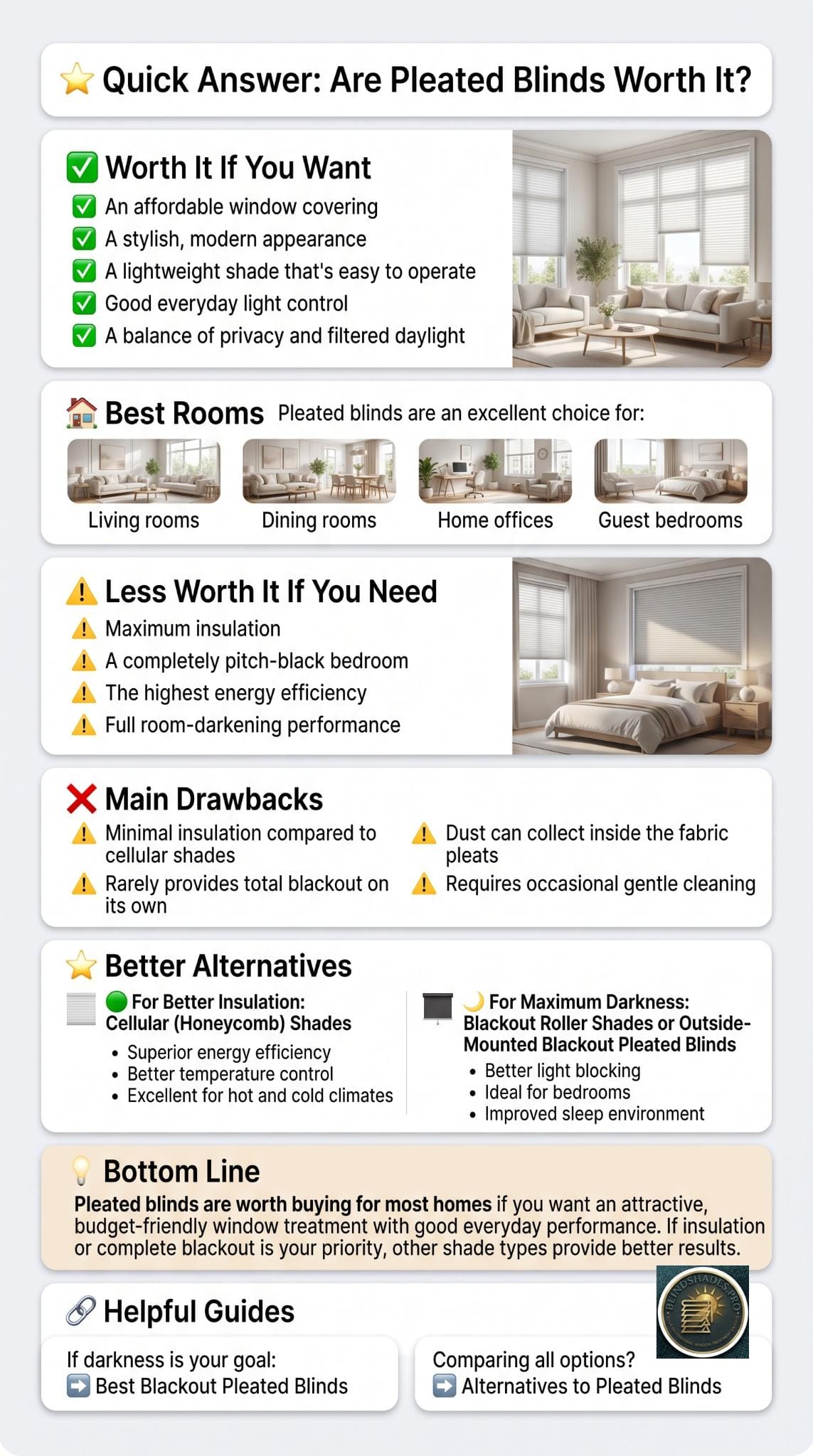
Authored by Michael Turner — 30 Years of Home Improvement Expertise | BlindShades.pro
Pleated blinds are worth it if you want an affordable, stylish, lightweight window treatment with good light control and a soft, textured look, which makes them a smart choice for living rooms, dining rooms, home offices, and guest bedrooms. They are less worth it if your top priority is insulation or a completely dark bedroom, because their single fabric layer provides minimal insulation and rarely achieves total blackout, small gaps around the cords and edges let a little light through. So the honest verdict comes down to the room and your priority: for value, style, and everyday light control, pleated blinds deliver a lot for the price; for energy efficiency or a pitch-black bedroom, a cellular or blackout roller shade is the better investment. This guide gives the full case, the real drawbacks, and which rooms pleated blinds are genuinely worth it for.
Key Takeaways
- Worth it for value and style. Pleated blinds offer one of the lowest entry prices for a quality fabric shade, with a wide range of decorative fabrics.
- Best in decorative, low-demand rooms. They shine in living rooms, dining rooms, home offices, and guest bedrooms where insulation is not the priority.
- Limited insulation is the main drawback. A single fabric layer insulates very little; for energy efficiency, cellular shades are the better buy.
- Rarely fully blackout. Small gaps around the cords and edges mean pleated blinds seldom achieve total darkness without an outside mount.
- They collect some dust. The pleats gather dust and need gentle, regular dusting, an easy but real upkeep task.
⭐ Quick Answer
Are pleated blinds worth it? Yes for affordable style and everyday light control, but less so if your priority is insulation or a pitch-black bedroom.
- Worth it if you want an affordable, stylish, lightweight shade with good light control, the kind of value Bali highlights.
- Worth it for living rooms, dining rooms, home offices, and guest bedrooms, decorative, low-demand spaces.
- Less worth it if your priority is insulation or a completely dark bedroom.
- The honest drawbacks: minimal insulation, rarely total blackout, and some dust in the pleats, trade-offs Blindsgalore and Affordable Blinds also note.
- Better for those needs: see best blackout pleated blinds for darkness, alternatives to pleated blinds for insulation, or our best pleated blinds guide.
The Honest Verdict
Great value for the right room; not the pick for insulation or total darkness.
Pleated blinds are genuinely worth it for what they are: an affordable, good-looking, versatile fabric shade. For the money, they deliver a clean, textured look, a wide fabric range, and solid everyday light control, which is why they remain popular. Where they are not worth it is when you ask them to do a job they are not built for. Because they are a single layer of fabric, they insulate very little and rarely block all light. So the verdict is not a simple yes or no, it depends entirely on the room and your priority. Match them to a decorative, low-demand space and they are excellent value; ask them to insulate a drafty window or fully darken a bedroom and you will be disappointed. The sections below give the full case on both sides.
The Benefits: Why Pleated Blinds Are Worth It
Affordable, stylish, and versatile.
| Benefit | What it means |
|---|---|
| Cost-effective | Among the lowest entry prices for a quality fabric shade |
| Versatile styling | Slim stack, clean look, wide range of decorative fabrics |
| Good light control | Various opacities cut glare and diffuse light softly |
| Space-saving | Compresses into a slim stack, great for doors and small windows |
| Easy to install | A straightforward DIY job with basic tools |
The core case for pleated blinds is value. They offer one of the lowest entry prices of any quality fabric window covering, so they stretch a budget across a whole home. They fold into a slim, tidy stack for a clean, streamlined look, and they come in a very wide range of colors, patterns, and textures, giving real decorating flexibility. Available in opacities from sheer to blackout-lined, they cut glare and control daytime light well, and their compact stack suits doors and small windows. For most everyday rooms, that combination of price, style, and function is exactly why they are worth it.
The Drawbacks: Where Pleated Blinds Fall Short
Insulation, blackout, and dust are the honest limits.
| Drawback | The honest detail |
|---|---|
| Limited insulation | A single fabric layer insulates very little; cellular is far better |
| Rarely total blackout | Cord holes and edge gaps let a little light through |
| Collects dust | Pleats gather dust and need regular gentle dusting |
| Less durable than hard treatments | Fabric and cords wear before a shutter or blind would |
| Not ideal for wet or greasy rooms | Fabric is harder to wipe than a roller or shutter |
Being honest about the limits is the whole point of a worth-it question. First, insulation: a pleated blind’s single fabric layer provides minimal thermal benefit, so if energy efficiency matters, it falls short of a cellular shade. Second, blackout: the cords running through the fabric create tiny holes, and the edges leave small gaps, so pleated blinds rarely achieve total darkness, a real point raised by owners whose bedrooms are darkened but not pitch black. Third, dust: the pleats do collect dust over time and need occasional gentle dusting, covered in how to clean pleated blinds. None of these is a dealbreaker for the right room, but they decide whether pleated blinds are worth it for yours.
Best and Worst Rooms for Pleated Blinds
They shine in decorative, low-demand spaces.
| Room | Worth it? |
|---|---|
| Living room | Yes, style and daytime light control |
| Dining room | Yes, decorative fabric look |
| Home office | Yes, glare control and a clean look |
| Guest bedroom | Yes, light-duty and affordable |
| Main bedroom (dark sleep) | Only with blackout fabric and outside mount |
| Cold or drafty window | No, choose cellular for insulation |
| Kitchen or bathroom | Often no, choose a wipe-clean roller |
Because thermal performance is not their strength, pleated blinds excel in decorative or low-demand spaces: living rooms, dining rooms, home offices, and guest bedrooms, where affordability and a soft fabric look matter more than insulation or total darkness. They can work in a main bedroom, but only with a blackout fabric and, ideally, an outside mount to cut the edge gaps, as covered in best blackout pleated blinds. Where they are usually not worth it is on a cold, drafty window that needs insulation, better served by a cellular shade, or in a kitchen or bathroom, where a wipe-clean roller is more practical.
Are Pleated Blinds Still in Style?
Yes, the clean fold reads as modern and timeless.
Pleated blinds remain firmly in style. Their crisp, even fold gives a clean, understated look that suits both modern and traditional interiors, and the wide range of contemporary fabrics, colors, and textures keeps them current. Designers still reach for them where a soft, architectural fabric treatment is wanted without the bulk of drapery, and they pair well with curtains for a layered look. Far from dated, the simple pleated shade is a decor staple precisely because it stays out of the way and lets the room’s other elements lead. So style is not a reason to hesitate, they look as current today as ever.
How Long Do Pleated Blinds Last?
Several years with gentle care, though cords and fabric wear first.
With normal use and gentle care, a quality pleated blind lasts for years, and the fabric holds its look well when dusted regularly and not soaked. The parts that tend to wear first are the lift cords, which can fray or break over time, and the fabric’s pleat crispness, which can soften on heavily used or sun-exposed windows. The good news is that these are often repairable rather than replacement-worthy: a broken cord can be restrung, as covered in how to restring pleated blinds, and a shade that will not hold its height can usually be fixed. So while a pleated blind is a soft treatment rather than a lifetime fixture like a shutter, good care and simple repairs make it a lasting, worthwhile buy.
Worth It, or Choose an Alternative?
The decision, keyed to your priority.
| Worth it if | Consider an alternative if |
|---|---|
| You want affordable style and light control | You need strong insulation (cellular) |
| It is a living, dining, or office space | You need a pitch-black bedroom (blackout roller) |
| You want a wide fabric look on a budget | You want a permanent, high-end fixture (shutters) |
| You are covering a door or small window | You want a warm natural look (woven wood) |
| Easy DIY installation matters | It is a wet or greasy room (roller) |
The clearest way to decide is to weigh your priority. If it is affordable style, everyday light control, and a decorative fabric look, pleated blinds are well worth it. If it is insulation, total darkness, permanence, or a wipe-clean surface, an alternative will serve you better, and there is a strong one for each need. Compare the closest options in pleated blinds vs cellular shades, browse the full list in alternatives to pleated blinds, or if pleated is your pick, choose one from our best pleated blinds guide.
Best Sources
- Bali — on pleated shades providing light control and privacy, the range of opacities, and how they compare with cellular for insulation.
- Blindsgalore — on pleated shades offering the lowest entry price for quality fabric styles and where they fit versus other treatments.
- American Blinds — on the slim stack and clean, streamlined appearance of pleated shades and their wide decorative fabric range.
- Affordable Blinds — on pleated shades being a versatile, adjustable choice for varying light, and their cost-effectiveness for any space.
- Absolute Blinds — on pleated shades’ simple structure taking up little space on the frame, making them a good choice for smaller windows.
Related Guides
- Best Pleated Blinds Buying Guide
- Best Blackout Pleated Blinds
- Alternatives to Pleated Blinds
- Pleated Blinds vs Cellular Shades
Frequently Asked Questions
Are pleated blinds worth it?
Pleated blinds are worth it if you want an affordable, stylish, lightweight shade with good everyday light control, which makes them a smart choice for living rooms, dining rooms, home offices, and guest bedrooms. They are less worth it if your priority is insulation or a completely dark bedroom, since their single fabric layer insulates very little and rarely achieves total blackout. So the answer depends on the room and your priority: for value and style, they deliver a lot for the price; for energy efficiency or a pitch-black bedroom, a cellular or blackout roller shade is the better investment.
What are the pros and cons of pleated blinds?
The pros are strong value, a wide range of decorative fabrics, a clean slim-stacking look, good daytime light control, a space-saving profile ideal for doors and small windows, and easy DIY installation. The cons are minimal insulation from the single fabric layer, rarely achieving total blackout because cord holes and edges let a little light through, and some dust collecting in the pleats that needs gentle regular cleaning. They are also less durable than hard treatments like shutters and less ideal for wet or greasy rooms. For decorative, low-demand rooms the pros clearly win; for insulation or total darkness, the cons matter more.
Do pleated blinds keep heat in or provide insulation?
Only a little. A pleated blind is a single layer of fabric with no air pocket, so it provides minimal insulation and does little to keep heat in or out compared with an insulating shade. If reducing heat loss or gain is a priority, a cellular, or honeycomb, shade is far more effective, because its trapped-air cells create a real thermal barrier. Some specific pleated lines add a reflective or metallized backing that helps with solar heat, but standard pleated blinds should not be relied on for insulation. For an energy-efficient window, choose cellular over standard pleated.
Do pleated blinds get dusty or hard to clean?
Pleated blinds do collect some dust in their pleats over time, which is one of their honest drawbacks, but they are not hard to keep clean. Regular gentle dusting with a soft microfiber cloth or a vacuum on low suction, run along the pleats, keeps them looking good, and stains can be spot-cleaned by blotting gently. The key is to be gentle and never soak a standard pleated shade, since that can flatten the pleats. So while the pleats mean a little more dusting than a flat roller shade, the upkeep is simple and quick with the right technique.
How long do pleated blinds last?
With normal use and gentle care, a quality pleated blind lasts for years. The fabric holds up well when dusted regularly and kept from moisture, and the parts that wear first are usually the lift cords, which can fray over time, and pleat crispness on heavily used or sun-exposed windows. Many of these issues are repairable rather than replacement-worthy, a broken cord can be restrung and a shade that will not hold can often be fixed, which extends the life further. A pleated blind is a soft treatment rather than a lifetime fixture like a shutter, but good care and simple repairs make it last and keep it worthwhile.
