What Is a Cassette Headrail? Definition, Cost, and Worth-It Verdict

Authored By Michael Turner -30 Years Home Improvement Expertise | Updated 2026 | BlindShades.pro
Updated on July 5, 2026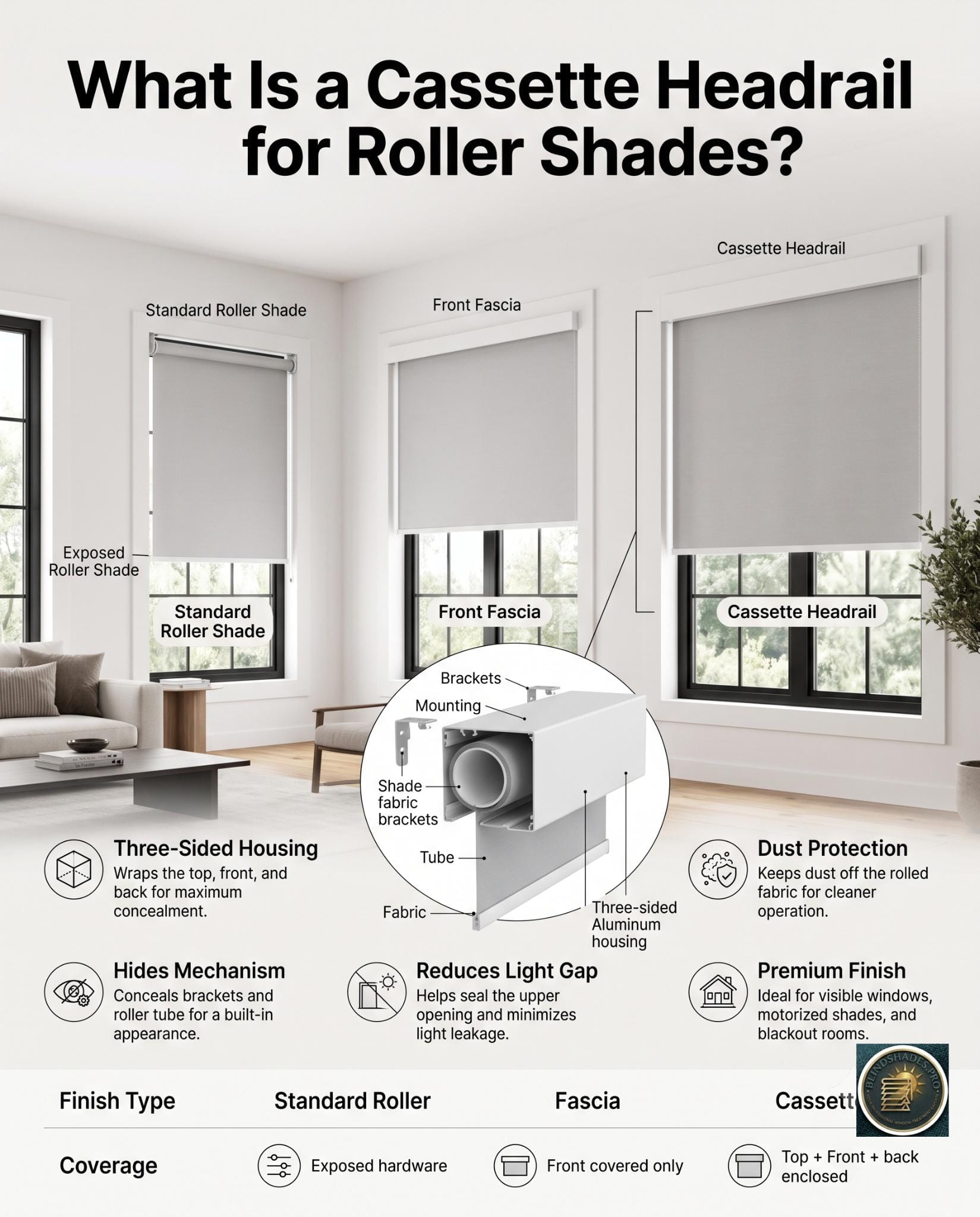
By Michael Turner | 30 years in window treatments
A cassette headrail is a slim, three-sided housing that wraps the top, front, and back of a roller shade’s fabric roll — hiding the tube, brackets, and mechanism to give the shade a clean, built-in, valance-like finish. That is the definition every guide agrees on. What they leave out is the decision behind it: a cassette is the top rung of three possible finishes, it seals the light gap above the shade, and it is worth the upcharge in some situations and skippable in others. This guide gives you the definition and the verdict.
🎯 5 Key Takeaways
- A cassette fully encloses the roll on three sides. Unlike an exposed open roll, or a fascia that only covers the front, a cassette wraps the top, front, and back — hiding the mechanism from every viewing angle.
- It is the top of a three-finish ladder. Every roller shade top is one of three finishes — open roll, fascia, or cassette — rising in coverage, cleanliness, and light-sealing. Knowing the ladder is how you choose.
- It seals the top light gap specifically. By enclosing the top of the shade, a cassette cuts the light that seeps in above the roll — the single most useful thing it does for a bedroom or media room.
- “Cassette” has several aliases. Headbox, cassette, fascia, valance, and headrail get used loosely and interchangeably; they are not all the same thing, and the confusion trips up buyers.
- It is worth it for visible, motorized, or darkness-critical windows — and skippable on budget utility windows where a plain open roll or a simple fascia does the job.
⭐ Quick Answer
What is a cassette headrail? A slim, three-sided housing that hides a roller shade’s tube and brackets for a clean, built-in look. The short version:
- What it is: a low-profile cover that houses the roller tube and brackets in a three-sided enclosure, as Blinds Chalet describes; it is one finish option for a roller shade.
- Versus a fascia: a fascia covers only the front, while a cassette wraps the top, front, and back to hide the mechanism from every angle, per World Wide Shades.
- What it does: gives a built-in, valance-like look, keeps dust off the fabric, and seals the top light gap; see how that helps blackout roller shades block light.
- Finishes: square or rounded, in metal or fabric-wrapped to match the shade, with the Rollease Acmeda cassette system the most common in North America.
- Worth it on visible, darkness-critical, or motorized windows where it hides the motor; skippable on plain utility windows.
Best Sources: Blinds Chalet (cassette headrail on roller shades); World Wide Shades (exposed roll vs fascia vs cassette); Rollease Acmeda (North American cassette systems); Maxxmar (cassettes and valances); Graham & Brown (headrail types).
What Is a Cassette Headrail?
A cassette headrail is a slim enclosure that houses the roller tube, brackets, and mechanism, wrapping them on three sides to create a clean, finished, valance-like top edge.
Here is the plain definition, then the detail the ranked pages stop at. On a standard roller shade, the tube the fabric wraps around sits exposed at the top of the window, brackets and all. A cassette headrail — also called a headbox — is a housing that encloses that tube on the top, front, and back, hiding the hardware so the shade looks built-in rather than bolted on. Blinds Chalet describes it as a low-profile cover that houses the roller tube and brackets while creating a finished, valance-like look and protecting the fabric roll. The AI Overview and World Wide Shades add the key contrast: a classic shade leaves the roll fully exposed, a fascia covers only the front, and a cassette wraps three sides to hide the mechanism from multiple viewing angles.
So the cassette does three jobs at once: it dresses the window with a clean top edge, it shields the fabric and mechanism from dust and damage, and it closes the gap where light would otherwise leak in above the roll.
What Is the Difference Between a Cassette, Fascia, and Open Roll?
The Three-Finish Ladder: every roller shade top is one of three finishes — open roll, fascia, or cassette — rising in coverage, cleanliness, and light control, so you pick the rung that matches your look, light need, and budget.
This is the frame the ranked pages never assemble, even though they mention all three parts. Lay them on a ladder and the choice becomes obvious.
| Finish | Coverage of the roll | Top light seal | Look | Relative cost |
|---|---|---|---|---|
| Open roll | None — tube exposed | Open | Utilitarian, hardware visible | Lowest |
| Fascia | Front only | Partial | Clean front, back still open | Middle |
| Cassette | Top, front, and back | Sealed | Fully built-in, valance-like | Highest of the three |
Open roll is the budget baseline and fine for utility windows. A fascia is the middle rung — it hides the front for a cleaner face while leaving the back open, which suits inside-mounted shades where the back is not visible. A cassette is the top rung, wrapping three sides for the most finished look and the best top-gap light seal. Maxxmar groups all three under the umbrella term headrail, which is exactly why buyers confuse them.
The cassette’s light-sealing matters most for darkness; see how the top gap fits into the bigger picture in our guide on whether blackout roller shades block all light.
Is a Cassette Headrail Worth It?
A cassette is worth the upcharge on windows that are highly visible, motorized, or need real darkness — and skippable on plain, low-visibility utility windows where an open roll or fascia is enough.
This is what the “are cassette blinds better?” question is really asking, and the honest answer is conditional. Score your window against this.
| Situation | Cassette verdict | Why |
|---|---|---|
| Highly visible living space | Worth it | The built-in, valance-like look is the whole point |
| Bedroom or media room | Worth it | Seals the top light gap for better darkness |
| Motorized shade | Worth it | Hides the motor and wiring for a clean finish |
| High-traffic or dusty room | Worth it | Three-sided enclosure keeps dust off the fabric |
| Commercial / hospitality | Worth it | Durability and polish, as Sun Decor notes for hospitality use |
| Budget utility window | Skip | Open roll or a fascia does the job for less |
| Back-of-house / unseen window | Skip | No one sees the roll; save the upcharge |
The pattern: a cassette earns its cost wherever the window is seen, needs darkness, or carries a motor. On a laundry-room or garage window, it is money you do not need to spend.
Does a Cassette Headrail Improve Blackout and Light Control?
Yes — a cassette seals the light gap at the top of the shade, which is one of the biggest leak points, making it a meaningful upgrade for any darkness-critical room.
This is the cassette’s most underrated benefit. On a standard roller shade, light leaks in a predictable order, and the top — where the fabric leaves the exposed roll — is one of the worst offenders. By enclosing that top, a cassette cuts the light that seeps in above the window frame, as Blinds Chalet notes among its benefits. For a bedroom, media room, or nursery, that top seal is a real gain toward darkness. It does not, on its own, make a room fully black — the sides still leak — which is why the strongest setup pairs a cassette with side channels. A cassette plus side tracks (a combination the “cassette blinds with side tracks” searches are hunting for) seals the top and both sides at once, approaching near-total darkness. For the full darkness stack, see our guide on blackout roller shades, and for a fabric-based seal, our guide on layering roller shades with curtains.
Which Cassette Finish and Shape Should You Choose?
Choose the shape for your aesthetic — square for modern, rounded for softer rooms — and the finish for how seamless you want the match, with fabric-wrapped giving the most built-in look.
Cassettes are not one-size, and the finish decision changes how the window reads. Rollease Acmeda, the most common cassette system in North America, offers several round profiles and a square one; the shape and finish are yours to match to the room.
| Option | Best for |
|---|---|
| Square cassette | Modern, architectural rooms; crisp lines |
| Rounded cassette | Softer, traditional, or transitional spaces |
| Metal finish | Contemporary look; durable, wipe-clean |
| Fabric-wrapped insert | The most seamless, built-in match to the shade fabric |
The fabric-wrapped insert is the choice for a truly invisible transition — the cassette disappears into the shade. A coordinated metal finish reads more like an intentional architectural detail. Neither is wrong; it is a look decision, and Rollease Acmeda’s size range means most windows can be matched cleanly.
What Do the Terms Headrail, Fascia, and Valance Actually Mean?
These terms overlap and get used loosely — “headrail” is the umbrella for the top section, while cassette, fascia, and valance are specific styles of it.
The People Also Ask box is full of “what does headrail mean / what does cassette mean / what is a cassette head” precisely because the vocabulary is a mess. Here is the clean decoder.
| Term | What it actually means |
|---|---|
| Headrail | The umbrella term for the top section of the shade that holds the mechanism |
| Open roll | No cover — the tube and fabric roll are fully exposed |
| Fascia | A flat cover over the front of the roll only |
| Cassette / headbox | A three-sided enclosure wrapping top, front, and back |
| Valance | A decorative top covering, often fabric or soft, more traditional |
Graham & Brown’s guidance draws the line simply: a cassette headrail hides the roll of fabric at the top, whereas the alternative leaves it exposed. Once you know headrail is the category and cassette is one specific, fully enclosed style of it, the marketing language stops being confusing.
Related Buying Guides
- The Best Roller Shades Buying Guide — where the cassette fits in the full spec
- Do Blackout Roller Shades Block All Light? — the top-gap seal in context
- Are Motorized Roller Shades Worth It? — cassettes hide the motor cleanly
- Roller Shades Layered With Curtains — the fabric alternative for sealing light
Frequently Asked Questions
What is a cassette headrail? A cassette headrail is a slim, three-sided housing that encloses the top, front, and back of a roller shade’s fabric roll, hiding the tube, brackets, and mechanism. It gives the shade a clean, finished, valance-like look, protects the fabric from dust, and seals the light gap above the shade. It is the most enclosed of the three roller shade top finishes.
What does headrail mean? Headrail is the umbrella term for the top section of a shade or blind that holds the roller tube, brackets, and operating mechanism. It can be left exposed (open roll), covered on the front only (fascia), or fully enclosed on three sides (cassette). So a cassette is one specific style of headrail, not a separate part.
What is the difference between a cassette and a fascia? A fascia covers only the front of the roller mechanism, leaving the back and top open, while a cassette wraps the top, front, and back to hide the mechanism from every viewing angle. A cassette therefore gives a more finished, built-in look and a better top-light seal, while a fascia is a simpler, lower-cost middle option.
Are cassette blinds better? They are better for windows that are highly visible, motorized, or need darkness, because a cassette delivers a clean built-in look, hides motors and wiring, keeps dust off the fabric, and seals the top light gap. On plain, low-visibility utility windows, a cassette is an unnecessary upcharge and an open roll or fascia works just as well.
Does a cassette headrail help block light? Yes, by enclosing the top of the shade it reduces the light that seeps in above the roll, which is one of the main leak points on a roller shade. It does not make a room fully dark on its own, since the sides still leak, but a cassette paired with side channels seals the top and sides together for near-total darkness.
Can you get a cassette headrail on a motorized roller shade? Yes, and it is one of the best uses for a cassette. The enclosure hides the motor, battery, or wiring along with the tube, giving a motorized shade a completely clean, built-in appearance. Because motorized shades are often installed on visible, feature windows, the cassette’s finished look tends to be worth it there.
