Roman Shades for Sliding Glass Doors (2026): Will They Fit?

Authored By Michael Turner -30 Years Home Improvement Expertise | Updated 2026 | BlindShades.pro
Updated on July 10, 2026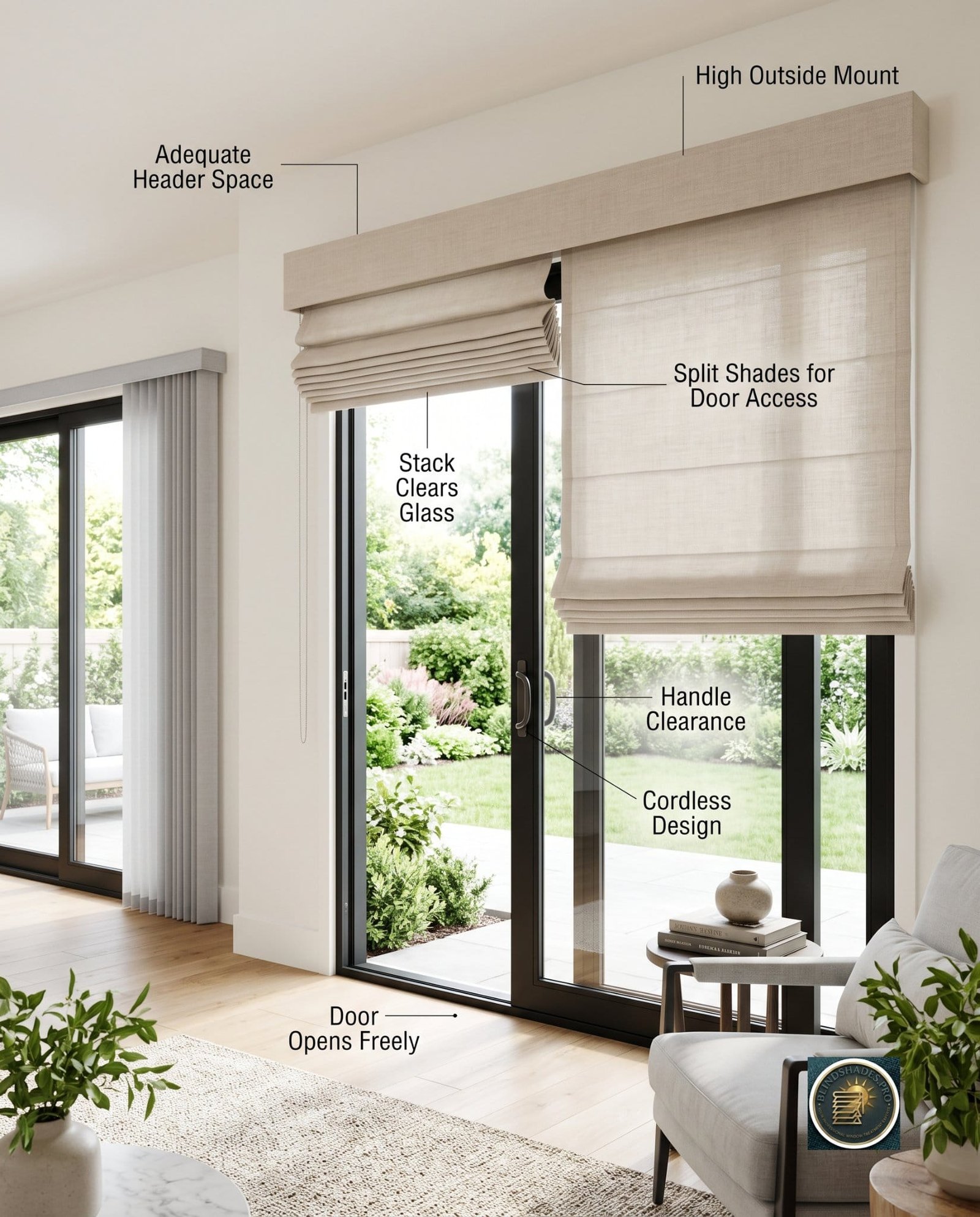
By Michael Turner | 30 years in window treatments
Roman shades work on a sliding glass door only when four clearances are satisfied, and the one nobody mentions is the ceiling above the door. Every other treatment made for a slider stacks sideways. A Roman shade stacks upward. That single mechanical fact decides everything: with a one-piece Roman shade hanging over a slider, either the shade is fully raised or the door is unusable. Understand that before you look at a single fabric swatch.
🎯 5 Key Takeaways
- A slider is not a wide window; it is a wide window you walk through. Every ranking page on this topic treats it as the former.
- Check the header first. Standard sliding glass doors are 80 inches tall, and under a standard eight-foot ceiling that leaves roughly sixteen inches of wall above the door for a stack that runs seven to ten inches.
- One shade means all or nothing. Two shades split at the operating panel let you raise only the half you walk through. Select Blinds sells 30 by 60 inch and 36 by 60 inch door-panel shades for exactly this reason.
- Width is a load problem. Standard two-panel sliders run 60, 72, or 96 inches wide, and three-panel doors reach 144. Wide Roman shades sag mid-span no matter how carefully the cords are tensioned.
- If you use the door daily, buy a different product. Vertical blinds and panel track shades stack sideways and let you walk through a partially closed covering. Roman shades cannot.
⭐ Quick Answer
Roman shades for sliding glass doors work when four clearances pass: the header has room for the raised stack, the shade clears the door handle, the door still opens, and the width stays inside the lift’s limit. Every other slider treatment stacks sideways. A Roman shade stacks upward.
- Measure the wall above the door first. Standard sliding doors are 80 inches tall, leaving about sixteen inches under an eight-foot ceiling for a stack that runs seven to ten inches.
- Mount high. Set the headrail as close to the ceiling as the wall allows so the raised stack clears the glass entirely.
- Split the shade at the operating panel if you want to use the door without raising the whole covering. Two shades also halve the span, which reduces the mid-span sag wide shades develop.
- Go cordless. Under ANSI/WCMA A100.1-2018, effective December 15, 2018, stock coverings must be cordless or have short cords. A door is a traffic path.
- Daily-use door? Buy something else. Vertical blinds and panel track blinds stack sideways and let you walk through a partially closed covering.
If darkness matters more than fold style, start with blackout blinds for sliding glass doors. The Shade Store notes that Tulip and Relaxed Roman shades must be re-dressed by hand after every adjustment — a daily chore on a patio door.
Best Sources: U.S. Consumer Product Safety Commission and the Window Covering Manufacturers Association (ANSI/WCMA A100.1-2018); Infinity by Marvin and Mr. Handyman (standard patio door dimensions); 3HLinen (extra-wide custom Roman shade specifications); Select Blinds (door-panel Roman shades); The Shade Store (fold styles for doors, March 2025); Houzz (patio door mounting height).
Can You Use Roman Shades on a Sliding Glass Door?
Yes, but only on a door you do not open constantly, and only after four measurements pass. The answer everywhere else on this topic is an unqualified yes, and that is how people end up with a shade they have to raise every time they let the dog out.
The honest version has conditions attached. A Roman shade is a horizontal covering that gathers upward into a stack. On a window, the stack sits above the glass and nothing is lost. On a door, the stack sits above your head, and the fabric that is not stacked is standing between you and the patio.
Love Is Blinds wrote in February 2025 that Roman shades are an excellent option for sliding glass doors. That is true in the same way a wool coat is an excellent option for June. It depends on the situation, and the situation here is defined by four clearances.
The Slider Clearance Test
The Slider Clearance Test: header, handle, traffic, and load. Run all four before you consider fabric, because failing any one of them cannot be fixed with a better liner.
| Clearance | What to measure | Pass condition | What failing looks like |
|---|---|---|---|
| Header | Wall height from door frame to ceiling | Enough for the full raised stack, plus the headrail | Stack hangs into the doorway; you duck |
| Handle | Projection of the door handle from the glass | Shade hangs clear of the hardware | Fabric catches and wears at the handle |
| Traffic | How often the door is opened | Rarely, or the shade is split at the panel | Raising the whole shade to step outside |
| Load | Total shade width against the lift’s rated maximum | Inside the manufacturer’s limit | Mid-span sag, uneven folds, failing lift |
The Houzz thread that still ranks for this query is from June 2010. Its top answer says to mount the shade high enough above the patio door. That was correct then, it is correct now, and in sixteen years not one of the pages that outranks it has explained how high, or what happens if you cannot.
Will a Roman Shade Fit Above Your Door?
Run the arithmetic before you shop. On many doors the answer is yes by only a few inches, and on a tall door it is often no.
Standard sliding glass doors are 80 inches tall, according to Infinity by Marvin and Mr. Handyman, with 82 and 96 inch heights also standard. A standard eight-foot ceiling is 96 inches. That leaves roughly sixteen inches of wall above an 80-inch door. A raised Roman shade parks a stack of seven to ten inches of gathered fabric, and deeper folds stack taller still.
| Door height | Ceiling height | Wall above the door | Verdict |
|---|---|---|---|
| 80 inches | 8 feet | About 16 inches | Works, if you mount tight to the ceiling |
| 80 inches | 9 feet | About 28 inches | Comfortable; mount high and clear the glass |
| 96 inches | 9 feet | About 12 inches | Tight; measure the stack before ordering |
| 96 inches | 8 feet | Effectively none | Do not fit a Roman shade |
Mount the headrail as high as the wall allows. The raised stack should sit entirely above the glass rather than across the top of it, where it blocks the view you bought the door for.
Do You Need One Roman Shade or Two?
Two, in almost every case where you use the door. A single wide shade forces you to raise the entire covering to open one panel.
A two-panel sliding door has one fixed panel and one operating panel, each roughly half the total width. Standard two-panel doors are 60, 72, or 96 inches wide, per Mr. Handyman, with the most common single configuration being 80 inches tall by 72 inches wide. Three-panel doors run 108, 120, or 144 inches, and four-panel doors reach 192.
Hang one shade across a 72-inch door and you have built an all-or-nothing covering. Hang two shades split at the panel line and you can raise the operating half, walk through, and leave the fixed half covered. Select Blinds sells its Roman Window Shades Adjustable Door in 30 by 60 inch and 36 by 60 inch sizes, which is not a coincidence — those are door-panel dimensions. Not one editorial page on the first page of Google explains why that product exists.
Width also determines whether the shade survives. Wide Roman shades sag across the middle regardless of how carefully the lift is tensioned, a failure mode covered in our guide to uneven Roman shade folds. Splitting a 96-inch door into two 48-inch shades halves the span and halves the problem.
What Is the Downside of Roman Blinds on a Door?
They must be fully raised to use the door, they stack into the head clearance, they are heavy at door widths, and the decorative fold styles need re-dressing every time you touch them.
Google asks this question in its People Also Ask box for this query. No page on the first page answers it. Here it is.
The stack is the first cost. The second is the operating cycle: a shade raised and lowered several times a day wears its cords and its fabric far faster than one that moves seasonally. The third is style. The Shade Store noted in March 2025 that Tulip and Relaxed Roman shades are decorative rather than functional, and that their swooping folds must be dressed — adjusted by hand — after each use. On a patio door, that is a daily chore. Our guide to flat vs relaxed vs hobbled Roman shades sorts which styles tolerate handling.
The fourth is the cord. Under ANSI/WCMA A100.1-2018, developed by the Window Covering Manufacturers Association with the U.S. Consumer Product Safety Commission through the American National Standards Institute, stock window coverings sold in the United States must be cordless or have inaccessible or short cords, which the CPSC defines as eight inches or less. The standard took effect December 15, 2018, and WCMA states stock products account for more than eighty percent of coverings sold in the United States and Canada. Custom shades are the exception, and a slider is exactly where people order custom, wide, and corded — beside a doorway people walk through.
What Kind of Blinds Are Best for Sliding Patio Doors?
Anything that stacks sideways. That is the whole answer, and it is why vertical blinds and panel track shades still dominate this application.
| Treatment | Stacks | Use the door while covered? | Handles door widths |
|---|---|---|---|
| Roman shade | Upward | No, unless split at the panel | Poorly above 96 inches |
| Vertical blind | Sideways | Yes | Yes, to very wide openings |
| Panel track | Sideways | Yes | Yes, purpose-built for sliders |
| Roller shade | Upward | No | Sagging at wide spans |
| Vertical cellular | Sideways | Yes | Yes, with better insulation |
If you use the door daily, our guides to vertical blinds and panel track blinds cover the products designed for the job. If darkness is the priority rather than the fold style, start with blackout blinds for sliding glass doors instead.
Roman shades earn their place on a slider you rarely open: a bedroom door onto a balcony, a formal room, a fixed panel beside a hinged door, or any opening where the covering stays down and the look matters more than the traffic.
Best Roman Shades for Sliding Glass Doors: Our Picks
Selected on width capability, lift type, and whether the product is actually built for a door rather than resized from a window shade.
Every product below is real and currently available. Prices move constantly, so where one appears it is quoted to a named source.
| Category | Product | Why it works on a door |
|---|---|---|
| Best Extra-Wide | 3HLinen Linen Roman Shades for Sliding Glass Doors | Custom widths of 60, 72, 96, 108, and 144 inches; 80 or 100 percent blackout lining; European Flax certified |
| Best Split-Panel | Select Blinds Roman Window Shades Adjustable Door | Sold at 30 by 60 and 36 by 60 inches, sized to one door panel |
| Best Custom | Levolor Custom Roman Shades | Made to your exact opening, sold through Home Depot |
| Best Budget Cordless | Chicology Cordless Roman Shades | Cordless lift, widely stocked; check the width limit before ordering |
| Best Woven | Backyard X-Scapes Cord Free Reed Roman Shades | Cord-free reed, suited to a patio door’s indoor-outdoor look |
3HLinen lists its extra-wide linen shades from roughly three hundred forty-four to two thousand forty-one dollars, which tells you what door-width Roman shades cost when made properly. American Blinds lists patio and French door blinds at roughly fifty-nine to two hundred fifty-two dollars, carrying a 4.8 store rating from 680 ratings. That spread is the difference between a resized window shade and a covering engineered for an opening you walk through.
Related Buying Guides
- The Best Roman Shades Buying Guide — the full category
- Best Vertical Blinds — the sideways-stacking alternative
- Best Panel Track Blinds — purpose-built for sliders
- Blackout Blinds for Sliding Glass Doors — when darkness is the priority
- Flat vs Relaxed vs Hobbled Roman Shades — which styles tolerate daily handling
- Uneven Roman Shade Folds — why wide shades sag mid-span
Frequently Asked Questions
Can you use Roman shades on a sliding glass door? Yes, provided the wall above the door has room for the raised stack, the shade clears the door handle, and you are willing either to raise the whole shade to open the door or to split it into two shades at the operating panel. On a door you open several times a day, a sideways-stacking covering such as a vertical blind or panel track is the better choice.
What is the downside of Roman blinds on a door? They stack upward, so a one-piece shade must be fully raised before you can use the door. The stack occupies the wall above the frame, decorative fold styles need re-dressing by hand after each use, and at door widths the shade becomes heavy enough to sag across the middle. The Shade Store noted in March 2025 that Tulip and Relaxed styles in particular must be dressed after adjusting.
What kind of blinds are best for sliding patio doors? Anything that stacks sideways rather than upward. Vertical blinds, panel track shades, and vertical cellular shades all let you walk through a partially closed covering, which is the single functional requirement a door imposes and a window does not. Roman and roller shades both stack upward and must be raised clear of the opening.
How high should you mount a Roman shade above a sliding door? As high as the wall allows. Standard sliding glass doors are 80 inches tall, and a standard eight-foot ceiling leaves roughly sixteen inches above the frame. A raised Roman shade stacks seven to ten inches of gathered fabric, so mounting tight to the ceiling is what keeps that stack above the glass rather than across the top of it.
Should you use one Roman shade or two on a sliding door? Two, if you use the door. A two-panel slider has one operating panel of roughly half the total width, so splitting the covering at the panel line lets you raise only the half you walk through. Select Blinds sells door-panel Roman shades at 30 by 60 and 36 by 60 inches for this purpose. Splitting also halves the span, which reduces mid-span sag.
What are the best shades for a sliding glass door you use every day? Not Roman shades. A daily-use door needs a covering that stacks to the side, so vertical blinds, panel track shades, or vertical cellular shades are the practical answers. Reserve Roman shades for a slider that stays closed, a fixed panel beside a hinged door, or a room where the look matters more than the traffic.
