Solar Shades vs Cellular Shades: Which Should You Actually Buy?

Authored By Michael Turner -30 Years Home Improvement Expertise | Updated 2026 | BlindShades.pro
Updated on July 22, 2026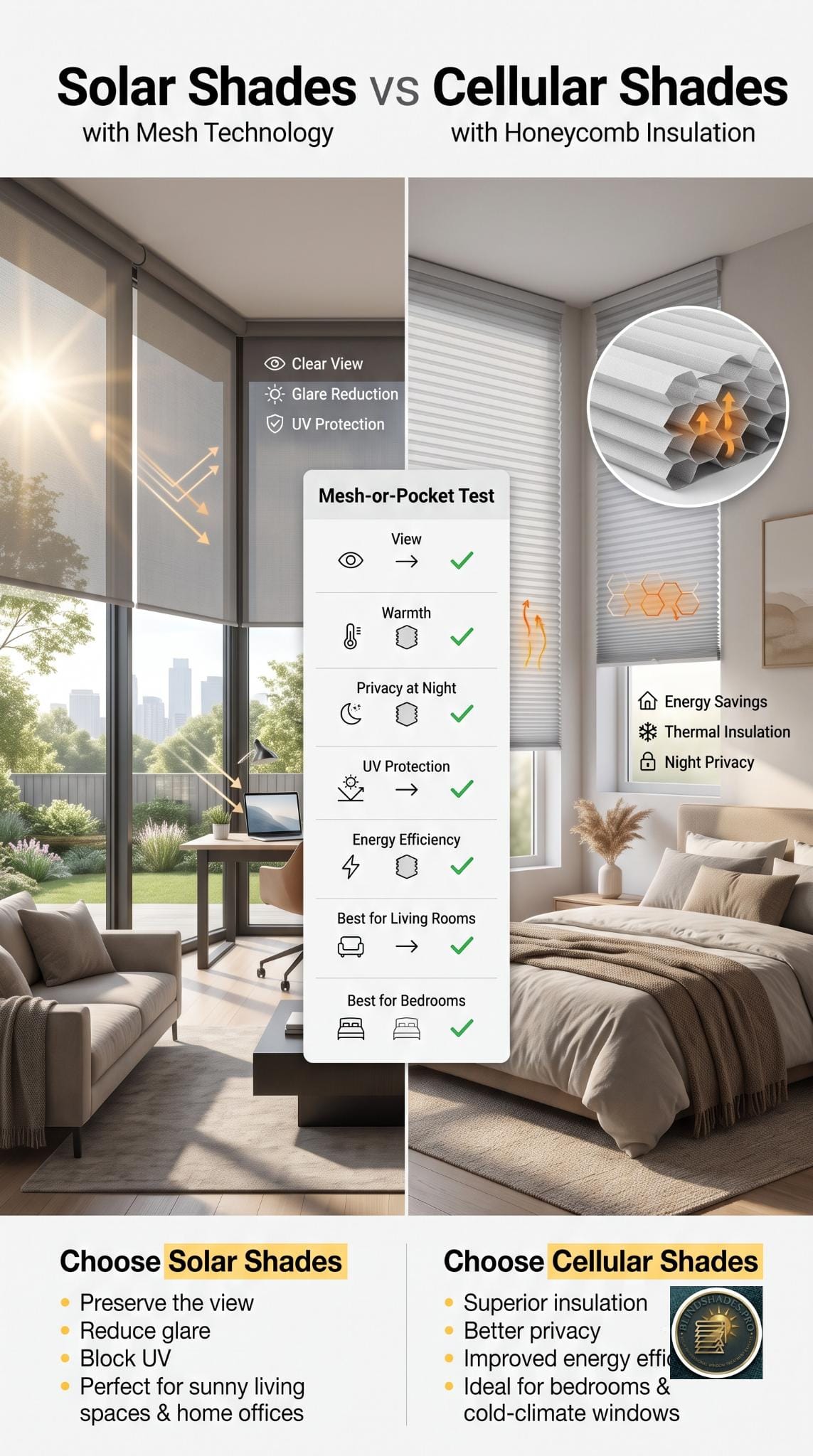
By Michael Turner — 30 years in window treatments
Solar shades win when the job is glare, UV, and keeping your view; cellular shades win when the job is insulation, darkness, and nighttime privacy — and the fastest way to decide is the Mesh-or-Pocket Test: an open-weave mesh cannot insulate, and a sealed honeycomb pocket cannot preserve a view. Neither product is “better” — they solve opposite problems, which is why the room-by-room verdict table further down this page settles more arguments than any feature list, including the one room where I recommend hanging both on the same window.
Key Takeaways
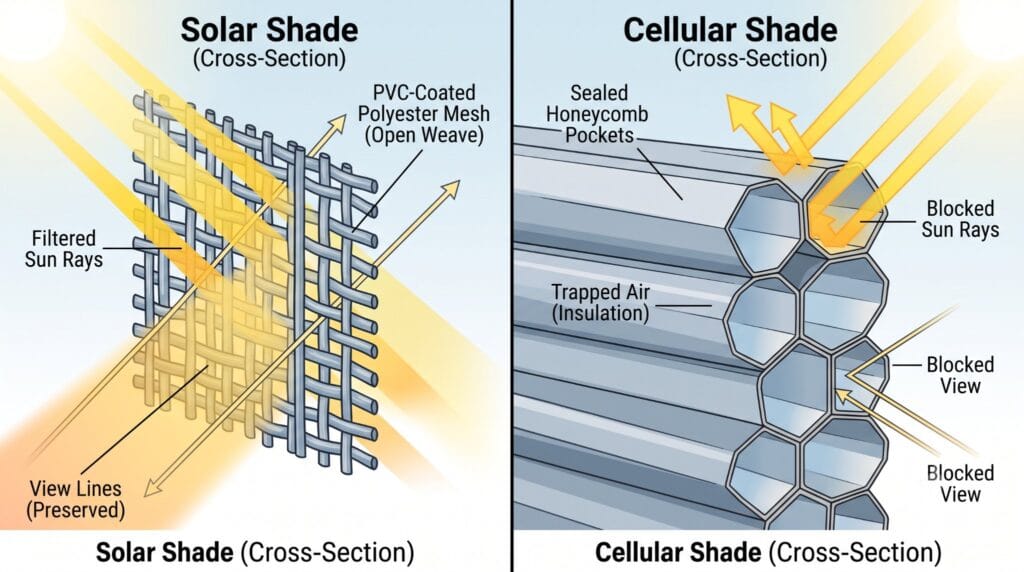
- They’re opposites, not rivals. A solar shade is a woven screen that filters light while you see through it; a cellular shade is a fabric wall of air pockets that blocks the view and holds warmth.
- The energy math favors different seasons. The U.S. Department of Energy credits insulated cellular shades with cutting heat loss through windows by forty percent or more in winter — the single biggest number in this comparison — while solar shades earn their keep in cooling season by rejecting glare and solar gain before it lands.
- Privacy reverses at night on the solar side. A solar shade’s see-out mesh becomes see-IN after dark when interior lights come on; cellular fabric stays opaque around the clock.
- UV protection is the solar shade’s cleanest win. Fabric makers publish blocking figures in the ninety-five to ninety-nine percent range depending on openness factor — protection cellular can’t match without giving up all its light.
- Price classes overlap almost entirely. Both start around thirty dollars ready-made and run to a few hundred custom per current retail listings — so price decides less here than in any comparison we cover; the room decides.
⭐ Quick Answer — Solar Shades vs Cellular Shades
The solar shades vs cellular shades decision is the Mesh-or-Pocket Test — View, Warmth, and Wallet — and neither wins outright:
- Choose solar for sun-facing living rooms, offices, and any window whose view you keep: the mesh kills glare and blocks most UV — fabric makers like Phifer publish blocking specs in the ninety-five-plus percent range at low openness — while you still see out.
- Choose cellular for bedrooms, cold-climate glass, and street-facing windows: the Department of Energy credits insulated honeycombs with cutting window heat loss by forty percent or more, and the fabric stays private around the clock.
- The trap to avoid: solar mesh reverses at night — see-out becomes see-in when the lights come on; the full physics is in our night privacy guide.
- The one both-answer: sunrooms and all-glass rooms layer solar on the glass with cellular over it — opposite talents, one window.
- Ready to shop your side: verified picks with ratings live in the complete solar shades guide and the cellular and honeycomb shades guide; the seller-side comparison coverage this SERP surfaces most is at Blindsgalore, and ready-made entries at both start around thirty dollars.
Contents
- Fit Check: Which One Fits Your Window
- What’s the Real Difference — Solar vs Roller vs Cellular?
- Are Solar Shades Better Than Cellular Shades?
- What Are the Drawbacks of Cellular Shades?
- Which Wins Room by Room?
- Common Mistakes When Choosing Between Them
- The Bottom Line
- Frequently Asked Questions
Fit Check: Which One Fits Your Window
| Fit Check | Solar shade | Cellular shade |
|---|---|---|
| ✔ Best for | Glare control with a view · UV protection · sun-facing daytime rooms · moisture rooms | Insulation · bedrooms · night privacy · sound softening |
| ✖ Not ideal for | Night privacy · winter insulation · blackout | Preserving a view · humid rooms · tight budgets on very wide glass |
| Typical price class | Around thirty dollars ready-made to the low hundreds custom (per current retail listings) | Similar entry, similar custom ceiling |
| Signature spec | Openness factor (one, three, five, or ten percent) | Cell structure (single, double, triple) |
What’s the Real Difference — Solar vs Roller vs Cellular?
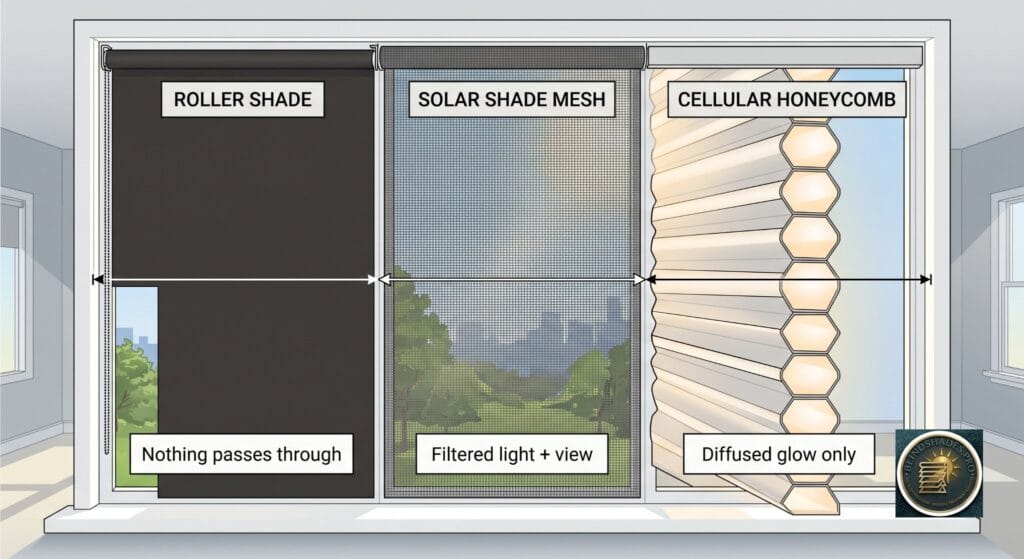
A solar shade is a roller shade woven as a screen, and a cellular shade is neither — the three products form a ladder from see-through to sealed, which is also the answer to the common question of how solar shades differ from “regular” shades.
All three hang from a similar headrail; the resemblance ends there. A standard roller shade is continuous opaque or light-filtering fabric — what you block, you block completely. A solar shade swaps that for an engineered mesh, usually PVC-coated polyester or fiberglass, woven to a stated openness factor — the percentage of the weave that is open hole, from a tight one percent to an airy ten. A cellular shade abandons the flat sheet for bonded honeycomb pockets trapping still air against the glass — the mechanism behind every insulation claim it makes. Searchers increasingly frame this as solar shades vs cellular shades vs roller, and the table below scores all three; the pros and cons of the two headliners then get their own honest sections.
| Feature | Solar shade | Standard roller shade | Cellular shade |
|---|---|---|---|
| Daytime view out | ★★★★★ preserved through the mesh | ☆ none when lowered | ☆ none when lowered |
| Glare control | ★★★★★ its core job | ★★★☆☆ all-or-nothing | ★★★★☆ diffused |
| UV protection | ★★★★★ ninety-five to ninety-nine percent, per fabric-maker specs by openness | ★★★☆☆ | ★★★★☆ |
| Winter insulation | ★☆☆☆☆ open weave cannot hold air | ★★☆☆☆ | ★★★★★ the DOE’s forty-percent heat-loss reduction class |
| Summer heat rejection | ★★★★☆ intercepts solar gain, dark colors best | ★★★☆☆ | ★★★★☆ blocks gain by blocking everything |
| Night privacy | ★☆☆☆☆ reverses after dark | ★★★★☆ | ★★★★★ |
| Moisture rooms | ★★★★★ vinyl-coated mesh shrugs at humidity | ★★★☆☆ fabric-dependent | ★★☆☆☆ pockets hold humid air |
The energy column’s numbers, plainly attributed: the U.S. Department of Energy credits insulated cellular shades with cutting window heat loss by forty percent or more in winter and unwanted solar heat by up to sixty percent in summer — the category’s strongest published figures. Solar answers on certification: attachment energy performance is rated by the AERC (Attachments Energy Rating Council), and rated screen fabrics from makers like Phifer publish UV-blocking specs in the ninety-five-plus range at low openness. What the mesh can never publish is an insulation number — open holes don’t hold air, which brings us to the verdict.
Are Solar Shades Better Than Cellular Shades?
The solar shades vs cellular shades question has no outright winner — solar takes the sun’s problems (glare, UV, heat arriving with your view intact), cellular takes the house’s problems (heat escaping, darkness, privacy). The winner depends on which problem your window has.
Here is the category-by-category call, and my reasoning where it’s close:
🏆 The Winner Box
- Winner for glare and view: Solar — this is the whole reason the product exists; nothing else kills glare while keeping the skyline.
- Winner for UV and fading: Solar — the published ninety-five-to-ninety-nine-percent blocking specs protect floors and furniture with the light still on.
- Winner for insulation: Cellular — the DOE’s forty-percent figure is unanswerable; the mesh doesn’t even compete.
- Winner for night privacy: Cellular — solar mesh reverses after dark; the full physics of that reversal, and what your windows look like from the street at night, is in our solar shade night privacy guide.
- Winner for moisture rooms: Solar — PVC-coated mesh dries instantly; humid air sitting inside honeycomb pockets is cellular’s quiet weakness.
- Winner for cost: Effectively a tie — both classes start around thirty dollars ready-made and climb similar custom ladders per current listings; buy on fit, not price.
- Winner overall: the room decides — which is exactly what the verdict table two sections down is for.
One recommendation-voice note on the solar side before the drawbacks section, because openness factor decides how well the mesh does its winning: in south- and west-facing rooms I generally specify a three percent openness — it holds the glare line without turning the room dim — while a five percent suits most other exposures, and a one percent belongs in media rooms where screen washout matters more than the view. The full ladder decision lives in our five versus ten percent openness guide.
What Are the Drawbacks of Cellular Shades?
Five honest ones — view loss, trapped humidity, dust in the cells, stack bulk, and cord-path repairs — and buyers deserve them listed plainly, because the insulation number is usually the only thing the honeycomb’s sellers talk about.
Google attaches this exact question to nearly every solar shade search, and the answer rarely comes from anyone selling cellulars. Here it is from the comparison side:
| Cellular drawback | Why it happens | How much it should matter |
|---|---|---|
| The view disappears | Opaque cell walls — lowering the shade means losing the window | Decisive for view windows; irrelevant for bedrooms |
| Humidity lives in the pockets | The same trapped air that insulates also holds moisture in baths and kitchens | Real — choose solar or faux wood in wet rooms |
| Cells collect dust and insects | Open-ended honeycomb channels are hard to reach | Cosmetic but persistent; compressed-air cleaning helps |
| Bulkier raised stack | Two or three bonded layers compress less than a flat mesh | Matters on short windows where the stack eats glass |
| Cord and mechanism repairs | Lift cords route inside the cells — elegant until a restring is needed | A repair-cost line solar’s simpler roll avoids |
Fairness requires the mirror image, and the solar shade’s own honest list — the night-privacy reversal, the near-zero insulation, the fact that it is never blackout — is covered in full in the disadvantages of solar shades, with the winter question specifically in do solar shades keep cold out. Neither product survives its own drawbacks list unbruised — which is why the room, not the spec sheet, should pick. The confusion is common enough that a Houzz thread on this exact choice recounts a store claiming both would “control temperature well” — the DOE’s numbers above are the honest correction. (And for buyers weighing cellular against curtains instead, that matchup belongs to the cellular guide linked above.)
Which Wins Room by Room?
Sun-facing living spaces and offices go solar, sleeping rooms and cold walls go cellular — and the sunroom is the one place I recommend paying for both on the same window.
This is the table the rest of the page has been building toward:
| Room | Verdict | Why |
|---|---|---|
| South/west living room | Solar, three percent | Glare dies, the view survives, furniture stops fading |
| Home office | Solar, three to five percent | Screen glare control with daylighting intact — the energy-efficiency play that keeps lights off |
| Bedroom | Cellular, double-cell blackout | Night privacy + darkness + the warmest window in the house |
| Nursery | Cellular | Cordless blackout cells; sleep beats view |
| Bathroom | Solar (or faux wood) | Mesh dries instantly; pockets and steam disagree — the wet-room specifics are in solar shades for bathroom privacy |
| Kitchen | Solar, five percent | Wipeable vinyl-coated mesh over the sink and stove zone |
| Cold-climate north wall | Cellular, triple-cell | The forty-percent DOE number is the argument; nothing else on this page touches it |
| Media room | Solar one percent, or blackout cellular | One percent tames washout with some view; cells if true dark is the brief |
| Sunroom / all-glass room | Both, layered | Solar on the glass for daytime glare and UV, a cellular over it for winter evenings — the one window where the two products’ opposite talents justify two headrails |
| Street-facing ground floor | Cellular (or solar + curtain layer) | The night reversal makes bare solar mesh the wrong lone treatment here |
Common Mistakes When Choosing Between Them
Five errors show up over and over in this decision, and every one of them traces back to ignoring the Mesh-or-Pocket logic.
- Buying solar for a bedroom — then discovering the night reversal and the morning light at 6 a.m. The mesh was never designed for sleeping rooms.
- Buying cellular for a view window — the insulation is real, but you’ll resent the wall it makes of your best glass.
- Choosing ten percent openness for a west window — the airier weave that felt bright in the showroom surrenders to a setting sun; west glass wants three percent, sometimes one.
- Expecting either to be the other — solar is not insulation, cellular is not a view product; layering (the sunroom row above) is the honest fix when a window needs both.
- Deciding on price — with both classes starting around thirty dollars and overlapping all the way up, price cannot break this tie.
The Bottom Line
The solar shades vs cellular shades split is clean: the mesh owns daylight problems, the pocket owns comfort problems — decide per window, not per house. The scenario matrix, condensed:
- Hot climate, sun-facing glass → solar, three percent openness
- Home office → solar, three to five percent
- Bedrooms and nurseries → cellular, blackout cells, cordless
- Cold-climate windows → cellular, double or triple cell
- Wet rooms → solar
- Media rooms → solar one percent, or blackout cellular for true dark
- Sunrooms → both, layered
- Large view windows → solar, and consider motorized for the widest spans
Ready to shop your side of the split? The verified picks with ratings and review bases are in the complete solar shades buying guide and the cellular guide above — and every custom program in both categories runs recurring thirty-to-fifty-percent promotion cycles, so the sale price is the real price when you get there.
Frequently Asked Questions
Are solar shades better than cellular shades?
Neither is better outright: solar shades win glare, UV protection, and daytime view; cellular shades win insulation, night privacy, and darkness. Match the product to the window’s problem — sun-facing living spaces go solar, bedrooms and cold-climate glass go cellular — rather than picking one for the whole house.
What are the drawbacks of cellular shades?
Five honest ones: the view disappears when they’re lowered, the air pockets can hold humidity in wet rooms, the open cells collect dust, the raised stack is bulkier than a rolled mesh, and internal cord repairs cost more than a simple roller mechanism. None of them outweigh the insulation case in the rooms cellular is built for.
Do solar shades insulate like cellular shades?
No — an open-weave mesh cannot trap air, so a solar shade adds almost no winter insulation. The Department of Energy’s strong numbers, including heat-loss reductions of forty percent or more, belong to insulated cellular shades; solar shades earn their energy value in cooling season by intercepting glare and solar gain instead.
Which lasts longer, solar or cellular shades?
Comparable lifespans in their intended rooms — PVC-coated and fiberglass solar mesh is notably resistant to sun and moisture degradation, while cellular fabric lasts equally well kept out of humid rooms. Mechanism quality decides more than fabric here: cordless lifts on either product outlast budget corded ones.
Are solar or cellular shades more expensive?
They overlap almost completely: both start around thirty dollars ready-made and run to a few hundred per window custom, per current retail listings, with the same recurring promotion cycles. Price genuinely cannot break this tie — choose on the Mesh-or-Pocket logic and buy on the sale cycle.
Can I use solar and cellular shades together?
Yes — layering is the honest answer for sunrooms and all-glass rooms: solar mesh on the glass handles daytime glare and UV, with a cellular shade layered over it for winter evenings and privacy. Two headrails on one window sounds extravagant until you live with a room that needs both jobs done.
Best Sources
- U.S. Department of Energy, energy-saver guidance on window coverings — the heat-loss (forty percent or more) and cooling-season (up to sixty percent) figures for insulated cellular shades
- AERC (Attachments Energy Rating Council) — the certification body rating energy performance of window attachments, including solar screen fabrics
- Phifer published fabric specifications — openness factors and UV-blocking figures for PVC-coated polyester and fiberglass solar mesh
- Live retail listings (Home Depot, Lowe’s, Blindster, SelectBlinds), July 2026 — price classes and promotion depths cited in words throughout
Related Guides
- The Best Solar Shades Buying Guide — the parent hub with verified picks
- The Best Cellular & Honeycomb Shades Guide — the other side of this comparison
- Can You See Through Solar Shades at Night? — the reversal explained
- 5% vs 10% Solar Shades: The Openness Decision — the ladder in full
