5% vs 10% Solar Shades: The Openness Factor Decision

Authored By Michael Turner -30 Years Home Improvement Expertise | Updated 2026 | BlindShades.pro
Updated on July 22, 2026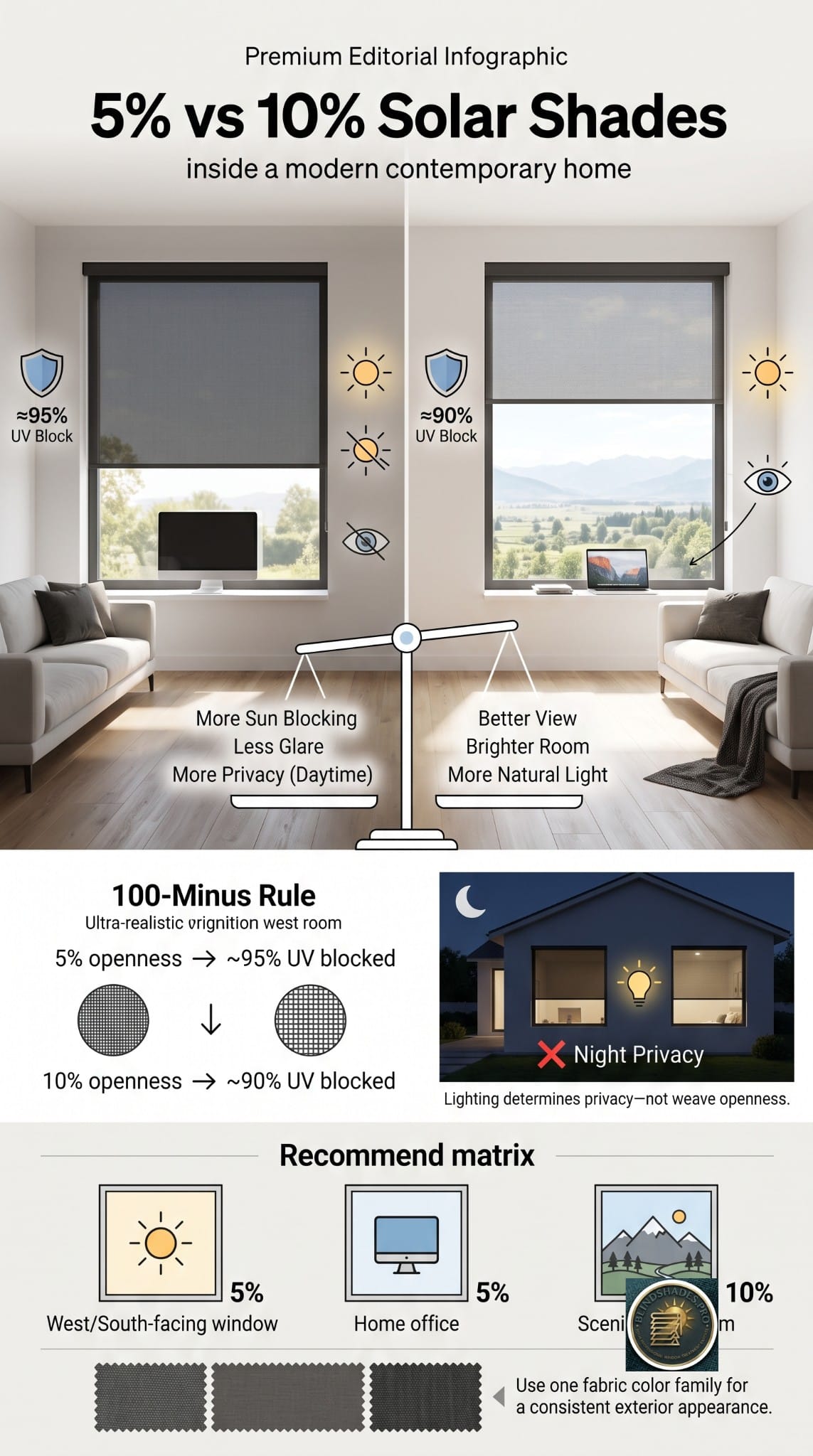
By Michael Turner — 30 years in window treatments
Choose 5% for sun-facing windows where glare is the enemy, and 10% where the view is the whole point — that is the honest core of the 5% vs 10% solar shades decision, and the label does the math: the openness number is roughly how much you see, one hundred minus it is roughly the UV you block. These are the shades that block the sun but not the view; the percentage sets where the balance lands. This guide decodes the numbers, adjudicates the decade-old glare debate, answers the combo question nobody else touches, and ends with the window-by-window matrix that decides it.
Key Takeaways
- The 100-Minus Rule decides most of it. North Solar Screen (January 21, 2026) puts 10% openness at about 90% UV blocked; Shade Doctor (April 1, 2026) and Made in the Shade Kearney put 5% at up to 95% — the label’s number is your view, one hundred minus it is your shield.
- UV is not heat. The featured-snippet claim of “90% heat reduction” for 5% mesh conflates two measurements — the corroborated numbers are UV figures; heat is a separate metric covered in our heat guide.
- The glare debate is real and both sides are right. A Houzz commenter reports glare even at 5% while 10% “might have been problematic” — it depends on whether the room hosts screens or views.
- 10% is not reckless. Canisteo Blinds argues clients should stop fearing 10% openness — about 90% UV blocked with the view preserved — while calling 1% and 3% “too clinical” for many living spaces.
- The forums’ real question is the combo. The top Houzz thread asks “3%, 5% or 10% — or a combo?” — and mixing percentages by orientation, in one color family, is the answer no ranking article gives.
⭐ Quick Answer — 5% vs 10% Solar Shades
The 5% vs 10% solar shades decision is the 100-Minus Rule: the openness number is roughly how much you see, and one hundred minus it is roughly the UV you block — so the window, not the fabric, decides:
- Choose 5% for sun-facing glass and screen-heavy rooms — up to ninety-five percent UV interception per Shade Doctor, with a good if slightly veiled view.
- Choose 10% where the view leads — North Solar Screen puts the looser weave at about ninety percent UV blocked, and Canisteo Blinds argues clients should stop fearing it: tighter weaves often feel too clinical in living spaces.
- The trap to avoid: “heat reduction” percentages — the corroborated numbers are UV figures, and heat is a separate measurement; neither weave gives night privacy either, as our night privacy guide explains.
- The professional answer is a combo: percentages per window, one fabric color family for a uniform facade — and if you also need insulation or darkness, the fork is solar shades vs cellular shades.
- Ready to pick the fabric: verified picks with retail ratings live in the complete solar shades guide.
What Does Openness Mean for Solar Shades?
The 100-Minus Rule: the openness number is roughly how much you see; one hundred minus it is roughly the UV you block. Both answers are on the label.
Openness factor is the percentage of a solar shade’s woven surface that is open hole. The mesh — PVC-coated polyester or fiberglass, in the 1%-to-10% ranges fabric houses like Phifer publish for their Sheerweave lines — carries one number that sets nearly everything: view, glare, daylight, UV. What does 5% openness mean in practice? Five percent of the surface passes light and view straight through, and the weave intercepts roughly the rest — Shade Doctor (April 1, 2026) and Made in the Shade Kearney both put 5% at up to 95% UV blocked. At 10%, North Solar Screen (January 21, 2026) describes a much looser weave blocking about 90% of UV while admitting notably more visibility and sunlight — the figure Canisteo Blinds also cites.
One honest correction: a widely repeated comparison credits 5% with “90% heat reduction” and 10% with “85%” — velablinds’ claim (July 1, 2025), and a conflation. The corroborated industry numbers are UV figures; heat gain is a different measurement (the SHGC concept), driven heavily by fabric color and covered in our solar-shades-for-heat guide. Openness buys view and UV math, not a furnace rating. Decoder set — the two-way fight is next.
| Openness | View out (day) | UV blocked (≈100-minus) | Glare control | Honest role |
|---|---|---|---|---|
| 1% | Muted ★★☆☆☆ | ~99% per Phifer-class specs | Maximum ★★★★★ | Media rooms, harsh western sun; “clinical” in living areas per Canisteo |
| 3% | Softened ★★★☆☆ | ~97% | Strong ★★★★☆ | Screen-heavy rooms wanting some connection outside |
| 5% | Good ★★★★☆ | Up to 95% (Shade Doctor, Kearney) | Solid ★★★☆☆ | The all-rounder for sun-facing living spaces |
| 10% | Near-panoramic ★★★★★ | ~90% (North Solar Screen, Canisteo) | Moderate ★★☆☆☆ | View windows, shaded exposures, daylight-first rooms |
5% vs 10% Solar Shades: Which Should You Choose?
Choose by the window’s job: 5% when the glass takes direct sun and the room hosts screens, 10% when the view is the reason the window exists. The trade is symmetrical — Aoodor (March 9, 2025) frames 5–10% as the medium band balancing sunlight against glare — and where you land depends on what you are protecting: eyes and screens, or scenery.
| Round | 5% openness | 10% openness | Winner |
|---|---|---|---|
| View clarity | Good, slightly veiled | Near-panoramic | 10% |
| Glare control | Solid — workable with screens | Moderate — bright rooms stay bright | 5% |
| UV interception | Up to ~95% | ~90% | 5% |
| Natural daylight | Softened | Generous | 10% |
| Daytime privacy | Better fabric face | Lighter veil | 5% |
| Night privacy | None — lit rooms show through | None — identical failure | Tie |
| Verdict | Sun-facing default | View-window default | The window decides |
Winner Box: Glare — 5%. View — 10%. UV — 5%. Daylight — 10%. Night privacy — neither (a lighting problem; the physics is in our night privacy guide). Overall — the window, not the fabric, decides, which is why the matrix below exists. And if you want the shade to also insulate or darken, you have outgrown mesh — that fork is solar shades vs cellular shades.
Is 10% Openness Too Much?
Not for a view window — with one honest caveat about glare. Canisteo Blinds runs an entire piece titled “Why I Tell Clients to Stop Fearing 10% Openness”: a 10% factor blocks about 90% of UV while preserving the view, and the tighter 1% and 3% weaves often feel too clinical for residential rooms. The counter-testimony lives on Houzz, where a commenter reports some glare even at 5% — not too bad — and suspects 10% would have been problematic.
Both are right, and the reconciliation is what I call the Glare Threshold: glare tolerance is set by the room’s job, not the fabric. Screen rooms — home office, TV wall, a tablet on the kitchen counter — sit at a low threshold; 10% on a sunny exposure washes displays, so take 5% or tighter. Scenery rooms — living room on woods, upper-floor water view — sit high, and 10% is the correct call Canisteo describes. One caveat no percentage escapes: direct low-angle sun at sunrise or sunset defeats every openness — a layering problem, not a reason to buy 1% everywhere. My rule after three decades: pick the weave for the room’s worst regular hour, not its worst two minutes of solstice glare. Which raises the tighter end of the ladder.
What About 1% and 3% Openness?
The tight weaves are specialists, not upgrades. In the 1% vs 5% decision, 1% buys maximum glare kill and the highest UV interception at the cost of a muted, screen-door view — right for media rooms and brutal western exposures, and the weave the night-privacy forums argue over (verdict: even 1% is obscurity after dark, not privacy — the night guide adjudicates it). In the 3% vs 5% decision, 3% keeps stronger glare control for screen-facing rooms with some outside connection; 5% flips toward view and light. The Houzz record shows how long this ladder has been debated — a 12-post openness thread from 2013, a 19-post “1, 3 or 5%?” thread from 2016 — and the pattern matches Canisteo’s warning: the tightest weave in ordinary living rooms breeds aquarium regret, while screen rooms bless it. If your motive for a tight weave is evening privacy or a darker bedroom, the honest answer is a second layer or a different product — the disadvantages guide covers what mesh cannot do. And if no single number fits the whole house, it was never supposed to.
Can You Mix Openness Percentages in One House?
Yes — mixing is the professional answer, and the question has sat publicly unanswered since 2014, when a Houzz poster asked “3%, 5% or 10% — or a combo?” while sketching 5-or-10 for the living room and 3-or-1 for the dining room. That instinct is correct; I formalize it as the Combo Doctrine, two rules long:
Rule one — the percentage follows the window, not the house. Order openness per exposure and per room job: looser mesh where view and daylight lead, tighter mesh where sun and screens lead. Suppliers sell by the shade, not the house; nothing forces uniformity.
Rule two — the color stays in one family. Mixed percentages read as chaos only when colors differ; keep every shade in the same fabric color family (ideally the same fabric line at different openness) and the facade reads uniform from the street while every room gets its correct weave. Dark fabrics also sharpen view-through at any openness — the color half of the decision is its own guide.
| Room in one south-facing house | Openness | Why |
|---|---|---|
| Living room, view side (north/shaded) | 10% | View and daylight lead; sun never hits directly |
| Family room, south glass | 5% | Direct sun + television = glare threshold |
| Home office, west window | 3% | Afternoon sun on monitors — screens set the threshold |
| Kitchen, east breakfast window | 5% | Morning sun, softened but connected |
| Media room | 1% | Maximum glare kill; dimness is the point |
| Bedrooms | Route the decision | Mesh gives no night privacy or darkness — see the night guide before ordering |
Which Openness for Which Window?
The matrix this page has been building toward — orientation and job decide, in that order:
| Window situation | Best openness | The reasoning |
|---|---|---|
| South- or west-facing living glass | 5% | Direct sun most of the day; up to ~95% UV with a usable view |
| Harsh western exposure with screens | 1–3% | Below the glare threshold; “clinical” is correct here |
| North-facing or fully shaded | 10% | No direct sun to manage — buy the view and daylight |
| View corridor (water, woods, skyline) | 10% | The view is the point; ~90% UV still intercepted |
| Ground-floor street-facing | 5% + a night layer | Tighter daytime veil; mesh still fails at night — layer per the night guide |
| Sunroom / three-season room | 10% (5% on the sun wall) | The Combo Doctrine in miniature |
Fit Check
✔ 5% fits you if: your problem windows take direct sun, screens live in the room, you want the stronger UV math, and a slightly veiled view is an acceptable price. ✖ 5% is wrong if the window exists for its view and never takes harsh sun — you would be paying in scenery for protection you do not need. ✔ 10% fits you if: the view leads, the exposure is shaded or northern, and daylight matters more than glare. ✖ 10% is wrong if you read screens in that room’s sun hours or want the strongest daytime fabric face. Either way, the room-by-room percentage guide carries the living-room-specific verdict this ladder feeds into.
Common Mistakes
- Reading “heat reduction” claims as gospel. The corroborated openness numbers are UV figures; heat performance is a separate metric (SHGC) driven heavily by color — sellers who merge them are rounding the physics.
- Buying 1% for privacy. No openness gives lit-room night privacy; the tightest weave buys obscurity and a dim view, nothing more.
- One percentage for the whole house. The 2014 Houzz question had it right — the window’s exposure and job decide, and the color family keeps the facade uniform.
- Ignoring color’s share of the outcome. A dark 10% often out-views a light 5% while running warmer — openness is half the decision.
- Shopping exterior-screen advice for interior shades. Much of the advice published on openness is written about outdoor screens; exterior products carry different math and mounting — a separate family entirely.
- Buying for the worst two minutes. Low-angle sunrise/sunset sun defeats every openness; pick for the room’s worst regular hour and layer for the solstice moments.
The Bottom Line
The 5% vs 10% solar shades decision is the 100-Minus Rule applied per window: 5% trades view for stronger glare and UV interception on sun-facing glass; 10% trades a few UV points for a near-panoramic view where scenery leads; and the professional move is a combo — percentages per window, one color family, facade uniform. Night privacy belongs to neither, heat belongs to a different metric, and tight weaves are specialists, not upgrades. Ready to pick the fabric itself? Our verified picks — retail ratings with review counts, no house scores — are in the complete solar shades guide, across budget and custom lanes at every openness discussed here.
FAQ
What does 5% openness mean in solar shades? Five percent of the woven surface is open hole — so roughly five percent of view and light passes straight through, and the weave intercepts up to about 95% of UV per Shade Doctor and Made in the Shade Kearney. It is the common all-rounder for sun-facing living spaces where glare and view both matter.
Should I get 1% or 5% solar shades? Take 1% only when glare is the enemy — media rooms, monitors in harsh western sun — and accept a muted, screen-door view in exchange. Take 5% everywhere the room still wants a connection to outside. If night privacy is your motive for 1%, neither delivers it; that requires a second layer.
Is 3% or 5% openness better? 3% suits screen-heavy rooms: meaningfully stronger glare control with some outside connection kept. 5% flips the balance toward view and daylight for general living spaces. The decade-old Houzz threads on exactly this ladder show the pattern — screen rooms bless the tighter weave, living rooms often regret it.
Does higher openness mean less UV protection? Yes, by roughly the 100-Minus Rule: 10% openness blocks about 90% of UV per North Solar Screen and Canisteo Blinds, while 5% reaches up to 95%. The gap is real but modest — five points of UV against a large difference in view and daylight, which is why view windows still choose 10%.
Do solar shades provide privacy at night? No — at any openness, a lit room is visible from outside after dark, because daytime privacy is a brightness trick that reverses at lamps-on. Tighter weaves blur the show; none stop it. Our night privacy guide covers the physics, the 1% debate, and the layered fixes room by room.
Do solar shades reduce heat or just UV? Both, but the numbers you see quoted are usually UV figures. Heat performance is a separate measurement — the SHGC concept — and depends heavily on fabric color and mounting, not just weave. Our heat-blocking guide separates the two honestly and ranks the configurations that actually cut solar gain.
Related Guides
- Best Solar Shades — the complete guide
- Can You See Through Solar Shades at Night?
- Solar Shades vs Cellular Shades
- Best Solar Shades for Blocking Heat
- How to Choose Solar Shade Color
- What Percentage Solar Shade for a Living Room?
