Do Reflective Foil Window Covers Work?

Authored By Michael Turner -30 Years Home Improvement Expertise | Updated 2026 | BlindShades.pro
Updated on July 24, 2026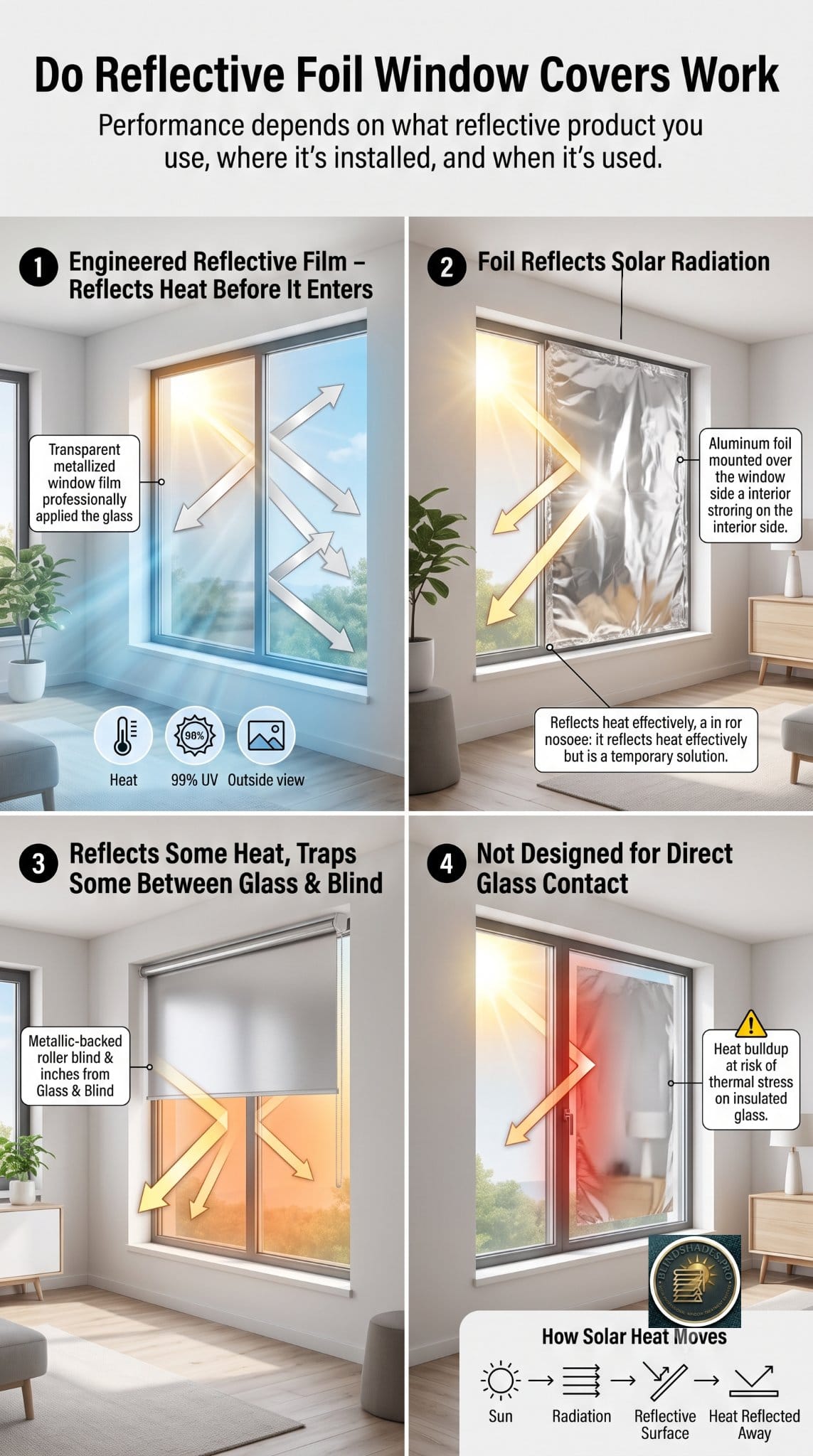
By Michael Turner — 30 years in window treatments
Yes — reflective foil window covers work, and better than most heat fixes at their price. But “foil covers” is four different products wearing one name: kitchen foil taped to glass, rigid reflective panels like Reflectix, metallized window film, and exterior reflective barriers. All four bounce radiant heat; they differ wildly in safety, looks, and lease-friendliness — and the cheapest version, raw foil taped straight to double glazing, is the one documented to trap enough heat to crack the glass. Sort the four, mount them safely, and take them down when the heat does.
Key Takeaways
- The performance is real: professional reflective films and foil barriers block up to 80 to 90 percent of incoming solar heat gain, and makeshift or professional setups alike drop temperatures near the window by roughly 8 to 10 degrees Fahrenheit — with quality metallized options blocking nearly all UV.
- The community has measured it too: one documented DIY build — Mylar sewn into removable panels — took a room from 80 down to 72 degrees, and the fresh 792-answer heat-wave thread’s method (reflective insulation adhered to fabric with a finished edge) is the safe-mount pattern in the flesh.
- The one product to fear is the one everyone tries first: kitchen foil taped directly to double-paned glass traps absorbed heat against the pane, and the resulting thermal stress can shatter a sealed unit — a window-tinting professional’s own warning is not to put foil or anything solid in or on dual-pane windows.
- The social tax is real: raw foil reads as neglect from the street, leases and homeowner associations frequently ban it, and the community’s most honest line stands — insulated blackout curtains “do the same thing without giving off that crack vibe.”
- The mirror flips at night: reflective surfaces give privacy only while the bright side is outside; lamps on after dark reverse it.
⭐ Quick Answer — Do Reflective Foil Window Covers Work?
Yes — do reflective foil window covers work has a measured yes behind it, but the answer splits across four products wearing one name:
- The performance is real: professional reflective films and foil barriers block up to 80 to 90 percent of incoming solar heat gain with drops of 8 to 10 degrees near the glass — the flat yes stated by American Window Film, with quality metallized options blocking over 99 percent of UV per Window Film Depot.
- Frame-mounted reflective panels are the safe workhorse: cut to size, mounted with an air gap, removable by fall — one documented DIY Mylar build took a room from 80 down to 72 degrees, and this summer’s 792-answer heat-wave method (reflective insulation sewn to fabric with a finished edge) is the pattern.
- The one version to skip is raw kitchen foil on sealed double glazing: trapped heat between foil and pane creates thermal stress that has shattered units — a window-tinting professional’s standing warning is nothing solid in or on dual-pane windows.
- Exterior placement wins the physics: reflective material outside the glass stops heat before it enters the pane entirely — the tier the U.S. Department of Energy’s window-covering guidance ranks above every interior fix.
- The year-round alternative with zero glass risk: insulated blackout cellular shades — the two-spec case is in blackout vs thermal blinds, the summer discipline in do thermal blinds keep heat out, and the ranked picks in our Thermal & Insulated Blinds guide.
Do Reflective Foil Window Covers Work?
Right Product, Right Mount, Right Season: the yes depends on which of four products you mean, whether it touches the glass, and whether it comes down when the heat does.
Start with why they work: summer heat arrives mostly as radiation, and shiny metallized surfaces reflect it instead of absorbing it — which is why film sellers can claim big interceptions with a straight face. American Window Film answers the question flatly (“the answer is yes — reflective window film greatly reduces heat”), Window Film Depot adds the UV case (more than 99 percent blocked), and even the skeptical Quora take concedes aluminium foil “is a bit better” than alternatives at bouncing heat and visible light back out. One seller claim needs refereeing: Designer Films argues films beat curtains and blinds because they’re applied directly to the glass. At the glass is the right place to reflect — and the wrong place to absorb: anything mounted hard against a pane that absorbs heat builds the trapped pocket documented cracking a sealed double-glazed unit. The direct-to-glass advantage belongs to films engineered for it, not to whatever shiny thing is nearest the tape.
That distinction is the whole subject, so here are the four products hiding inside the question.
Which of the Four Products Do You Mean?
| Product | Does it work? | The risk | The verdict |
|---|---|---|---|
| Kitchen foil taped to glass | Yes, briefly — it reflects | Highest: trapped heat against dual-pane glass creates thermal stress that can shatter the unit; baked adhesive and foil leave residue | Skip it — every better option below costs little more |
| Reflective panels (Reflectix, superfoil, Mylar builds) | Yes — the community’s workhorse | Low when frame-mounted with an air gap; the measured DIY build cooled a room from 80 to 72 degrees | The renter’s summer tool: cut to size, mount to frame, remove in fall |
| Metallized window film | Yes — 80–90 percent solar-gain interception at the top end | Glass-compatibility rules: lower light-transmission films on the wrong glass add cooking risk; patterned glass is a no | The tidy permanent route — buy film rated for your specific glazing |
| Exterior reflective barriers | Best of all — stops heat before the pane | Access and weather-fastening; looks | The physics champion: outside the glass, nothing gets trapped — the documented conservatory fix cooled scalding panes to room temperature |
The Safe-Mount Clinic
| Rule | Why |
|---|---|
| Never tape anything solid to sealed double glazing | The tinting professional’s own warning — trapped heat stresses the unit at its edges; single panes tolerate more, sealed units don’t |
| Keep an air gap | Reflection works from any distance; heat pockets only form against the glass. An inch of gap removes most of the risk |
| Mount to the frame, not the pane | Hook-and-loop strips, magnetic tape, or a friction fit on the frame — the panel performs the same and the glass stays unstressed |
| Sew or edge the panel | The 792-answer heat-wave method: reflective insulation adhered to fabric with a finished edge — durable, removable, and presentable enough to survive a lease inspection |
| Take it down when the season turns | The documented RV verdict — owners removed covers “because it got too hot” behind them; a reflective layer left up past its season traps warmth you now want |
| Respect the residue warning | Foil and adhesives baked onto glass leave aluminium-oxide deposits that need a scraper, not a spray — one more reason the frame-mounted panel wins |
Reflective covers are one rung of a bigger ladder: the seal-first logic lives in cheapest ways to insulate windows, and the whole seal-in-winter, vent-in-summer discipline in do thermal blinds keep heat out.
Avoid These Mistakes
Taping foil to sealed double glazing. The cheapest version of this idea is the one with a documented glass-cracking failure mode. The full case file — including why better-sealed products fail hotter — is in disadvantages of thermal blinds.
Leaving reflective layers up past the heat. A summer tool, by design. Fall removal is part of the method, not an admission of defeat.
Trusting the mirror after dark. Reflective privacy works while the bright side is outside; lamps on at night reverse the direction. Evening privacy still needs a covering.
Ignoring the lease and the street. Raw foil is frequently banned outright by leases and homeowner associations, and it broadcasts to the neighborhood. The sewn panel and the film exist precisely to pass both tests.
Scraping baked residue with a spray and a rag. Aluminium-oxide deposits are scraper work. Better: never bond metal to the glass in the first place.
Who Should Use Which?
Frame-mounted reflective panels ✔
- Renters and heat-wave responders — removable, cheap, measured to work
- West- and south-facing glass in cooling season
Frame-mounted panels ✖
- Anyone who won’t take them down in October
Metallized film ✔
- Owners wanting a permanent, invisible-from-inside solution matched to their glazing
Exterior barriers ✔
- Brutal-sun cases — conservatories, skylights, single-pane hotboxes — where stopping heat before the pane is the only full answer
Raw kitchen foil ✖
- Everyone. The panel costs pocket change more and removes the risk, the residue, and the crack vibe.
The Bottom Line
Do reflective foil window covers work? Yes — reflection is the right physics for radiant summer heat, the professional numbers run to 80–90 percent of solar gain, and the community’s measured builds back it up. Buy the version that matches your situation: frame-mounted panels for renters and heat waves, rated film for permanence, exterior barriers for brutal glass — and never raw foil on sealed units. And note what the field itself recommends alongside: insulated blackout cellular shades deliver year-round thermal control with none of the glass risk or the street-facing shine — the two-spec case is in blackout vs thermal blinds, and the ranked picks in our Thermal & Insulated Blinds guide.
FAQ
Is it bad to put aluminium foil on your windows? On sealed double glazing, yes — trapped heat between foil and pane creates thermal stress that has shattered units, and a window-tinting professional’s standing advice is nothing solid in or on dual-pane windows. On single panes the glass risk drops but the residue, the look, and the lease problem remain. Frame-mounted panels do the same job safely.
How much heat do reflective covers actually block? Bound to their measurements: professional reflective films and barriers intercept up to 80 to 90 percent of incoming solar heat gain; real-world setups drop temperatures near the window by roughly 8 to 10 degrees; and the documented DIY Mylar build took a room from 80 down to 72 degrees. Exterior placement performs best because nothing gets trapped.
Do reflective foil covers work in winter too? The reflection points the wrong way in winter — you want solar gain coming in, not bounced out — which is why seasonal removal is part of the method. Winter’s version of this idea is a radiator-side reflector and a proper insulating layer at the glass; the covers go back up when the heat does.
Will my landlord or HOA allow foil window covers? Raw foil is frequently banned by lease agreements and neighborhood associations on appearance alone. The routes that pass inspection: sewn-edge fabric-backed panels that read as blinds from the street, silvered film in permitted buildings, and interior cellular shades that need no permission at all.
Related Guides
- The Best Thermal & Insulated Blinds — the complete guide
- Do Thermal Blinds Keep Heat Out? — the summer gap rule
- Disadvantages of Thermal Blinds — the glass-stress case file
- Cheapest Ways to Insulate Windows — the full budget ladder
