What Do Blackout Blinds Cost?

Authored By Michael Turner -30 Years Home Improvement Expertise | Updated 2026 | BlindShades.pro
Updated on July 31, 2026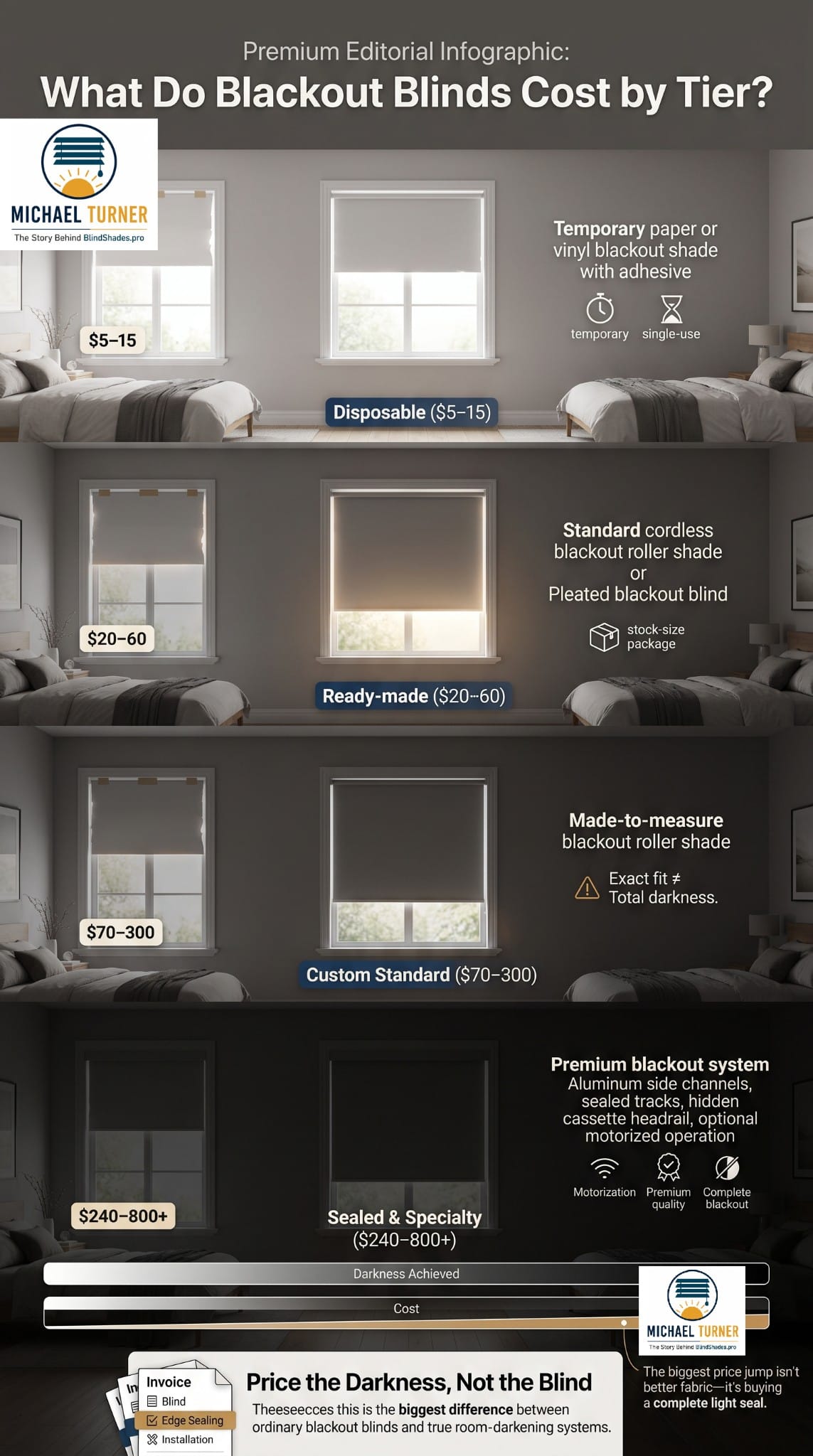
By Michael Turner — 30 years in window treatments
A blackout blind costs anywhere from about six dollars to about eight hundred, and the number that actually matters is not on any of those price tags — it is what you will spend to get the room genuinely dark. For a standard bedroom window, a ready-made blackout roller runs somewhere between about twenty and sixty dollars, a custom cellular shade between about seventy and three hundred, and motorised systems from around two hundred forty upward. But almost everyone who buys at the cheap end discovers the same thing: the fabric works and the edges do not, and closing the edges is a second purchase nobody quotes for.
Key Takeaways
- The blind is cheap; darkness is not. Ready-made blackout fabric costs very little. Sealing the perimeter is a separate spend, often larger than the blind.
- ⚠️ The list price is close to fiction. Half-off is the standing state of this category, not an event, and the same “sale” runs for days on end.
- Where you shop sets your band. The same product category runs six to seventy dollars at one retailer and two hundred seventy to seven hundred ninety at another.
- Custom costs roughly three to five times ready-made — and buys fit, not darkness.
- Fitting adds one hundred to two hundred dollars or more if you pay someone, which can exceed the blinds on a small job.
⭐ Quick Answer — What Do Blackout Blinds Cost?
Between about six dollars and eight hundred — but blackout blinds cost less than the darkness they are bought for, and that is the figure nobody quotes:
- Ready-made: about twenty to sixty dollars. IKEA lists blackout blinds from about six dollars for a pleated shade to about seventy for a cellular one.
- Custom: about seventy to three hundred. Affordable Blinds suggests budgeting forty to two hundred for blackout rollers and seventy to three hundred for cellular — and that buys fit, not darkness.
- ⚠ Sealed systems start around two hundred forty. UBlockout prices its sealed-track motorised shades from about two hundred forty-three, which is where a room genuinely goes dark.
- The cheaper route to darkness is two layers. A low-cost blind plus a lined curtain closes more of the perimeter than a single shade — see blinds versus curtains and what side tracks actually cost.
- Ignore the crossed-out price. Half-off is the standing state of this category rather than an event, so compare current selling prices across two or three sellers — or get a figure for your own window from our blind cost calculator.
✉ Ask Michael a Question — installation, buying advice or repair
Straight to Michael Turner — 30 years in window treatments.
What Do Blackout Blinds Cost by Tier?
PRICE THE DARKNESS, NOT THE BLIND — there are three lines on the real invoice: the blind, the edges, and the fitting. Almost every published price covers only the first.
The published guidance is fairly consistent once lined up. Affordable Blinds suggests forty to two hundred dollars for blackout roller shades and seventy to three hundred for cellular. UBlockout puts rollers under fifty, cellular at eighty to three hundred and above, and its own sealed-track motorised from about two hundred forty-three. IKEA sells a blackout pleated blind at about six dollars and a cellular at about seventy. The Shade Store starts rollers around two hundred ninety and romans around four hundred.
| Tier | What you are buying | Typical spend per window | What it still will not do |
|---|---|---|---|
| Disposable | Paper or vinyl temporary shades, adhesive top edge | About five to fifteen dollars | Survive a tenancy, or seal any edge |
| Ready-made | Stock-size blackout roller, pleated or cellular, cordless | About twenty to sixty dollars | Fit an off-size window, or close the sides |
| Custom standard | Made-to-measure roller or cellular in your exact size | About seventy to three hundred dollars | ⚠️ Still leaks at the edges — fit is not darkness |
| Sealed and specialty | Side-track systems, premium woven woods, motorised | About two hundred forty to eight hundred dollars | Little; this is the tier that actually darkens |
| Professional fitting | Labour, added to any of the above | About one hundred to two hundred dollars or more | Change what you bought |
Read the fourth column rather than the third. The jump people do not expect is between rows three and four, and it is not about fabric quality — it is where you stop buying a blind and start buying a seal.
Where Should You Shop for Your Budget?
The same product category runs from about six dollars at one retailer to about seven hundred ninety at another, so the shop you choose sets your band before you choose anything else.
This is the most practical table in the subject and nobody prints it. Every retailer publishes its own range, and those ranges barely overlap.
| Retailer | Published range | Store rating and base | Best suited to |
|---|---|---|---|
| IKEA | About six to seventy dollars | 4.0 on roughly 1,700 | Stock sizes, disposable and budget tiers |
| Walmart | About nine to one hundred thirteen dollars | 4.3 on roughly 3,700 | Ready-made, wide brand choice |
| Blindsgalore | About twenty-six to one hundred sixty-nine dollars | 4.7 on roughly 4,600 | Ready-made into custom, heavy discounting |
| The Home Depot | About seventy-one to one hundred ninety-six dollars | 4.7 on roughly 3,900 | Custom standard, in-store returns |
| The Shade Store | About two hundred seventy to seven hundred ninety dollars | 4.4 on roughly 2,800 | Specialty, roman and premium materials |
If your budget is under about seventy dollars, three of those five cannot help you and two are the only places to look. Over about three hundred, only one sells at that level. Working out your band first saves more time than comparing individual products.
⚠️ One warning about ranges. A retailer’s published range is the span across its whole catalogue, not what your window will cost. A shade at the bottom of a range is almost always a small stock size; yours will sit higher. Use the ranges to choose where to shop, not to predict your invoice — and if you want a figure for your actual window, our blind cost calculator will get you closer than any published range.
Why Is Everything in This Category Always Half Price?
Because in blackout blinds the discount is not an event, it is the price — and the crossed-out figure exists to make the real one look urgent.
Take any single page of blackout blind listings and count the discount badges. On one such page thirteen products carried them, from twenty percent off to fifty-five, averaging a little over forty. Retailers advertise the same at store level: up to fifty-five percent off across one whole catalogue, up to forty at another, twenty at a third.
Two observations make the point sharper than any badge count.
| What was listed | On one day | On the next | What it tells you |
|---|---|---|---|
| A cellular shade at a specialist retailer | About sixty-one dollars, from one hundred twenty-two | ⚠️ The identical price and the identical fifty percent claim | The “sale” is the standing price |
| A cordless cellular shade at a national chain | About thirty dollars | About fifty dollars, and unchanged the following day | The real price moves more than the discount does |
| One total-blackout blind, on a single page | About one hundred twenty-three, from one hundred eighty-nine | About one hundred fifty-three, listed simultaneously | ⚠️ Two prices for one product at the same moment |
| A pleated paper shade, two retailers | About eleven dollars | About five dollars | The same shade, twice the price, depending where you look |
Every figure above is what a retailer published about its own product, and none of it is dishonest in a legal sense. But it means a discount claim carries no information. The only things worth acting on are today’s selling price and whether the same shade is cheaper elsewhere — which, on this evidence, it often is.
What Does Actual Darkness Cost?
Roughly eight times what the blind costs, if you buy the sealed system — or about twice, if you do what the people who have already made this mistake recommend.
The most useful account of this is not from a retailer. It is from a homeowner who bought blackout blinds at about thirty pounds, found the fabric perfectly good, and then found light pouring in around the sides and top. Looking for a fix, he discovered that completely blackout with edging is a different product at a different price. That thread drew well over two hundred replies, which tells you how common the discovery is.
Here is the arithmetic the tiers hide. A ready-made blackout roller costs about twenty to sixty dollars and stops light through the fabric. It does not close the two vertical lines down the sides, because an inside-mounted blind must run narrower than the recess to travel. To close those you either buy a sealed system, starting around two hundred forty dollars and running to eight hundred, or you add something in front.
The most upvoted answer is the second route: double up, and fit a lined curtain in front. It works because the failure modes do not overlap — the blind’s weak edges sit behind the curtain’s overlap — and it costs what a second mid-range item costs rather than what a specialist system does. It is the answer owners give each other when nobody is selling. The mechanics are in blackout blinds versus blackout curtains; if you would rather solve it at the blind, do blackout side tracks actually seal prices the hardware route, and why light comes through the sides shows where it gets in.
Avoid These Mistakes
- Buying on the discount. A crossed-out price in this category carries no information. Compare selling prices across two or three retailers instead.
- Budgeting for the blind alone. If the room has to be dark, budget for the blind and the edges. The second number is usually the larger one.
- ⚠️ Paying for custom when you needed sealed. Made-to-measure buys fit, not darkness. A perfectly fitted blind still leaks at the sides.
- Forgetting fitting. Professional installation adds about one hundred to two hundred dollars or more, which on a small job can exceed the blinds.
- Shopping in the wrong band. If your budget is under about seventy dollars, three of the five main retailers cannot serve you at all.
- Assuming a higher price means darker. Premium woven woods cost more than a sealed roller and block far less light.
What Should You Spend on Your Window?
| Your situation | Realistic budget per window | What to buy |
|---|---|---|
| Short let or spare room | About five to fifteen dollars | Temporary paper or vinyl shade |
| Standard bedroom, stock size | About twenty to sixty dollars | Ready-made cordless blackout roller or cellular |
| Off-size or awkward window | About seventy to three hundred dollars | Made-to-measure, fit only |
| Shift worker, real darkness | About seventy to one hundred twenty dollars | ⭐ Cheap blind plus a lined curtain |
| Shift worker, single-product fix | About two hundred forty dollars and up | Sealed side-track system |
| Nursery, safety first | About thirty to eighty dollars | Cordless ready-made, no loose cords |
| Whole house, several windows | Band by room, not one spec | Sealed in bedrooms, ready-made elsewhere |
✔ Spend at the bottom if the window is a stock size, the room is not a bedroom, or you are renting — see blackout blinds for renters for what you can fit without losing a deposit.
✔ Spend in the middle if the window is an odd size, or you want cellular for insulation as well as darkness — the format is compared in best blackout cellular shades.
✖ Do not spend at the top unless you specifically need the sides sealed. Most of that money buys materials and motors, not darkness.
✖ Do not buy a second blind before trying a curtain. If you already own blinds, adding blackout to what you have is usually cheaper than replacing them.
The Bottom Line
Blackout blinds cost about twenty to sixty dollars ready-made, seventy to three hundred custom, and two hundred forty and up sealed or motorised, with fitting adding one hundred to two hundred or more. The tier list misleads, because the expensive tier is the only one that actually darkens a room and most people buy from the cheap one expecting the same result. Decide first whether you need a dark room or a dimmer one. If it is darkness, budget for the edges from the start — or buy the cheap blind and a lined curtain, which is what people who learned this the hard way recommend.
Compare every format and price point in our blackout blinds and shades guide, and check two or three retailers before ordering. On the evidence above, the same shade can differ by a factor of two depending only on where you buy it.
FAQ
How much do blackout blinds cost?
About five to fifteen dollars for temporary shades, twenty to sixty for ready-made, seventy to three hundred for made-to-measure, and two hundred forty upward for sealed or motorised systems. Professional fitting adds roughly one hundred to two hundred dollars or more on top.
Why are complete blackout blinds so expensive?
Because complete means sealed, not just opaque. Blackout fabric is cheap; closing the two vertical gaps at the sides needs tracks or channels, and that hardware plus the tighter tolerances it demands is what moves a shade from the twenty-dollar tier to the two-hundred-plus tier.
Are cheap blackout blinds any good?
The fabric usually is. Cheap blackout rollers and cellular shades block light through the cloth about as well as expensive ones. What you lose is fit, mechanism life and any edge treatment, so the room ends up dim rather than dark.
What do blackout blinds cost at IKEA?
Their published range across blackout blinds runs roughly six to seventy dollars, with a blackout pleated blind at about six and a blackout cellular at about seventy. That places them firmly in the disposable and ready-made tiers rather than the custom one.
Is it cheaper to buy blackout blinds or blackout curtains?
Blinds are cheaper per window at the budget end. For genuine darkness the cheapest route is usually both — a low-cost blackout blind with a lined curtain in front, which costs less than a sealed track system and closes more of the perimeter.
Does custom-made cost more than ready-made blackout blinds?
Yes, typically three to five times more. Custom buys an exact fit for an off-size window, better hardware and a wider fabric choice. What it does not buy is darkness, because even a perfectly fitted inside-mount blind still runs narrower than the recess it sits in.
Related Guides
- Best Blackout Blinds & Shades — the parent guide
- Blind Cost Calculator — a figure for your actual window
- Do Blackout Side Tracks Actually Seal? — what the edges cost
- Blackout Blinds vs Blackout Curtains — the cheaper route to darkness
- Best Blackout Cellular Shades — where the mid tier goes
- Blackout Blinds for Renters — spending when you cannot fix
- Add Blackout to Existing Blinds — before you buy a replacement
- Made-to-Measure Blinds Cost Guide — custom pricing across all formats
