Blackout Blinds for Renters: No Drill, No Damage

Authored By Michael Turner -30 Years Home Improvement Expertise | Updated 2026 | BlindShades.pro
Updated on July 30, 2026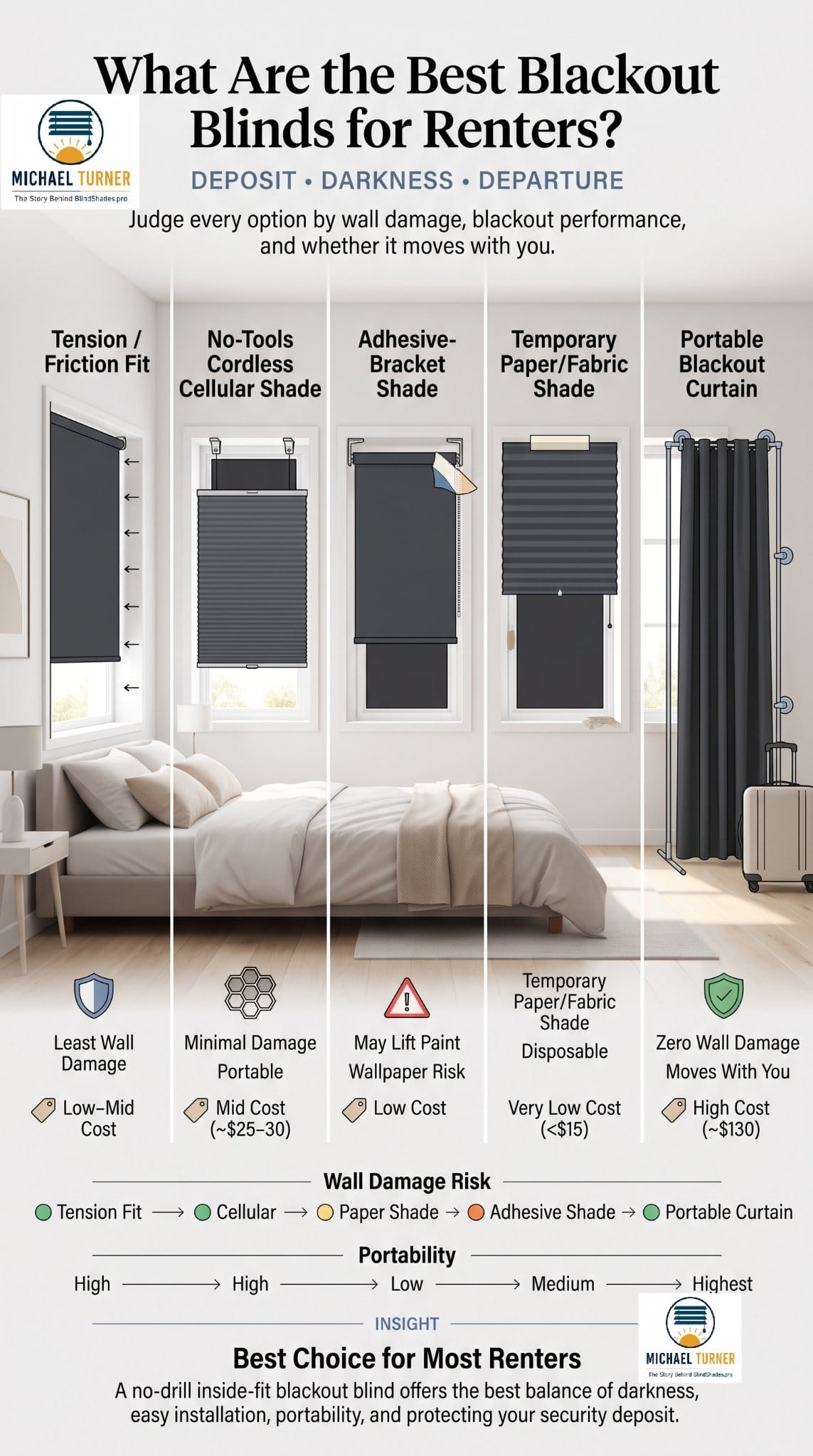
By Michael Turner — 30 years in window treatments
The best blackout blinds for renters are the ones you can take down cleanly, and the threat to your deposit is almost never the drill — it is the adhesive. Landlords rarely notice two filled screw holes in a frame. They do notice a strip of paint pulled off the plaster above the window, which is exactly what happens when a year-old adhesive bracket comes away. The category sells itself on “no drill” and quietly leaves the harder question alone. Meanwhile the cheapest no-drill products carry the worst ratings on the page, and the one that breaks that pattern costs about twenty dollars more.

Key Takeaways
- Adhesive is the deposit risk, not drilling. Tape lifts paint and veneer on removal; two filled screw holes usually do not.
- The cheap end has a ratings problem. Paper and temporary shades sit at 3.6 to 4.1 stars while a no-tools cellular sits at 4.6.
- Buy for departure. A shade that comes down cleanly and moves with you is worth more than one that fits perfectly and stays.
- ⚠️ Check the tenancy agreement before anything else. Some prohibit adhesives on painted surfaces specifically, which rules out most of this category.
- Full darkness in a rental is possible, but it needs the sides closed, and that is the one part no-drill products rarely solve.
⭐ Quick Answer — Blackout Blinds for Renters
Fix to the frame, never the wall — the best blackout blinds for renters are judged on what they cost you when you leave, not on the words on the box:
- ⚠ Adhesive is the deposit risk, not drilling. Mounting tape keeps bonding for years, so on removal the paint film lifts with the bracket, taking skim or lining paper with it.
- Buy the cellular, not the paper. Budget paper shades sit between 3.6 and 4.1 stars, while a no-tools cordless cellular at around twenty-eight dollars rates 4.6 on more than five hundred reviews.
- Tension and clip-in fittings touch nothing. If the reveal is deep enough for an inside fit, use it — see the full comparison of no-drill blinds.
- Darkness is decided at the edges. Any inside-mounted shade runs narrower than the opening, so two lines of daylight remain whatever the fabric claims.
- Read the tenancy clause first. Many prohibit adhesives on painted surfaces by name. The Spruce found a frame-securing extender well suited to renters, Redi Shade runs a rental line, and Sleepout sells the no-wall-contact route — then compare formats in blackout cellular shades and the thermal half in insulating windows for renters.
✉ Ask Michael a Question — installation, buying advice or repair
Straight to Michael Turner — 30 years in window treatments.
What Are the Best Blackout Blinds for Renters?
DEPOSIT · DARKNESS · DEPARTURE — judge every option on what it costs you when you leave, how dark it actually gets, and whether it comes with you.
Most renting advice stops at the first word of the product name: no drill, therefore safe, therefore buy it. That skips the two questions that decide whether it was a good purchase — how the fixing behaves after a year on the wall, and whether the shade is usable in the next flat. Renters answer the second themselves: the most useful comment in the rental threads is that a custom-cut shade blocks light well, goes up easily, and you can take it with you.
There are five routes, and they are not equally safe.
| Route | How it holds | What it risks when removed | Roughly what it costs |
|---|---|---|---|
| Tension or friction fit inside the recess | Pressure against the reveal | Least of any route — occasional burnishing on soft paint | Low to mid |
| No-tools cordless cellular | Light-touch brackets or friction inside the recess | Minimal, if the brackets clip rather than stick | Mid, around twenty-five to thirty dollars |
| Adhesive-bracket shades | Foam or acrylic tape on frame or reveal | ⚠️ The real hazard — lifts paint, veneer and wallpaper on removal | Low |
| Temporary paper or fabric shades | Adhesive strip along the top edge | Residue on the frame; the shade itself is disposable | Very low, under about fifteen dollars |
| Portable blackout curtain on a frame | Clamps or suction to the frame or glass | Nothing on the wall at all — the safest route | High, around one hundred thirty dollars |
The pattern in that last column is worth sitting with. The two safest routes are the cheapest and the dearest, and the risky one is in the middle where most of the marketing sits. If your reveal is deep enough for an inside fit, use it — the no-drill blinds guide covers every fitting type in detail, and this page only adds the renting layer on top of it.
Which No-Drill Fixings Actually Threaten Your Deposit?
Adhesive on a painted surface, in almost every case — and the damage happens on the way out, not on the way in.
Nobody in this category prices the deposit against the product, which is strange when the deposit is usually several times the cost of the shade. The mechanism is simple. Modern acrylic and foam mounting tapes are built to hold under load for years, and the bond keeps strengthening. When you pull the bracket off, the tape is stronger than the paint film beneath it, so the paint comes away with it, taking a patch of skim or lining paper too.
| Fixing type | Surface at risk | What typically happens on removal | Safer alternative |
|---|---|---|---|
| Acrylic or foam mounting tape | Painted plaster, painted timber | ⚠️ Paint film lifts; on older frames, veneer can peel | Clip-in brackets inside the recess |
| Command-style stretch-release strips | Emulsioned walls | Better than tape if removed correctly, but fails on textured or freshly painted surfaces | Tension fitting, no wall contact |
| Suction cups on glass | The glass itself | Nothing, but they release in heat and are unreliable long term | Frame clamps rather than glass |
| Tension rods across the reveal | Reveal paint | Burnishing or a dent where the rod bears, easily filled | Wider bearing pads under the ends |
| Trim-clamp curtain-rod brackets | The window trim | Nothing if correctly sized — they grip the architrave | The renter favourite for curtains |
⭐ That last row is worth knowing, because renters find it and retailers rarely mention it. Brackets that clamp onto the moulding around a window let you hang a full curtain pole without a single fixing in the wall. Owners name specific brands in rental threads; the type matters more than the brand. It is the cleanest way to add blackout curtains to a rented room, and it pairs with a shade inside the recess.
Two things to do before buying anything. Read the tenancy agreement — a surprising number prohibit adhesives on painted surfaces by name, which quietly rules out half this category. And photograph the reveal and frame on move-in day, so that a mark you did not make is not a mark you pay for.
Why Do the Cheapest Renter Shades Have the Worst Ratings?
Because the products aimed hardest at renters are the ones built to be thrown away, and the ratings show it.
Line up what this market actually sells to renters and sort it by published rating rather than price, and an uncomfortable pattern appears. The cheap end is not merely basic. It is rated worse by the people who bought it.
| Product class | Roughly what it costs | Published rating and base | What the score is telling you |
|---|---|---|---|
| Cut-to-size temporary shades | About eleven dollars | 3.6 on 28 reviews | Thin base and a low score together |
| Portable temporary fabric shades | About eighteen dollars | 3.8 on 23 reviews | Same pattern, same caution |
| Room-darkening pleated paper | About eleven dollars | 3.9 on roughly 2,700 | ⭐ A big base and still under four stars |
| Budget pleated paper shade | About six dollars | 4.1 on roughly 2,700 | Honest for the money, no more |
| ⭐ No-tools cordless blackout cellular | About twenty-eight dollars | 4.6 on 542 reviews | The best-rated no-drill product in view |
Read the bottom row against the ones above it. About twenty dollars separates a disposable paper shade from a cordless cellular shade that owners rate half a star higher on a base of several hundred. So the renter’s real decision is not drill versus no drill. It is paper versus cellular, and the gap is roughly the price of two coffees a month over a year’s tenancy. The blackout cellular shades guide sets out that format in full, including the review-base and pricing traps that run right across this category.
How Dark Can a Renter Actually Get a Room?
Dim is easy and dark is hard, because darkness is decided at the edges — and the edges are where no-drill options are weakest.
A no-drill shade inside the recess has to be narrower than the opening to sit there at all, so two lines of daylight run down the sides regardless of how opaque the fabric is. That is not a defect of cheap products; it is geometry, and it applies to every inside-mounted blind. The full anatomy is in why light comes through the sides of blackout blinds.
Three routes close it without touching the wall. Side tracks, usually taped or clipped to the frame rather than the plaster — a specialist maker publishes a guide to fitting them in rentals, so the market exists — assessed in do blackout side tracks actually seal. Magnetic edge systems, which work only on a steel frame and otherwise become an adhesive product in disguise, as set out in are magnetic blackout blinds any good. Or a portable blackout curtain clamped to the frame, overlapping the gaps rather than sealing them.
The independent testing supports the frame-fixing approach rather than the wall-fixing one. The Spruce, after its testing programme, named a blackout roller its clear winner and singled out the extender that secures the shade to the window frame as being well suited to renters. Wirecutter’s picks are designed to block at least ninety-nine percent of light, which is close to but not the same as darkness.
Avoid These Mistakes
- Sticking anything to painted plaster. The paint comes off with it. Fix to the frame, the trim or nothing.
- Buying the six-dollar paper shade for a two-year tenancy. It is a stopgap product and its ratings say so.
- Measuring the glass instead of the recess. Inside-mount shades are sized to the reveal, and the wrong measurement is not returnable once cut.
- Assuming your agreement allows adhesives. Many prohibit them on painted surfaces by name. Check first.
- Expecting darkness from the fabric alone. Blackout cloth stops light passing through it, not around it.
- ⚠️ Leaving removal to moving day. Take one bracket off early, while there is still time to fix a mark and still evidence of how it looked.
Who Should Choose Which?
| Your situation | Choose | Why |
|---|---|---|
| Deep recess, one bedroom window | No-tools cordless cellular inside the recess | Best-rated no-drill route and it comes with you |
| Nothing may touch the walls | Portable blackout curtain on the frame | No wall contact at all; highest cost |
| Short let or a few months | Temporary shade | Disposable by design, priced accordingly |
| Shift work, real darkness needed | Cellular plus frame-fixed side tracks | Only edge closure gets past dim |
| Very tall or awkward windows | Frame-clamped curtain on trim brackets | Avoids both drilling and a bespoke blind |
| Ground-floor flat, privacy first | Room darkening, top-down bottom-up | Light over the top, privacy below |
| Cold, draughty rented flat | Cellular, chosen for the cells | Insulation and darkness in one purchase |
✔ Choose a no-tools cordless cellular if you have a usable recess and expect to move again — it is the best-rated route and the easiest to take with you. Cheaper cordless options are compared in best cordless mini blinds.
✔ Choose a portable frame-mounted curtain if your agreement forbids fixings entirely, or the window is an awkward shape.
✖ Do not choose adhesive brackets on painted plaster in a rented flat. The saving is not worth the repair.
✖ Do not rely on a blind alone for privacy at ground level — see ground-floor and basement window privacy.
The Bottom Line
Rent-friendly blackout comes down to three things: fix to the frame rather than the wall, spend the extra twenty dollars on a cellular shade rather than paper, and accept that the sides need separate treatment if you want genuine darkness rather than dimness. Everything in this category is sold on the word “no-drill,” which is the easy part. Removal is the part that costs money, and it is the part nobody advertises.
Compare the whole category in our blackout blinds and shades guide, and if your flat is also cold, insulating windows for renters covers the thermal side of the same problem. Check prices across two or three sellers before ordering — this category discounts almost permanently, and the same shade can move substantially in a day.
FAQ
What are the best blackout blinds for renters?
No-tools cordless cellular shades fitted inside the recess, for most people. They need no wall fixings, come down cleanly, block far more light than paper alternatives, and carry the best ratings of any no-drill option — around 4.6 stars on several hundred reviews at roughly twenty-eight dollars.
Can you put blackout blinds up without drilling?
Yes, by four routes: tension or friction fitting inside the recess, clip-in brackets, adhesive mounts, or a portable curtain clamped to the frame. Only the adhesive route puts your deposit at meaningful risk, and it is the one most heavily marketed to renters.
Will no-drill blinds damage the paint?
Adhesive ones frequently do, on removal rather than installation. Mounting tape bonds harder over time until it is stronger than the paint film, so the paint lifts with the bracket. Tension and clip-in fittings inside the recess avoid this entirely and are the safer choice in a rental.
Are temporary paper blackout shades any good?
For a few months, yes. For a tenancy, no. They are disposable products and the published ratings reflect it, sitting between 3.6 and 4.1 stars even where thousands of people have bought them. Spend the extra and buy something you can take to the next flat.
How do I make a rented room completely dark?
Close the edges, not just the window. A blackout shade inside the recess stops light through the fabric, but two lines remain down the sides. Add frame-fixed side tracks, a magnetic edge system on a steel frame, or overlap the whole opening with a portable blackout curtain.
Do landlords allow blackout blinds?
Usually, if nothing is drilled and nothing is stuck to painted surfaces. Many agreements prohibit adhesives by name while saying nothing about tension fittings. Read the clause before you buy, and photograph the window on move-in day so existing marks are on record.
Related Guides
- Best Blackout Blinds & Shades — the parent guide
- Best No-Drill Blinds — every no-drill fitting compared
- Do Blackout Side Tracks Actually Seal? — closing the edges
- Are Magnetic Blackout Blinds Any Good? — the steel-frame route
- Best Blackout Cellular Shades — the format this page recommends
- Insulating Windows for Renters — the thermal half of the problem
- Best Cordless Mini Blinds — the budget cordless option
- Ground-Floor & Basement Window Privacy — privacy at street level
