Are Magnetic Blackout Blinds Any Good? The Frame Decides.

Authored By Michael Turner -30 Years Home Improvement Expertise | Updated 2026 | BlindShades.pro
Updated on July 30, 2026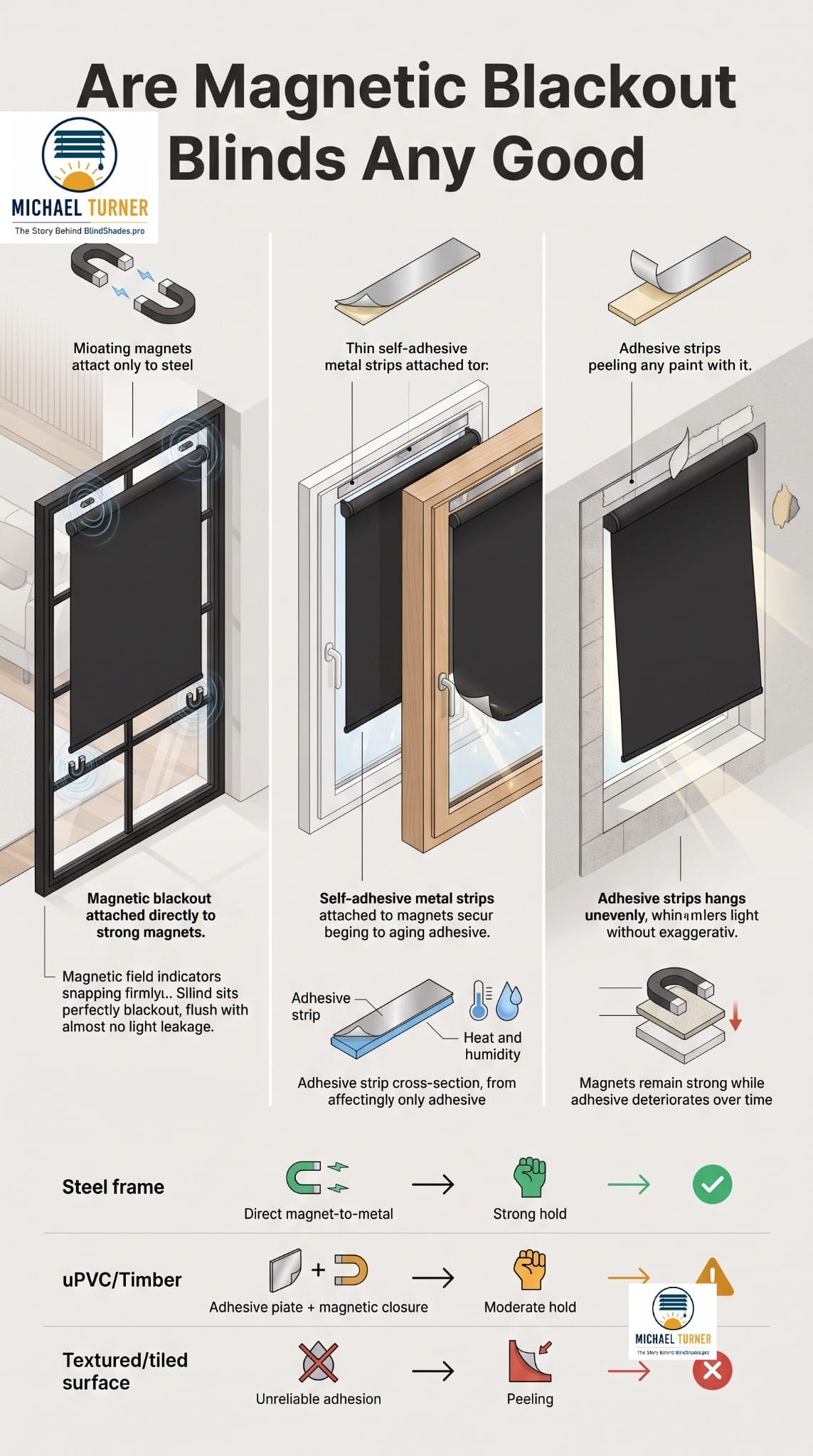
By Michael Turner — 30 years in window treatments
Magnetic blackout blinds are very good on a metal window frame and something quite different on any other kind — and almost nobody selling them makes that distinction. On steel or iron, the magnet does the work and the result is a fast, removable, genuinely tight seal. On uPVC or wood, which is most of the housing stock, there is no magnetism to use, so you stick metal strips to the frame with adhesive and clip the blind to those. The magnet is then only the closure; the adhesive is holding everything up. That single fact explains the failure everyone reports, and it decides whether this product is right for your window before any other consideration.

Key Takeaways
- The frame decides, not the blind. Ferrous metal means a true magnetic fitting; everything else means an adhesive fitting wearing a magnet’s name.
- Test before you buy — if a fridge magnet sticks to your window frame, the product will work as advertised.
- The failure everyone describes is adhesive failure, not magnet failure: strips peel, and light gaps open at the edges.
- Magnets rarely do all four edges. Many kits ship hook-and-loop for the top and magnets for the sides and bottom.
- Owners treat these as a layer, not a solution — the strongest real-world verdict is that they help, in addition to what you already have.
⭐ Quick Answer — Are Magnetic Blackout Blinds Any Good?
On metal, genuinely — magnetic blackout blinds are one of the best no-drill seals available. On uPVC or timber they are a different product entirely:
- The frame decides, not the blind. 1ClickBlinds states it plainly: the system works only on ferromagnetic materials — steel and iron frames in older properties, commercial buildings and some metal-framed windows.
- ⚠ On uPVC there is no magnetism to use. Affordable Blinds describes the workaround: stick adhesive-backed mounts to the frame first, then attach the shade to those. The tape is the fixing; the magnet is only the catch.
- Test it in three seconds. If a fridge magnet sticks to your frame, the product performs as advertised. If not, compare the alternatives in no-drill blinds before ordering.
- Magnets rarely seal all four edges. Many kits ship hook-and-loop for the top and reserve magnets for the sides and sill — and UBlockout notes blackout fabric blocks 85–99 percent while edge and head gaps let light in regardless.
- Vans, caravans and steel doors are where they shine. Everywhere else, treat one as a strong extra layer — the permanent fix for side leaks is blackout side tracks, and the ranked picks sit in our Blackout Blinds & Shades guide.
✉ Ask Michael a Question — installation, buying advice or repair
Straight to Michael Turner — 30 years in window treatments.
Are Magnetic Blackout Blinds Any Good?
The Frame Decides (Ferrous · Adhesive · Neither)
Yes — conditionally, and the condition is not the blind. Industry guidance converges on an unqualified recommendation: easy to fit, no drilling, no cords, good light control. All true. What it omits is that the product behaves like two different things depending on what it is attached to.
1ClickBlinds states the mechanism plainly, and it is the clearest sentence published on the subject: the magnetic system works exclusively on ferromagnetic materials — primarily steel and iron frames common in older properties, commercial buildings and some modern metal-framed windows. Everything else is outside the mechanism.
| Your frame | What you are actually buying | How it holds | How it fails |
|---|---|---|---|
| Steel or iron | A true magnetic fitting | Magnet to metal, direct | Barely does — magnets do not fatigue in normal use |
| uPVC or timber | An adhesive fitting with magnetic closures | Self-adhesive plates on the frame, magnets clamp the fabric to them | ⚠️ The tape lets go — heat, humidity and time, and light gaps open |
| Tiled, textured or painted reveal | Neither reliably | Adhesive on a surface it was not designed for | Peels early, and may lift paint on removal |
Read that table before you read a product page. On the first row, the enthusiastic reviews are earned. On the second, you are buying tape.
The Two Products Sold Under One Name
The magnet is the convenience. On most windows, the adhesive is the fixing.
Retailers describe the non-metal route as a feature rather than a downgrade. Affordable Blinds explains it in two steps: magnetic blinds can also be mounted on non-metal windows and doors using adhesive mounts — first affix the adhesive-backed magnets to the frame, then attach the shade to those frame-mounted magnets. That is accurate as far as it goes. What it omits is that the second step is the easy one and the first step is the whole load path.
The kits themselves make it unmistakable. A typical magnetic closure set pairs one metal plate carrying adhesive tape with one magnet plate carrying none: the plate sticks to the window frame, and the blackout panel is clamped between plate and magnet. Strip the marketing away and it is an adhesive mount with a magnetic catch.
This is why the disadvantage most commonly reported is not a disappointment about magnetism. It is that the strips peel and gaps appear — a straightforward adhesive failure, and one that behaves exactly as adhesive does. It goes first where it is hottest — on a sunlit window, precisely where you fitted it — and it goes early in a steamy bathroom or on a textured or freshly painted reveal.
People converting vehicles have already solved this the hard way, and their fix is instructive: on textured plastic, thin adhesive on steel tape is not trusted at all, so the strips go on over a primer and a high-bond tape instead. That is a lot of preparation for a product sold on taking a few minutes.
⚠️ The renter’s version of the same point. Adhesive that holds well for two years is adhesive that may take paint or veneer with it. On a frame you do not own, weigh that against the alternatives in no-drill blinds and temporary blinds and shades, and see insulating windows for renters for the wider set of non-permanent options.
Do Magnets Seal All Four Edges?
No — and the kits admit it in the packaging.
A window leaks at the sides, the top, the bottom and, on a roller, around the roll. Magnetic sets are strong on the vertical edges and the sill, because a magnet clamps fabric flat against a plate. The head is the weak one, which is why many kits supply hook-and-loop strips specifically for the top of the window and reserve the magnets for the sides and bottom.
| Edge | What magnetic kits use | How well it holds |
|---|---|---|
| Sides | Magnetic closures | Strong — this is the product’s best feature |
| Bottom | Magnetic closures | Strong, if the sill is flat |
| Top | Usually hook-and-loop, not magnets | ⚠️ The weak edge, and the reason a fitted panel still glows at the head |
| Behind the fabric | Not addressed | A separate problem — see side tracks for the framed-shade version |
If the light in your room is coming from the head rather than the sides, this product is not the fix. Diagnose it first with why light comes through the sides of blackout blinds, which works through the leak paths in order.
What Do the Blackout Claims Actually Mean?
The boldest numbers in this category sit on the thinnest evidence.
Blackout percentages here are fabric claims, not installed results — a distinction UBlockout makes against its own category, noting that blackout fabric blocks somewhere between eighty-five and ninety-nine percent of the light passing through it while gaps at the edges, top, bottom and centre let light in regardless. The fabric was never the variable.
More useful than the percentage is the review base behind it.
| Product claim | Verified review base | How to read it |
|---|---|---|
| Magnetic Roman shades advertised at 99.99 percent blackout (GoDear Design) | ⚠️ A single review, rated 1.0 | The strongest claim in the category on the thinnest base on the page |
| A portable blackout curtain making no percentage claim (Sleepout) | About 1,200 reviews, averaging 4.8 | Modest claim, substantial base, generous returns window |
| Blackout fabric generally, 85–99 percent (UBlockout) | Stated as a fabric range | Honest, and the reason edge sealing matters more than fabric grade |
There is one genuinely independent voice here. Wirecutter interviewed industry experts and tested sixteen shades for its 2026 blackout roundup — but that covers blackout shades broadly, not magnetic systems. No independent test of magnetic blackout blinds exists, which is worth knowing before any percentage persuades you.
Where Magnetic Blackout Blinds Actually Earn Their Keep
Follow the people who use them and you end up in vehicles and lofts, not bedrooms.
This comes from reading what owners fit rather than what retailers sell. The recurring installations are a car’s rear window, a caravan’s front window, a trailer, a van conversion, a boat cabin and a loft — every one of them metal, or close enough, which is exactly the condition under which the product works as advertised.
The boat owners state it most economically: magnets need something to attach to unless your cabin is steel. That is the whole science of it, arrived at independently.
Vehicles and conversions are the strongest case in the category. Van, caravan, motorhome and trailer windows sit in metal, the panels come off for daylight and stow flat, and nothing is drilled into a vehicle you may sell. If that is your application, RV blinds and shades covers the full range rather than the magnetic slice of it.
Steel doors and metal-framed windows in older properties, warehouse conversions and commercial buildings are the second strong case — and often the only no-drill option that works at all, since clip-on systems are built around uPVC.
Lofts and skylights are the honest middle. Owners report magnetic panels in loft rooms helping without being perfect, which matches the mechanism: the frame may be metal, but the angle and the head gap work against you. For a sloped or roof window, Velux skylight blinds and skylight blinds and shades are the purpose-built route.
And the verdict on bedrooms is a layer, not a solution. The most-endorsed advice in the largest discussion of expensive blackout is to double up — fit a lined curtain in front of what you have — with a home-made version at modest cost also well regarded. That is not what the marketing says.
Magnetic or One of the Alternatives?
On uPVC, the magnetic route is rarely the best no-drill option.
| Option | Fixing | Best for | Main limit |
|---|---|---|---|
| Magnetic | Magnet to ferrous metal, or adhesive plates | Metal frames, vehicles, steel doors | On uPVC it is an adhesive product |
| Clip-on | Spring or friction on the frame | uPVC, the commonest modern frame | Needs a suitable bead to grip |
| Tension-fitted | Pressure between reveals | Square reveals of adequate depth | Nothing to press against on shallow frames |
| Adhesive shades | Tape direct to frame | Short stays, travel, temporary rooms | Same tape limits, without the removability |
Choosing among them is the same decision covered in no-drill blinds; the magnetic option deserves its place on the list, and rarely the top of it unless your frame is steel.
Avoid These Mistakes
- Ordering before testing the frame. A fridge magnet settles it in three seconds, and 1ClickBlinds recommends exactly that check.
- Fitting adhesive strips to a hot, damp or freshly painted reveal. That is where tape fails first, and where the light gaps then appear.
- Expecting magnets to seal the top. Most kits do not even claim it — read what is in the box before assuming a full perimeter.
- Buying on a blackout percentage. Those are fabric figures, and the field’s boldest claims carry the least verified feedback behind them.
- Treating it as the whole answer in a bedroom when the community’s own consensus is that it works best as an added layer.
Who Should Fit Magnetic Blackout Blinds — and Who Shouldn’t?
✔ Worth it if: your window frame, door or vehicle panel is steel · you need a panel that comes off in seconds and stows flat · you are fitting out a van, caravan, motorhome or boat · you are in a rental with metal frames where nothing may be drilled · you want a removable extra layer over an existing shade.
✖ Not worth it if: your frames are uPVC or timber and a clip-on or tension fitting is available · the leak is at the head rather than the sides · the reveal is tiled, textured or newly painted · the room is hot or steamy enough to work adhesive loose · you need one product to deliver total darkness on its own.
The Bottom Line
Are magnetic blackout blinds any good? On metal, genuinely — fast, removable, tight at the edges, and often the only no-drill fitting that works at all. On uPVC or timber, you are buying an adhesive mount with a magnetic catch, and it should be judged as adhesive: good for a while, vulnerable to heat and damp, and capable of taking paint with it. Check the frame with a magnet before you order, expect to solve the top edge separately, and treat the result as a strong layer rather than a complete blackout.
If your frames are not metal, the ranked alternatives are in our complete Blackout Blinds & Shades buying guide — and if the light is escaping around a shade you already own, blackout side tracks solve the sides more permanently.
FAQ
Are magnetic blackout blinds any good for a bedroom? On a metal-framed bedroom window, yes. On uPVC or timber they become an adhesive fitting, and the most endorsed advice from people who have tried them is to use one as an added layer over an existing shade or lined curtain rather than as the whole solution.
Do magnetic blinds work on uPVC windows? Not magnetically. There is nothing ferrous for a magnet to grip, so the kit supplies self-adhesive metal plates that stick to the frame first. It works, but the fixing is tape, and it should be judged on how tape behaves in that room’s heat and humidity.
How do I know if magnetic blinds will fit my window? Hold a fridge magnet against the frame. If it sticks, you have a true magnetic fitting and the product will perform as advertised. If it does not, you are buying the adhesive version, and a clip-on or tension-fitted blind may suit the frame better.
Do magnetic blackout blinds block all light? Rarely on their own. The magnets seal the sides and sill well, but many kits use hook-and-loop for the top edge, which is where residual light usually appears. Advertised blackout percentages describe the fabric, not the installed result.
Are magnetic blackout blinds good for a van or caravan? This is their strongest application. Vehicle windows sit in metal, panels come off for daylight and stow flat, and nothing is drilled into a vehicle you may later sell. Owners converting vans, caravans, trailers and boats reach for magnets first for exactly these reasons.
Will magnetic blind strips damage my window frame? The magnets will not, but the adhesive plates can. Tape that has held for a year or two may lift paint or veneer on removal, which matters most on rented or recently decorated frames. Test on a small area first and remove slowly.
Related Guides
- Best Blackout Blinds & Shades — the complete buying guide
- Blackout Blinds with Side Tracks — sealing the sides permanently
- Why Is Light Coming Through the Sides of My Blackout Blinds? — diagnose the leak first
- Best No-Drill Blinds — the full no-drill comparison
- Best Temporary Blinds & Shades — short stays and rentals
- Best RV Blinds & Shades — vehicles, where magnets work best
- Magnetic Blinds for French Doors — the glazed-door application
- Insulating Windows for Renters — non-permanent options that leave no mark
