Blackout Blinds vs Blackout Curtains: Which Blocks More?

Authored By Michael Turner -30 Years Home Improvement Expertise | Updated 2026 | BlindShades.pro
Updated on July 30, 2026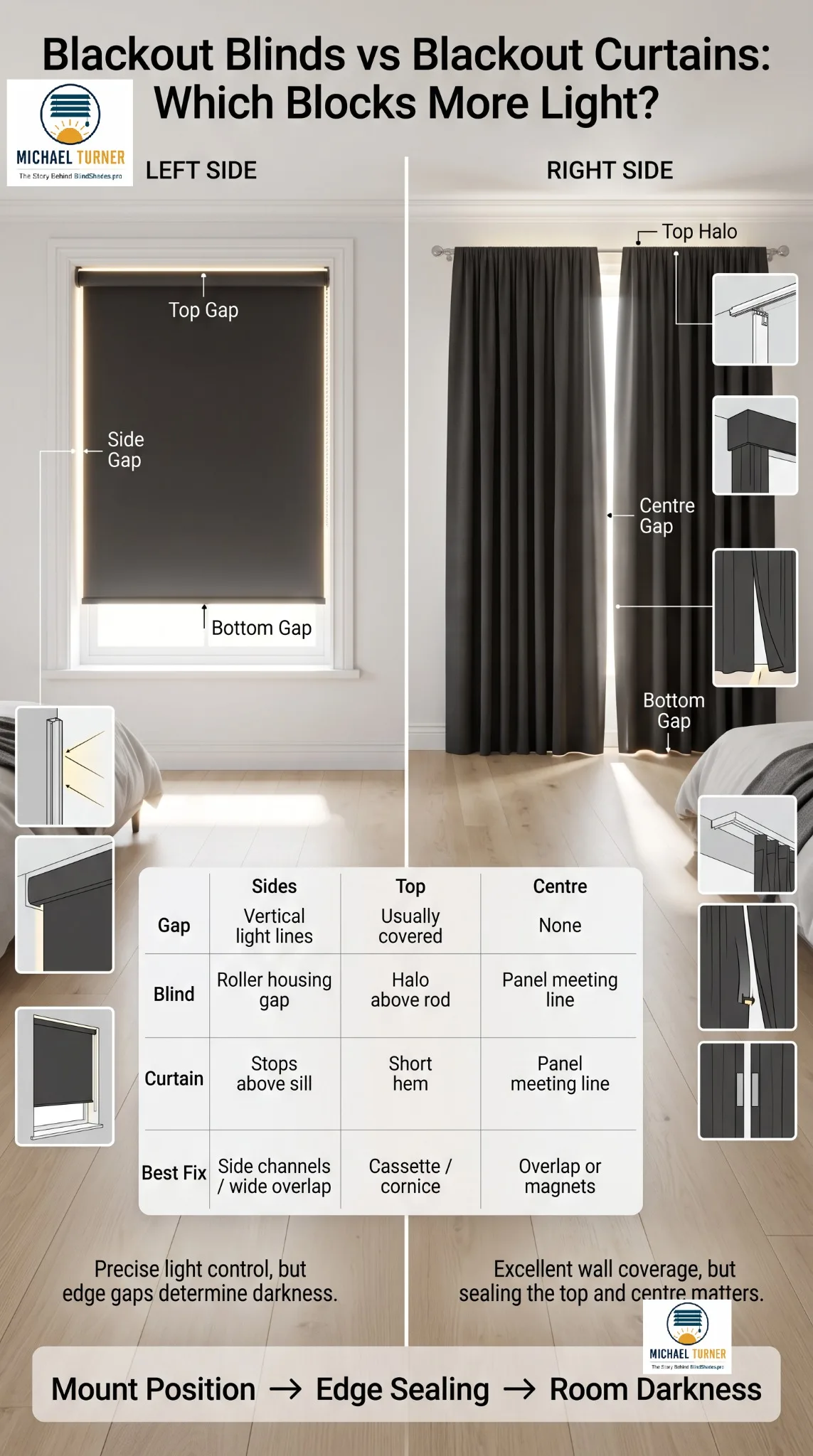
By Michael Turner — 30 years in window treatments
Neither wins on fabric, because fabric is not what fails — the seal is, and whichever product closes more of the gap around your window wins the room. A blackout blind mounts close to the glass and loses light down both sides and across the headrail. A curtain overlaps the wall generously and loses it at the rod pocket and where the panels meet. Both need help to reach real darkness. The uncomfortable part: nearly every published verdict here comes from a company selling one of the two products, and the verdicts follow the product lines almost perfectly.

Key Takeaways
- The seal decides, not the fabric. Both use light-blocking material; neither closes the perimeter unaided.
- Blinds fail at the sides and the head — fabric runs narrower than the recess, and the housing leaks across the top.
- Curtains fail at the top and the centre — good wall overlap, but light passes above the heading and where panels part.
- Published blackout percentages contradict each other and nobody certifies them: sales claims, not specifications.
- For a genuinely dark room the answer is both, and federal energy guidance says as much in different words.
⭐ Quick Answer — Blackout Blinds vs Blackout Curtains: Which Blocks More?
Neither, on fabric — blackout blinds vs blackout curtains is decided by the seal, and each one fails at a different gap:
- Blinds leak at the sides and the head. The fabric must run narrower than the recess to travel, so two thin lines of daylight sit down the edges all day, with more escaping around the housing.
- Curtains leak at the top and the centre. They overlap the wall generously, but the rod pocket passes light over the heading and the two panels rarely seal against each other.
- Ignore the blackout percentages. UBlockout puts curtain fabric at 85–99 percent while Sleepout claims 100 percent for its own cloth — and no body certifies either figure.
- ⚠ Every published verdict matches what its author sells. The curtain sellers pick curtains, the blind sellers pick blinds, and the firms selling neither exclusively both recommend layering the two.
- For a genuinely dark room, use both. The U.S. Department of Energy tells you to seal a curtain at the sides and overlap it at the centre, which is what a blackout side track does for a blind — see where the light gets in and the ranked picks in our Blackout Blinds & Shades guide.
✉ Ask Michael a Question — installation, buying advice or repair
Straight to Michael Turner — 30 years in window treatments.
Blackout Blinds vs Blackout Curtains: Which Blocks More Light?
SEAL BEATS FABRIC — judge any covering on three things: where it mounts, which gaps it closes, and what it costs to close the rest.
Both start in the same place. Blackout cloth is tightly woven, foam-coated or three-pass laminated, and the material stops most light. That is the easy part. What separates a dark room from a dim one is the perimeter — decided by where the covering is fixed, not what it is made of.
| Gap | How a blackout blind fails | How a blackout curtain fails | What closes it |
|---|---|---|---|
| Sides | Fabric runs narrower than the recess, leaving two vertical lines | Overlaps the wall well; fails only if panels are narrow | Side channels; wide wall overlap |
| Top | Light escapes around the roller housing or headrail | The rod pocket stands proud and passes light over the top | A cassette or fascia; a cornice or ceiling fix |
| Bottom | Fabric stops short of the sill or curls away | Short hems let light and draughts under | Order the drop long, resting on sill or floor |
| Centre | Not applicable — one continuous panel | Panels meet but rarely seal to each other | Several inches of overlap, taped or magnetised |
A blind gives precise hourly control and a predictable pair of light lines; a curtain gives a heavier block with a brighter halo near the ceiling. Full anatomy of edge leakage, fixes ranked by cost: why light comes through the sides of blackout blinds.
What Do the Blackout Percentages Actually Mean?
Very little, because the figures in circulation contradict each other and nobody certifies them.
| Published claim | Who publishes it | What it measures | How to read it |
|---|---|---|---|
| Curtain fabric blocks eighty-five to ninety-nine percent | UBlockout, which sells a track-guided shade | Cloth only, not the fitted window | A wide band from a curtain competitor |
| Curtains ninety-five to ninety-eight percent; blinds ninety-nine point nine | VelaBlinds, which sells commercial blinds | Claimed installed performance | One decimal place, no method |
| Own fabric blocks one hundred percent | Sleepout, which sells blackout curtains | The fabric, per the seller | A ceiling no fabric reaches once mounted |
| Both types leave gaps whatever the fabric | Ooble, which sells neither exclusively | The installed result | The claim the others quietly concede |
There is a structural reason for the mess. Window attachments have an energy-rating body — the Attachments Energy Rating Council rates thermal and solar performance — but no equivalent standard exists for light blocking. Nobody certifies a blackout percentage, so the label is a sales claim, and the only test that counts is the one your room runs at six in the morning.
Who Sells the Answer You Are Reading?
Every widely published verdict here comes from a business selling one of the two products, and the verdicts track the product lines almost without exception.
Sleepout sells blackout curtains. Its verdict: curtains win on light-blocking performance when correctly installed, and a suction-seal approach eliminates gaps entirely — a description of its own panels. VelaBlinds sells commercial blinds. Its verdict: blinds deliver superior light control, supported by that ninety-nine point nine figure and a claim to have analysed light transmission across more than two hundred commercial installations — an analysis never published for anyone to check, so it belongs in the same box as the percentages. UBlockout sells a shade running through wall-mounted channels. Its verdict: complete darkness with curtains requires modifications most homeowners find impractical, followed by a recommendation for a channel-guided shade.
Three firms, three products, three verdicts, each pointing at the shelf its author stocks. None is lying — each describes the failure mode of the product it does not sell, accurately, and stays quiet about the one it does.
Now the two with least at stake. Ooble, carrying both, says the most light-proof arrangement is a blind inside the recess plus curtains overlapping the wall either side. Bumble Bee Blinds, a franchise that could comfortably argue for blinds alone, says many customers layer the two. Take the commercial pressure off and the answer stops being a choice.
For the record: we earn commission on either category, which is its own bias and worth knowing. We have also left out a figure the field passes around freely — a university sleep finding on melatonin suppression in children, quoted secondhand by a retailer. It may be sound, but we have not read it at source, so it is not here.
What Does the Department of Energy Say About Sealing a Curtain?
It says to seal the sides, overlap the centre and fit a cornice — a federal agency conceding that a bare curtain leaks exactly where the table above predicts.
This is the strongest independent evidence on either side, and neither camp uses it. The U.S. Department of Energy’s Energy Saver guidance treats draperies as a partial measure in their raw state: drawn in cold weather, most conventional draperies cut heat loss from a warm room by up to ten percent. To do materially better, its instructions are specific — hang the drapery as close to the window as possible, let it fall onto sill or floor, fit a cornice at the top or fix the drapery against the ceiling, seal both sides, and overlap it in the centre, using hook-and-loop or magnetic tape at sides and bottom. Do all of that, the agency says, and heat-loss reduction reaches around twenty-five percent.
Read it as a light argument rather than an energy one and it is the same instruction set: sides, top, bottom, centre. Federal guidance for making a curtain perform is to convert it into a sealed system — precisely what a side channel does for a blind. Not competing philosophies; two starting points toward one destination.
The same guidance also notes that roughly seventy-five percent of household coverings never move position at all — so if yours stay shut all day, blackout versus thermal blinds covers the split that matters more than light.
Which One Wins Beyond Light?
Once both are sealed, light is close to a tie — so cost, tenancy and cleaning decide, and those are not close at all.
| Criterion | Blackout blind | Blackout curtain | Verdict |
|---|---|---|---|
| Precision through the day | Adjustable to any height, hourly | Effectively open or shut | Blind |
| Renting and damage | Brackets in the recess; small, fillable holes | Rod into plaster; larger repair | Blind, unless tension-rodded |
| Cleaning | Wipe only — washing destroys the coating | Washable, but liners shrink | Draw; both fail differently |
| Insulation and noise | Reflective blinds cut heat gain about forty-five percent, per the Department of Energy | White-backed draperies cut it about thirty-three percent; fabric absorbs sound | Curtain on noise, blind on summer heat |
| Cost to reach real darkness | Blind plus side channels | Curtain plus rod plus cornice plus overlap tape | Depends on window size |
The cleaning row is where owners do real damage. A blind is blackout because of a coating: wash it and you remove the property you paid for while the fabric still looks fine. Curtains survive washing but rarely unchanged — the liner shrinks at a different rate from the face cloth.
Room decides the rest — the bedroom guide, blackout blinds and sleep, nursery blinds, and sliding glass doors, where a curtain on a door you use daily becomes a nuisance within a week.
The Cheapest Route to a Genuinely Dark Room
A modest blind inside the recess plus modest curtains overlapping outside it will out-dark a premium version of either, usually for less.
Buy in this order. A plain blackout roller inside the recess, ordered longer than the drop so it rests on the sill. Then curtains on a rod fixed as high as the wall allows, wide enough to overlap the opening several inches each side and each other in the middle. Then, only if a line still shows, side channels or edge tape — the step most people buy first and need least.
It works because the failure modes do not line up. The blind’s weak edges sit behind the curtain’s overlap; the curtain’s bright rod pocket sits above the blind’s housing. Each covers the other’s worst gap, which no single product does at any price — and it is what owners tell each other when nobody is selling. For the mechanics, roller shades layered with curtains; for the no-drill version on metal frames, magnetic blackout blinds.
Avoid These Mistakes
- Shopping on the blackout percentage. Uncertified and mutually contradictory. Ask where the product seals.
- Ordering the blind to the exact drop. Fabric level with the sill leaves a bright line beneath. Order it long.
- Fixing the curtain rod just above the frame. The biggest source of curtain leak — go as high as the wall allows.
- Buying narrow panels. Curtains that only just meet will part. Overlap the centre and the wall each side.
- Washing a blackout blind. You strip the coating and keep the cloth. Wipe only.
- Treating room darkening as blackout. Different specifications at similar prices — see blackout versus room-darkening shades and, in folded fabric, blackout vs light-filtering roman shades.
Who Should Choose Which?
| Your situation | Choose | Why |
|---|---|---|
| Shift worker, sleeping in daylight | Both, layered | Only two seals reach that darkness |
| Renting, cannot make big holes | Blind inside the recess | Small fillable holes, no rod into plaster |
| Nursery or child’s room | Cordless blind plus curtains | Safety rules out long cords |
| Want warmth and a finished look | Curtains, ceiling-fixed | Fabric softens and absorbs noise |
| Hot, sun-facing room | Blind | Reflective blinds cut solar gain further |
| Patio or sliding door | Blind or panel track | A curtain on a working door obstructs |
✔ Choose a blackout blind if you want hourly control, you rent, the window is small or awkward, or the room overheats. Budget route: best blackout pleated blinds.
✔ Choose blackout curtains if noise matters, you have wall height above the window, or the shape is unusual — see curtains for arched windows, curtains for bay windows and hanging curtains on a bay window.
✖ Do not choose either alone if genuine darkness is the requirement — buy the cheaper version of both.
✖ Do not choose curtains if you cannot fix into the wall above, or the window is a door you use daily.
The Bottom Line
Blackout blinds block more light at the sides; blackout curtains block more at the wall. Sealed properly the two land close enough that light stops deciding, and cost, tenancy and cleaning decide instead. Take the blind for control, small windows and rented rooms; the curtain for warmth and sound; both if the room has to be genuinely dark — which is what the least conflicted sources and the federal guidance amount to recommending.
Compare every product type in the blackout blinds and shades guide, and check prices before ordering — blackout fabrics move in and out of promotion constantly.
FAQ
Is it better to have blackout curtains or blinds?
For precise control through the day, blinds. For a heavier block and a softer room, curtains. For genuine darkness, both on one window — a blind inside the recess, curtains overlapping outside it.
What is the difference between blackout and blackout curtains?
Blackout describes the fabric specification: a coating, lamination or dense weave that stops light passing through cloth. Blackout curtains are one product built to it — the word describes material, the name describes format. Identical fabric performs differently once mounted.
What is the difference between blackout and blackout blinds?
One is the fabric property, the other the finished covering. A blackout blind mounts on or in the frame, which puts cloth close to the glass but requires it to run narrower than the opening — and that clearance is why an opaque blind still shows daylight down the sides.
What are the disadvantages of blackout blinds?
Side and headrail leak, no tolerance for washing without destroying the coating, a hard look some rooms resist, and extra cost when side channels are needed. Cellular versions add a faint glow at low sun angles as light bounces inside the cells.
Do blackout curtains block more light than blinds?
Through the fabric they are comparable. Installed, curtains cover more wall and blinds sit closer to the glass, so each wins a different gap. Curtains can be pushed further, but only with a cornice or ceiling fix. Rollers specifically: do blackout roller shades block all light.
Are IKEA blackout blinds and curtains any good?
Honest budget products and a reasonable first layer. Their blackout rollers behave like other coated rollers, with the same side gaps, and reviews of individual lines are mixed on mechanism life rather than light blocking.
Related Guides
- Best Blackout Blinds & Shades — the buying guide
- Do Blackout Side Tracks Actually Seal? — closing a blind’s worst gap
- Why Is Light Coming Through the Sides? — edge leak
- Blackout vs Room-Darkening Shades — the specification difference
- Blackout Roller vs Cellular Shades — choosing a blind type
- Can Pleated Shades Be Blackout? — the liner upgrade
- Roller Shades Layered With Curtains — layering mechanics
