The Best Roller Shades Buying Guide (2026)

Authored By Michael Turner -30 Years Home Improvement Expertise | Updated 2026 | BlindShades.pro
Updated on July 17, 2026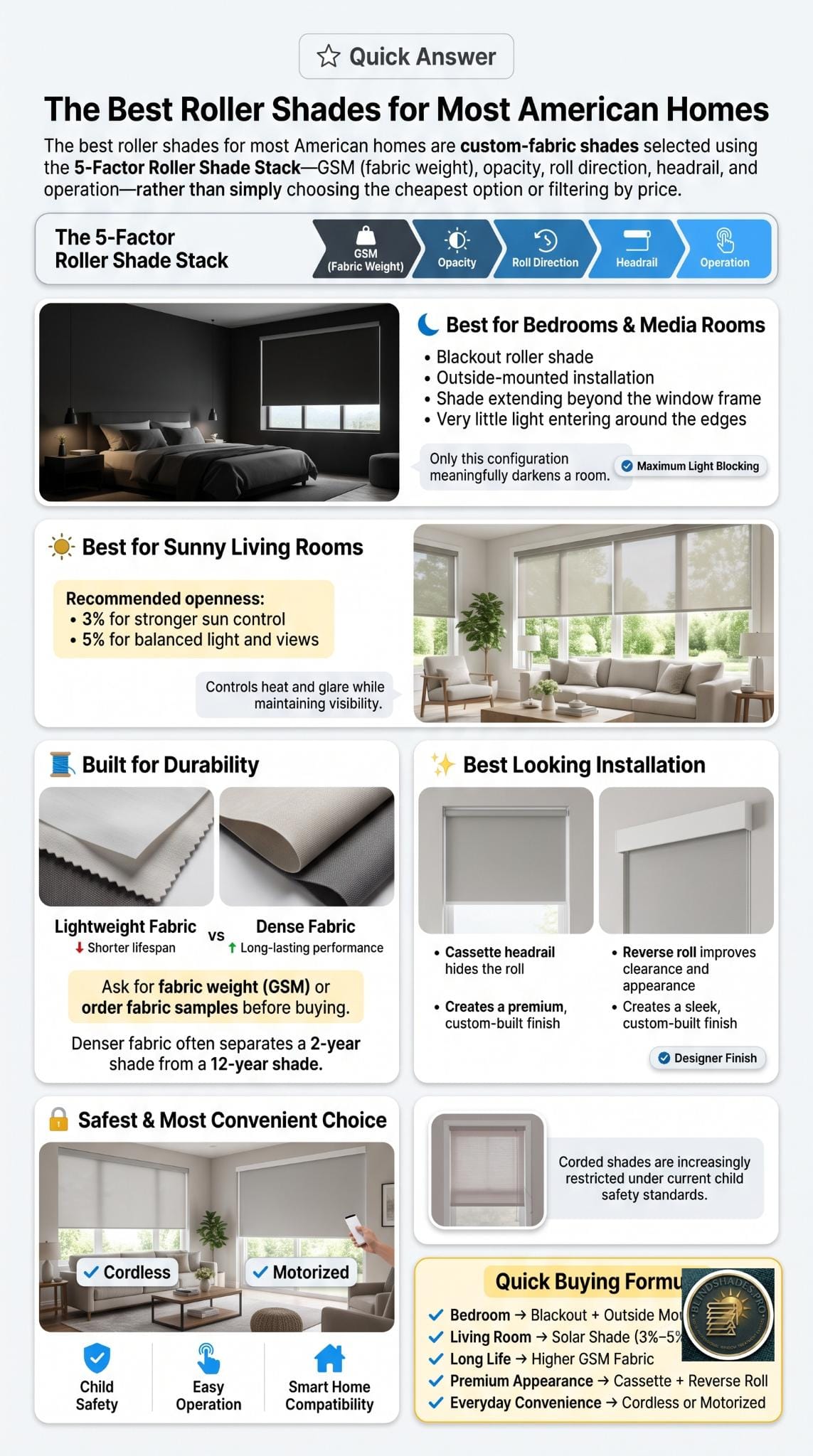
By Michael Turner | 30 years in window treatments
The best roller shades are the ones matched to five specifications — fabric weight (GSM), opacity, roll direction, headrail type, and operation — not the ones with the lowest price or the prettiest swatch. Get those five right and a roller shade lasts a decade and does exactly the job you bought it for. Get them wrong and you replace a sagging, light-leaking shade in two summers. This guide walks the exact decision the way a 30-year fitter would, and it starts by clearing up the one confusion that sends more buyers home with the wrong product than anything else: roller shades are not roller blinds.
🎯 5 Key Takeaways
- Fabric weight is the durability spec almost no retailer publishes. Heavier, denser fabric resists the sag, curl, and edge-fray that kill cheap roller shades early — yet it rarely appears on a product page. Ask for the GSM or request a physical sample before you buy; the hand of the fabric tells you more than any star rating.
- “Blackout” does not mean a dark room. A blackout fabric blocks light through itself, but an inside-mounted shade still leaks around all four edges. According to guidance echoed across the industry, only an outside mount extended past the frame gets you close to true darkness — a point most product pages quietly skip.
- Solar shades are chosen by openness percentage, not color. The 1%, 3%, 5%, and 10% openness factors are the real spec: lower numbers block more heat, glare, and UV but reduce your view; higher numbers preserve the view but let more sun through. Match the number to the window’s compass direction.
- Reverse roll is a real decision, not a default. Letting the fabric drop off the front of the tube (reverse roll) closes the light gap against the wall and clears window cranks and trim; standard roll hangs closer to the glass. Specify it deliberately — most buyers never know it was an option.
- The cassette headrail is becoming the 2026 default. What used to be a premium upgrade — a fabric-covered housing that hides the roll and seals the top light gap — is now widely available from mainstream makers like Levolor and Graber, and it is the single upgrade that most changes how finished a roller shade looks.
⭐ Quick Answer
The best roller shades are chosen with the 5-Factor Roller Shade Stack (GSM fabric weight, opacity, roll direction, headrail, and operation), not off a price filter. Here is the short version:
- Bedrooms and media rooms: only a blackout fabric that is outside-mounted and extended past the frame darkens a room, because inside mounts leak at every edge. See whether blackout roller shades really block all light.
- Sunny living rooms: pick a solar shade by openness percentage (3% or 5% for most south and west glass) to cut heat and glare while keeping the view. See what percentage solar shade you need, plus the U.S. Department of Energy on energy-saving window treatments.
- Durability: heavier, denser fabric (a higher GSM) resists sag, curl, and fray, so ask for the GSM or order a sample, guided by independent bodies like the Attachments Energy Rating Council.
- Cleanest look: add a cassette headrail to hide the tube and seal the top light gap, and specify reverse roll to clear window hardware. Roller shades are softer than the stiffer roller blinds, so do not confuse the two.
- Safety and convenience: cordless or motorized operation is now the mainstream default, and corded products are restricted under the current Window Covering Manufacturers Association safety standard.
Best Sources for this guide: U.S. Department of Energy (window-covering heat-gain guidance); Window Covering Manufacturers Association / ANSI-WCMA A100.1 (cordless safety standard); U.S. Consumer Product Safety Commission (corded-blind hazard reporting); Attachments Energy Rating Council (independent energy ratings for window attachments); Hunter Douglas, Levolor, Graber, Lutron, SmartWings (manufacturer product specifications).
Quick Specification Reference
The cheat sheet — scan this before you read anything else.
| Decision | Your options | Pick this if… |
|---|---|---|
| Opacity | Sheer → Light-filtering → Room-darkening → Blackout → Solar | Sheer for softness only; blackout for sleep; solar for sunny glass with a view to keep |
| Fabric weight (GSM) | Light hand / Medium hand / Heavy hand | Heavier hand for high-use windows, wide spans, and longer life |
| Roll direction | Regular roll / Reverse roll | Reverse roll to clear cranks, trim, or close the wall-side light gap |
| Headrail | Open roll / Cassette / Fascia | Cassette to hide the tube and seal the top light gap |
| Operation | Cordless spring / Continuous chain / Battery motor / Hardwired / PoE | Cordless or motorized for child safety; hardwired/PoE for whole-home installs |
| Mount | Inside mount / Outside mount | Outside mount whenever darkness or full coverage matters |
Read the complete guide below for: the roller-shades-versus-roller-blinds distinction that trips up most buyers, the full opacity ladder, why GSM fabric weight decides longevity, how to read solar openness percentages against window orientation, when reverse roll and a cassette headrail are worth it, whether motorization earns its price in 2026, our cross-brand product picks, real cost ranges, and ten of the questions buyers ask most.
What Are Roller Shades — and How Are They Different From Roller Blinds?
A roller shade is a single sheet of soft, textile-forward fabric that winds around a tube; a roller blind is the stiffer, structured cousin — and confusing the two is the most common buying mistake.
Someone searches “roller shades,” lands on a roller blinds page, and buys the wrong product — not out of carelessness, but because the industry has never explained the line cleanly. Here it is. Roller shades use softer, more drapeable fabrics — polyester, linen-look weaves, textured blends — that hang with a gentle textile character and suit bedrooms, living rooms, and home offices. Roller blinds use stiffened, structured, or PVC-backed materials with a firmer, more architectural hand, and they lean commercial. Most American retailers use the words interchangeably, which is exactly why buyers end up confused.
The mechanism is shared: a continuous piece of fabric wraps a cylindrical tube mounted at the top of the window and rolls up or down. What differs is the fabric’s personality and, with it, the rooms each product belongs in.
| Attribute | Roller shades | Roller blinds |
|---|---|---|
| Fabric | Soft, textile-forward (polyester, linen-look, weaves) | Stiffened, structured, or PVC-backed |
| Hand / drape | Drapeable, gentle | Firm, rigid |
| Look | Warm, residential | Architectural, commercial |
| Backing | Optional light-filtering or blackout liner | Often PVC or stiffener built in |
| Best rooms | Bedrooms, living rooms, home offices | Commercial spaces, high-abuse windows |
This guide covers the softer roller-shade category; if you need the rigid, commercial-grade version, that is a different purchase.
For the full breakdown of construction, fabric, and which to buy for your room, see our supporting article on roller shades vs roller blinds.
The 5-Factor Roller Shade Stack
Every good roller-shade decision comes down to five specifications, stacked in order — this is the framework the rest of the guide follows. Rather than shopping by color first, work the stack: GSM (how long it lasts), Opacity (how much light it controls), Roll Direction (how it hangs against the window), Headrail (how finished it looks), and Operation (how you raise it and how safe it is). Nail these five and color becomes the easy, last decision it should be.
What Types of Roller Shades Should You Consider?
Opacity is the second factor in the stack, and it is the one that decides whether a shade actually solves your problem.
Roller shades run along an opacity ladder, and the terms matter because a retailer’s “room-darkening” is not another’s “blackout.” Here is the honest breakdown.
| Type | What it does | Blocks light | Best rooms |
|---|---|---|---|
| Sheer / light-filtering | Diffuses daylight, softens glare, keeps a bright feel | Minimal | Living rooms, kitchens, offices wanting daytime brightness |
| Room-darkening | Cuts most light but leaves a glow at the edges | Substantial, not total | Nurseries, guest rooms, TV rooms |
| Blackout | Opaque fabric blocks light through itself | Total through the fabric — edges still leak | Primary bedrooms, media rooms (outside mount) |
| Solar | Screen-weave fabric blocks heat/UV, preserves view | By openness % | Sunny living rooms, home offices, sliding-door walls |
| Dual / double roller | Two fabrics (sheer + blackout) on one headrail | Adjustable | Rooms needing day view and night blackout in one unit |
The trap competitors fall into is treating “blackout” and “room-darkening” as marketing synonyms. They are not the same product, and the difference shows up the first morning the sun hits the window.
For the room-by-room blackout decision, see our supporting article on the best roller shades for a bedroom, and to understand dual-fabric options see our layering guide.
What GSM Fabric Weight Actually Matters for Durability?
Fabric weight — measured in GSM, grams per square meter — is the first factor in the stack and the single best predictor of how long a roller shade survives daily use.
Here is the metric almost nobody advertises. GSM describes how much fabric is packed into each square meter — in plain terms, the density and heft of the material. It is not printed on most product pages, which is precisely why it is a buying edge: a heavier, denser fabric resists the three things that kill cheap roller shades early — sagging along the bottom rail, curling at the vertical edges, and fraying where the fabric meets the tube. A featherweight fabric can look identical in a photo and fail in a fraction of the time.
Because manufacturers rarely publish GSM, the practical move is to judge the hand of the fabric — its weight and stiffness when you handle it — and to ask the retailer directly. A good sample program tells you more than any spec sheet.
| Fabric hand | How it feels | Durability outlook | Best fit |
|---|---|---|---|
| Light | Thin, flexible, translucent | Wears and sags soonest | Low-use windows, budget refreshes |
| Medium | Balanced weight, slight body | Solid everyday longevity | Most living rooms and offices |
| Heavy | Dense, substantial, firm drop | Longest-lasting, resists sag and curl | Wide spans, high-use rooms, blackout units |
The buying rule that follows: never order a wide or heavily used roller shade in the lightest fabric to save a few dollars — it is the choice you pay for twice. Independent bodies such as the Attachments Energy Rating Council rate window attachments for performance, but for longevity specifically, fabric density is your lever, and requesting a sample is how you verify it.
Do Blackout Roller Shades Really Block All the Light?
No inside-mounted roller shade blocks all light — the fabric can be fully opaque and the room can still be bright, because light leaks around every edge.
This is where honesty separates a trustworthy guide from a catalog. A blackout fabric does its job: no light passes through the material itself. But an inside-mounted shade sits within the window frame, leaving a gap on both sides, at the top, and along the bottom rail. Those gaps glow at sunrise regardless of how opaque the fabric is.
The fix is mounting, not fabric. An outside mount, with the shade extended several inches past each side of the frame and hung above it, is the configuration that gets a room genuinely dark. A cassette or side channels close the remaining gaps. Any product page promising “100% blackout” from a standard inside mount is overselling the fabric and ignoring the physics. The U.S. Department of Energy notes that operable window coverings reduce heat gain and loss meaningfully — but light control, specifically, is governed by how you mount as much as what you hang.
For the full test-by-test reality of blackout performance, see our supporting article on whether blackout roller shades actually block all light.
What Percentage Solar Shade Do You Need?
Solar shades are specified by openness percentage — 1%, 3%, 5%, or 10% — and the right number depends on which compass direction the window faces.
This is the roller-shade equivalent of a published spec, and most retailers mention solar fabric without ever explaining the number that governs it. Openness percentage describes how much of the weave is open space. A lower percentage means a tighter weave: more heat, glare, and UV blocked, but a more veiled view. A higher percentage keeps a crisp view at the cost of letting more sun through.
| Openness | View vs. protection | Best window orientation |
|---|---|---|
| 1% | Maximum heat/UV/glare block, most veiled view | Intense west and south glass in hot climates |
| 3% | Strong protection, still-usable view | South- and west-facing windows in most climates |
| 5% | Balanced protection and clear view | East-facing and moderate south exposure |
| 10% | Clearest view, lightest protection | North-facing glass and shaded exposures |
There is one honesty note solar buyers deserve: the same weave that gives you daytime privacy reverses after dark. When your interior lights are on and it is black outside, people can see in through a solar shade. For any room used at night, pair the solar shade with a room-darkening or blackout layer.
For the room-specific openness decision, see our supporting article on what percentage solar shade you need for a living room.
What Is Reverse Roll — and Do You Actually Need It?
Reverse roll drops the fabric off the front of the tube instead of the back, and it is the right call whenever you need to clear window hardware or close the wall-side light gap.
Factor three in the stack is roll direction, and it is almost never explained. On a regular roll, the fabric unwinds from the back of the tube and hangs close to the glass. On a reverse roll, it unwinds from the front, dropping the fabric forward — away from the window.
| Situation | Regular roll | Reverse roll |
|---|---|---|
| Crank windows or protruding hardware | Fabric can catch on it | Clears the obstruction |
| Deep sills or trim | May sit behind trim | Hangs cleanly in front |
| Wall-side light gap | Larger gap near the wall | Fabric hugs closer, smaller gap |
| Closest-to-glass look | Best | Sits slightly forward |
Most buyers never learn reverse roll was an option and default to regular roll by omission. Specify it deliberately when a window has cranks, deep trim, or an outside mount where you want the fabric to hug the wall.
For the full specification walkthrough, see our supporting article on what reverse roll is and whether you need it.
Is a Cassette Headrail Worth the Extra Cost?
A cassette headrail — a fabric-covered housing that hides the rolled-up tube — is the single upgrade that most changes how finished a roller shade looks, and in 2026 it is close to a default expectation.
Factor four is the headrail. An open-roll shade leaves the tube and fabric roll exposed at the top. A cassette encloses that roll in a housing, usually wrapped in the shade fabric or a coordinating fascia, presenting a clean, architectural top edge — and sealing the top light gap in the process.
| Headrail | Look | Light gap at top | Typical positioning |
|---|---|---|---|
| Open roll | Exposed tube visible | Open | Budget and utility installs |
| Cassette | Fabric-wrapped, hidden tube | Sealed | Mid-to-premium standard |
| Fascia | Flat decorative front panel | Sealed | Design-forward rooms |
What was once a premium add-on is now widely available from mainstream makers — Levolor and Graber have both pushed cassette options into the mid-market at lower premiums. If the shade is going anywhere visible, the cassette usually earns its keep.
For the full cost-benefit analysis, see our supporting article on what a cassette headrail is and whether it is worth it.
Are Motorized Roller Shades Worth It in 2026?
Factor five is operation, and motorization is now mainstream — worth it for hard-to-reach windows, whole-home installs, and anyone who wants scheduling and voice control, with the real decision being which power architecture you choose.
Operation is no longer just “corded or cordless.” Under the current ANSI-WCMA A100.1 safety standard, developed with the U.S. Consumer Product Safety Commission in response to cord-strangulation hazards, corded products are restricted, and cordless or motorized operation has become the default for homes with children and pets. The Window Covering Manufacturers Association’s cordless push reshaped the whole category.
Within motorization, the choice that actually matters is power.
| Operation | How it works | Best for | Trade-off |
|---|---|---|---|
| Cordless spring | Manual push/pull, no cord | Standard reachable windows, child safety | Manual only |
| Continuous chain | Beaded loop | Large or heavy shades needing leverage | Loop present (tensioned to wall) |
| Battery motor | Rechargeable lithium motor, app/remote | Retrofits, renters, no wiring | Recharge every several months |
| Hardwired | Mains-powered motor | New builds, permanent installs | Requires electrical work |
| Power over Ethernet (PoE) | Power + data over one Cat cable | Whole-home, many windows | Requires cabling |
For smart-home buyers, the Matter standard from the Connectivity Standards Alliance now lets shades speak across ecosystems rather than locking you to one app. At the premium end, Lutron’s Serena line — reviewed by outlets such as TechHive for its whole-home power model and notably quiet motor — anchors the hardwired tier, while battery systems like SmartWings cover the no-wire retrofit case. If you are outfitting many windows, decide the power architecture first; you wire a house once.
For the full worth-it math and smart-home compatibility breakdown, see our supporting article on whether motorized roller shades are worth it in 2026.
Related guides: the sixteen-dollar blackout vinyl roller and its whole material family are covered in the best plastic and vinyl window covers guide.
Best Roller Shades — Our Picks for 2026
These are cross-brand picks by job, chosen for fabric quality and fit rather than a single retailer’s catalog — verify current pricing and available sizes directly with each seller.
Because we are not tied to one manufacturer, these recommendations span brands. We do not fabricate test numbers or prices; each pick is named for what it does well and where it fits in the stack.
| Category | Pick | Why it earns the spot |
|---|---|---|
| Best Overall | Hunter Douglas Designer Roller Shade | Deep fabric library spanning sheer, light-filtering, blackout, and solar; strong build and cassette options |
| Best Budget | Blindsgalore Classic Roller Shade | Custom sizing and honest fabric range at an accessible tier; solid value for standard windows |
| Best Blackout | SelectBlinds blackout roller (outside-mount) | Opaque fabric; darkens best when outside-mounted and extended past the frame |
| Best Motorized | Lutron Serena Smart Roller Shade | Whole-home power architecture and a quiet motor; SmartWings is the no-wire battery alternative |
| Best for Large Windows | Mecho / commercial-grade roller systems | Built for wide spans and tall glass standard residential shades cannot handle cleanly |
Affiliate note: purchase links (SelectBlinds via CJ; Blinds.com via Impact) are inserted at publication. We only recommend configurations we would specify for a client, and we never invent prices or test claims.
How Much Do Roller Shades Cost?
Roller shades are among the more affordable custom window treatments, with cost driven by size, fabric weight, opacity, headrail, and operation rather than brand alone.
Cost scales with the five factors more than with the logo. Blinds.com places typical roller shades in the range of roughly twenty-five to one hundred dollars per window, with blackout fabric, solar screen, a cassette headrail, and motorization each adding to that base. The honest framing: a plain, light-fabric, open-roll cordless shade sits at the bottom of the range; a wide, heavy-fabric, cassette-headrail, motorized shade sits well above it. Spend where the stack matters for your room — fabric weight for longevity, opacity for the actual job, mounting for darkness — and economize on the factors your window does not need.
Related guides: a roller with a trick — alternating sheer and opaque bands on one loop — is explained and ranked in the best zebra shades guide.
Related Buying Guides
- The Best Roller Blinds Buying Guide — the structured, PVC-backed alternative to roller shades
- The Best Venetian Blinds Buying Guide — horizontal slat alternatives
- The Best Solar Screens Buying Guide — fixed exterior mesh for heat control
- The Best Window Sheers Buying Guide — soft, light-diffusing treatments
- The Best Day & Night Blinds Buying Guide — dual-fabric day-and-night systems
- The Best Pleated Blinds Buying Guide — compact pleated alternatives
📚 The 10 Topics Covered in This Guide’s Supporting Articles
Each roller-shade decision has a deep dive. As these publish on BlindShades.pro, they answer the questions this hub only summarizes:
- Roller Shades vs Roller Blinds — What Is Actually the Difference and Which Should You Buy?
- What Percentage Solar Shade Should I Get for My Living Room? The Openness Factor Explained
- Do Blackout Roller Shades Actually Block All Light — The Honest Answer
- Are Motorized Roller Shades Worth It in 2026 — And Which Smart Home Systems Work Best?
- Can Roller Shades Be Layered With Curtains — And How Do You Do It Properly?
- What Is a Cassette Headrail and Is It Worth the Extra Cost?
- The Best Roller Shades for a Bedroom — Blackout, Room-Darkening, or Something Else?
- IKEA Roller Shades — Are They Actually Any Good or Should You Spend More?
- What Is Reverse Roll on Roller Shades and Do I Need to Specify It?
- How to Clean Roller Shades Without Damaging the Fabric or the Mechanism
Frequently Asked Questions
What is the difference between roller shades and roller blinds? Roller shades use softer, textile-forward fabrics that drape naturally and suit bedrooms, living rooms, and offices; roller blinds use stiffer, structured, or PVC-backed materials with a firmer, more commercial hand. The rolling mechanism is the same, but the fabric character and the rooms they suit differ. Most American retailers use the terms interchangeably, which is the source of most buyer confusion.
Do blackout roller shades block 100% of light? The fabric blocks all light through itself, but an inside-mounted shade leaks around the side, top, and bottom edges, so the room stays bright at those gaps. Only an outside mount extended past the frame — ideally with a cassette or side channels — gets a room genuinely dark. Any “100% blackout” claim from a standard inside mount overstates what the fabric alone can do.
What percentage solar shade should I choose? Choose by window orientation: 1% or 3% for intense south- and west-facing glass where heat and glare are worst, 5% for east-facing and moderate exposures, and 10% for north-facing or shaded windows where you want the clearest view. Lower percentages block more heat and UV but veil the view; higher percentages preserve the view but admit more sun.
What is GSM and why does it matter for roller shades? GSM (grams per square meter) is the fabric’s weight and density. It is the best predictor of durability — heavier fabric resists sagging, curling, and fraying — yet most retailers do not publish it. Ask for the GSM or request a physical sample and judge the hand of the fabric before you buy, especially for wide or high-use windows.
Is a cassette headrail worth the extra cost? For any shade in a visible location, usually yes. A cassette hides the exposed roll, delivers a clean architectural top edge, and seals the top light gap. Once a premium upgrade, it is now widely available from mainstream makers like Levolor and Graber at modest premiums, which is why it is close to a default expectation in 2026.
What is reverse roll and do I need it? Reverse roll drops the fabric off the front of the tube rather than the back, hanging it slightly forward of the glass. Specify it when a window has cranks or protruding hardware to clear, deep trim to hang in front of, or an outside mount where you want the fabric to hug the wall and close the light gap. Regular roll keeps the fabric closest to the glass.
Are motorized roller shades worth it? They are worth it for hard-to-reach windows, whole-home installs, and anyone wanting scheduling or voice control, and cordless or motorized operation is now the safety-standard default for homes with children. The key decision within motorization is power: battery motors for retrofits and renters, hardwired or Power-over-Ethernet for permanent whole-home systems. Match the Matter standard for cross-ecosystem smart-home control.
Can roller shades be layered with curtains? Yes, and layering a roller shade with drapes is increasingly the default approach in American homes rather than using one treatment alone. It adds flexibility, better light control, and a more finished look — a room-darkening or solar roller shade for function, paired with drapery panels for softness and nighttime privacy.
How long do roller shades last? It depends far more on fabric weight and use than on brand. A heavy, dense fabric on a quality mechanism can last a decade or more; a lightweight budget fabric on a wide window may sag or fray within a couple of years. Fabric density and mechanism quality are the two levers, which is why requesting a sample and asking about GSM pays off.
Are roller shades good for bedrooms? They can be excellent for bedrooms when specified correctly: a blackout fabric, outside-mounted and extended past the frame, with a cassette or side channels to seal the edges. An inside-mounted light-filtering shade will not darken a bedroom on its own — the mount and opacity choices are what make roller shades work for sleep.
