The Best Roman Shades Buying Guide (2026)

Authored By Michael Turner -30 Years Home Improvement Expertise | Updated 2026 | BlindShades.pro
Updated on July 18, 2026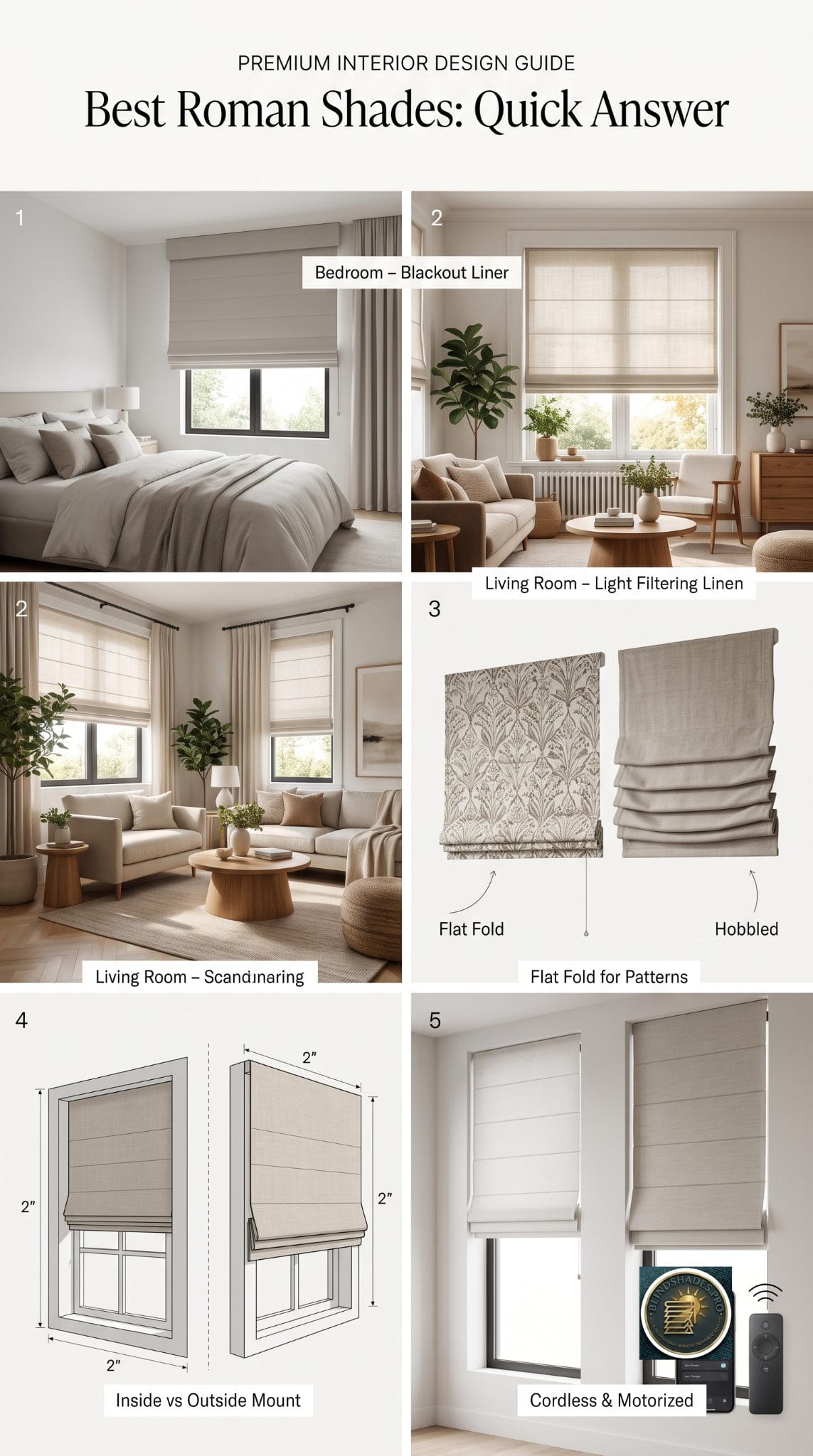
By Michael Turner | 30 years in window treatments
The best Roman shades are the ones matched to five decisions — fold style, fabric, liner, mount, and lift — not the ones with the prettiest photo or the lowest price. Roman shades give you the softness and pattern of a curtain with the precise light control of a shade, but they are the one window treatment where the liner matters more than the fabric color and the stack height can quietly eat the top of your view. This guide walks the exact decision the way a 30-year fitter would, drawing on independent picks from Architectural Digest, Room for Tuesday, and Emily Henderson rather than any testing claim of our own — and it starts by clearing up what a Roman shade actually is.
🎯 5 Key Takeaways
- The liner is the real performance decision, not the fabric color. Unlined, privacy, room-darkening, blackout, and thermal liners change what the shade actually does; the face fabric is mostly looks. Choose the liner for the job first.
- Fold style is a decision, not a gallery. Flat and relaxed folds display patterns best; hobbled folds suit solids and textures because their permanent overlapping loops break up a print. Match the fold to your fabric and room.
- Roman shades stack tall when raised. All that fabric bunches at the top of the window, so a raised shade can block the upper part of your view — plan the mount height so the stack clears the glass you want to see.
- Mount depth makes or breaks the fit. A Roman shade needs roughly two inches of depth for an inside mount; shallower windows need an outside mount, which also covers the frame and reduces edge light.
- Not for bathrooms. The fabric construction is wrong for high-moisture rooms, and woven-wood and bamboo Romans especially should stay out of damp spaces.
⭐ Quick Answer
The best roman shades are chosen with the Roman Shade Blueprint (fold, fabric, liner, mount, and lift), not off a photo. Here is the short version:
- Bedrooms: a blackout-lined shade, outside-mounted past the frame, is what darkens a room; see blackout vs light-filtering liners.
- Living rooms: a light-filtering or privacy liner in linen or a woven texture gives soft light and warmth, the look design editors like Room for Tuesday favor.
- Pattern lovers: choose a flat or relaxed fold so the print shows uninterrupted, and save hobbled folds for solids and textures.
- The fit: confirm about two inches of depth for an inside mount, or go outside mount on a shallow window; room-darkening liners block roughly 95% of light, per Blinds.com.
- Picks and safety: cordless is the child-safe default and motorized suits hard-to-reach windows; for cross-brand picks see Architectural Digest, our best Roman shades for a bedroom, or the sleeker roller shade alternative.
Best Sources: Architectural Digest (best Roman shade picks); Room for Tuesday (designer-approved selection and layering); Emily Henderson (readymade value picks); Blinds Chalet and California Window Fashions (styles, liners, brand ranges); U.S. Department of Energy (window-covering insulation); Window Covering Manufacturers Association (cordless safety).
Quick Specification Reference
The cheat sheet — scan this before you read anything else.
| Decision | Your options | Pick this if… |
|---|---|---|
| Fold | Flat / Relaxed / Hobbled / Cascade | Flat or relaxed for patterns; hobbled for solids and rich texture |
| Fabric | Linen / Cotton / Woven wood / Print | Linen for airy casual; woven wood for organic texture; print for a focal point |
| Liner | Unlined / Privacy / Room-darkening / Blackout / Thermal | Blackout for bedrooms; privacy for street-facing; thermal for drafty glass |
| Mount | Inside / Outside | Inside if depth is 2 inches or more; outside for shallow frames or more darkness |
| Lift | Cordless / Continuous loop / Motorized / Top-down-bottom-up | Cordless for child safety; motorized for hard-to-reach; loop for heavy shades |
| Room | Living / Bedroom / Kitchen (not bathroom) | Keep fabric Romans out of high-moisture rooms |
Read the complete guide below for: what Roman shades are and how they differ from roller shades and curtains, the fold-style decision, the fabric and liner choices that decide performance, the mount-depth and stack-height rules that decide fit, lift systems, our cross-brand picks, real cost ranges, whether Roman shades are still in style for 2026, and ten of the questions buyers ask most.
What Are Roman Shades — and How Are They Different From Roller Shades?
A Roman shade is a fabric window covering that folds up into neat horizontal pleats as it rises and lies flat or gently folded when lowered — giving you the look of drapery with the light control of a shade.
Roman shades occupy the middle ground between a curtain and a roller shade, and that is exactly why people choose them. Unlike a roller shade, which winds a single flat sheet around a tube, a Roman shade gathers its fabric into folds that stack at the top when raised. Unlike a curtain, it delivers precise, adjustable light control rather than just opening and closing. The trade is that a Roman shade uses far more fabric, which brings two consequences the photos never show: it stacks tall when raised, and it needs a deeper window to mount inside.
| Attribute | Roman shade | Roller shade | Curtain / drape |
|---|---|---|---|
| Look | Soft folded fabric, tailored or relaxed | Flat, sleek, minimal | Loose flowing fabric |
| Light control | Precise, adjustable height | Precise, adjustable height | All-or-nothing |
| Stack when open | Tall fabric stack at the top | Compact roll | Pulls to the sides |
| Best for | Warmth plus precise control | Simple, budget, wet rooms | Softness, framing, layering |
If you want the sleek, lower-cost, wet-room-friendly option instead, our best roller shades buying guide covers it, and the head-to-head is in our Roman shades vs roller shades comparison.
The Roman Shade Blueprint
Every good Roman shade decision comes down to five choices, made in order — this is the framework the rest of the guide follows. Rather than shopping by fabric photo first, work the blueprint: Fold (how it looks), Fabric (the character), Liner (what it actually does), Mount (whether it fits), and Lift (how you raise it and how safe it is). Nail these five and color becomes the easy, last decision it should be.
What Fold Style Should You Choose?
Fold style is the first decision, and it comes down to one rule: flat and relaxed folds display patterns best, while hobbled folds suit solids and textures because their permanent overlapping loops break up a print.
This is where the design blogs give you a gallery and no guidance. Here is the decision. A flat fold — sometimes called plain fold — lies smooth when lowered and folds only when raised, giving a clean, tailored, modern look that shows a pattern cleanly. A relaxed fold adds a gentle smile-shaped swoop at the bottom for a casual, coastal feel. A hobbled or soft fold keeps permanent cascading folds even when down, for a full, traditional, luxurious look — but those folds break up a large print, so hobbled is best in solids and textures.
| Fold style | Look | Best for | Note |
|---|---|---|---|
| Flat (plain) | Clean, tailored, modern | Patterns and prints, minimalist rooms | Seam lines fall at the fold points |
| Relaxed (casual) | Soft smile at the hem | Coastal, casual living spaces | Not for precise, formal looks |
| Hobbled (soft) | Full permanent folds | Solids, textures, traditional rooms | Uses more fabric; breaks up prints |
| Cascade / gathered | Swooped or gathered rise | Larger windows, decorative focal points | Style names vary by maker |
As Architectural Digest notes in its own Roman shade coverage, style names like Cascade, Aventura, Relaxed, and Tulip vary by manufacturer, so match the shape to your room rather than the brand’s label. For the full fold-by-fold breakdown, see our guide on flat vs relaxed vs hobbled Roman shades.
What Fabric Is Best for Roman Shades?
Related guides: Romans are a made-to-order product at heart — how to measure, which maker tier, and when custom beats ready-made is covered in our made to measure blinds guide.
Fabric sets the character and the ease of operation — linen for airy casual rooms, woven wood for organic texture, cotton for versatility, and prints when you want the shade to be the focal point — with weight being the practical limit.
Fabric is the second decision, and Blinds.com is right that weight matters as much as looks: too heavy a fabric is hard to raise and lower and will not hold a clean fold. Here are the workhorses.
| Fabric | Character | Best for | Watch for |
|---|---|---|---|
| Linen | Light, airy, elegant | Casual and coastal rooms; easy lift | Wrinkles; sheer versions need a liner |
| Cotton / blends | Versatile, durable | Most rooms, patterns and solids | Choose a mid weight for clean folds |
| Woven wood / bamboo | Organic natural texture | Living rooms, warm modern spaces | Not for bathrooms or high moisture |
| Printed / patterned | Decorative focal point | A statement window | Pair with a flat or relaxed fold |
Woven-wood and bamboo Romans deserve a specific warning: their handcrafted natural weaves are beautiful but must stay out of high-moisture rooms. And a sheer or bold fabric changes color as light passes through it, which is exactly what the liner is for.
Related guides: a woven wood is a Roman woven from grass — the bamboo, reed and jute side of the family, with the liner decision that fixes night privacy, is in the complete woven wood & bamboo shades guide.
Which Liner Do You Actually Need?
The liner is the most underrated decision in the whole purchase — it, not the face fabric, determines privacy, light control, and insulation, so choose it for the job before you fall in love with a color.
This is the reframe that separates a good Roman shade from a disappointing one. The same linen shade can be a soft daytime glow or a near-blackout bedroom shade depending only on the liner behind it. Match the liner to what the room needs.
| Liner | What it does | Best room |
|---|---|---|
| Unlined | Soft glow, most light through | Casual living spaces, layered looks |
| Privacy liner | Daytime privacy, cuts silhouettes | Street-facing windows, common areas |
| Light-filtering liner | Softens glare, keeps rooms bright | Kitchens, family rooms |
| Room-darkening liner | Blocks most light, some edge glow | Media rooms, nurseries |
| Blackout liner | Near-total darkness through the fabric | Primary bedrooms, media rooms |
| Thermal / interlining | Adds insulation and R-value | Drafty or single-pane windows |
Blinds.com puts room-darkening liners at blocking roughly 95% of light, and for true bedroom darkness a blackout liner paired with an outside mount is the answer. On the energy side, the U.S. Department of Energy notes that operable fabric window coverings reduce heat transfer, so a thermal-lined Roman on a drafty window earns its keep in comfort and cooling load — an effect layering with drapery panels compounds. For the full opacity breakdown, see our guide on blackout vs light-filtering Roman shades.
Should You Choose an Inside or Outside Mount?
Mount depth decides the fit: a Roman shade needs roughly two inches of window depth for an inside mount, and shallower windows need an outside mount — which also covers the frame, reduces edge light, and lets you manage the fabric stack.
Mounting is where Roman shades trip up more buyers than any other treatment, for two reasons the ranked pages under-explain: depth and stack. On depth, American Blinds notes Roman shades are thick and generally need a deep window for an inside mount; if your window depth is under about two inches, an outside mount is the fix so the shade sits flush.
| Factor | Inside mount | Outside mount |
|---|---|---|
| Look | Built-in, shows the trim | Framed, makes the window look larger |
| Depth needed | About 2 inches or more | Any depth |
| Edge light | Small side gaps | Covers the frame, less leak |
| Out-of-square frames | Shows gaps | Hides them |
| Stack management | Stack sits inside the reveal | Can mount higher to clear the view |
The second issue is the stack: when a Roman shade raises, all that fabric bunches into a tall stack at the top of the window. On a shorter window an inside-mounted stack can block the upper part of your view. The professional fix is an outside mount installed several inches above the frame, so the raised stack sits above the glass rather than in front of it — a measurement worth taking before you order. Measure width at the top, middle, and bottom and use the smallest; measure height at left, center, and right and use the largest.
What Lift System Is Best for Roman Shades?
Cordless is the mainstream, child-safe default; continuous-loop suits large or heavy shades; motorized is worth it for hard-to-reach windows; and top-down-bottom-up adds privacy control most buyers overlook.
Lift is the fifth decision, and safety has reshaped it. Under the current ANSI-WCMA cordless safety standard from the Window Covering Manufacturers Association, corded products are restricted, and cordless or motorized operation is now the default for homes with children and pets.
| Lift system | How it works | Best for |
|---|---|---|
| Cordless | Push or pull, no cords | Standard windows, child safety, clean look |
| Continuous loop | A tensioned chain loop | Large or heavy shades needing leverage |
| Motorized | App, remote, or voice | Tall or hard-to-reach windows, smart homes |
| Top-down-bottom-up | Opens from the top or bottom | Privacy without losing daylight |
Top-down-bottom-up deserves a mention because 3 Day Blinds is right that it is a quiet game-changer for bedrooms and bathrooms-adjacent rooms: you can lower the top to let in light while keeping the bottom closed for privacy. For the cordless-versus-motorized decision in detail, see our guide on cordless vs motorized Roman shades.
Best Roman Shades — Our Picks for 2026
These are cross-brand picks by job, drawn from independent selections by Architectural Digest, Room for Tuesday, and Emily Henderson plus specification experience — not testing of our own, and with no fabricated prices.
Because we are not tied to one manufacturer and do not run a lab, these recommendations span brands and lean on the outlets that curated them. Verify current pricing and sizes directly with each seller.
| Category | Pick | Why it earns the spot |
|---|---|---|
| Best Overall (custom luxury) | The Shade Store custom Roman | The custom-luxury benchmark cited across expert roundups |
| Best Value (custom) | Select Blinds Roman | Frequent sales and deep discounts on highly customizable shades |
| Best Budget Blackout | Sun Zero textured blackout Roman | Off-the-rack 100% blackout, cordless, well-rated |
| Best Designer | Hunter Douglas Vignette / Provenance | Premium fold construction and woven-wood range |
| Best No-Drill / Cordless | LazBlinds or Chicology cordless Roman | Tool-free, renter-friendly, budget cordless |
| Best Ready-Made Prints | Pottery Barn Riviera | Distinctive ready-to-ship prints, per Architectural Digest |
Affiliate note: purchase links (SelectBlinds via CJ; Blinds.com via Impact; Amazon Associates for ready-made picks) are inserted at publication. We recommend only configurations we would specify for a client and never invent prices or test claims.
Related guides: Romans are a made-to-order product at heart — how to measure, which maker tier, and when custom beats ready-made is covered in our made to measure blinds guide.
Which Room Are You Buying For?
Roman shades excel in living rooms and bedrooms, work in kitchens with the right fabric, and do not belong in bathrooms — match the liner and fabric to the room’s job.
Room decides the liner and fabric more than the color does. Here is the room-by-room formula.
| Room | Recommended setup | Why |
|---|---|---|
| Living room | Light-filtering or privacy liner, linen or woven wood | Soft light, texture, decorative warmth |
| Bedroom | Blackout liner, outside mount | Darkness for sleep, sealed edges |
| Kitchen | Light-filtering, easy-clean fabric | Bright, but keep fabric away from grease and moisture |
| Dining / formal | Hobbled fold, rich fabric | Full, traditional, dressed look |
| Bathroom | Not recommended | Fabric construction fails in high moisture |
For darkness-first bedroom setups, see our best Roman shades for a bedroom guide, and for tricky openings like patio doors, our Roman shades for sliding glass doors guide.
How Much Do Roman Shades Cost?
Roman shades sit on the higher end of window treatments, with cost driven by fabric, liner, size, fold style, and lift rather than brand alone.
American Blinds is candid that Roman shades run higher than most other window treatments because of the fabric involved. As reference points from the results, Architectural Digest places premium custom Romans starting around four hundred dollars per window depending on fabric and hardware, value-focused custom options can start well under one hundred dollars during sales, and ready-made shades run roughly forty to one hundred dollars. Spend where the blueprint matters for your room — the liner for performance, the fold for looks, the mount for fit — and economize on the factors your window does not need. For getting the measurements right before you spend, see our how to measure for Roman shades guide.
Are Roman Shades in Style for 2026?
Yes — Roman shades remain firmly in style, with the current move toward natural texture, warmth, and softer window treatments putting linen and woven-wood Romans especially in demand.
The People Also Ask box asks it directly, so here is the straight answer: Roman shades are a timeless treatment, not a trend, and the 2026 design direction actively favors them. The shift toward organic materials and layered, textural rooms has pushed woven-wood and linen Romans to the front, and their blend of soft fabric with precise light control keeps them relevant in both modern and traditional interiors. If you are weighing whether the look will date, we cover it fully in our guide on whether Roman shades are outdated.
Related Buying Guides
- The Best Roller Shades Buying Guide — the sleek, lower-cost alternative
- The Best Cellular & Honeycomb Shades Buying Guide — when energy efficiency leads
- The Best Sheer Shades Buying Guide — soft fabric with tilt control
- Roman Shades vs Roller Shades — the direct comparison
📚 The 10 Topics Covered in This Guide’s Supporting Articles
Each Roman shade decision has a deep dive. As these publish on BlindShades.pro, they answer the questions this hub only summarizes:
- Roman Shades vs Roller Shades — Which Should You Buy?
- Flat vs Relaxed vs Hobbled Roman Shades — Fold Styles Explained
- Blackout vs Light-Filtering Roman Shades — Which Liner Do You Need?
- Are Roman Shades Outdated? What’s In Style in 2026
- Cordless vs Motorized Roman Shades — Which Lift Is Worth It?
- Why Won’t My Roman Shade Stay Up? Causes and Fixes
- How to Fix Uneven Roman Shade Folds
- The Best Roman Shades for a Bedroom
- Roman Shades for Sliding Glass Doors and French Doors
- How to Measure for Roman Shades
Related guides: Romans are the bay classic, but only flat folds respect the corners — the projection table and the angle audit live in our bay window blinds guide.
Frequently Asked Questions
What is the best brand for Roman shades? There is no single best brand; the right one depends on your priority. For custom luxury, The Shade Store and Hunter Douglas lead; for customizable value, Select Blinds is frequently recommended; for off-the-rack blackout, brands like Sun Zero and Arlo Blinds are well rated; and for ready-made prints, Pottery Barn is a common pick. Match the brand to whether you want custom fit, budget, or a specific fabric.
What is the best material for Roman shades? Linen is the most popular for its light, airy, elegant look and easy operation, while woven wood and bamboo bring organic texture, cotton offers versatility, and printed fabrics work as a focal point. The best material depends on the room and fold style, and weight matters: a mid-weight fabric holds a clean fold and raises easily, whereas very heavy fabric is harder to operate.
Are Roman shades good for bedrooms? Yes, when specified with a blackout liner and an outside mount. The blackout liner blocks light through the fabric, and the outside mount extended past the frame seals the edge gaps for true darkness. A light-filtering or unlined Roman will not darken a bedroom on its own, so the liner and mount choices are what make Roman shades work for sleep.
Are Roman shades in style for 2026? Yes. Roman shades are a timeless treatment rather than a passing trend, and the 2026 move toward natural texture and warmth has made linen and woven-wood Romans especially popular. Their combination of soft fabric and precise light control keeps them relevant in modern, traditional, and transitional interiors alike.
What is the difference between Roman shades and roller shades? Roman shades are made of fabric that folds into horizontal pleats and stacks at the top when raised, giving a soft, decorative look; roller shades wind a single flat sheet around a tube for a sleek, minimal look. Roman shades offer more warmth and pattern but cost more, stack taller, and need a deeper window, while roller shades are simpler, cheaper, and better for wet rooms.
How much depth do you need for inside-mount Roman shades? A Roman shade generally needs about two inches of window depth to mount inside so it sits flush and operates cleanly, and some styles need more because of their thickness. If your window is shallower than that, choose an outside mount, which sits on the wall or frame and works at any depth while also covering the frame and reducing edge light.
Can you put Roman shades in a bathroom? It is not recommended. Roman shades are made of fabric, and high-moisture rooms like bathrooms can cause the fabric to warp, mildew, or deteriorate, with woven-wood and bamboo versions especially vulnerable. For bathrooms, a moisture-tolerant option such as a faux-wood blind or a vinyl roller shade is a safer choice.
Do Roman shades block light completely? Only with a blackout liner and an outside mount. A blackout liner blocks light through the fabric, but an inside-mounted shade still leaks around the edges, and an unlined or light-filtering Roman lets significant light through by design. For a fully dark room, pair a blackout liner with an outside mount extended past the frame, or add side channels.
Are cordless Roman shades better than corded? For safety, yes. Cordless Roman shades remove the hanging-cord hazard that makes corded products unsafe around children and pets, which is why the current safety standard restricts corded options. Cordless also gives a cleaner look, while motorized adds convenience for tall or hard-to-reach windows. Corded lifts survive mainly on very large or heavy shades where a continuous loop provides leverage.
How much do Roman shades cost? Roman shades sit on the higher end of window treatments. Premium custom shades start around four hundred dollars per window depending on fabric and hardware, value-focused custom options can start well under one hundred dollars during sales, and ready-made shades run roughly forty to one hundred dollars. Fabric, liner, size, fold style, and lift system drive the price more than the brand name.
