Why Are My Office Blinds Yellowing — UV Degradation and the Correct Fabric Specification

Authored By Michael Turner -30 Years Home Improvement Expertise | Updated 2026 | BlindShades.pro
Updated on May 12, 2026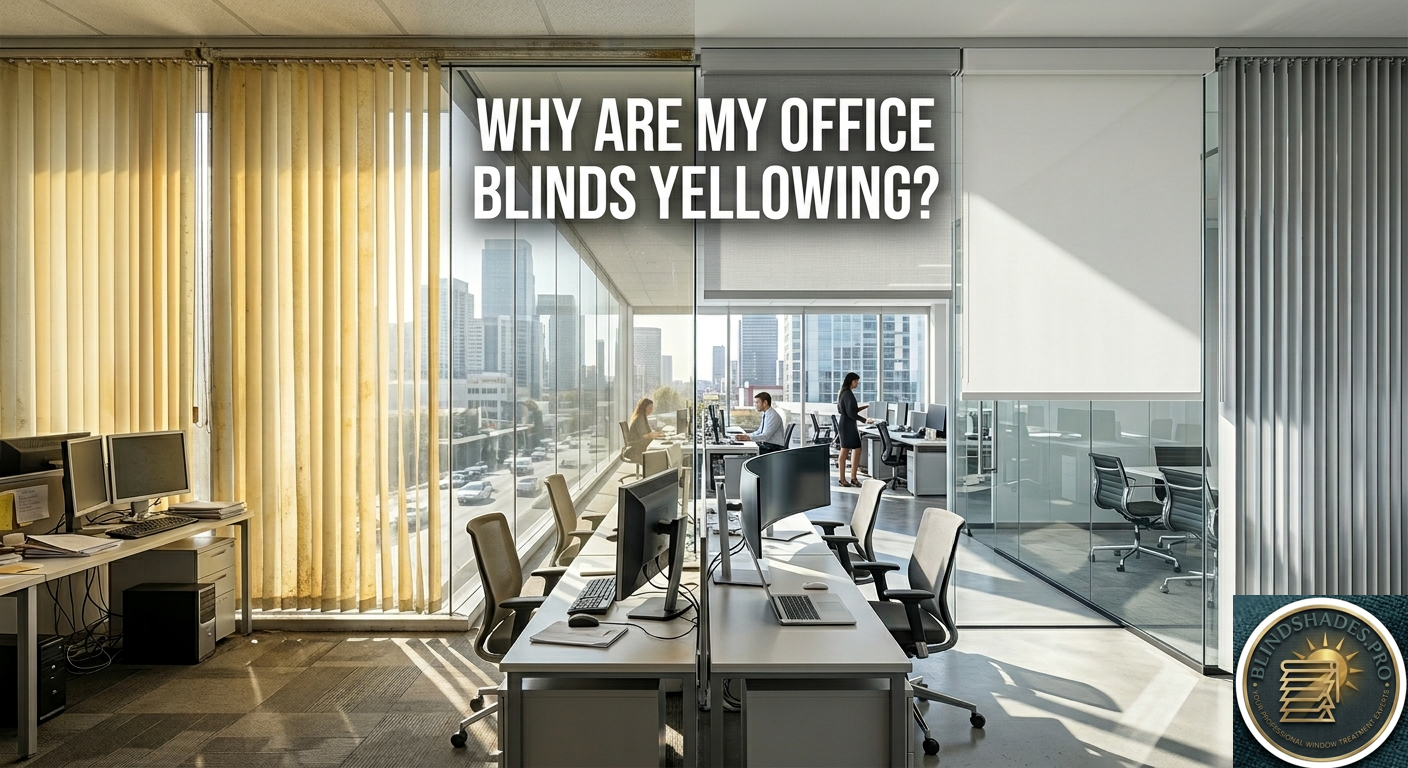
⭐ Quick Answer — Why Are My Office Blinds Yellowing?
- The Mechanism: PVC and vinyl blinds yellow through irreversible photooxidation of phthalate plasticizer compounds in the polymer — UV radiation (280–380nm) converts these into yellow chromophoric carbonyl groups embedded inside the plastic matrix, not on the surface
- Why Offices Are Worse Than Homes: Commercial offices accelerate yellowing to 4–6 years vs 7–10 years at home — due to 8–10 hours daily solar exposure, HVAC particulate deposition on blind surfaces, ozone from printers and photocopiers, and floor-to-ceiling glass exposing the entire blind simultaneously
- Can It Be Cleaned? No — for UV-caused yellowing. The yellow colour is inside the polymer matrix, not on the surface. Cleaning removes surface grime and can marginally improve appearance — but cannot reverse UV photooxidation. If yellow returns within weeks of cleaning: replacement is the only solution
- Which Materials DON’T Yellow: Fiberglass solar shades (12–20 year commercial lifespan — glass fibre doesn’t photooxidise) · Aluminium mini and vertical blinds (oxidise differently — not true yellowing) · Commercial polyester roller shades (fade gradually, don’t yellow)
- The UV Film Solution: Applying UV-blocking window film to the glass surface intercepts 99%+ of UV before it reaches the blind — extending PVC blind lifespan from 4–6 to 8–12 years. Per 3M’s commercial film programme: 99.9% UV reduction achievable
- Best Replacement Sources: Fiberglass solar shades → Blindsgalore commercial programme · Insolroll commercial · Phifer SheerWeave dealers. Commercial polyester roller shades → Blindsgalore Envision Roller Shades
⚠️ Two Things Every Online Guide Gets Wrong for Office Blinds: (1) All competitor guides are written for residential homes — not commercial offices. Office environments have four additional yellowing factors: HVAC particulate deposition, ozone from printers and copiers, higher daily solar exposure (8–10 hours vs 4–6), and floor-to-ceiling glass exposing the entire blind simultaneously. These make commercial office blinds yellow 30–50% faster than the same product in a home. (2) The “buy UV-resistant replacements” advice is incomplete. UV-resistant means UV-resistant coating on the same PVC polymer — the coating extends life by 1–2 years but doesn’t change the underlying material. The correct commercial specification is switching material entirely: fiberglass solar shades, aluminium vertical blinds, or commercial polyester roller shades. See the full material comparison below.
💡 The Wrong-Side-Faces-Sun Problem in Commercial Installations — and the Window Film Fix: In commercial floor-to-ceiling glass installations, the back (window-facing) side of the blind receives primary UV exposure — but most manufacturers apply UV protective coatings more heavily to the front (room-facing) side. The back yellows first and fastest. Specify blinds with UV protection on both sides, or switch to fiberglass (uniform structure, no directional coating). And for any existing installation: UV-blocking window film applied to the glass surface intercepts 99%+ of UV before it reaches the blind, extending lifespan from 4–6 years to 8–12 years at a fraction of replacement cost. See the full UV film guide below.
📖 Read the complete guide below for: the exact chemistry of PVC photooxidation (phthalate plasticizers → carbonyl chromophores), the four office-specific yellowing factors not found in residential guides, why cleaning can’t fix UV-caused yellowing, the full material-by-material comparison (PVC vs aluminum vs polyester vs fiberglass), the yellowing vs fading distinction, the wrong-side-faces-sun problem in commercial installations, the UV window film solution with 3M documentation, commercial replacement specifications for south vs east/west vs north-facing offices, and the 20-year total cost of ownership comparison.
Why Every Guide You’ve Found Gets This Wrong for Offices
Search “why are my blinds yellowing” and every Page 1 result gives you the same residential advice: UV breaks down the coating, clean with mild soap, buy UV-resistant replacements. This advice is written for homeowners — not for facilities managers, property managers, or commercial tenants managing an office window treatment specification.
Commercial offices have four additional yellowing factors that residential guides never address:
Factor 1 — More solar exposure hours: A commercial office is occupied and sunlit for 8–10 hours per day versus 4–6 hours for a typical residential room. The cumulative annual UV dose on a commercial office blind is approximately 60–100% higher than on a residential blind at the same orientation.
Factor 2 — HVAC particulate deposition: Commercial HVAC systems circulate large volumes of air continuously — more than residential systems. Even with HEPA filtration, HVAC air carries fine particulates (dust, VOCs from office equipment, carpet off-gassing) that deposit on blind surfaces. This accelerates the grime component of yellowing specifically in office environments.
Factor 3 — Floor-to-ceiling glass exposure: Modern commercial office buildings frequently use floor-to-ceiling glazing. Standard residential blinds are sized and rated for windows where only the fabric receives direct UV. In floor-to-ceiling commercial glazing — the headrail, mechanism, and entire blind surface is exposed to direct UV simultaneously. The manufacturer’s UV rating, typically tested for residential window dimensions, understates the total UV exposure in this configuration.
Factor 4 — Ozone from office equipment: Printers, photocopiers, and laser printers emit ozone during operation. Ozone is a powerful oxidising agent that accelerates the degradation of PVC and vinyl compounds. An open-plan office with multiple printers running simultaneously has measurably higher ozone concentrations than any residential room.
The result: Commercial office blinds that are expected to last 7–10 years in a residential context frequently show significant yellowing in 4–6 years in a commercial office environment.
The Chemistry — Why Yellowing Is Irreversible
No competitor guide explains this — and understanding it prevents expensive mistakes.
The specific chemical mechanism:
PVC and vinyl blinds are manufactured with plasticizer compounds — most commonly DEHP (diethylhexyl phthalate) and similar phthalate esters — that keep the rigid PVC polymer flexible and workable. These plasticizer compounds are the primary site of UV-induced degradation.
When UV radiation in the 280–380nm range (UV-A and UV-B) strikes the PVC surface, it triggers photooxidation of the phthalate plasticizer compounds. Photooxidation progressively converts these compounds into chromophoric carbonyl groups — chemical structures that absorb visible light in the blue wavelength range and reflect yellow and brown wavelengths. The blind appears yellow because the carbonyl groups are now embedded in the polymer matrix itself.
Why it cannot be cleaned away: The yellow color is not on the surface of the blind — it is inside the plastic polymer matrix. No amount of cleaning, bleaching, or scrubbing removes carbonyl groups from inside the polymer. The bathtub bleach soak recommended by multiple competitor guides removes surface grime and can marginally lighten yellowing caused by surface contaminants — but it cannot reverse photooxidation of the polymer itself.
What this means for facilities decisions: When office PVC or vinyl blinds are yellow — replacement is the only effective solution. Cleaning removes surface grime; it does not reverse UV photooxidation. Budgeting for blind replacement at 4–6 year intervals in south and west-facing commercial offices is more accurate than expecting 10-year lifespan.
The Material-Specific Guide — Which Blinds Yellow and Which Don’t
This is the information missing from every competitor article. “Yellowing” is not a single phenomenon — it varies dramatically by material. Here is the honest material-specific guide for commercial offices:
PVC / Vinyl Mini Blinds and Vertical Blinds — Highest Yellowing Risk
Mechanism: Photooxidation of phthalate plasticizers as described above. The yellow color develops within the polymer matrix and is irreversible.
Commercial office lifespan before yellowing: 4–6 years on south, east, or west-facing windows with significant solar exposure.
The cheap specification trap: PVC mini blinds are the lowest-cost commercial blind specification — purchased and installed across thousands of rooms in commercial buildings because of the unit price. But at 4–6 year replacement cycles, the total cost of ownership frequently exceeds more durable alternatives.
Aluminum Mini Blinds and Aluminum Vertical Blinds — Different Degradation, Not True Yellowing
Mechanism: Aluminum blinds do not yellow through photooxidation — they are metal, not plastic. What appears as yellowing in aluminum blinds is actually oxidation of the paint coating on the aluminum slats. The aluminium itself does not degrade.
Important distinction: Yellowing in aluminium blinds can sometimes be cleaned — because it is surface oxidation of the coating, not internal polymer degradation. A mild cleaning solution can restore some of the coating surface.
Commercial office lifespan: 8–12 years for painted aluminum blinds in a commercial environment. Significantly longer than PVC. The coating eventually chalks and discolours but the structural integrity is maintained.
Recommendation for commercial offices: Aluminum blinds are a better long-term specification than PVC for high-UV commercial office windows. The 20–40% cost premium over PVC is typically recovered within the first replacement cycle.
Polyester Fabric Roller Shades — Fading, Not Yellowing
Mechanism: Polyester fabric roller shades undergo UV-induced dye fading rather than polymer yellowing. The mechanism is different: UV radiation breaks down the colorant molecules in the fabric dye. White or light-coloured polyester shades become slightly off-white or grey rather than yellow.
Important distinction: Fading in polyester fabric is a different visual outcome than yellowing in PVC. A white polyester shade becomes creamy-grey; a white PVC blind becomes yellow-brown. The fading rate in high-quality commercial polyester shade fabric is significantly slower than the yellowing rate in PVC.
Commercial office specification: High-quality commercial polyester roller shades — such as Blindsgalore’s Envision Roller Shades or Phifer SheerWeave fabrics — are the correct roller shade specification for commercial offices specifically because they fade without yellowing and maintain a neutral appearance longer.
Fiberglass Solar Shades — Virtually No Yellowing
Mechanism: Fiberglass solar shade fabrics are woven from glass fibre coated with vinyl or PVC. Critically — the fibre structure provides UV resistance that solid PVC films do not. The glass fibre itself does not photooxidise.
The commercial office advantage: Fiberglass solar shades (openness factor 1–14%) are the most UV-stable window treatment available for commercial offices. The fiberglass structure resists photooxidation far more effectively than solid PVC slats or vinyl film.
Commercial lifespan: 12–20 years without yellowing in commercial environments. This is the correct long-term specification for south, east, and west-facing commercial office windows where PVC blinds are currently cycling every 4–6 years.
Cost comparison: Fiberglass solar shades cost approximately 30–60% more than PVC mini blinds per window. But at 2–4× the lifespan — the 20-year total cost of ownership is frequently 40–60% lower than repeated PVC replacement cycles.
The Yellowing vs Fading Distinction — The Terminology Error All Competitors Make
Every competitor article uses “yellowing” and “fading” interchangeably. They are different phenomena with different causes, different visual outcomes, and different remedies.
| Yellowing | Fading | |
|---|---|---|
| Primary cause | UV photooxidation of PVC plasticizer | UV degradation of dye/colorant molecules |
| Materials affected | PVC, vinyl, polypropylene | Fabric, painted surfaces, some films |
| Visual outcome | Yellow/brown colour development | Loss of colour saturation, greying |
| Reversible? | No — chemistry is in polymer matrix | Sometimes — surface dye protection possible |
| Prevention | UV stabilisers in polymer; switch to fiberglass | UV-resistant dyes; Scotchgard/UV coating |
| Cleaning restores? | Surface grime only | Surface oxidation of coating sometimes |
The “Wrong Side Faces the Sun” Problem in Commercial Installations
This is a commercial-specific issue that no residential guide addresses — because it rarely applies to residential installations.
The standard residential installation: A blind is mounted inside the window frame with the face fabric (front side) facing the room. The back of the blind faces the window glass and receives UV through the glass.
The commercial floor-to-ceiling installation: In commercial buildings with floor-to-ceiling glazing — blinds are frequently mounted on the ceiling or the glazing mullion. In these installations, the back (window-facing) side of the blind receives the primary direct UV exposure. The front (room-facing) side faces interior lighting only.
The problem: Most manufacturer UV protective coatings are applied primarily or more heavily to the front (room-facing) side of the blind. This is the side that customers see in showrooms and that marketing photography shows. The back side often has thinner or lighter UV protection.
The result in commercial floor-to-ceiling installations: The back of the blind — the side with less UV protection — is the side receiving the most UV. Yellowing develops first and fastest on the window-facing back of the blind in commercial floor-to-ceiling glazing installations. By the time the visible front side shows yellowing, the back has typically been yellow for 12–24 months.
The specification implication: When specifying blinds for floor-to-ceiling commercial glazing — specifically request UV protection on both sides, or specify fiberglass solar shades (which have uniform fibre structure throughout the fabric, not a directional coating) to eliminate this asymmetric degradation problem.
The UV Window Film Solution — Extending Blind Lifespan 2–3× at Low Cost
No competitor guide mentions this — yet it is one of the most cost-effective interventions available.
The concept: Applying UV-blocking window film to the glass surface before the blind installation intercepts 99% of UV radiation before it reaches the blind. The blind operates in a UV-filtered environment — dramatically reducing the photooxidation rate.
The evidence: 3M’s commercial window film programme documents UV transmission reduction of 99.9% for their commercial solar control films. A PVC blind that would normally yellow in 4–6 years in direct UV exposure may last 8–12 years behind a high-quality UV window film.
The cost comparison:
- UV window film: $5–$15 per square foot installed (commercial)
- Replacing PVC mini blinds every 4–6 years: $15–$40 per window per cycle, × multiple cycles
For a commercial office with significant south or west-facing glazing — the combination of UV window film applied to the glass plus fiberglass solar shades on the interior represents the lowest 20-year total cost of ownership of any specification.
The Correct Replacement Specification — What to Specify When PVC Blinds Yellow
Generic advice to “buy UV-resistant replacements” is not specific enough for a commercial office specification. Here is the material-specific recommendation:
For south-facing commercial offices with significant direct sun: Specify fiberglass solar shade fabric (openness factor 5–10%, neutral colour) with motorized or cordless operation. The fiberglass structure provides the best available UV resistance. Roller shades in commercial-grade fiberglass are available from Blindsgalore commercial program, Insolroll commercial, and Phifer SheerWeave dealers.
For east and west-facing offices (morning or afternoon direct sun): Specify high-quality commercial polyester roller shade with UV-stabilised fabric — such as Blindsgalore Envision or equivalent — with motorized lift for automatic scheduling (raise when sun exposure is at angle, lower at direct sun). The motorized scheduling reduces cumulative UV exposure by 30–50% compared to manually operated blinds that are frequently left lowered all day regardless of sun position.
For north-facing offices (no direct sun): Any specification is appropriate for durability. Specify for light control, privacy, glare management, and aesthetics. PVC mini blinds are acceptable because the photooxidation driver is absent. Aluminium venetian blinds or fabric roller shades are both suitable.
For open-plan offices with multiple printers (ozone exposure): Specify fiberglass or aluminium over PVC. Ozone from office equipment accelerates PVC plasticizer oxidation. Non-PVC specifications are significantly more resistant to ozone-induced degradation.
Frequently Asked Questions
Why are my office blinds turning yellow? Office PVC and vinyl blinds yellow through irreversible photooxidation of plasticizer compounds in the polymer — specifically phthalate esters that are oxidised by UV radiation in the 280–380nm range into chromophoric carbonyl groups. These yellow-coloured compounds are embedded inside the polymer matrix itself, not on the surface. In commercial offices, this process occurs 30–50% faster than in residential settings because of higher solar exposure hours (8–10 hours vs 4–6 hours), HVAC particulate deposition, floor-to-ceiling glass exposure, and ozone from office equipment.
Can yellowed office blinds be restored to white? Yellowing caused by PVC photooxidation cannot be reversed — the yellow colour is inside the polymer matrix, not on the surface. Cleaning with bleach solutions or mild detergent removes surface grime and can marginally improve appearance but cannot reverse UV-induced polymer degradation. If the yellow colour returns within weeks of cleaning, the cause is UV photooxidation and replacement is the only effective solution.
What type of blinds don’t yellow in a commercial office? Fiberglass solar shades are the most UV-resistant commercial blind specification — the glass fibre structure does not photooxidise the way PVC/vinyl does, and quality fiberglass solar shades can last 12–20 years without yellowing in commercial office environments. Aluminium mini and vertical blinds do not yellow (they oxidise differently through surface coating degradation which is slower and sometimes cleanable). High-quality commercial polyester roller shades fade gradually rather than yellowing, maintaining a more neutral appearance longer than PVC.
Why do my commercial office blinds yellow faster than my home blinds? Four commercial-specific factors accelerate yellowing compared to residential: (1) higher solar exposure hours — commercial offices are lit and occupied 8–10 hours daily versus 4–6 hours for residential rooms; (2) HVAC particulate deposition — commercial air handling systems deposit more particulates on blind surfaces; (3) floor-to-ceiling glass — exposes the full blind to direct UV simultaneously; (4) ozone from printers and photocopiers — a powerful oxidising agent that accelerates PVC plasticizer degradation.
Does window film help prevent office blinds from yellowing? Yes significantly. UV-blocking window film applied to the glass surface intercepts 99%+ of UV radiation before it reaches the blind. According to 3M’s commercial window film programme, quality commercial solar films reduce UV transmission by 99.9%. A PVC blind that would normally yellow in 4–6 years behind unfiltered glass may last 8–12 years when installed behind a quality UV window film, making the combination of UV film plus any blind specification the most cost-effective long-term approach for high-UV commercial office windows.
Related Guides on BlindShades.pro
- The Best Office & Commercial Blinds & Shades Buying Guide — the complete commercial blind specification guide
- Are Solar Shades Worth It for a Commercial Office — fiberglass solar shade vs PVC performance comparison
- Pleated Shades for a Commercial Office — Antimicrobial Fabric Options — fabric specification for healthcare and institutional settings
- The Best Solar Shades Buying Guide — full solar shade specification guide including fiberglass options
- Roller Shades vs Venetian Blinds for Commercial Offices — the complete commercial comparison
By Michael Turner | 30 Years Home Improvement Expertise | Updated 2026 | BlindShades.pro
