Best Window Treatments for Privacy in an Open-Plan Office — What Blinds Add Privacy Without Blocking Natural Light?

Authored By Michael Turner -30 Years Home Improvement Expertise | Updated 2026 | BlindShades.pro
Updated on July 14, 2026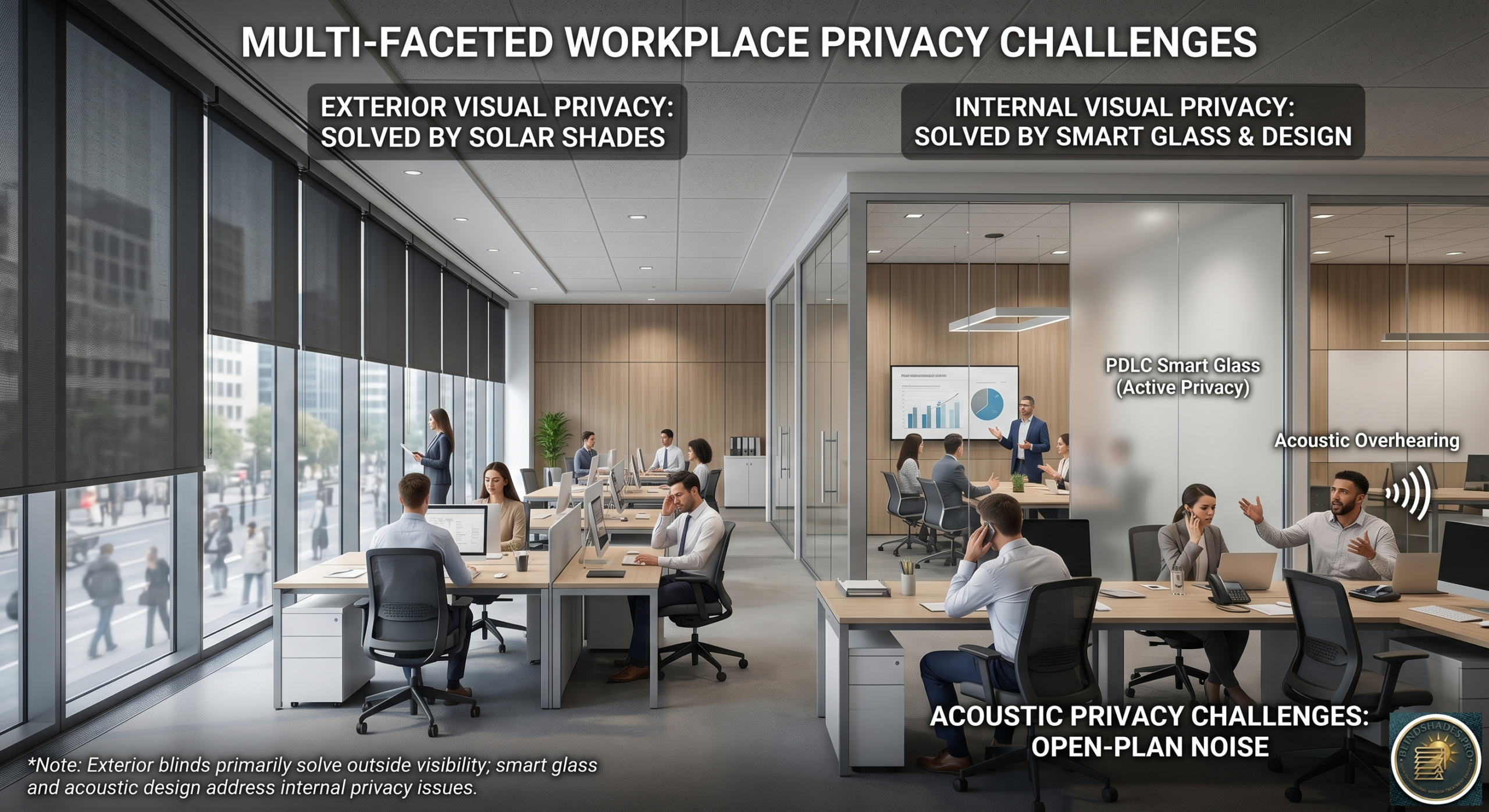
⭐ Quick Answer — Best Window Treatments for Privacy in an Open-Plan Office
- Identify the Privacy Type First: Open-plan offices have 3 distinct privacy types — exterior visual (people outside seeing in), interior visual (colleagues seeing screens), and acoustic (voices carrying). Window blinds solve only Type 1. Installing blinds to solve Types 2 or 3 is the most common open-plan privacy specification mistake
- Best Window Treatment for Exterior Privacy Without Blocking Natural Light: 3–5% openness charcoal solar shade on a centrally-controlled motorized zone — adds exterior privacy during peak sun hours without blocking natural light when the sun angle doesn’t require it. Raises automatically; doesn’t stay down all day blocking therapeutic daylight
- The Desk-Distance Guide: Not all workstations need the same treatment. Within 3–6 feet of glazing = 3–5% openness · 6–10 feet = 5–10% openness · 10+ feet from window = no external privacy treatment needed (the viewing angle from outside makes screen reading impossible at standard floor heights)
- Glass Partition Privacy — Window Blinds Are the Wrong Solution: The most common open-plan privacy complaint is interior glass partition visibility (meeting rooms, executive offices seen from the open floor). Window treatments on exterior windows do not help. The correct solution: PDLC smart film (Sonte, ~$30–$60/sq ft) — transitions from transparent to opaque in under 1 second. Frosted film ($3–$8/sq ft) for permanently private spaces
- Centrally-Controlled Zones Only: Individually-operated per-window blinds create patchy, inconsistent privacy coverage in open-plan offices. Specify motorized zone control — all south-facing shades lower together at 11am, raise at 2pm. Hunter Douglas PowerView or Lutron Palladiom for BMS integration
- Best Sources: Zone-controlled motorized solar shades → Hunter Douglas PowerView · Lutron Palladiom · Blindsgalore commercial motorized · PDLC smart film → Sonte via commercial dealer · Standard solar shade → SelectBlinds commercial
⚠️ The Open-Plan Privacy Paradox — and Why Blackout Blinds Are the Wrong Answer: Open-plan offices were designed to create visual openness and collaborative energy by removing barriers. Adding opaque or blackout blinds to all exterior windows partially defeats this intent — creating a darker, more enclosed environment that reduces the openness the layout was built to provide. The correct open-plan privacy specification is NOT blackout. It is a solar shade at the minimum openness factor needed for the floor level and orientation, preserving as much natural light as privacy requirements allow. Per the WELL Building Standard v2 Feature L04, natural light access in commercial offices is a documented occupant health requirement — not an aesthetic preference. Blackout blinds in an open-plan office are an evidence-based design error. See the full privacy paradox analysis below.
💡 Acoustic Privacy — Window Treatments as a Secondary Tool + the PDLC vs Frosted Film Comparison: Window treatments that add acoustic absorption also help with the voice-carry problem in open-plan offices. Heavy roller shade fabric (NRC 0.05–0.12) and cellular shades (NRC 0.10–0.20) reduce room reverberation that lets voices travel across the open floor — but this is a secondary contribution. Acoustic ceiling panels, carpet, and partition furniture are the primary acoustic privacy solutions. For interior glass partitions: PDLC smart film ($30–$60/sq ft) = transparent when meetings aren’t confidential, opaque in under 1 second when they are — preserves the open-plan feel. Frosted film ($3–$8/sq ft) = permanent privacy, lower cost, no control. Interior roller shade on glass partition ($15–$30/sq ft) = manual control, mid-cost alternative. See the full glass partition comparison table below.
📖 Read the complete guide below for: the three privacy types and which solution solves each, the open-plan privacy paradox (why blackout blinds defeat the design intent), the desk-proximity-to-window privacy risk table with openness factor recommendations, why window blinds cannot solve interior glass partition visibility, the full PDLC vs frosted film vs interior roller shade comparison, the centrally-controlled zone motorization specification, the acoustic NRC contribution table, the WELL Building Standard framework for open-plan privacy, and the complete YES verdict guide.
The Three Privacy Types — Why Most Open-Plan Blind Guides Answer the Wrong Question
Every competitor guide answers “what blind provides privacy in an open-plan office?” as if privacy is a single concept. In an open-plan office, it is three distinct challenges that require three different solutions.
Type 1 — Exterior Visual Privacy
Definition: Preventing people outside the building (pedestrians, people in adjacent buildings, people in the car park) from seeing into the office.
Who is at risk: Workstations within approximately 6 feet of exterior glazing where screen content or personal papers could be viewed from outside. Workstations further than 10 feet from the window face are at minimal exterior visual privacy risk because the viewing angle becomes too steep for readable observation.
What solves it: Window blinds on exterior windows. Solar shade 3–5% openness for daytime privacy; 1–3% for ground floor facing public pavements. See the Can You See Through Solar Shades From Outside guide for the full openness factor and floor height specification.
Type 2 — Interior Visual Privacy
Definition: Preventing colleagues within the open-plan floor from observing each other’s screens, work materials, or faces during sensitive phone or video calls.
What does NOT solve it: Exterior window blinds. A closed solar shade on the exterior glazing has zero effect on whether the colleague at the next workstation can see your screen. This is the most common open-plan privacy specification mistake — installing window blinds to address an interior visibility problem that window blinds cannot solve.
What solves it:
- Workstation privacy screens (physical panels at desk height)
- High-back seating or desk-mounted acoustic screens
- Screen privacy filters on monitors (3M Privacy Filter — narrows the viewing angle so only the seated occupant can read the screen)
- Acoustic phone pods and focus booths for sensitive calls
- Interior glass partition roller shades or PDLC film on meeting room glass walls
Type 3 — Acoustic Privacy
Definition: Preventing colleagues from overhearing conversations across the open plan — the most frequently cited open-plan workplace complaint.
What does NOT solve it: Exterior window blinds alone. A solar shade on exterior windows does not absorb the sound that travels across the open plan.
What partially helps: Fabric window treatments that add meaningful sound absorption to the room’s total acoustic environment. A heavy roller shade fabric (400–800 g/m²) or cellular shade across multiple windows contributes NRC 0.05–0.20 to the room’s total absorption. This reduces the reverberation time that amplifies voice carry across the open plan.
What primarily solves it: Acoustic ceiling panels, acoustic partition screens, soft floor coverings, acoustic pods — the spatial acoustic design of the office, not window treatments. Window treatments are a secondary acoustic contributor, not the primary solution.
The correct approach: Address all three privacy types with the correct solution for each type. Do not try to solve Type 2 and Type 3 with exterior window blinds — the correct solution for each is different.
The Open-Plan Privacy Paradox — The Design Tension Nobody Discusses
Open-plan offices were specifically designed to increase visual connection, collaborative energy, and informal communication by removing barriers between workstations. Adding opaque or room-darkening blinds to all exterior windows partially defeats this design intent by creating a darker, more enclosed environment that reduces the openness the layout was designed to provide.
The design tension:
- Privacy argument: workers need visual separation from external observation
- Open-plan design argument: natural light and visual openness improve wellbeing and collaboration
- Evidence-based design research: Ulrich (1984) and Huisman et al. (2012) document measurable benefits of natural light access for occupant wellbeing
The resolution: Specify solar shades with openness factors (3–5%) that provide adequate external visual privacy while maintaining the visual openness and daylight that makes open-plan spaces work. The correct open-plan privacy specification is NOT blackout. It is a solar shade at the minimum openness factor needed for the specific floor level and orientation — preserving as much daylight as external privacy requirements permit.
The WELL Building Standard framework: WELL Building Standard v2 Feature Mind M03 (Workplace Norms for Restorative Spaces) and Feature L04 (Daylight) together establish the framework for balancing privacy and daylight in commercial workplaces. The WELL approach emphasises providing a variety of space types — from fully open collaborative areas to enclosed private spaces — rather than attempting to make the open plan simultaneously private and open. This framework argues against heavy universal window treatment in open-plan areas and in favour of providing enclosed booths and rooms for privacy-sensitive tasks.
The Desk-Proximity-to-Window Variable — Specific Risk Assessment
No competitor guide gives a specific framework for assessing which workstations actually need external visual privacy protection. This allows informed specification rather than treating all windows equally.
The external visibility risk by desk distance from glazing:
| Desk Distance From Window | External Privacy Risk | Recommended Openness |
|---|---|---|
| 0–3 feet (within arm’s reach) | High — screen content and papers visible | 1–3% openness |
| 3–6 feet | Moderate — faces and movement visible | 3–5% openness |
| 6–10 feet | Low — general movement visible, detail not readable | 5–10% openness |
| 10+ feet | Minimal — at standard window height, viewing angle too steep | 10%+ or no treatment |
The implication: In an open-plan office where most workstations are 10+ feet from the glazing (as is typical in deep-plan open-floor offices), the external visual privacy risk may not justify the visual impact and daylight reduction of low-openness solar shades. Before specifying 3% openness shades on all windows — assess actual workstation proximity to glazing.
Glazing-adjacent workstations (0–6 feet): Solar shade 3–5%, charcoal colour, on centrally-controlled zone schedule. Mid-floor workstations (6–15 feet): Solar shade 5–10%, or no treatment. Interior workstations (15+ feet): No external privacy treatment needed — the viewing angle from outside makes screen content observation impossible at standard floor heights above ground level.
The Interior Partition Problem — The Privacy Challenge Window Blinds Cannot Solve
This is the most critical open-plan privacy distinction absent from every competitor guide — and it is where most real open-plan privacy complaints originate.
Modern open-plan offices feature glass-walled meeting rooms, executive offices with glass partitions, and phone booths with glass panels. These interior glass surfaces create the visible privacy problem that workers most frequently complain about:
- The meeting room where six executives can be observed from the open plan during a sensitive discussion
- The phone booth where the occupant making a confidential call is visible to the entire floor
- The open-plan collaborative area where the team can be observed from reception
What does NOT solve this: Exterior window blinds. A solar shade on the outer glazing has no effect on whether the glass-walled meeting room is visible from the open-plan area.
What solves interior glass partition privacy:
Option 1 — Frosted window film (permanent): Frosted vinyl film applied directly to the glass. Provides permanent semi-opaque privacy from floor to ceiling or at specific heights. Cost approximately $3–$8 per square foot installed. Cannot be reversed without window film removal. Appropriate for spaces that always require privacy.
Option 2 — PDLC Smart Film (on-demand): Polymer Dispersed Liquid Crystal (PDLC) film applied to the glass partition surface, connected to a power supply. When powered off — the liquid crystals disperse randomly, making the film opaque. When powered on — crystals align, making the film clear. Transition in under 1 second.
Commercial suppliers include Sonte Smart Film (self-adhesive, Wi-Fi controlled, approximately $30–$60 per square foot installed) and Smart Glass Country. ArchDaily has highlighted PDLC film applications including Sonte as the emerging standard for privacy-sensitive glass partitions in open-plan commercial offices.
Option 3 — Electrochromic Glass (premium): Electrochromic smart glass transitions from clear to tinted (not opaque) with an electrical signal. Premium specification for new construction and major refurbishment. Sage Glass, View Glass, and similar manufacturers supply. Cost approximately $50–$100 per square foot installed. Provides privacy-grade tinting rather than full opacity.
The comparison:
| Solution | Privacy Level | Cost Per Sq Ft | Reversibility | On-Demand Control |
|---|---|---|---|---|
| Frosted film | Full opacity | $3–$8 | No (removal required) | No |
| Interior roller shade on partition | Full opacity | $15–$30 | Yes | Yes (manual) |
| PDLC Smart Film (Sonte) | Full opacity | $30–$60 | Yes | Yes (instant) |
| Electrochromic glass | Partial tint | $50–$100 | No (permanent glass) | Yes |
Recommendation for open-plan meeting room glass walls: PDLC smart film at $30–$60 per square foot provides on-demand privacy that maintains the open, connected visual feel of the open plan during non-sensitive periods — and instant full opacity during confidential meetings. This is the specification that preserves open-plan design intent while satisfying privacy requirements.
The Centrally-Controlled Zone Specification — Why Individual Blinds Fail in Open-Plan
In a residential home, each window treatment is operated by the same one or two people with consistent habits. In an open-plan commercial office, any individual-control specification creates a patchy privacy coverage problem:
- Some employees raise their nearest window blind completely, creating an unshaded high-visibility zone
- Others lower it all day regardless of sun angle, creating unnecessary darkness
- The result is a random mosaic of open and closed blinds that neither achieves consistent privacy nor consistent daylight
The correct open-plan specification: Motorized solar shades controlled in zones by a central schedule or building management system — not individually. All shades in the south-facing zone lower together at 11am and raise at 2pm. All west-facing shades lower at 1pm and raise at 5pm. The result: consistent privacy coverage, consistent appearance, and consistent daylight management across the entire floor.
Available systems: Hunter Douglas PowerView — the most capable building management system integration with zone-based control, scheduling, and occupancy integration. Lutron Palladiom — premium commercial motorized shade system with central scheduling. Both allow individual override within zones when occupants need to adjust locally, while maintaining the zone-wide default behaviour.
The Acoustic Contribution — Window Treatments as a Secondary Privacy Tool
While window blinds cannot solve acoustic privacy across an open plan, they are a secondary contributor to the acoustic environment that makes voice carry more or less audible.
How room acoustics affect voice privacy: In a reverberant room (hard floors, bare windows, exposed ceilings), sound reflects multiple times before decaying — a voice at 20 feet carries much further and at higher volume than in an acoustically treated room. Reducing reverberation reduces the effective distance of conversational voice carry.
Window treatment acoustic contribution:
| Treatment | Approximate NRC | Acoustic Contribution |
|---|---|---|
| Bare window | 0.00 | None (reflective) |
| Light solar shade | 0.03–0.08 | Minimal |
| Heavy roller shade | 0.05–0.12 | Minor |
| Cellular shade | 0.10–0.20 | Moderate |
| Cellular shade + lined drape | 0.20–0.35 | Meaningful |
The open-plan specification implication: In an open-plan office seeking acoustic privacy improvement — specify heavy fabric roller shades or cellular shades on perimeter windows rather than light solar shades. The additional acoustic absorption across 50 windows makes a measurable contribution to the room’s total reverberation time reduction.
However: window treatments alone will not solve open-plan acoustic privacy. Acoustic ceiling panels, carpet, and acoustic partition furniture are the primary solutions. Window treatments are a valuable secondary contributor.
The Best Blind for Privacy in an Open-Plan Office — The Verdict
Combining all considerations — the correct specification for a typical modern open-plan commercial office:
For exterior windows on south and west-facing perimeter:
- 3–5% openness charcoal solar shade in fiberglass (Phifer SheerWeave or equivalent)
- Outside mount with cassette headrail
- Motorized with centrally-controlled zone scheduling (not individual operation)
- Raises during off-peak hours (preserving open-plan visual environment)
- Lowers during peak sun periods and end of day
For interior glass partitions on meeting rooms and executive offices:
- PDLC smart film (Sonte or equivalent) for on-demand privacy
- Frosted film for permanently private spaces (HR office, medical room)
- Interior roller shade on glass partition as the mid-cost alternative to PDLC
For acoustic privacy improvement:
- Heavy fabric roller shade or cellular shade on perimeter windows
- Coordinate with acoustic ceiling treatment, carpet, and partition furniture for meaningful open-plan acoustic privacy
What NOT to specify for open-plan privacy:
- Blackout blinds on all perimeter windows (eliminates therapeutic daylight)
- Individually-operated blinds per window (creates patchy coverage)
- Any window blind to solve interior partition visibility (wrong solution for the problem)
- Light-coloured or white solar shades (poor glare control and Zoom backdrop)
Related guides: privacy is one pressure of six — the full space-by-space commercial decision, compliance stack included, is in the complete office & commercial blinds guide.
Where to Order — Open-Plan Privacy Specification
For zone-controlled motorized solar shades (the core exterior specification): Hunter Douglas PowerView commercial — the market leader for zone-controlled commercial shade systems with building management system integration. Lutron Palladiom — premium commercial motorized alternative.
Blindsgalore commercial motorized programme — Phifer SheerWeave fiberglass solar shade fabric with motorized cassette headrail, mid-range commercial pricing, app-based scheduling.
For PDLC smart film on interior glass partitions: Sonte Smart Film — self-adhesive PDLC film, Wi-Fi controlled, available for commercial glass partition applications. Contact through Sonte’s commercial dealer network.
For standard commercial solar shades (non-motorized smaller offices): SelectBlinds commercial solar roller shade — 3–5% openness, charcoal available. Blindsgalore Envision solar roller shade — mid-range commercial with cassette headrail option.
Frequently Asked Questions
What is the best blind for privacy in an open-plan office? The best blind for exterior privacy in an open-plan office is a 3 to 5 percent openness charcoal solar shade on a centrally-controlled motorized zone system rather than individually-operated per-window blinds. However, the more important question is whether the privacy challenge is exterior (people outside seeing in) or interior (colleagues seeing each other’s screens or overhearing calls). Window blinds on exterior windows only solve exterior privacy — interior visual privacy between workstations requires workstation screens and monitor privacy filters, and interior glass partition privacy requires PDLC smart film or frosted film, not exterior window blinds.
Do solar shades provide enough privacy in an open-plan office? For exterior visual privacy — yes, during daylight hours when exterior light is 3 times or more brighter than interior lighting. For ground-floor offices facing public streets, 1 to 3 percent openness provides adequate exterior visual privacy. For upper floors above level 5, 3 to 5 percent is typically adequate. However, solar shades have no effect on interior visual privacy between workstations, and do not address acoustic privacy across the open plan. For comprehensive open-plan privacy — solar shades on exterior windows should be combined with workstation privacy panels, acoustic treatment, and PDLC smart film on any interior glass partitions.
What is PDLC smart film and why is it recommended for open-plan offices? PDLC (Polymer Dispersed Liquid Crystal) film is an adhesive film applied to existing glass surfaces that transitions from opaque to clear with an electrical switch. When powered off, liquid crystals disperse randomly making the film opaque; when powered on, crystals align making the film clear. The transition takes under one second. Commercial suppliers include Sonte Smart Film at approximately $30 to $60 per square foot installed. For open-plan meeting rooms and executive offices with glass partitions — PDLC smart film is the optimal specification because it maintains the visual openness that open-plan design intends during non-sensitive periods and provides instant full opacity during confidential meetings — without the permanent obscuring effect of frosted film.
Should open-plan office blinds be individually operated or centrally controlled? Centrally-controlled motorized zones are the correct open-plan specification. Individually-operated per-window blinds create inconsistent privacy coverage — some employees raise their blind completely, others leave it closed all day — producing a random mosaic of open and closed shades that fails both privacy and daylight objectives. A motorized zone system lowers all south-facing shades simultaneously at scheduled peak sun periods and raises them when direct sun is absent, providing consistent coverage across the entire floor. Hunter Douglas PowerView and Lutron Palladiom both provide building management system-integrated zone control with individual override capability.
Do window treatments help with acoustic privacy in an open-plan office? Yes, as a secondary contributor. Heavy fabric roller shades (400 to 800 g/m² fabric) provide a Noise Reduction Coefficient of approximately 0.05 to 0.12. Cellular honeycomb shades provide NRC 0.10 to 0.20. Across 50 perimeter windows in an open-plan floor, this fabric adds meaningful sound absorption to the room’s total acoustic environment — reducing the reverberation time that allows voices to carry across the open plan. However, window treatments alone are insufficient for open-plan acoustic privacy. Acoustic ceiling panels, carpet, and acoustic partition furniture are the primary solutions. Specify heavy fabric roller shades or cellular shades rather than light solar shades to maximise this secondary acoustic contribution.
Related Guides on BlindShades.pro
- The Best Office & Commercial Blinds & Shades Buying Guide — the complete commercial specification guide
- Can You See Through Solar Shades From Outside — The Office Privacy Answer — the detailed openness factor and floor height privacy guide
- Roller Shades vs Venetian Blinds for Commercial Offices — visual uniformity at commercial scale
- Motorized vs Manual Commercial Blinds — The 10-Year ROI Comparison — the zone-control motorized ROI calculation
- Are Solar Shades Worth It for a Commercial Office — the full solar shade commercial specification guide
By Michael Turner | 30 Years Home Improvement Expertise | Updated 2026 | BlindShades.pro
