Can You Get Blackout Roman Shades — Are They as Good as Roller Shades for a Bedroom

Authored By Michael Turner -30 Years Home Improvement Expertise | Updated 2026 | BlindShades.pro
Updated on July 10, 2026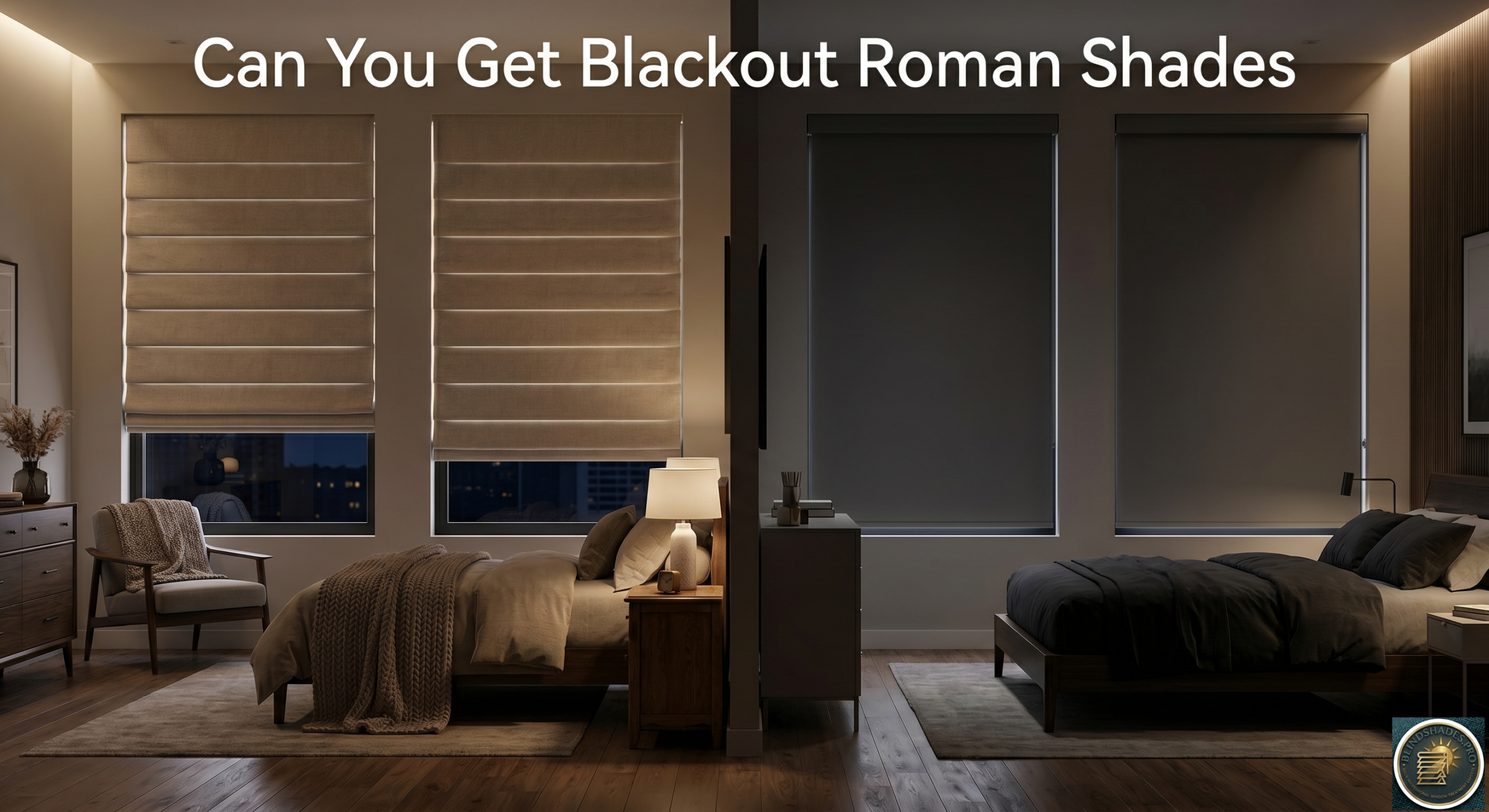
⭐ Quick Answer — Blackout Roman Shades for a Bedroom: Can You Get Them, and Are They as Good as Roller Shades?
- The Direct Answer: Yes — blackout roman shades for a bedroom are available and genuinely reduce light. But they are not as dark as blackout roller shades because the fold gaps at each lifting rod are structural geometry, not a fabric quality issue. A 60-inch drop Roman shade with 7 rods has 7 light paths that no lining — however thick — can eliminate. A roller shade’s flat fabric has no such structural gaps
- The Correct Lining Specification: Specify interlining + blackout liner (two separate back layers) — not blackout liner alone. The interlining is a thick wadded batting layer that adds weight, improving drape and pressing the folds flatter, which reduces (but cannot eliminate) the fold gap angles. Blackout liner alone blocks light through the fabric but adds no weight to reduce the geometry gaps
- Fabric Weight Matters: Heavy cotton canvas (12–14 oz/yd²) or velvet + interlining + blackout liner creates the smallest achievable fold gaps — gravity presses heavier fabric into a flatter hang. Light linen or voile + liner only = large fold gaps. For bedroom blackout Roman shades: always specify heavyweight face fabric
- The Raised Position Problem: When raised, a Roman shade stacks into a fold bundle covering 20–30% of the window height. A 60-inch shade = 12–18 inch raised stack, blocking 12–18 inches of window permanently. A roller shade tube = 3–4 inches when raised. For bedrooms with limited headroom above the window — this is the decisive factor
- 7-Scenario Verdict: ✅ Roman wins: traditional/formal aesthetic + moderate sleep sensitivity · guest bedroom · decorative priority. ❌ Roller wins: light-sensitive sleeper needing near-total darkness · shift worker · nursery · low ceiling above window · daily raise/lower operation
- Best Sources: Custom interlining + blackout lining → Blindsgalore Roman shade custom spec · Standard blackout liner → SelectBlinds Roman with blackout liner · Design-first + blackout → Norman USA Day & Night system
⚠️ Why the Fold Gap Is Structural — and the One Solution for Design-First Buyers Who Need Real Blackout: The fold gap in blackout roman shades exists because each horizontal lifting rod sewn into the shade creates a crease angle in the fabric when the shade is lowered — a wedge-shaped gap between the shade surface and the window glass. This is not a defect; it is the physical consequence of the Roman shade mechanism. No liner, however thick, changes the geometry. Fabric weight and interlining reduce the gap angle; they do not eliminate it. For buyers committed to the Roman shade aesthetic who genuinely need near-total darkness — the correct answer is the Norman USA Day & Night system: an independently operated blackout roller shade layer behind a Roman shade on the same headrail. The Roman shade provides the decorative folded aesthetic; the roller layer provides the flat, fold-gap-free blackout. Each layer operates independently. See the Norman USA shade guide for the Day & Night specification. See the full fold gap explanation below.
💡 Motorized Roman Shades for a Bedroom — Why They Cost 40–60% More Than Motorized Roller Shades: Motorized blackout roman shades for a bedroom use a cord-management motor system — multiple lifting cords must wind and unwind simultaneously and evenly to keep the horizontal folds level. This mechanism is significantly more complex than a tube motor rolling a flat sheet. As a result, motorized Roman shades cost approximately 40–60% more than motorized roller shades of equivalent quality, and fold evenness (whether all pleats remain perfectly horizontal) can become irregular over time as cord tension varies with daily use. If motorization for sunrise simulation or smart home integration is a bedroom priority — a motorized blackout roller shade is the more reliable and cost-effective specification. If the Roman aesthetic is essential and motorization is also desired — specify the Norman USA Day & Night with the roller layer motorized; keep the Roman shade manual. See the full motorized comparison below.
📖 Read the complete guide below for: why blackout Roman shades structurally cannot match roller shade darkness (the fold rod geometry explained), the three lining options compared (direct blackout liner vs interlining vs interlining + blackout liner), fabric weight and its effect on fold gap size, the raised position fold stack bulk table by drop length, the motorized Roman shade mechanism differences and cost premium, the full 7-scenario bedroom verdict table, and the Norman USA Day & Night system as the design-first total blackout solution.
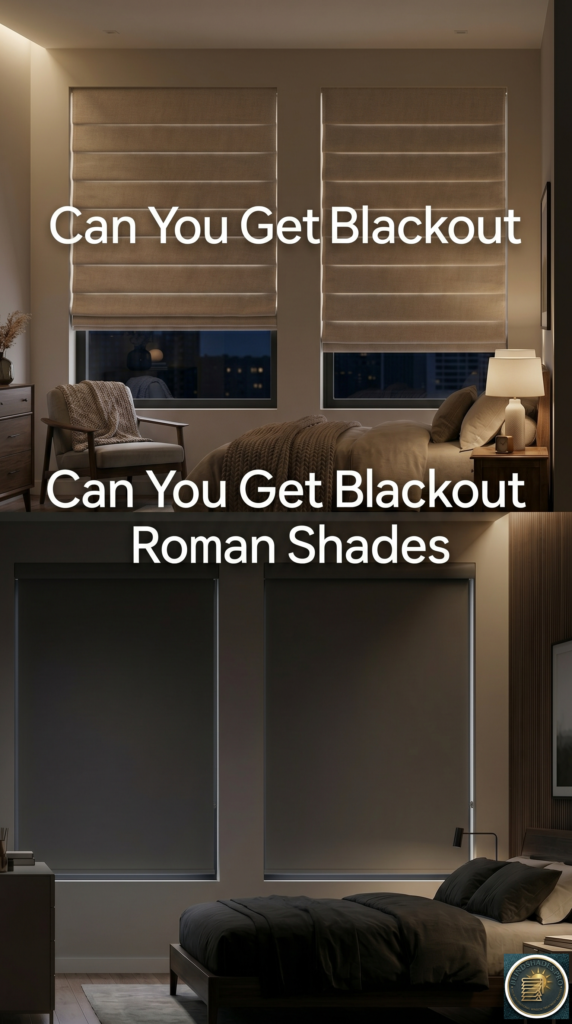
Can You Get Blackout Roman Shades for a Bedroom?
Yes — blackout Roman shades are widely available and genuinely effective at reducing light. They are made in two blackout configurations:
Configuration 1 — Blackout-lined Roman shade: A standard Roman shade fabric (linen, cotton, polyester or any face fabric) with a blackout-coated liner stitched to the back. The liner prevents light transmission through the fabric itself. This is the most common blackout Roman shade configuration.
Configuration 2 — Blackout-interlined Roman shade: A Roman shade with two back layers: an interlining (a thick wadded cotton or polyester batting layer) stitched between the face fabric and the blackout liner. The interlining provides thermal insulation, improved acoustic absorption, and — critically for blackout performance — additional weight that helps the shade hang flat.
For a bedroom application — Configuration 2 (interlining + blackout liner) is the better blackout specification. The interlining weight keeps the folds pressed flat and the shade surface closer to the window frame, reducing the fold gap light entry described below.
The Fold Gap Problem — Why Roman Shades Cannot Match Roller Shade Blackout
This is the fundamental construction difference that no competitor article explains clearly.
How Roman Shade Fold Gaps Form
A Roman shade operates by horizontal lifting rods sewn into rod pockets at regular intervals across the shade height. When the shade is raised, these rods create the characteristic horizontal fold pleats. When the shade is fully lowered, the fabric hangs from the top mounting point down to the bottom rail.
The structural problem: Even when fully lowered, a Roman shade does not hang as a perfectly flat surface. Each lifting rod creates a slight angle at the fold crease — the fabric bends backward at the rod position, creating a V-shaped or wedge-shaped opening between the front face of the shade and the window glass surface behind it.
This wedge-shaped gap at each rod position allows light to enter along the bottom edge of each fold:
- A 60-inch drop Roman shade with rods at 8-inch intervals has approximately 7 rod positions
- Each rod creates a gap of approximately 1/4 to 3/8 inch at the fold crease
- Under bright daylight conditions, these gaps create horizontal strips of light visible in the room — the characteristic “Roman shade halo” pattern
Why lining cannot fix this: Adding a thicker liner prevents light from transmitting through the fabric itself. It does not change the geometry of the folds. The fold gaps admit light around the shade, not through it — no liner, however opaque, eliminates geometry-induced gaps. The only mitigation is fabric weight (heavy fabric hangs flatter, reducing the gap angle) and the interlining specification (the added mass reduces the fold gap size).
The Lining Specification — What “Blackout Roman Shade” Actually Means
All guides mention “blackout liner” as though it is a single product. There are three distinct lining options for blackout Roman shades, each with different bedroom performance implications.
Option 1 — Direct Blackout Liner Only
A lightweight blackout-coated fabric (typically white blackout backing on a thin base) stitched directly to the back of the face fabric.
Performance: Prevents light transmission through the fabric. Does not add meaningful weight. Does not improve fold flatness. Fold gaps remain as wide as without lining.
Best for: Rooms where moderate light reduction is sufficient. Not the optimal bedroom blackout specification.
Option 2 — Interlining Only (No Blackout Liner)
A thick cotton or polyester batting layer stitched between face fabric and a standard white lining.
Performance: Adds weight and improves drape, reducing fold gap angles. Provides excellent thermal insulation and acoustic absorption. Does not prevent light transmission through the fabric itself.
Best for: Thermal performance and drape quality. Not a standalone blackout specification.
Option 3 — Interlining + Blackout Liner (The Recommended Bedroom Specification)
Both an interlining layer and a blackout liner stitched as a combined back system.
Performance:
- Blackout liner: prevents light transmission through the fabric ✅
- Interlining weight: improves drape, pressing the fabric flatter and reducing fold gap angles ✅
- Combined thermal R-value: better than either layer alone ✅
- Acoustic benefit: the combined mass of interlining + blackout liner is significantly heavier than a roller shade; provides meaningful room-boundary sound absorption
Best for: A bedroom where blackout Roman shades are the design choice and maximum available blackout performance is required. This is the specification that gets closest to roller shade darkness — though it does not match it completely.
Where to order: Custom interlining + blackout-lined Roman shades are available from Blindsgalore (specify “blackout interlining” in custom options), SelectBlinds (premium Roman shade with blackout liner — see the SelectBlinds blackout Roman shade guide), and Norman USA Centerpiece Roman Shades with blackout lining.
The Fabric Weight and Drape Effect
This is the most important Roman shade blackout specification factor that no guide addresses.
The physics of fabric weight and fold gap: A heavy fabric hanging under gravity presses more firmly against the window frame surface than a lightweight fabric. At each fold rod position, a heavier fabric creates a smaller wedge gap angle because gravity pulls the fabric more directly downward, reducing the geometric deviation from flat.
Fabric weight comparison for blackout Roman shades:
| Fabric | Weight | Fold Gap Effect |
|---|---|---|
| Voile, sheer, or lightweight linen | Light | Large fold gaps — not suitable for bedroom blackout |
| Standard cotton, medium linen | Medium | Moderate fold gaps — adequate for room darkening |
| Heavy cotton canvas (12–14oz/yd²) | Heavy | Smaller fold gaps — best available for blackout Roman |
| Cotton velvet or heavyweight chenille | Very heavy | Smallest fold gaps — premium bedroom blackout Roman |
The combined specification for minimum fold gaps: Heavy cotton canvas or velvet face fabric + interlining + blackout liner = the Roman shade specification with the smallest achievable fold gaps and the highest blackout performance available in the Roman shade format.
Available from Blindsgalore as a custom specification. Contact SelectBlinds for their heavyweight face fabric options with interlining available.
The Raised Position — A Unique Roman Shade Problem
When a Roman shade is raised, all the fabric folds stack at the top of the window. This creates two light-entry situations that a roller shade avoids:
Problem 1 — Stack bulk covers window area: A 60-inch drop Roman shade with 7 folds raises to a stack approximately 12–18 inches deep at the top of the window. This stack permanently covers the top 12–18 inches of the window opening — even when the shade is “fully raised.” A bedroom window that is partially blocked by the raised Roman shade stack has proportionally less usable daylight area than the same window with a roller shade rolled to a 3–4 inch tube at the headrail.
Problem 2 — Light enters through the raised fold stack: The folded fabric stack is not a solid light-blocking surface — it is a series of overlapping fabric layers with gaps between folds. When bright exterior light hits the raised fold stack, some light filters through the fabric layers and enters the room from above. A roller shade tube admits no light once raised.
The practical bedroom implication: For a bedroom where the primary use pattern is total blackout at night + maximum light during the day — a roller shade provides better performance at both extremes. The Roman shade’s fold stack compromises both the fully-down blackout (fold gaps) and the fully-raised daylight (stack bulk and light penetration).
Fold Stack Bulk in Low Headrooms
This is the most practically important Roman shade specification factor for bedroom installations in rooms with limited height above the window.
The calculation: Roman shade raised stack height ≈ 20–30% of total drop length.
| Shade Drop | Raised Stack Height |
|---|---|
| 36 inches | 7–11 inches |
| 48 inches | 10–14 inches |
| 60 inches | 12–18 inches |
| 72 inches | 14–22 inches |
| 84 inches | 17–25 inches |
For bedroom windows in rooms with low ceilings or limited wall clearance above the window: If the distance between the top of the window frame and the ceiling is less than 6 inches — a Roman shade may not be able to be fully raised without the fold stack contacting the ceiling. Outside-mount Roman shades mounted directly on the wall above the casing exacerbate this problem further because they start even higher.
The roller shade comparison: A blackout roller shade rolled to the headrail tube takes up 3–4 inches at the top of the window regardless of the shade drop length. For a bedroom with limited clearance above the window — a roller shade specification is functionally superior.
Motorized Roman Shades — The Mechanism Difference
Both Roman shades and roller shades can be motorized. The mechanism differences matter for bedroom applications.
Motorized roller shade: A tube motor drives a simple rolling mechanism — one motor, one tube, minimal complexity. Extremely reliable in daily bedroom use.
Motorized Roman shade: Uses a cord-management motor system that winds and unwinds the lifting cords simultaneously, raising and lowering the shade. This mechanism is more complex than a tube roller motor, with multiple cords that must wind and unwind evenly to keep the horizontal folds level.
The bedroom implications:
- Motorized Roman shades are approximately 40–60% more expensive than motorized roller shades of equivalent quality
- Fold evenness (whether horizontal pleats remain perfectly level) can become irregular over time as cord tension varies — a cosmetic issue that is more visible in a bedroom where the shade is viewed close-up daily
- Programming for sunrise simulation works identically in principle, but the mechanical complexity slightly increases the risk of uneven operation over time
Recommendation: For a bedroom where motorization is a priority for sleep inertia prevention or smart home integration — a motorized blackout roller shade is the more reliable and cost-effective specification. If the Roman shade aesthetic is essential AND motorization is desired — specify the Norman USA Day & Night system that combines a motorized Roman shade with an independent roller shade layer.
Blackout Roman Shades for a Bedroom — The Honest Verdict by Scenario
| Bedroom Scenario | Verdict | Reason |
|---|---|---|
| Large feature window, traditional/formal aesthetic, moderate sleep sensitivity | ✅ Good choice | Design priority justifies minor blackout compromise; interlining + blackout liner gets close enough |
| Primary bedroom, design-focused, average sleeper, dark room preferred but not critical | ✅ Good choice | Roman shade aesthetics add warmth and texture; moderate blackout adequate |
| Primary bedroom, light-sensitive sleeper needing near-total darkness | ❌ Not recommended | Structural fold gaps prevent near-total blackout regardless of liner quality |
| Shift worker bedroom, total blackout required | ❌ Not recommended | Fold gaps admit disproportionate light at midday brightness; roller + side channels required |
| Nursery blackout requirement | ❌ Not recommended | GREENGUARD-certified blackout cellular shades better specified; interlining introduces additional fabric mass not needed |
| Bedroom with low ceiling or limited window headroom | ❌ Not recommended | Fold stack takes 20–30% of drop height; limits usable window opening when raised |
| Bedroom where shade is raised and lowered multiple times daily | ❌ Caution | Frequent operation increases fold alignment drift and cord tension unevenness |
| Guest bedroom, occasional use, decorative priority | ✅ Excellent choice | Occasional use means fold gap issue is minor; Roman shade aesthetic enhances room |
Where to Order — Blackout Roman Shades for a Bedroom
For the maximum blackout Roman shade specification (interlining + blackout liner, heavy fabric): Blindsgalore custom Roman shades — specify heavy face fabric + interlining + blackout liner in the custom order. The interlining option reduces fold gaps meaningfully compared to blackout liner alone.
SelectBlinds Roman shades with blackout liner — good mid-range specification. See the SelectBlinds blackout Roman shades guide for their available lining configurations.
Norman USA Centerpiece Roman Shades — blackout lining option, cordless available. The Norman USA Day & Night system adds an independent roller layer for maximum light control when both aesthetics and blackout performance are required. See the Norman USA shade lining guide.
For the bedroom requiring both Roman shade aesthetic and maximum blackout: Norman USA Day & Night system — Roman shade for aesthetics with an independent blackout roller shade layer behind it. Each operates separately. The Roman shade is the decorative element; the roller shade provides the actual blackout performance. This is the honest solution for buyers who love Roman shades but need genuine bedroom blackout. See the Blindster Roman vs roller comparison for additional context.
Related guides: For complete buying advice, see our blackout blinds and shades buying guide, Roman shades buying guide, and Roman and roll-up curtains guide.
Frequently Asked Questions
Can you get blackout roman shades for a bedroom? Yes — blackout Roman shades for a bedroom are widely available and genuinely reduce light. The best specification is a heavy face fabric combined with an interlining layer and a separate blackout liner: the interlining adds weight that presses the shade flatter, reducing the fold gap angles at each lifting rod position; the blackout liner prevents light transmission through the fabric. However, blackout Roman shades do not achieve the same room darkness as blackout roller shades because the lifting rods create geometry-induced fold creases that admit horizontal strips of light regardless of lining quality. For a bedroom where aesthetics matter and total blackout is not critical — blackout Roman shades are an excellent choice.
Why do blackout Roman shades let in more light than blackout roller shades? The fold gap problem is structural. A Roman shade’s horizontal lifting rods — sewn into rod pockets at regular intervals — create fold crease angles in the fabric when the shade is lowered. At each crease, the fabric bends backward, creating a wedge-shaped gap between the shade surface and the window glass. A 60-inch drop Roman shade with 7 rod positions has 7 structural light gaps. Adding a thicker blackout liner prevents light from passing through the fabric but cannot change the physical geometry of the folds. A blackout roller shade’s flat fabric has no internal fold geometry — only edge gaps at the frame which can be eliminated with side channels or outside mount.
What lining should blackout Roman shades have for a bedroom? The best bedroom blackout lining specification is an interlining layer combined with a separate blackout liner — not blackout liner alone. The interlining is a thick wadded batting layer stitched between the face fabric and the blackout liner. Its weight improves the shade’s drape, pressing the folds flatter and reducing the fold gap angles at each rod position. A blackout liner alone provides good light blockage through the fabric but adds little weight to improve fold geometry. Specify heavy face fabric such as heavy cotton canvas or velvet combined with interlining and blackout liner for the best available blackout performance in the Roman shade format.
Are blackout Roman shades suitable for a nursery? Not as the primary blackout specification. Blackout cellular shades in cordless configuration with GREENGUARD Gold certification are the correct nursery specification — they provide better blackout performance (no fold gaps), safe cordless operation, R-3.5 to R-5.0 thermal resistance, and certified low VOC emission. Roman shades for a nursery present additional risks: the lifting cords require careful management even in cordless specifications, and the interlining fabric mass adds additional untested VOC exposure. See What Are the Best Blinds for a Nursery for the complete nursery specification guide.
What is the best blackout Roman shade specification for someone who loves the aesthetic but needs maximum darkness? The Norman USA Day & Night system — a Roman shade for aesthetics paired with an independently operated roller shade layer behind it. The Roman shade provides the decorative folds, texture, and warmth of the traditional Roman aesthetic. The roller shade layer behind it provides the flat, fold-gap-free blackout performance that Roman shades cannot achieve alone. Each layer operates independently. This is the honest specification for buyers who are committed to the Roman shade aesthetic and genuinely need near-total bedroom darkness.
Related Guides on BlindShades.pro
- The Best Bedroom Blinds & Shades Buying Guide
- Blackout Roller Shades vs Blackout Cellular Shades — Which Is Better for a Bedroom — the complete roller vs cellular comparison
- What Is the Difference Between Blackout Shades and Room-Darkening Shades — the blackout fabric and lining specification guide
- Why Is Light Coming Through the Sides of My Blackout Blinds — fixing edge gaps in both roller and Roman shade installations
- What Are the Best Blinds for a Nursery — Blackout, Cordless and Safety Guide — the nursery-specific blackout specification guide
By Michael Turner | 30 Years Home Improvement Expertise | Updated 2026 | BlindShades.pro
