What Are the Best Window Treatments for a Bathroom Next to a Bathtub

Authored By Michael Turner -30 Years Home Improvement Expertise | Updated 2026 | BlindShades.pro
Updated on May 15, 2026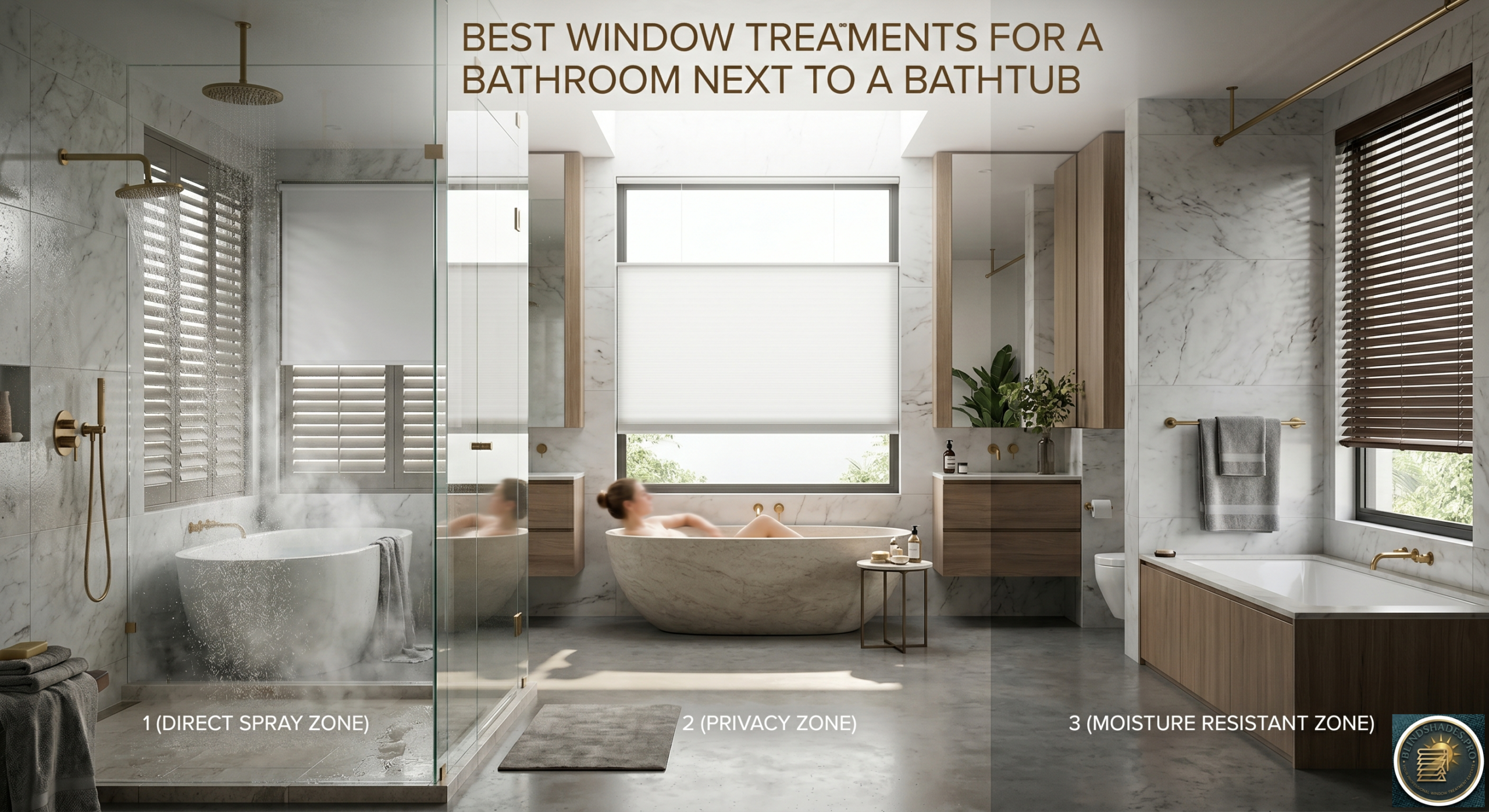
⭐ Quick Answer — What Are the Best Window Treatments for a Bathroom Next to a Bathtub?
- Identify the Sub-Scenario First: The best window treatments for a bathroom bathtub depend on the window position. Inside tub enclosure: ABS/polycarbonate polymer shutter or commercial PVC vinyl roller with marine-grade hardware (same as shower window Type A). Above the bathtub rim (sill 18–24 inches from floor): PVC vinyl roller on outside mount — the most stringent scenario. Adjacent side wall: faux wood or PVC vinyl inside mount, ceiling-track to clear towel bar below
- Why Above-Tub Windows Are the Most Stringent Privacy Scenario: A reclining bath occupant is at 18–30 inch height — significantly lower than a seated toilet user (35–40 inches). At a sill height of 18–24 inches, virtually any street-level observer who can see the window has a direct sightline to the bath occupant at all positions. A TDBU shade must have the bottom rail raised to 30–36 inches — higher than for any other bathroom activity — to fully cover the bath sightline zone
- The Overflow Scenario Nobody Mentions: When a bathtub fills too full, water overflows over the rim (at 14–18 inch height) and runs down the tiled wall to the window sill. Any window treatment at sill level in this bathroom bathtub location is periodically wetted by overflow water — not just steam. Specify PVC vinyl (handles direct water contact); avoid cellular shades at sill level (honeycomb cells trap overflow water). Always specify outside mount for above-tub windows to keep the shade fabric 4–6 inches clear of sill-level condensation pooling
- The Towel Bar Conflict: An outside-mount shade fully lowered contacts the wall surface — and any towel bar below the window. Wet towels create secondary moisture exposure on shade fabric. Solutions: (1) Inside mount positions fabric inside the window recess, clearing wall hardware; (2) Ceiling-track mount drops straight down clear of wall-mounted bars; (3) relocate the towel bar to a non-window wall
- Child Safety — Fall Prevention, Not Just Cord Safety: Cordless specification for bathtub windows prevents two risks: (1) standard cord entanglement, AND (2) a child reaching for a cord over a slippery wet surface and falling into the bathtub — a significantly higher injury risk than a fall to a dry floor. For any bathtub window accessible to children: specify fully cordless or motorized only
- Best Sources: Above-tub PVC outside mount → Blindsgalore bathroom range · Sub-Scenario A marine hardware → Norman USA PolyCore · Full product guide → Blinds.com tub and sink window guide · Also: SelectBlinds cordless PVC vinyl
⚠️ Bathtub Steam vs Shower Steam — and the Light Quality Difference That Matters: Window treatments near a bathroom bathtub face a different moisture challenge than shower windows. Bathtub steam is lower velocity and sustained for 20–60 minutes throughout the soak, versus shower steam which peaks in 5–10 minutes then disperses. Condensation forms gradually on the cold window glass, drips to the sill, and pools continuously during the bath. This extended wet cycle means above-tub window sill materials are wetter for longer than any other bathroom window position. And because the bath occupant reclines looking toward the window for 15–60 minutes, the light quality through the treatment matters more than for any other bathroom use. Frosted film provides the best ambient spa-like diffuse light for a reclining occupant. Polymer shutters with cracked louvres give the most controllable sky-view light. PVC vinyl roller (light-filtering) provides a pleasant glow. Direct sun through clear glass is the most uncomfortable specification for a bathtub window. See What Are the Best Blinds for a Bathroom Window for the full zone-by-zone specification. See the full three sub-scenario guide below.
💡 The TDBU Bathtub Configuration and the Sky-View Bath Experience: For window treatments in a bathroom bathtub context where a TDBU cellular shade is specified (Zone 3 or well-ventilated Zone 2 adjacent-wall windows), the correct bathtub configuration differs from both the living room and toilet configuration. The reclining bath occupant at 18–30 inch height requires the bottom rail raised to 30–36 inches — higher than the 35–40 inch setting for toilet privacy. With the bottom rail at 30–36 inches and the upper window zone fully open, the reclining bath occupant can see clouds and sky through the upper window — the “sky view from the bath” experience valued in bathroom design. This sky-view configuration is unique to bathtub windows: the low position of the bath occupant means the sky-view angle achievable through the upper window is wider and more immersive than from a standing or seated position. For the full TDBU operation guide for bathrooms, see What Are Top-Down Bottom-Up Shades — Are They Good for a Bathroom. See the full light quality comparison below.
📖 Read the complete guide below for: the three bathtub window sub-scenarios (inside enclosure, above rim, adjacent wall) with specifications for each, the reclining bath occupant sightline geometry (18–30 inch height vs toilet 35–40 inch), why the above-tub sill at 18–24 inches is the most stringent bathroom privacy scenario, the overflow scenario and why PVC outside mount is required, bathtub steam physics vs shower steam (sustained 20–60 min), the towel bar conflict and three solutions, the child fall-into-bath safety argument for cordless specification, the natural light quality comparison for reclining occupants, and the TDBU bathtub configuration with bottom rail at 30–36 inches.
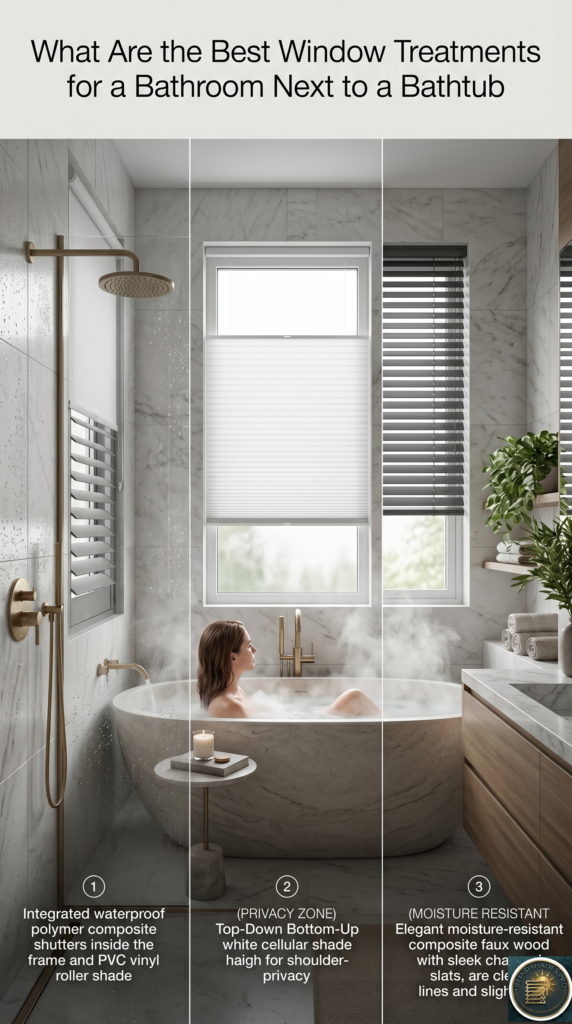
Window Treatments for a Bathroom Bathtub – The Three Sub-Scenario Guide
All guides treat “window next to a bathtub” as one scenario. There are three distinct sub-scenarios with meaningfully different window treatment specifications.
Sub-Scenario A – Window Inside the Bathtub Enclosure: The window is within the tiled walls of the bathtub enclosure. The bath taps or shower head can direct water at the window surface. This is the same exposure as a shower window Type A.
Specification: Solid ABS or polycarbonate polymer composite shutters with nylon polymer hardware, or commercial-grade PVC vinyl roller with marine-grade 316 stainless steel brackets. Standard residential materials and hardware corrode within 6-18 months.
For the complete Type A shower/bath enclosure specification, see What Are the Best Blinds for a Window Inside a Shower.
Sub-Scenario B – Window Above the Bathtub Rim (Sill at 18-24 Inches from Floor): The window sill sits at approximately bathtub rim height (standard bathtub rim: 14-18 inches from floor) plus 4-6 inches of tile above the rim. Typical sill height: 18-24 inches from the finished floor.
This is the most specification-challenging of all three sub-scenarios for two specific reasons:
First: the privacy requirement is more stringent than any other bathroom window. A reclining bath occupant is at 18-30 inches height – significantly lower than a seated toilet user (35-40 inches) or standing shower occupant (60-66 inches). At this height, virtually any observer at street level who can see the window at all has a direct sightline to the bath occupant. Full lower window coverage is required.
Second: the overflow scenario. When a bathtub fills to the overflow drain level, any additional water overflows over the rim and down the tiled wall below the window. Water pools at the window sill and the lower portion of any window treatment at sill level is periodically wetted by this overflow path. The window treatment at sill level must handle occasional direct water contact, not just steam.
Specification for Sub-Scenario B: PVC vinyl roller shade (inside mount if recess is adequate; outside mount if not) as the primary specification. The PVC surface handles the occasional direct water contact of the overflow scenario. Polymer composite shutters are the alternative premium specification – the louvre gap allows water to drain rather than pool behind the shutter face. Do NOT specify cellular shades for Sub-Scenario B – the honeycomb cells will trap overflow water against the window sill.
Sub-Scenario C – Window Adjacent to Bathtub (Side Wall, Within 36 Inches of Bath End): The window is on the bathroom wall beside the bathtub – not above it. The window sill may be at standard height (36-48 inches) or lower depending on the room layout. Receives heavy steam during bath use but minimal direct splash.
Specification for Sub-Scenario C: Zone 2 specification – faux wood PVC composite Venetian blind or PVC vinyl roller shade. Specify inside mount or ceiling-track to avoid the towel bar conflict (see below). The primary considerations are moisture resistance, privacy during bathing, and avoiding the secondary moisture exposure from wet towels hanging below the window.
The Bathtub Sightline – Why the Privacy Requirement Is More Stringent
Definition: A sightline is the unobstructed line of sight from an external observer to a bathroom occupant through the window.
The sightline geometry for a bathtub window differs fundamentally from all other bathroom windows:
| Bathroom Activity | Occupant Height | Window Zone Requiring Coverage |
|---|---|---|
| Reclining in bath | 18-30 inches | Entire lower window from sill to 30+ inch height |
| Seated on toilet | 35-40 inches | Lower window from sill to ~40 inch height |
| Standing shower | 60-66 inches | Middle window up to standing eye level |
| Standing at vanity | 60-66 inches | Middle window |
A standard bathroom window specification designed for toilet privacy (raise bottom rail to 35-40 inches) leaves a window above a bathtub with the lowest 18-24 inches of window exposed to the bath occupant’s full sightline zone. For Sub-Scenario B, the TDBU bottom rail must be raised to a minimum of 30-36 inches from the floor – higher than for any other bathroom activity.
The sky-view benefit for bath occupants: Raising the TDBU bottom rail to 30-36 inches while leaving the upper window zone open provides a meaningful benefit specifically for bathtub use: the bath occupant lying with head near the window end of the bath can see the sky above without any observer below being able to see them. This “sky view from the bath” experience – seeing clouds, trees, or sky while soaking – is a quality-of-life element specific to bathtub window design that no other bathroom window configuration provides.
The Bathtub Steam Physics – How It Differs from Shower Steam
Every guide discusses bathroom moisture in relation to showers. Bathtub steam behaves significantly differently and has different implications for window treatments.
Shower steam characteristics:
- High-velocity water spray from shower head at 2-3 bar pressure
- Duration: typically 5-15 minutes
- Steam rises rapidly and is extracted quickly by an exhaust fan
- Window condensation peaks in the first 5 minutes and reduces as shower ends
Bathtub steam characteristics:
- Low-velocity evaporation from bath water surface at ambient temperature differential
- Duration: typically 20-60 minutes (full bath soak duration)
- Steam rises slowly and lingers throughout the bath
- Window condensation builds gradually and is sustained for the entire bath period
The window treatment implication: A window above a bathtub experiences sustained condensation throughout a 30-60 minute soak at lower velocity than shower steam. The condensation forms on the cold window glass, drips down the glass to the window sill, and collects at the base of any window treatment. A PVC vinyl roller shade at sill level in the lowered position with an inside mount sits close to the glass surface during a bath – the lower edge of the shade fabric is in prolonged contact with dripping condensation throughout the bath period.
For Sub-Scenario B above-tub windows: always specify outside mount to position the shade fabric surface 10-15 cm (4-6 inches) away from the window glass, preventing the lower edge of the shade from sitting in pooled condensation at the sill level.
For the full condensation trap and microclimate analysis for bathroom window treatments in cold climates, see Do Bathroom Blinds Get Moldy – How to Prevent Mold on Bathroom Blinds.
The Towel Bar Conflict – The Installation Detail Nobody Mentions
Many bathrooms have a towel bar or towel ring mounted on the wall below the window adjacent to the bathtub. For outside-mount window treatments – whether PVC vinyl roller shade, cellular shade, or faux wood Venetian – the shade fabric when fully lowered drapes against the wall surface below the headrail.
The conflict: An outside-mount shade fully lowered to the wall surface will contact the towel bar mounted below the window. If wet towels are hanging on the bar at the time the shade is lowered, the shade fabric contacts wet terry cloth and absorbs moisture from the towel.
The consequence: For a PVC vinyl roller shade – the waterproof fabric wipes dry; the impact is minimal. For a fabric cellular shade or faux wood composite blind – the moisture transfer from a wet towel to the shade fabric creates a local wet zone that promotes mould at that contact point.
The solutions:
Option 1 – Inside mount: For a window with adequate recess depth (minimum 2.5 inches for roller shade), inside mount positions the shade fabric inside the window recess and keeps it clear of the wall surface and any hardware below the window.
Option 2 – Ceiling track mount: A ceiling-track-mounted roller shade or panel track positions the fabric flush with the ceiling and wall surface above the window, dropping straight down without contacting wall hardware. The shade clears the towel bar when fully lowered.
Option 3 – Relocate the towel bar: Move the towel bar to a wall that does not conflict with the window treatment drop path.
For the complete bathroom window measurement and mount guide, see What Are the Best Blinds for a Bathroom Window – Privacy and Moisture Guide.
The Natural Light Quality for Bathtub Windows
The bath occupant’s window experience differs from any other bathroom use case:
A shower occupant typically faces away from the window or is focused on functional tasks – the quality of light through the window matters less than privacy and moisture resistance. A bath occupant is:
- Reclining for 15-60 minutes
- Often facing or partially facing the window
- In a relaxed, ambient-seeking state rather than task-focused
The window treatment chosen for a bathtub directly affects the quality of the bathing experience for this duration.
Light quality comparison for bathtub windows:
Clear glass + no treatment: Maximum light, zero privacy – only appropriate for windows facing private courtyards or upper-floor locations with no sightline.
Frosted film: Converts harsh directional sunlight into diffuse spa-like ambient light. Significantly more comfortable for a reclining bath occupant looking toward the window. Provides day and night privacy. Does not require operation. This is frequently the best specification for a bathtub window where sky-view light (not direct sun view) is acceptable.
PVC vinyl roller shade (closed): Full privacy, minimal light when opaque. Light-filtering PVC provides some diffuse light. The “spa glow” effect of light-filtering vinyl roller shades in a bathroom is popular for bath-time use.
Polymer shutter with louvres cracked: Allows the bath occupant to precisely control the angle of incoming light and the degree of view through the louvres. The reclining occupant can angle louvres to see a sky view while blocking street-level sightlines. The premium light quality specification for a bathtub window.
TDBU cellular (configured for bath): Bottom rail raised to 30-36 inches, upper zone open for sky light. Creates a “sky window” effect for the reclining bath occupant while blocking all ground-level sightlines. Excellent for above-tub windows in Zone 2 or Zone 3.
The Child Safety Specification for Bathtub Windows
All guides mention cordless specification for child safety. For a bathtub window, the safety argument is more urgent than for any other window in the home.
The standard cord safety concern: Window blind cords pose an entanglement and strangulation risk. This is the basis for all cordless recommendations in child-accessible rooms.
The bathtub-specific additional risk: A child reaching for a window blind cord above a bathtub is reaching over a slippery hard surface. Any loss of balance while reaching for the cord results in a fall into the bathtub – a significantly higher injury risk than a fall to a carpeted or smooth floor. A child on a bath mat reaching up for a blind cord is at elevated slip-and-fall risk due to wet floor surfaces.
The specification: For any window adjacent to a bathtub accessible to children – specify fully cordless operation (cordless cellular, cordless roller) or motorized control (no accessible cords). This is not simply a strangulation prevention measure for bathtub windows – it is a fall prevention measure.
The Complete Bathtub Window Treatment Specification
| Sub-Scenario | Window Position | Best Material | Second Choice | Avoid |
|---|---|---|---|---|
| A – Inside tub enclosure | Within tiled walls | ABS/polycarbonate shutter + nylon hardware | PVC vinyl roller + 316 SS hardware | Standard residential materials |
| B – Above tub rim (sill 18-24 inch) | Directly above bath | PVC vinyl roller outside mount | Polymer composite shutter | Cellular shade (overflow trap), fabric, faux wood |
| C – Adjacent to bath (side wall) | Side wall within 36 inch | Faux wood Venetian inside mount | PVC vinyl roller ceiling track | Outside mount with towel bar conflict |
For all sub-scenarios:
- Specify cordless or motorized (child safety – fall prevention into bath)
- Specify moisture-treated where cellular is used (Zone 3 sub-scenarios only)
- Specify outside mount for Sub-Scenario B to keep shade clear of condensation pooling at sill
Where to Order
For Sub-Scenario A (inside tub enclosure): Norman USA PolyCore ABS shutters with nylon hardware. Blindsgalore commercial-grade PVC vinyl roller with 316 SS bracket specification.
For Sub-Scenario B (above tub rim, outside mount PVC): Blindsgalore Vinyl Roller Shade – specify outside mount, PVC fabric, cordless. See the Blindsgalore bathroom range and the Blinds.com tub and sink window guide for compatible products.
For Sub-Scenario C (adjacent tub, faux wood inside mount): Blindsgalore Faux Wood Venetian Blind – specify cordless, routeless, inside mount. The Shade Store bathroom privacy guide at theshadestore.com/blog/bathroom-window-privacy includes curated bathtub window treatment options with design context.
Frequently Asked Questions
What are the best window treatments for a bathroom next to a bathtub? The best window treatments for a bathroom bathtub window depend on the window’s position relative to the bath. For a window inside the tub enclosure receiving direct water contact, ABS polymer composite shutters or commercial-grade PVC vinyl roller with marine hardware are the only appropriate specifications. For a window above the bathtub rim with a sill at 18 to 24 inches from the floor, PVC vinyl roller shade on outside mount is the best specification – it handles the overflow scenario when bath water contacts the sill, and outside mount keeps the shade clear of condensation pooling. For a window adjacent to the bathtub on a side wall, faux wood or PVC vinyl inside mount is appropriate, with ceiling track mounting to avoid contact with towel bars below the window.
Why does a bathtub window need different privacy coverage than a standard bathroom window? A reclining bath occupant is at approximately 18 to 30 inches height – significantly lower than a seated toilet user at 35 to 40 inches. For a window above the bathtub with a sill at 18 to 24 inches, virtually any observer at street level who can see the window has a direct sightline to the bath occupant at all positions. This makes the privacy requirement for a window above a bathtub more stringent than any other bathroom window. A TDBU shade must have the bottom rail raised to approximately 30 to 36 inches from the floor – higher than the 35 to 40 inch setting appropriate for toilet privacy – to fully cover the bath occupant’s sightline zone.
How does bathtub steam affect window treatments differently from shower steam? Bathtub steam is lower velocity and sustained for 20 to 60 minutes throughout the bath soak period, compared to shower steam which peaks in the first 5 to 10 minutes and disperses quickly after the shower ends. Condensation from bathtub steam builds gradually on the cold window glass, drips down, and pools at the sill level for the entire duration of the bath. Any window treatment at sill level is in prolonged contact with dripping condensation during a bath. Specifying outside mount for above-tub windows keeps the shade fabric 4 to 6 inches away from the glass surface, preventing the shade’s lower edge from sitting in condensation pooling at the sill.
Why is cordless specification especially important for bathtub window treatments? For a window adjacent to a bathtub accessible to children, cordless specification serves two safety functions: it eliminates the entanglement and strangulation risk common to all corded blind safety concerns, and it eliminates the additional risk of a child falling into the bathtub while reaching for the cord. A child reaching up for a window blind cord above a bathtub is reaching over a slippery surface – any loss of balance results in a fall into the hard bath surface. Fully cordless or motorized specification for any bathtub window accessible to children is a fall prevention measure as much as an entanglement prevention measure.
What is the best light quality window treatment for a bathtub window? For a reclining bath occupant, frosted film provides the best ambient light quality by converting harsh directional sunlight into diffuse spa-like light without any operation required. Polymer composite shutters with louvres cracked provide the most controllable light quality, allowing the bath occupant to precisely angle light and sky view while blocking street-level sightlines. A TDBU cellular shade with the bottom rail raised to leave the upper zone open provides a sky-view effect – the reclining occupant can see clouds and sky through the upper window zone. Direct sun through clear glass is uncomfortable for a reclining bath occupant and is the least suitable light quality specification for a bathtub window.
Related Guides on BlindShades.pro
- The Best Bathroom Window Blinds and Shades Buying Guide
- What Are the Best Blinds for a Bathroom Window – Privacy and Moisture Guide
- What Are the Best Blinds for a Window Inside a Shower
- What Are Top-Down Bottom-Up Shades – Are They Good for a Bathroom
- Do Bathroom Blinds Get Moldy – How to Prevent Mold on Bathroom Blinds
By Michael Turner | 30 Years Home Improvement Expertise | Updated 2026 | BlindShades.pro
