Are Motorized Blinds Safe for a Bathroom – Waterproofing, IP Ratings and Smart Home

Authored By Michael Turner -30 Years Home Improvement Expertise | Updated 2026 | BlindShades.pro
Updated on July 12, 2026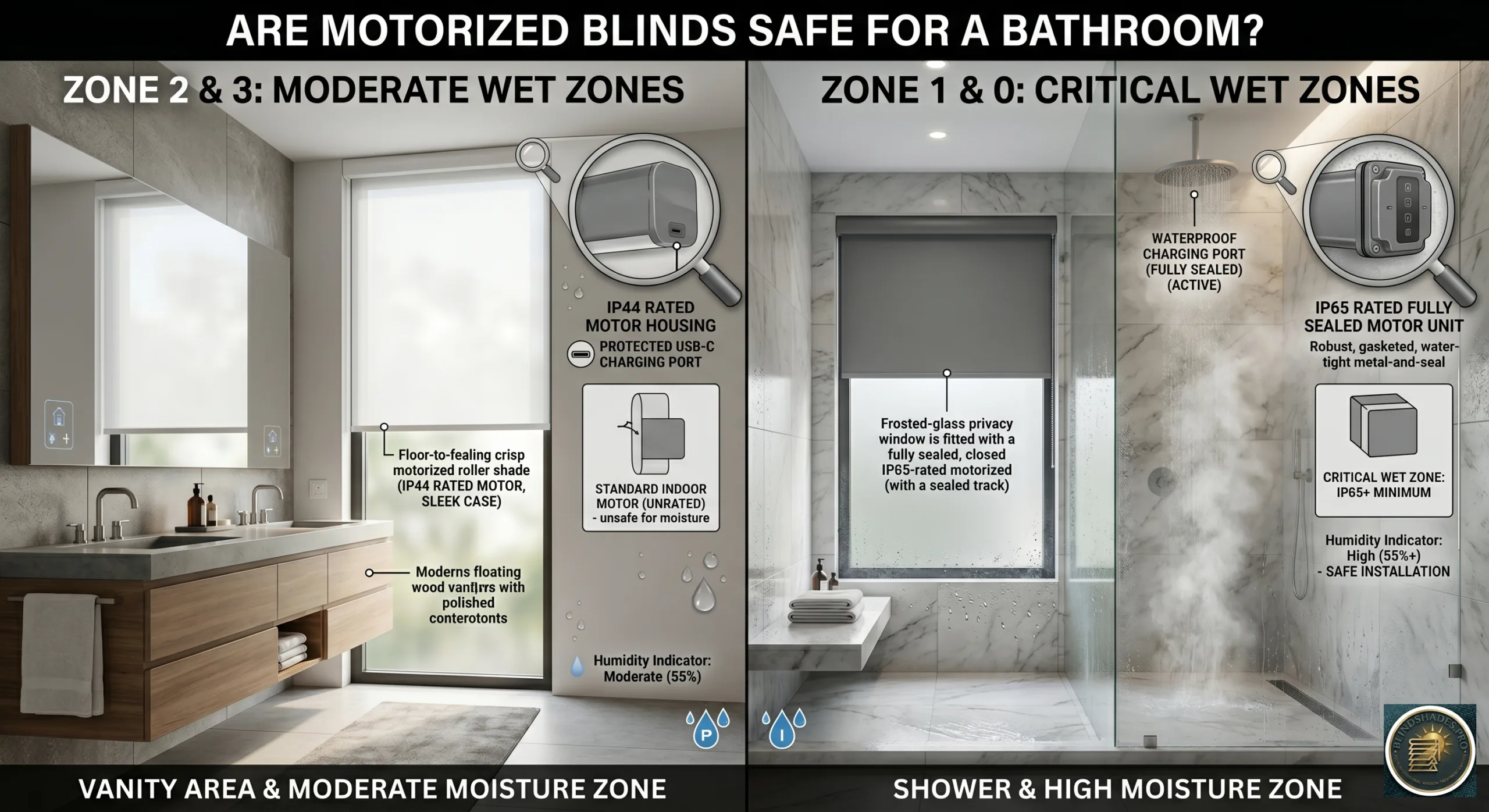
⭐ Quick Answer — Are Motorized Blinds Safe for a Bathroom?
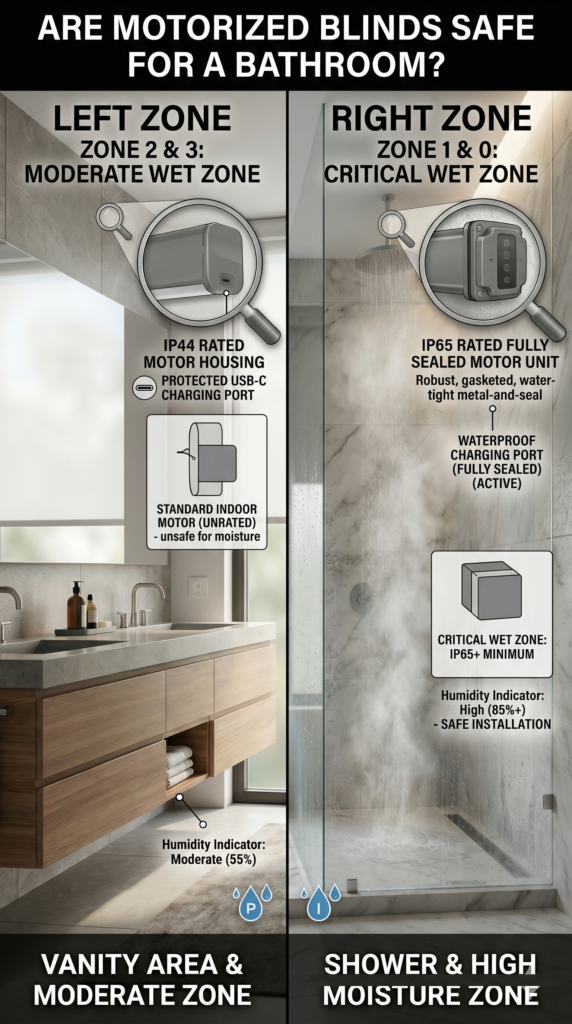
- The IP Rating Guide — Match Zone to Rating: Motorized blinds are safe for a bathroom when the motor IP rating matches the zone. Zone 3 (powder room): IP44 minimum. Zone 2 (vanity/steam): IP44 minimum, IP54 preferred. Zone 1 (shower-adjacent): IP65 minimum. Zone 0 (inside shower/bath): no motorized blind is appropriate. IP44 protects against splashing from any direction; IP65 protects against water jets; IP67 protects against temporary immersion
- The Only Mainstream IP44-Rated Brand: Most leading brands including Hunter Douglas PowerView Gen 3, Lutron Serena, IKEA FYRTUR, and Motionblinds CM-52 are not specifically IP44-rated — they are designed for general indoor Zone 3 use. Somfy Alto+ is the only mainstream motor with explicit IP44 bathroom zone certification. Yoolax also specifies waterproof construction for bathroom use. For Zone 2 placement: verify IP44 certification with the specific supplier in writing before ordering
- The Charging Port Risk Nobody Mentions: Battery-powered motors have a charging port that must be accessed periodically for recharging. The motor body may carry IP44 rating — but the charging port cover gasket may not be separately IP44-rated. In Zone 2 bathroom conditions, repeated exposure to steam degrades this gasket over 3–5 years, allowing moisture ingress at the electrical contacts. When ordering a battery motor for Zone 2: confirm both the motor body AND the charging port gasket carry IP44 rating
- Retrofit Motors Are NOT Appropriate for Zone 1 or Zone 2: SwitchBot Blind Tilt, ConnectedCurtain, and similar retrofit add-ons have no IP rating — exposed circuit boards and motor windings corrode in Zone 2 humidity within 12–24 months. For bathroom motorization: only integrated tube motors with explicit IP44+ ratings are appropriate. Retrofit motors are suitable for Zone 3 dry bathroom areas only
- Humidity-Sensor Automation — The Bathroom-Specific Smart Home Feature: Programme a humidity sensor (Aqara, Fibaro) to trigger the motorized blind to lower automatically when bathroom RH rises above 70% (shower start) and raise when RH drops below 60% (shower finished). This responds to actual shower use regardless of time — more reliable than a fixed schedule. Compatible with Apple Home, Alexa routines, and Google Home automations
- Best Sources: Zone 2 IP44 motor → Somfy Alto+ (only IP44-rated mainstream motor) · Smart home integration → Hunter Douglas PowerView Gen 3 (Zone 3) · Motorized PVC vinyl roller → Blindsgalore motorized range
⚠️ The Legal Bathroom Wiring Zones and the Hardwired vs Battery Full Picture: For motorized blinds in a bathroom, UK/EU standard BS 7671 (IEC 60364-7-701) defines legally required electrical protection per zone. Zone 1 (above bath/shower to 2.25m height) requires IP44 minimum and SELV only (Safety Extra Low Voltage: 12V AC or 25V DC maximum) — a standard 240V mains motor is not legally compliant in Zone 1. Zone 2 (extending 0.6m beyond Zone 1) requires IP44 minimum but standard voltage is permissible. And the hardwired vs battery question: “battery is always safer” is an oversimplification. A new battery motor with IP44-rated charging port is safe. But after 3–5 years of bathroom humidity, the charging port gasket may no longer maintain its IP rating. A professionally installed hardwired 24V DC SELV motor in Zone 2 with IP44 rating has no maintenance-dependent safety degradation — no gaskets to check, no charging ports to access in humidity. For a 10+ year installation, hardwired SELV may be the more reliable long-term specification. See What Are the Best Blinds for a Bathroom Window for the full zone framework. See the full IP rating and zone guide below.
💡 The Motorized Headrail Condensation Risk and the Outside Mount Mitigation: Motorized blinds in a bathroom have deeper headrails than manual blinds — typically 3–5 inches deep vs 2–3 inches for manual shades — because the tube motor adds to the headrail diameter. A deeper headrail presents more surface area to bathroom steam, more potential water ingress points (motor access panel, wiring entry, remote sensor port), and greater weight requiring secure mounting through bathroom tile into solid substrate. For Zone 2 bathroom motorized blinds: specify outside mount with the headrail positioned above the window casing at the wall-ceiling junction. This typically places the headrail outside the Zone 2 boundary (more than 0.6m from the shower perimeter) while the blind fabric still covers the full window. For the cordless specification that eliminates pull cord safety risks and reduces moisture exposure on cords, see What Are Top-Down Bottom-Up Shades — Are They Good for a Bathroom. See the full headrail risk and mitigation guide below.
📖 Read the complete guide below for: the full IP rating system (IP20 to IP67) mapped to bathroom zones, the UK/EU bathroom wiring zones legal framework (BS 7671 / IEC 60364-7-701 Zone 0/1/2/outside), the battery charging port gasket risk and how to verify IP44 coverage, the brand-by-brand IP rating table (Somfy Alto+ IP44; PowerView/Serena/IKEA/Motionblinds not specified; SwitchBot not appropriate), the hardwired 24V DC SELV vs battery safety comparison over a 10-year installation horizon, the humidity-triggered automation setup (70% RH trigger, Aqara/Fibaro sensors, Apple Home/Alexa/Google Home), the motorized headrail condensation risk and outside-mount mitigation, and why retrofit motors are not appropriate for Zone 1 or Zone 2.
Related guides: for whole-home planning, see the best motorized & smart blinds guide.
Are Motorized Blinds Safe for a Bathroom – The IP Rating Guide
Definition: IP (Ingress Protection) rating is a two-digit classification system defined by IEC standard 60529 that specifies the degree of protection provided by an electrical enclosure against the intrusion of solid objects (first digit) and liquids (second digit).
The two digits in an IP rating indicate:
- First digit (0-6): protection against solid particles (dust, debris)
- Second digit (0-9): protection against liquids (dripping, splashing, jets, immersion)
The bathroom-relevant IP ratings:
| IP Rating | Solid Protection | Liquid Protection | Bathroom Application |
|---|---|---|---|
| IP20 | Objects > 12mm | No liquid protection | Not appropriate for any bathroom |
| IP44 | Objects > 1mm | Splashing from any direction | Zone 2 and Zone 3 bathroom placement |
| IP54 | Dust protected | Splashing from any direction | Zone 2 enhanced specification |
| IP65 | Dust tight | Water jets from any direction | Zone 1 shower-adjacent placement |
| IP67 | Dust tight | Temporary immersion to 1 metre | Direct wet zone (inside shower/bath) |
The zone-to-IP-rating mapping:
- Zone 3 (powder room, 55-70% peak RH): IP44 minimum
- Zone 2 (vanity, 70-80% peak RH, steam): IP44 minimum; IP54 preferred
- Zone 1 (shower-adjacent, 90-100% RH, potential splash): IP65 minimum
- Zone 0 (inside shower or bath enclosure): IP67 — motorized blinds not appropriate for this zone
For the full bathroom zone framework, see What Are the Best Blinds for a Bathroom Window – Privacy and Moisture Guide.
The Legal Bathroom Wiring Zones – The Framework Every Guide Ignores
Definition: BS 7671 (IEE Wiring Regulations, UK) and IEC 60364-7-701 (EU standard for special installations in locations containing a bathtub or shower) define legally required electrical protection standards for different zones around bathroom fixtures. Similar standards apply across most jurisdictions worldwide.
The four bathroom wiring zones:
Zone 0 (inside the bath or shower basin): Only IP67 or IP68 rated equipment is permissible. Only SELV (Safety Extra Low Voltage) equipment operating at 12V AC or 25V DC maximum. Motorized window blinds are not appropriate for Zone 0 — no motorized system has a legitimate Zone 0 application for bathroom windows.
Zone 1 (above the bath or shower basin up to 2.25m from the floor): IP44 minimum required. Only SELV (12V AC or 25V DC) or suitably protected fixed equipment. For a motorized blind motor positioned in Zone 1 above a bathtub or shower tray: IP44 minimum, low-voltage or battery power supply only. A 240V AC mains-powered motor is not appropriate in Zone 1 under these standards.
Zone 2 (extending 0.6 metres beyond the perimeter of Zone 1): IP44 minimum required. Standard voltage equipment is permissible (including 240V AC) with IP44 protection. For most bathroom vanity windows with a motorized blind: the motor mounted at the headrail above the window is typically within Zone 2, requiring IP44 minimum.
Outside Zones (beyond 0.6m from Zone 1 boundary): Standard electrical equipment is permissible without specific IP rating requirements. For powder room windows remote from any bath or shower: standard indoor motorized blind motors are permissible.
The practical implication: Most motorized blind brands do not state their products’ compliance with these zone standards — because most products are designed for general indoor use, not specifically for bathroom zone compliance. For any motorized blind installation in a Zone 1 or Zone 2 bathroom location: verify with the supplier that the motor is rated for the specific zone, not just “suitable for humid environments.”
The Battery Charging Port Problem – The Safety Detail Nobody Raises
This is the most important motorized blind bathroom safety detail that is completely absent from all competitor guides.
The issue: Battery-powered motorized blind motors are the most common recommendation for bathroom use because they require no electrical wiring and are therefore considered inherently safe. A typical battery-powered blind motor consists of:
- A tube motor body (typically IP44-rated on quality products)
- A rechargeable lithium-ion battery pack
- A charging port (micro-USB, USB-C, or proprietary connector) accessed through a panel in the headrail
The gap in the IP rating: The motor body may carry an IP44 rating (protecting against splashing water from any direction). The charging port – which must be accessed periodically for recharging – typically has a dust cap or plug cover over the port. The IP rating of this cover is rarely specified and is frequently lower than the motor body rating.
In a Zone 2 bathroom with daily shower steam exposure:
- The charging port cover is exposed to humidity for 365 days per year
- Repeated thermal cycling (steam expansion, then cooling) creates slight pressure differentials that can draw humid air past the cover seal
- Over months and years, moisture introduced through the charging port degrades the battery cells, creates short-circuit risk, and potentially introduces corrosion to the charging contacts
The specification: When ordering a battery-powered motorized blind for a Zone 2 bathroom window – request specific confirmation that the charging port cover or gasket carries an IP44 rating, not just the motor body. If the manufacturer cannot confirm the charging port IP rating – specify a brand where this is explicitly stated.
Somfy Alto+ explicitly addresses this with a sealed motor design rated IP44 throughout the system. See somfy.co.uk/products/motorisation/tubular-motors/alto for the full specification.
Retrofit Motors Are NOT Appropriate for Bathroom Use
This is the most commonly made bathroom motorization mistake in 2026:
Retrofit add-on motors (SwitchBot Blind Tilt, ConnectedCurtain, and similar products) are clip-on mechanisms that attach to the drive mechanism of existing manual blinds to add motorization without replacing the shade. They are popular for their low cost and easy installation.
Why retrofit motors are not appropriate for Zone 1 or Zone 2 bathroom windows:
Retrofit motors are manufactured for general indoor use without an IP rating. The clip-on attachment mechanism does not create a sealed interface between the motor and the blind drive shaft – there are exposed circuit board surfaces, motor windings, and electronic components accessible to bathroom steam and humidity.
In Zone 2 bathroom conditions (70-80% RH daily during showers):
- Exposed circuit boards experience progressive corrosion of solder joints
- Motor windings absorb humidity and develop insulation breakdown over 12-24 months
- The clip attachment contacts corrode, causing unreliable operation before complete failure
The correct bathroom motorization specification: Integrated tube motors – factory-installed within the roller shade tube during manufacturing – provide a sealed motor cavity with defined IP ratings. These motors have no exposed components and no retrofit attachment interfaces. For any bathroom Zone 1 or Zone 2 motorization requirement: specify integrated tube motors with IP44 minimum rating.
For the full Zone 1 material and hardware specification, see What Are the Best Blinds for a Window Inside a Shower.
Hardwired vs Battery – The Full Bathroom Safety Picture
All guides say “battery-powered is safest for bathrooms because no wiring is needed.” This is an oversimplification.
The accurate comparison:
Battery-powered motor (new, properly rated): Safe for Zone 1 and Zone 2 with appropriate IP rating. No electrical installation required. Battery requires periodic recharging – the recharging process requires accessing the charging port. If the charging port is not IP-rated, repeated access in a bathroom environment introduces moisture risk over time.
Battery-powered motor (aged, gasket degraded): After 3-5 years of bathroom humidity exposure, the charging port cover gasket may no longer maintain its IP rating. At this point, a theoretically “safe” battery motor becomes a moisture ingress risk at the electrical components.
Hardwired 24V DC low-voltage motor (professionally installed): 24V DC is classified as Safety Extra Low Voltage (SELV) – the same classification as lighting systems specifically permitted in bathroom zones under BS 7671 Zone 1 rules. A hardwired 24V DC motor professionally installed in Zone 2 with IP44 rating is legally compliant and, once installed, has no maintenance-dependent safety degradation (no gaskets to check, no charging ports to access in a humid environment).
The recommendation: For a bathroom motorized blind that will be used daily for 10+ years (the expected life of a quality installation): hardwired 24V DC with IP44 rating, professionally installed, is the more reliable long-term specification. Battery is appropriate for shorter-term, lower-commitment applications where the charging port specification can be verified.
The Humidity-Triggered Smart Home Automation for Bathrooms
This is the bathroom-specific smart home feature that makes motorized blinds genuinely superior to manual blinds for privacy – and no guide describes it.
Definition: Humidity-triggered automation is a smart home routine that monitors bathroom relative humidity via a sensor and automatically triggers the motorized blind to lower when humidity rises above a defined threshold.
How it works:
- A Zigbee or Z-Wave humidity sensor (Aqara TVOC Air Quality Monitor, Fibaro Flood Sensor used as humidity sensor, or similar) is installed in the bathroom
- A smart home automation routine is programmed: when bathroom humidity rises above 70% RH (indicating a shower has started), trigger the motorized blind to fully lower
- A second automation: when bathroom humidity drops below 60% RH (shower finished and ventilation complete), raise the blind back to the preferred daytime position
Why this is superior to time-scheduled privacy: A time-scheduled privacy automation (“close at 7am daily”) assumes a fixed shower routine. In practice, shower times vary by day. A humidity-triggered automation responds to the actual moment of shower use – accurate regardless of what time the shower starts.
Compatible ecosystems in 2026:
- Apple Home: works with Aqara sensors + HomeKit automations; blind must be HomeKit compatible (Hunter Douglas PowerView, Lutron Serena, Eve MotionBlinds)
- Amazon Alexa: works with Aqara, Fibaro, or SmartThings sensors + Alexa routines
- Google Home: works with compatible humidity sensors + Google Home automations
The setup requirement: The humidity sensor must be positioned in the shower steam path (typically above the shower or on the wall near the shower head) but not inside the shower enclosure. The motorized blind must have a smart home protocol integration compatible with the chosen sensor ecosystem.
Brand IP Rating Guide for Bathroom Motorized Blinds
| Brand/Product | Motor IP Rating | Bathroom Zone | Notes |
|---|---|---|---|
| Somfy Alto+ | IP44 | Zone 2 and Zone 3 YES | Only mainstream brand explicitly IP44-rated |
| Somfy Sonesse | IP20 | Zone 3 only | General indoor motor; not Zone 1/2 |
| Hunter Douglas PowerView Gen 3 | Not specified | Zone 3 advised | General indoor specification |
| Lutron Serena | Not specified | Zone 3 advised | General indoor specification |
| Yoolax waterproof motor | Waterproof specified | Zone 2 (confirm with supplier) | Explicit waterproof claim for bathroom use |
| SwitchBot Blind Tilt (retrofit) | No IP rating | NOT appropriate | Exposed electronics; Zone 1/2 not suitable |
| IKEA FYRTUR | Not specified | Zone 3 only | 42dB motor; general indoor use |
| Motionblinds CM-52 | Not specified | Zone 3 advised | Standard indoor motor |
For Zone 1 (shower-adjacent) motorized blinds: No mainstream consumer motorized blind motor is explicitly rated for Zone 1 placement. For Zone 1 bathroom windows requiring motorization – the best specification is a Somfy Alto+ motor with the blind installed on outside mount such that the motor headrail is positioned above the Zone 1 boundary (typically above 2.25m from the bath floor or more than 0.6m from the shower head spray reach).
The Motorized Headrail Condensation Risk
Motorized blind headrails are significantly deeper than manual blind headrails because the tube motor adds to the headrail diameter. A typical manual cellular shade headrail is 2-3 inches deep. A motorized cellular shade headrail is 3-5 inches deep.
Why deeper headrails present more bathroom risk:
- Larger surface area exposed to bathroom steam and condensation
- More potential water ingress points: motor charging port access panel, wiring entry point (hardwired), remote sensor port, end cap joins
- Greater weight requires more secure mounting – tiled bathroom walls require drilling through tile into solid substrate for safe motorized headrail mounting
The mitigation: For Zone 2 bathroom motorized blinds: specify outside mount with the headrail positioned above the window casing at the wall-ceiling junction. This positions the headrail outside Zone 2 in most bathroom configurations (more than 0.6m from the shower or bath perimeter) while still allowing the blind fabric to cover the full window.
Where to Order – Motorized Bathroom Blind Specification
For Zone 2 bathroom motorization with IP44-rated motor: Somfy Alto+ integrated tube motor – the only mainstream brand with explicit IP44 bathroom zone certification. Available through Somfy dealers and specialist motorized blind retailers. See somfy.co.uk Alto+ specification for full technical data.
For Zone 2-3 bathroom motorization (general indoor motor with moisture-resistant fabric): Blindsgalore motorized roller shades with PVC vinyl fabric – waterproof fabric with standard indoor motor; outside mount recommended for Zone 2 placement. See blindsgalore.com/motorized-blinds for the bathroom-compatible range.
For premium bathroom smart home integration: Hunter Douglas PowerView Gen 3 with PowerView app and Alexa/Google/HomeKit integration – see hunterdouglas.com/operating-systems/powerview-automation. Specify outside mount and confirm motor placement is outside Zone 2 boundary.
Related guides: For complete buying advice, see our motorized and smart blinds buying guide.
Frequently Asked Questions
Are motorized blinds safe for a bathroom? Motorized blinds are safe for a bathroom when the motor’s IP rating matches the bathroom zone where it is installed. Zone 2 vanity and Zone 3 powder room windows require a minimum IP44 motor rating, which protects against water splashing from any direction. Zone 1 shower-adjacent windows require IP65 minimum. Most mainstream motorized blind brands including Hunter Douglas PowerView and Lutron Serena are not specifically IP44-rated and are designed for Zone 3 general indoor use only. For Zone 2 bathroom placement, specify Somfy Alto+ motors, which are the only mainstream brand with explicit IP44 bathroom zone certification.
What IP rating do motorized blinds need for a bathroom? The required IP rating for motorized blinds in a bathroom depends on the zone. Zone 3 powder rooms and dry bathroom areas require IP44 minimum. Zone 2 vanity windows with daily shower steam exposure require IP44 minimum, with IP54 preferred for enhanced protection. Zone 1 windows within 36 inches of a shower or bath require IP65 minimum. Zone 0 inside the shower or bath enclosure is not appropriate for any motorized blind installation. The two-digit IP rating system follows IEC standard 60529, where the second digit indicates liquid protection from 0 (none) through 9 (high-pressure hot water jets).
Are retrofit motorized blind motors safe for bathroom windows? Retrofit add-on motors such as SwitchBot Blind Tilt and similar products are not appropriate for Zone 1 or Zone 2 bathroom windows. Retrofit motors have no IP rating – they are manufactured for general indoor use with exposed circuit boards and motor windings that are not sealed against bathroom humidity. In Zone 2 bathroom conditions of 70 to 80 percent relative humidity during daily showers, exposed electronics experience progressive corrosion over 12 to 24 months. Only integrated tube motors with explicit IP44 or higher ratings are appropriate for Zone 1 and Zone 2 bathroom motorized blind installation.
Can humidity sensors automate motorized blinds in a bathroom? Yes – humidity-triggered automation is the most reliable smart home configuration for motorized bathroom blinds. A humidity sensor programmed to trigger the blind to lower when bathroom relative humidity rises above 70 percent responds to the actual start of a shower regardless of the time of day, unlike time-scheduled automations that assume a fixed routine. Compatible systems include Aqara sensors with Apple Home, Fibaro sensors with Amazon Alexa routines, and compatible sensors with Google Home automations. The motorized blind must have a smart home protocol compatible with the chosen sensor ecosystem.
Is hardwired or battery-powered safer for a motorized bathroom blind? Both are safe when correctly specified, but the safety comparison is not as simple as “battery is always safer.” A new battery-powered motor with an IP44-rated charging port is safe for Zone 2 bathroom use. However, the charging port gasket degrades over 3 to 5 years of humidity exposure, potentially introducing moisture risk at the electrical components as the gasket loses its IP rating. A professionally installed hardwired 24V DC motor in Zone 2 with IP44 rating is classified as Safety Extra Low Voltage and complies with BS 7671 Zone 1 and Zone 2 requirements. Once installed, it has no maintenance-dependent safety degradation – no gaskets to inspect or charging ports to access in a humid environment.
Contextual Internal Links – Used in Article Body
| Anchor Text | Links To | Location |
|---|---|---|
| What Are the Best Blinds for a Bathroom Window | /guide/best-blinds-for-bathroom-window/ | IP rating zone section |
| What Are the Best Blinds for a Window Inside a Shower | /guide/best-blinds-shower-window/ | Retrofit motors section |
Related Guides on BlindShades.pro
- The Best Bathroom Window Blinds and Shades Buying Guide
- What Are the Best Blinds for a Bathroom Window – Privacy and Moisture Guide
- What Are the Best Blinds for a Window Inside a Shower
- Are Faux Wood Blinds Better Than Aluminum Blinds for a Bathroom
- What Are Top-Down Bottom-Up Shades – Are They Good for a Bathroom
By Michael Turner | 30 Years Home Improvement Expertise | Updated 2026 | BlindShades.pro
