Are Motorized Blinds Good for Kitchen Windows?

Authored By Michael Turner -30 Years Home Improvement Expertise | Updated 2026 | BlindShades.pro
Updated on May 26, 2026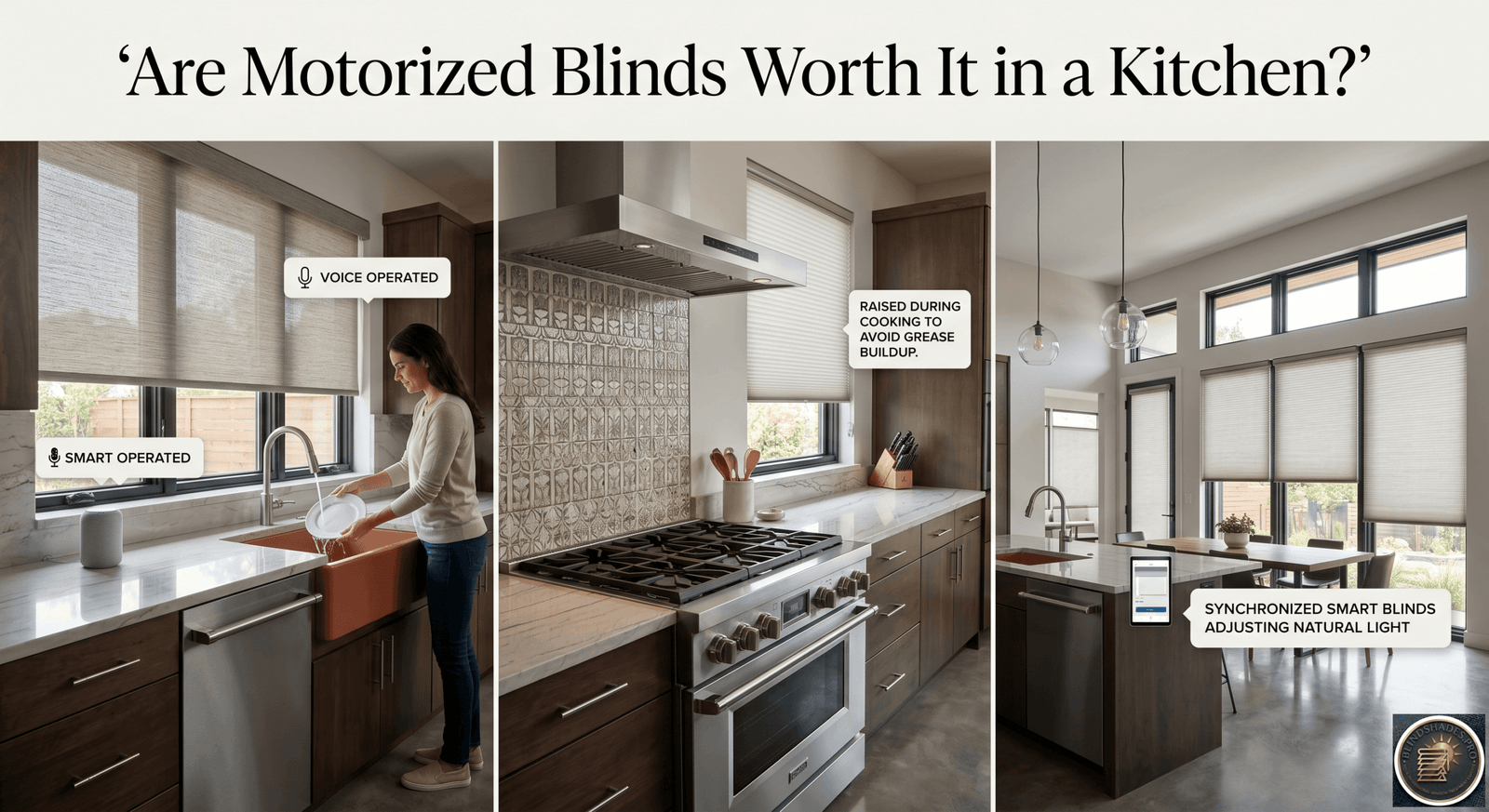
⭐ Quick Answer — Are Motorized Blinds Good for Kitchen Windows?
- Best Kitchen Positions for Motorized Blinds: Motorized blinds on kitchen windows are highest-value in three positions. Zone K1 (above sink): eliminates the reach-over-wet-surface operation problem and removes cord grease accumulation — a manual blind above a farmhouse sink that nobody raises accumulates grease continuously. Zone K2 (near stove): programmes to raise automatically when the stove turns on — safety automation no manual blind provides. Zone K3/K4 (dining area, picture window): scheduled dinner privacy, morning light, and simultaneous multi-blind operation
- The Farmhouse Sink TCO Reversal — When Motorized Is Cheaper Per Year: A manual blind above a farmhouse sink (30–36 inch reach over wet basin) is rarely raised before cooking. The blind remains lowered during cooking, accumulating grease continuously. Result: 2–3 year lifespan rather than 10–15 years = $25–$75 per year annual cost. A motorized blind voice-raised before every cooking session achieves full 10–15 year lifespan = $10–$40 per year. For farmhouse sinks: motorized is the more economical specification, not the premium one
- The Kitchen Hygiene Operation Ranking: (1) Voice control — no touching required; operate with food-soiled hands by spoken command; most hygienic. (2) Motion sensor — fully automatic; zero interaction. (3) App control — requires touching the phone. (4) Wall switch — fixed surface, requires touch. (5) Remote control — portable but accumulates kitchen grease; sticky within 12–18 months of Zone K1 use. (6) Cordless lift bar — direct contact with food-soiled hands; least hygienic for kitchen
- The 2026 Matter/Thread Standard — One Blind, All Voice Assistants: Specify Matter-compatible motorized blinds for kitchen windows in 2026. Matter is the unified smart home standard that allows a single blind to work with Alexa, Google Home, and Apple Home simultaneously — no ecosystem selection required. Thread provides lower latency than Wi-Fi or Bluetooth for faster voice command response during cooking. Hunter Douglas PowerView Gen 3 and Eve MotionBlinds are Matter over Thread compatible in 2026
- IP44 for Zone K1 — Motor AND Charging Port: For motorized kitchen window blinds above the sink, specify IP44-rated integrated tube motor — the Zone K1 over-sink position is a high-steam, high-grease environment. Critically: confirm both the motor body AND the charging port gasket carry IP44 rating — the motor body may be IP44-rated while the charging port cover is not. Retrofit add-on motors (SwitchBot etc.) have no IP rating and are not appropriate for Zone K1. Zone K4 large picture windows: hardwired preferred over battery — wide heavy blinds require consistent power
- Best Sources: Matter-compatible kitchen motorized → Hunter Douglas PowerView Gen 3 · IP44-rated over-sink motorized → SelectBlinds motorized range · Smart home kitchen scheduling → Blindsgalore motorized kitchen
⚠️ The Stove Safety Automation and the Grease on Motor Mechanisms: For motorized blinds on kitchen windows near the stove, the safety automation is the primary benefit — not convenience. Connect the hob to a smart plug and programme an automation: when the smart plug turns on (stove in use), raise the Zone K2 blind to above 54 inches from the floor (above the maximum heat zone height). A second automation: when the smart plug turns off (cooking finished), lower to the privacy position. This removes the blind from the heat zone during every cooking session automatically, eliminating the primary stove window treatment risk. For the complete stove clearance guide, see What Are the Best Window Treatments for a Kitchen Near a Stove. And the grease mechanism warning: the motor housing, remote control, and wall switch in Zone K1 and K2 proximity accumulate cooking grease from the kitchen air. Remote controls in Zone K1 positions become sticky within 12–18 months. Wipe remote and switch surfaces weekly with a damp cloth. Specify voice control or app control to eliminate portable device grease accumulation entirely. See the full hygiene operation ranking below.
💡 Kitchen-Specific Scheduling Applications for Motorized Blinds: General guides describe light scheduling for motorized kitchen window blinds — these kitchen-specific automations go further. Cooking Mode scene: one voice command (“Alexa, cooking mode”) raises all kitchen blinds to Zone K2 safe height, Zone K1 fully raised, Zone K3 open for light. Dinner privacy schedule: Zone K3 dining area blind lowers automatically at sunset. Morning light routine: Zone K3 and K4 raise at 7am weekdays, 8am weekends. Smoke alarm integration (advanced): link kitchen motorized blinds to the smoke detector — if the alarm activates, all kitchen blinds raise to maximum height, eliminating any blind proximity to a potential kitchen fire source. For the complete over-sink motorized specification including the reach-over-wet-surface geometry by sink type, see What Are the Best Blinds for a Window Over the Kitchen Sink. See all kitchen scheduling applications below.
📖 Read the complete guide below for: the zone-by-zone assessment (Zone K1 highest ROI / K2 stove safety / K3 K4 scheduling), the farmhouse sink TCO analysis (manual 2–3 year lifespan vs motorized 10–15 year = lower annual cost), the full kitchen hygiene operation ranking (voice to cordless lift bar), the grease accumulation on motor housing, remote, and charging port, the IP44 zone K1 specification with charging port confirmation, the stove safety smart plug and temperature sensor automation, the kitchen-specific scheduling applications (cooking mode scene / dinner privacy / smoke alarm integration), the 2026 Matter/Thread standard and compatible brands, and the zone-specific battery vs hardwired recommendation.
Motorized Blinds Kitchen Windows – The Zone-by-Zone Assessment
Definition: A motorized kitchen blind is a window covering – roller shade, Venetian blind, or cellular shade – operated by an integrated electric motor rather than by manual cord or lift bar, controllable by remote, wall switch, smartphone app, or voice command.
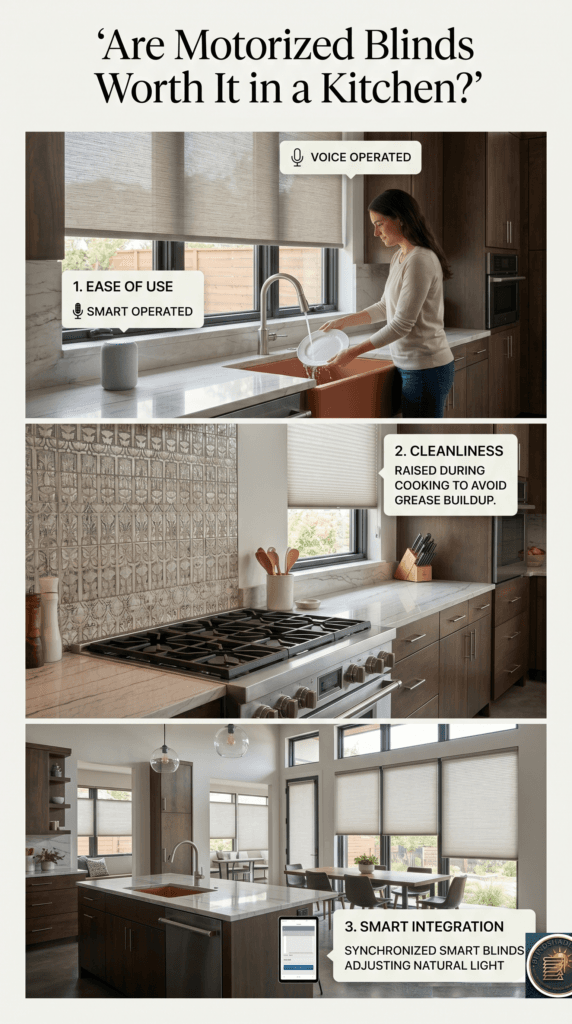
Zone K1 (above sink) – Highest ROI for kitchen motorization: The reach-over-wet-surface problem (covered fully in What Are the Best Blinds for a Window Over the Kitchen Sink) makes the sink window the position where motorization provides the most practical benefit. A standard drop-in sink requires reaching over 22-24 inches to operate a manual blind. A farmhouse apron-front sink requires reaching over 30-36 inches over a hard wet surface – a physically awkward and wet reach that most occupants avoid in daily practice.
The consequence of not raising a sink window blind before cooking: the blind remains in the lowered position during cooking and accumulates cooking grease continuously. A blind that is never raised for practical reasons loses its full kitchen lifespan within 2-3 years rather than the 10-15 year expectation. A motorized blind raised by voice command before every cooking session is protected from the worst grease accumulation zone – Zone K1 – and achieves its full design lifespan.
Zone K2 (near stove) – Safety automation primary value: As covered in What Are the Best Window Treatments for a Kitchen Near a Stove, a motorized blind near the stove can be programmed to raise automatically when the stove is in use – eliminating the primary stove window treatment safety risk. The automatic raise removes the blind from the heat zone during every cooking session without any manual operation required.
Zone K3 (breakfast nook, dining area) – Convenience and light scheduling: The Zone K3 dining area window benefits from motorization for light and privacy scheduling – automated dinner privacy and morning light routines. Not the primary kitchen motorization application but worthwhile for large Zone K3 windows in actively used kitchen-dining areas.
Zone K4 (large picture window) – Light management and scheduled operation: Large picture windows in open-plan kitchen-diners benefit from motorization for large-blind operation (manually raising a wide heavy blind is physically demanding), synchronised operation of multiple windows simultaneously, and scheduled light management.
The Kitchen Hygiene Operation Hierarchy
This kitchen-specific ranking does not appear in any competitor guide.
In a kitchen, the operator’s hands are frequently food-soiled, wet, or greasy. The hygiene of different motorized blind operation methods ranks as follows, from most to least hygienic for kitchen use:
1. Voice control (Alexa, Google Home, Apple Home Siri): The most hygienic kitchen operation method. The blind is operated by spoken command with zero physical contact. Food-soiled, wet, or greasy hands present no issue. “Hey Alexa, raise the kitchen blind” during fish filleting or bread kneading – no surface contamination from the operation.
2. Motion sensor trigger (fully passive): The blind operates automatically based on detected motion in the kitchen zone or on a timed schedule. Zero interaction required at any time. The most seamless kitchen experience but requires setup and configuration.
3. Smartphone app control: Requires picking up and touching the smartphone with potentially soiled hands. Less hygienic than voice in a kitchen context but more hygienic than any physical mechanism on the blind itself. Phone screen accumulates kitchen grease over time if used during cooking.
4. Wall switch: Fixed surface positioned away from the blind mechanism itself. Requires touching the switch with potentially soiled hands. Better than a cord (further from the cooking zone) but switch surface accumulates kitchen grease and requires periodic cleaning.
5. RF remote control: Portable, convenient – but the remote control surface accumulates cooking grease and becomes progressively stickier with kitchen use. Remote controls in Zone K1 proximity become hygienically problematic within 12-18 months of daily kitchen use without regular cleaning.
6. Manual cordless lift bar (least hygienic): Requires direct contact with the blind’s bottom rail with food-soiled hands. The bottom rail of a kitchen blind is itself in proximity to the cooking zone and accumulates grease. Manual contact transfers grease to the rail mechanism and is the least hygienic kitchen operation method.
The Grease Accumulation Problem on Motorized Mechanisms
This kitchen-specific issue is absent from all motorized blind guides.
A motorized blind in a kitchen is not just a blind that operates electrically – it is a mechanical and electronic assembly exposed to the same cooking grease environment as the blind fabric.
Components that accumulate kitchen grease:
The roller tube and motor housing: A motorized PVC vinyl roller shade has a headrail assembly containing the motor, battery pack (if battery-powered), and roller tube. The outer surface of this assembly is exposed to cooking grease aerosol in Zone K1 and Zone K2 positions. Grease deposits on the motor housing, accumulates around the end caps, and can enter the motor ventilation holes if present.
The charging port: Battery-powered motorized blinds have a charging port (micro-USB, USB-C, or proprietary) in the headrail assembly. In Zone K1 over-sink positions, this charging port is in a high-steam and high-grease environment. The same charging port gasket issue covered in Are Motorized Blinds Safe for a Bathroom – Waterproofing, IP Ratings and Smart Home applies to kitchen Zone K1 positions: the motor body may be IP44-rated but the charging port gasket may not be. For Zone K1 kitchen motorized blinds: specify IP44-rated motor and IP44-rated charging port.
The remote control or wall switch: In proximity to Zone K1 or Zone K2 cooking, remote control surfaces and wall switch faces accumulate cooking grease. A remote control stored near the kitchen sink or stove becomes progressively stickier. Wipe remote control and wall switch surfaces with a damp cloth weekly.
The solution: For Zone K1 kitchen motorized blinds: specify integrated tube motors with IP44 rating minimum. Specify voice control or app control rather than physical remote to reduce grease accumulation on portable devices.
The Farmhouse Sink Case – When Motorized Is Not a Luxury
The specific over-sink scenario that makes motorized blinds a practical necessity rather than a premium option.
A farmhouse or apron-front kitchen sink has a front face that extends to the cabinet face line. The person standing at a farmhouse sink is approximately 30-36 inches from the window – a distance that makes reaching any manual blind control impractical without leaning over hard porcelain or fireclay.
The consequence of a non-motorized blind above a farmhouse sink: In practice, homeowners with farmhouse sinks and manual blinds above them rarely raise the blind before cooking. The reach is too inconvenient for daily operation. The result:
- The blind remains lowered during most cooking sessions
- Zone K1 cooking grease accumulates on the lowered blind continuously
- The blind that should last 10-15 years with regular raising is replaced in 2-3 years
- The actual annual cost of a manual blind above a farmhouse sink: $25-$75 per year (2-3 year replacement cycle)
- A motorized blind voice-raised before every cooking session: $10-$40 per year (full 10-15 year lifespan)
For farmhouse and apron-front sinks: motorized specification with voice control is the more economical long-term choice, not the luxury choice.
The Total Cost of Ownership Analysis
The standard advice: “Motorized blinds cost more upfront.” This is accurate but incomplete.
The kitchen-specific TCO comparison:
| Scenario | Product | Upfront | Lifespan | Annual Cost |
|---|---|---|---|---|
| Manual blind above standard sink (regularly raised) | Faux wood Venetian | $50-$150 | 10-15 years | $3-$15/yr |
| Manual blind above farmhouse sink (rarely raised, grease accumulates) | Faux wood Venetian | $50-$150 | 2-3 years | $25-$75/yr |
| Motorized PVC vinyl roller above farmhouse sink (voice-raised daily) | Motorized roller | $150-$400 | 10-15 years | $10-$40/yr |
| Motorized PVC vinyl roller above standard sink | Motorized roller | $150-$400 | 10-15 years | $10-$40/yr |
The TCO finding: A motorized blind above a farmhouse sink costs 2-3 times less per year than a manual blind in the same position that is realistically never raised – because the manual blind’s lifespan is reduced from 15 years to 2-3 years by continuous grease accumulation.
The Kitchen-Specific Smart Home Scheduling Applications
General motorized blind guides describe light scheduling. These kitchen-specific applications are unique to this room.
Application 1 – Stove safety auto-raise: Connect the kitchen hob to a smart plug. Programme an automation: when the smart plug turns on (stove in use), raise Zone K2 stove-adjacent blind to above 54 inches from the floor. This removes the blind from the heat zone every time the stove is used, automatically. For the full stove safety specification, see What Are the Best Window Treatments for a Kitchen Near a Stove.
Application 2 – Pre-cooking raise routine: Programme a voice command: “Alexa, cooking mode” activates a scene that raises all kitchen motorized blinds to the cooking position (Zone K1 sink blind fully raised; Zone K2 stove blind raised above heat zone).
Application 3 – Dinner privacy schedule: Programme the Zone K3 dining area blind to lower at sunset automatically, providing dinner privacy without any manual operation.
Application 4 – Morning light routine: Programme Zone K3 and K4 blinds to raise at a set morning time (e.g., 7am on weekdays, 8am on weekends) for natural breakfast light.
Application 5 – Smoke alarm integration: Advanced smart home automation: link kitchen motorized blinds to the smoke alarm circuit. If the smoke alarm activates, raise all kitchen blinds to allow visual check through windows and to eliminate any blind proximity to a potential kitchen fire source. Requires smart home hub with smoke detector integration.
The 2026 Matter/Thread Standard – The Kitchen Integration Simplification
The connectivity development that changes the kitchen motorized blind selection decision in 2026.
Definition: Matter is a unified smart home connectivity standard launched in 2022 and maturing significantly in 2025-2026 that allows smart home devices from different manufacturers and ecosystems to communicate directly without requiring a hub or bridge.
Why this matters for kitchen motorized blinds:
Prior to Matter: selecting a motorized blind for a kitchen required choosing between Apple HomeKit (for Siri voice control), Amazon Alexa (for Alexa voice control), or Google Home (for Google Assistant) ecosystems. A blind designed for one ecosystem required a bridge or was simply incompatible with others.
In 2026 with Matter: A Matter-compatible motorized blind works simultaneously with Alexa, Google Home, and Apple Home without any bridge or adapter. For a kitchen where multiple people use different voice assistants – one household member using Alexa, another using Google, a third using Siri – a single Matter-compatible motorized blind responds to all of them.
Thread: The low-power mesh networking protocol that most Matter devices use for communication. Thread provides lower latency than Wi-Fi or Bluetooth for device commands – meaning the kitchen motorized blind responds faster to voice commands during cooking when responsiveness matters.
2026-compatible brands:
- Hunter Douglas PowerView Gen 3: Matter-compatible
- Eve MotionBlinds: Matter over Thread compatible
- Somfy TaHoma: Matter compatible via gateway
The Battery vs Hardwired Recommendation by Kitchen Zone
| Zone | Window Position | Battery or Hardwired | Notes |
|---|---|---|---|
| K1 | Above sink | Battery (preferred) | No electrical wiring above wet sink; specify IP44 motor AND IP44 charging port; confirm with supplier |
| K2 | Near stove | Battery (preferred) | No wiring near stove; motor must be positioned above heat zone (54 inches+); confirm IP44 |
| K3 | Dining/nook | Either | Battery convenient for Zone K3; hardwired for large windows or daily heavy use |
| K4 | Large picture window | Hardwired (preferred) | Large wide blind requires consistent power; battery may drain faster on heavy wide blinds; hardwired more reliable |
Where to Order
For Zone K1 over-sink motorized PVC vinyl roller (IP44-rated): SelectBlinds motorized roller shade – see selectblinds.com/motorized-blinds. Confirm IP44 motor and IP44 charging port specification in writing. Specify Alexa or Google Home compatibility for voice control over the sink.
For Zone K3 and K4 motorized blind with Matter/Thread integration: Hunter Douglas PowerView Gen 3 – see Hunter Douglas PowerView automation guide for the 2026 Matter-compatible PowerView Gen 3 specification. Compatible with Alexa, Google Home, and Apple Home simultaneously.
For motorized PVC vinyl with smart home scheduling for stove safety automation: Blindsgalore motorized roller shade – see blindsgalore.com/motorized-blinds for the smart-home-compatible motorized range with PVC vinyl fabric for Zone K1 specification.
Frequently Asked Questions
Are motorized blinds good for kitchen windows? Motorized blinds are particularly good for kitchen windows in three positions. For windows above the kitchen sink, motorized specification with voice control eliminates the reach-over-wet-surface operation challenge, removes the hygiene issue of touching the blind with food-soiled hands, and ensures the blind is raised before cooking to prevent grease accumulation. For windows near the stove, motorized blinds can be programmed to raise automatically when the stove turns on, eliminating the primary stove window safety risk. For large picture windows in open-plan kitchen-diners, motorized operation simplifies the operation of heavy wide blinds.
What is the most hygienic way to operate motorized blinds in a kitchen? Voice control via Alexa, Google Home, or Apple Home Siri is the most hygienic operation method for kitchen motorized blinds. Voice commands allow the blind to be operated without touching any surface, which is particularly important in a kitchen where hands are frequently food-soiled, wet, or greasy. Motion sensor automation is equally hygienic as it requires no interaction at all. Wall switches and remote controls are less hygienic because they require touch with potentially soiled hands and accumulate cooking grease on their surfaces over time.
Do motorized blinds save money in a kitchen in the long run? Motorized blinds can save money in specific kitchen positions by extending the functional lifespan of the blind. Above a farmhouse or apron-front sink where reaching a manual blind is impractical, a manual blind is rarely raised before cooking and accumulates grease continuously, reducing its lifespan to 2 to 3 years rather than the expected 10 to 15 years. A motorized blind raised by voice command before every cooking session achieves its full design lifespan. The annual cost of a motorized blind in this position can be lower than a manual blind that is effectively misused. In Zone K3 dining area positions where a manual blind is raised and lowered daily without difficulty, the motorization premium does not pay back through extended lifespan.
What smart home standard should kitchen motorized blinds use in 2026? In 2026, specify Matter-compatible motorized blinds for kitchen windows to future-proof the installation and ensure compatibility with all major voice assistant ecosystems simultaneously. Matter is the unified smart home standard that allows a single device to work with Alexa, Google Home, and Apple Home without bridges or adapters. Hunter Douglas PowerView Gen 3 and Eve MotionBlinds both offer Matter over Thread compatibility in 2026. Thread provides lower-latency communication than Wi-Fi or Bluetooth, which means faster blind response to voice commands during cooking.
Should kitchen motorized blinds be battery or hardwired? For Zone K1 windows above the sink, battery-powered motorized blinds are preferred because no electrical wiring should be installed over a wet sink. However, the battery motor and charging port must both carry IP44 ingress protection ratings for the steam and grease environment above a kitchen sink. For Zone K4 large picture windows, hardwired motorized blinds are preferred because wide heavy blinds require consistent electrical power and battery drainage is faster with large blind weight. For Zone K3 dining area windows, either battery or hardwired is appropriate.
Related Guides on BlindShades.pro
- The Best Kitchen Window Blinds and Shades Buying Guide
- What Are the Best Blinds for Kitchen Windows
- What Are the Best Blinds for a Window Over the Kitchen Sink
- What Are the Best Window Treatments for a Kitchen Near a Stove
- How Do You Clean Greasy Kitchen Blinds
By Michael Turner | 30 Years Home Improvement Expertise | Updated 2026 | BlindShades.pro
