




What Are the Best Blinds for Sidelights?

Authored By Michael Turner
Updated on May 28, 2026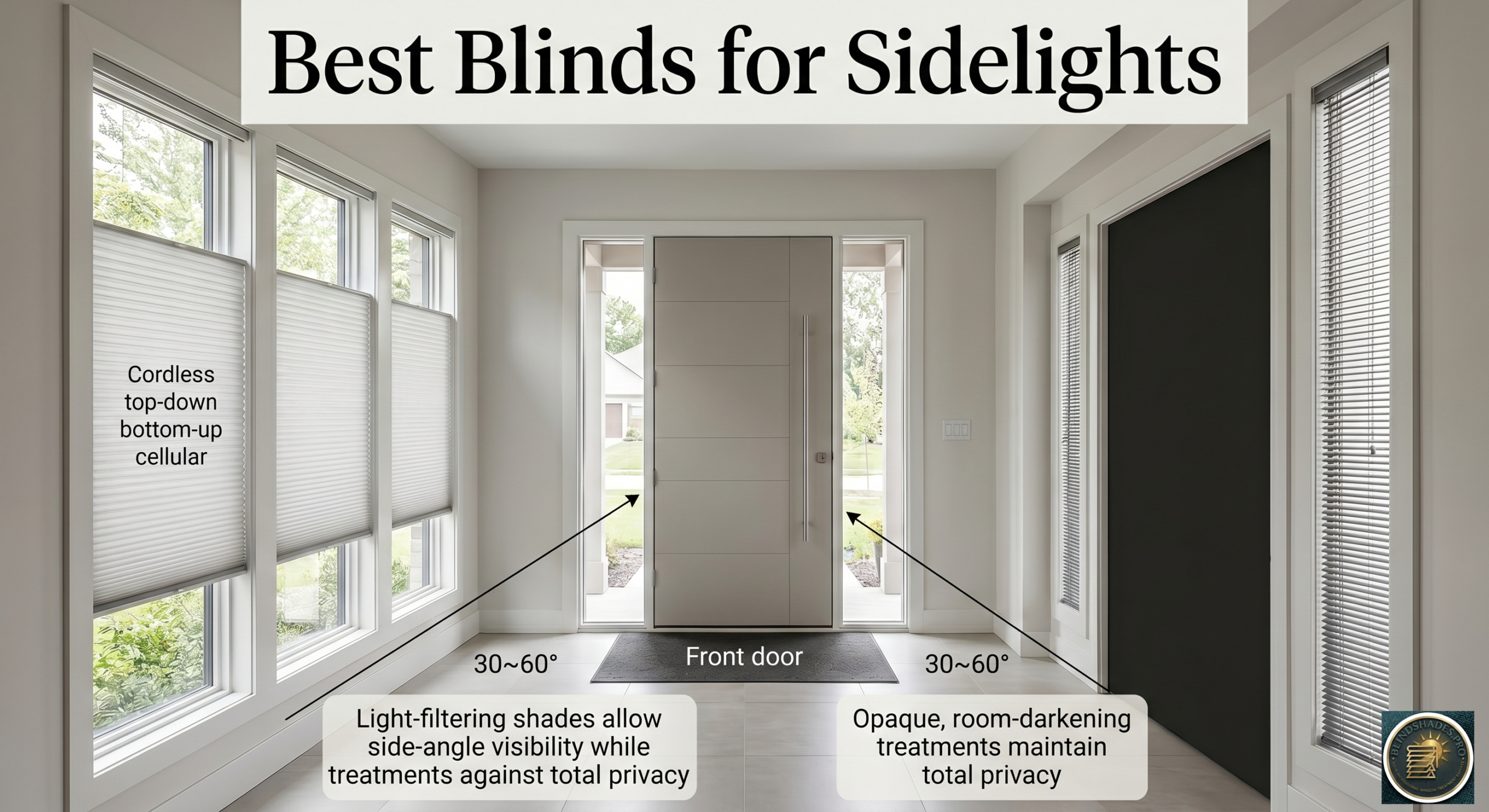
Key Takeaways:
- Most front door sidelights have only 1/2 to 1.5 inches of frame depth – below the 1.5 to 2 inch minimum required for most inside-mount cellular shade hardware; outside mount is the default for the majority of sidelights, not the exception
- Solar shade and light-filtering blind privacy ratings are calibrated for perpendicular viewing; a visitor approaching the door at 30 to 60 degrees sees through the angled weave – specify opaque or room-darkening treatments for true sidelight privacy
- The TDBU cellular shade with hold-down brackets solves the “quick peek” problem: the bottom section stays clipped for privacy while the top panel lowers to see who is at the door without releasing the hold-down clips
- Sidelights narrower than 9 inches can only accommodate a 1-inch aluminium mini blind or window film – cellular shades, roller shades, and plantation shutters have minimum width requirements above 9 to 10 inches
- Two sidelights of different actual widths must be ordered at the narrower measurement for visual symmetry from outside; asymmetric treatments are visible to every visitor who approaches the door
⭐ Quick Answer — What Are the Best Blinds for Sidelights?
- Outside Mount Is the Default — Not the Exception: The most important fact for sidelight blind buyers: most front door sidelights have only 1/2 to 1.5 inches of frame depth — the depth of the door casing — which is below the 1.5 to 2 inch minimum required for most inside-mount cellular shade and roller shade hardware. Standard windows have 3.5 to 4.5 inches of frame depth. Only a 1-inch aluminium mini blind can be reliably inside-mounted on a sidelight frame as shallow as 3/4 inch. Measure your frame depth before ordering any treatment. Below 3/4 inch: outside mount only. 3/4 to 1.5 inches: 1″ mini blind inside mount possible; all other treatments outside mount. Above 1.5 inches: cellular or roller inside mount viable
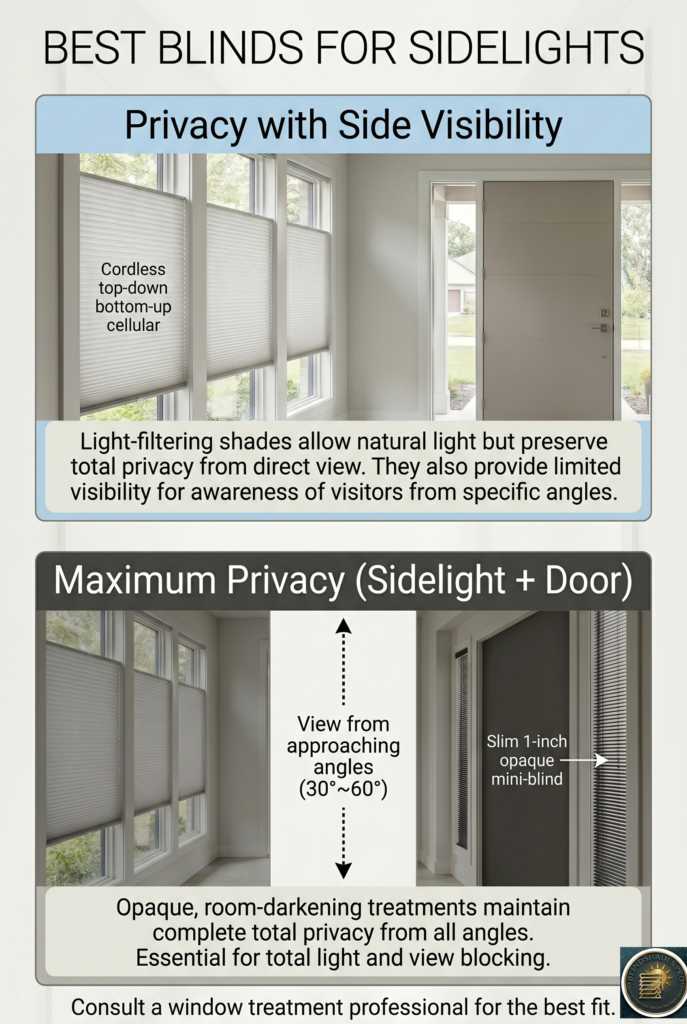
- Solar Shades Fail the Approach-Angle Privacy Test: The second critical fact for sidelight blinds: solar shade privacy ratings are calibrated for perpendicular viewing — the observer standing directly in front of the glass. A visitor approaching the front door walks at 30 to 60 degrees from perpendicular to the sidelight. At this angle, the weave of a solar shade opens up and the effective openness factor increases from 1–3% (rated) to 5–15% or higher — allowing clear interior visibility to anyone on the approach path. A shade that appears private when tested from directly in front is transparent to every delivery driver and visitor approaching at an angle. Specify room-darkening or opaque fabric for any front door sidelight — not solar shade or light-filtering
- The TDBU + Hold-Down Combination — The Definitive Operational Specification: Standard hold-down brackets clip the bottom rail permanently to the sill. Raising the blind requires releasing the clips — too many steps for daily use. The correct specification: TDBU cellular shade with hold-down brackets on the bottom rail. The bottom section stays permanently clipped for privacy. When you want to see who is at the door: lower the TOP panel 6–8 inches from the headrail — this opens a viewing zone at the top of the sidelight while the bottom section remains clipped and private. Hold-down clips are never released in daily operation. The top panel is the only operating element. This is the definitive best blind for sidelight adjacent to an actively used entry door
- The Four Sidelight Types — Each Has Different Treatment Requirements: (1) Full-length (60–80 inches): TDBU cellular + hold-downs; outside mount unless frame depth confirmed above 1.5 inches. (2) Half-height (24–48 inches, at eye level): most privacy-critical — full coverage required; no TDBU split that leaves any portion of an eye-level window exposed. (3) Decorative glass (leaded/etched): no inside-mount blind without covering the glass; outside-mount panel or window film only. (4) Obscure/frosted factory glass: glass already provides visual privacy; light-filtering treatment for glare control only; blackout unnecessary and counterproductive for the foyer’s primary daylight source
- Width Minimums and the Paired Sidelight Symmetry Rule: For very narrow sidelights: 1-inch aluminium mini blind is available as narrow as 6–8 inches; cellular shade minimum is 9–10 inches; roller shade minimum is 10–12 inches. Below 9 inches: only mini blind or window film. For paired sidelights (one each side of the door): if the two openings are slightly different widths (common in older settled frames — typically 1/4 to 1/2 inch difference), order BOTH treatments at the narrower measurement. Asymmetric treatments are visible to every visitor from the street. For motorized paired sidelights: programme both to raise and lower simultaneously
- Best Sources: Custom sidelight sizing and TDBU guide → Blindsgalore sidelights guide · Hold-down bracket installation → Blinds Chalet hold-down guide · TDBU cellular sidelight shades → SelectBlinds cellular range
⚠️ The Entryway Light Warning and the Door-Proximate Test: Before specifying blackout treatments for sidelights, consider that most closed foyers have no windows other than the sidelights — they are the sole source of natural light in the entry hall. A standard 12-by-72-inch sidelight provides approximately 300–600 lux of natural light on a clear day. A blackout treatment fully lowered delivers 0–6 lux — the foyer will require artificial lighting at midday every day. A TDBU cellular shade with the top panel partially open delivers 150–480 lux from the uncovered upper zone, preserving the foyer’s primary daylight while the lower zone provides privacy. Blackout is appropriate for half-height sidelights at maximum privacy zones and for decorative sidelights where aesthetics are the priority over light — not as a default for full-length foyer sidelights. And the door-proximate hold-down test: open and close your front door vigorously. If the sidelight frame moves, the sidelight is structurally connected to the door frame system — hold-down brackets are mandatory on any blind installed there. If the frame does not move, hold-downs are optional (still recommended to prevent HVAC draft swing). Most pre-hung door systems have connected sidelight frames — default to specifying hold-downs on all front door sidelight installations. For the complete sidelight measurement guide including frame depth measurement, width and height at three points, and deductions for inside vs outside mount, see How Do You Measure Sidelights for Blinds. See the full four sidelight type guide below.
💡 The Frame Depth Measurement and the Minimum Width Decision Tree: To confirm whether inside or outside mount is possible for your sidelight blinds, measure frame depth using a tape measure inserted into the window opening from the inside wall surface to the glass face. Record the shallowest point — obstructions like decorative moulding details can reduce usable depth by 3/4 inch or more. Use this decision tree: Below 3/4 inch: outside mount only — no inside-mount treatment fits. 3/4 to 1.5 inches: 1-inch aluminium mini blind inside mount only — all cellular, roller, and plantation shutter inside-mount hardware requires more depth. Above 1.5 inches: cellular shade and roller shade inside mount viable — confirm with supplier’s minimum depth spec for the specific product. Above 2.5 inches: plantation shutter frame system inside mount viable. For the width decision: measure the clear width at the top, middle, and bottom of the opening; use the narrowest measurement for inside mount; add 1.5 to 3 inches to each side for outside mount. If the sidelight is narrower than 9 inches: only 1-inch aluminium mini blind or window film is reliably available — cellular shades, roller shades, and plantation shutters have minimum widths above 9 to 10 inches. For a full comparison of frosted film versus blinds for sidelights including cost, permanence, and privacy ratings at approach angles, see Is Frosted Film Better Than Blinds for Sidelights. See the full frame depth and mount guide below.
📖 Read the complete guide below for: the four sidelight types (full-length / half-height / decorative glass / obscure factory glass) and their different treatment requirements, the frame depth decision tree (below 3/4 inch: outside mount only; 3/4 to 1.5 inches: 1″ mini blind inside mount; above 1.5 inches: cellular viable), the approach-angle privacy failure of solar shades (30–60 degree visitor angle opens weave to 5–15% effective), the TDBU + hold-down combination (bottom permanently clipped; top operates for quick peek without clip release), the minimum width threshold table (mini blind 6–8″; cellular 9–10″; roller 10–12″), the entryway light impact (300–600 lux from sidelight as sole foyer source; blackout requires artificial lighting), the symmetry rule for paired sidelights (order both at narrower measurement), and the door-proximate test for hold-down requirement.
The Best Blinds for Sidelights – The Four Sidelight Types
Definition: A sidelight is a tall, narrow window located immediately beside a front or rear entry door. Sidelights allow natural light into the entryway and enable homeowners to see who is approaching the door. Because they are positioned at eye level directly beside the door, they present a privacy challenge that standard window treatments often cannot adequately solve.
Before selecting any treatment, identify which of the four sidelight types you have – each has different treatment requirements.
Type 1 – Full-Length Sidelight (Most Common)
Dimensions: 60-80 inches tall, 10-16 inches wide. Runs the full height of the door or from sill to header.
Treatment requirements: The standard sidelight specification applies. TDBU cellular shade is the most versatile treatment, allowing the top panel to lower for privacy at the upper zone (where the standing observer sightline enters) while the lower panel provides the option for light entry. Outside mount required if frame depth is below 1.5 inches.
Privacy priority: Moderate to high depending on street proximity and pedestrian traffic.
Type 2 – Half-Height Sidelight
Dimensions: 24-48 inches tall, positioned at eye level on the upper half of the door frame surround.
Treatment requirements: Half-height sidelights are the most privacy-critical type because they are positioned precisely at the 60-66 inch observer eye height. A standing visitor can look directly through the glass at eye level. Standard TDBU configuration is less useful here – cover the full window with an opaque or room-darkening treatment rather than using a top-down or bottom-up configuration that leaves any portion of this eye-level window exposed.
Privacy priority: Maximum – full coverage required for any half-height sidelight that faces a pedestrian-accessible area.
Type 3 – Decorative Glass Sidelight
Dimensions: Any height, featuring leaded glass, etched glass, bevelled glass, or stained glass panels.
Treatment requirements: No standard inside-mount blind can be installed without covering the decorative glass, which defeats its purpose. Options: outside-mount roller shade or panel that covers the glass when privacy is needed and retracts when the decorative glass should be visible; window film (privacy film or frosted film) applied directly to the glass. Most homeowners with decorative glass sidelights choose window film as the primary treatment to preserve the glass’s appearance.
Privacy priority: Typically lower – decorative glass often has inherent obscuring properties; privacy film augments without covering.
Type 4 – Obscure or Frosted Factory Glass Sidelight
Dimensions: Any height. The glass itself is factory-frosted, sandblasted, or obscured – not clear glass.
Treatment requirements: Privacy treatment is not the primary need – the glass itself provides visual privacy. Treatment is needed only for additional light control (reducing glare in the foyer at peak sun hours) or for aesthetic completeness. Light-filtering cellular or roller shade is appropriate. Blackout specification is unnecessary and counterproductive for a foyer that relies on the sidelight for natural light.
Privacy priority: Low – glass provides inherent visual privacy; treatment is supplemental.
The Frame Depth Problem – Why Most Sidelights Need Outside Mount
This is the most commercially significant finding for sidelight buyers and is absent from all competitor guides.
The standard window frame depth: A typical double-hung or casement window has a frame depth (the distance from the inside wall surface to the glass) of 3.5 to 4.5 inches. This comfortably accommodates inside-mount hardware for cellular shades, roller shades, and Venetian blinds.
The sidelight frame depth: A typical front door sidelight surround has a frame depth of only 1/2 inch to 1.5 inches. This is the depth of the door casing and frame – not a full window box.
The hardware minimum requirements:
| Treatment Type | Minimum Inside Mount Depth | Sidelight Frame Depth (typical) | Result |
|---|---|---|---|
| 1-inch aluminium mini blind | 3/4 inch | 1/2 to 1.5 inches | POSSIBLE for frames at 3/4 inch or deeper |
| Cellular shade (standard hardware) | 1.5 to 2 inches | 1/2 to 1.5 inches | FAILS for most sidelights |
| Roller shade (standard hardware) | 1.5 to 2 inches | 1/2 to 1.5 inches | FAILS for most sidelights |
| Plantation shutter (frame system) | 2.5 to 3.5 inches | 1/2 to 1.5 inches | FAILS for most sidelights |
| Outside mount (any treatment) | N/A | N/A | ALWAYS WORKS |
The practical consequence: More than half of all front door sidelight buyers who order inside-mount treatments discover at installation that their frame is too shallow. The treatment protrudes forward from the frame or cannot be installed at all.
The correct approach: Measure the frame depth before ordering any sidelight treatment. Use a tape measure or ruler inside the frame to measure from the inside wall surface (or inside edge of the casing) to the glass surface.
- Below 3/4 inch: outside mount only
- 3/4 inch to 1.5 inches: 1″ mini blind inside mount possible; all other treatments outside mount
- Above 1.5 inches: cellular shade or roller shade inside mount possible (confirm with supplier)
- Above 2.5 inches: plantation shutter inside mount possible
The Approach-Angle Privacy Problem
The single most important privacy insight for sidelight buyers — absent from all competitor guides.
How solar shade privacy ratings work: A solar shade is rated for privacy based on openness factor (1% = 1% open weave) and tested at perpendicular viewing angle (the observer looks straight through the glass from directly in front of it). At perpendicular angle, a 1-3% solar shade provides daytime outside-to-inside privacy.
The sidelight approach angle: A visitor walking up the front path approaches the door at an angle – typically 30 to 60 degrees from perpendicular to the sidelight glass. At this angle:
- The weave of the solar shade fabric opens up from the observer’s perspective
- The apparent openness factor increases from 1-3% to 5-15% or higher depending on weave type
- Interior detail that is not visible through the shade from directly in front is clearly visible from the approach angle
Real-world consequence: A homeowner installs a 1% solar shade on their sidelight and tests it by standing directly in front of the sidelight from outside – it appears private. A delivery driver walking toward the door at 45 degrees can see clearly through the same shade into the entryway.
The correct specification: For any front door sidelight with pedestrian approach from an angle: specify opaque (blackout or room-darkening) fabric, not solar shade or light-filtering. The approach-angle failure eliminates the privacy benefit of semi-transparent treatments at sidelights entirely.
The only appropriate use for a solar shade on a sidelight: rear entry doors with no pedestrian approach angle; or ground-floor sidelights facing a private garden where no oblique-angle observer is present.
The TDBU + Hold-Down Combination
The correct operational specification for sidelights adjacent to an opening door – absent from all guides.
The problem with standard hold-down brackets: Hold-down brackets lock the bottom rail of a blind into fixed clips at the floor or sill level. When the door opens, the blind stays in place rather than swinging with air movement. To raise the blind: the clips must be pinched open to release the bottom rail, then the blind raised, then re-clipped when lowered.
For a homeowner who wants to see who is at the door without opening it, the sequence is: release hold-down clips → raise blind → look → lower blind → re-clip hold-downs. This is too many steps for casual use and results in homeowners leaving the blind raised (defeating the privacy purpose) or the hold-downs unclipped (allowing the blind to swing).
The TDBU solution: A TDBU (top-down bottom-up) cellular shade with hold-down brackets at the bottom rail permanently clips the BOTTOM of the shade to the sill. The bottom section stays private at all times without requiring daily clip management.
When the homeowner wants to see who is at the door: lower the TOP panel from the headrail 6-8 inches. This creates a viewing opening at the TOP of the sidelight – above the height where a standing visitor can see into the home – while the bottom section remains clipped and private.
The hold-down clips are never released during normal daily use. The top panel is the operational element. The bottom section remains permanently private.
This TDBU + hold-down combination is the definitive specification for sidelights adjacent to an actively used entry door.
The Minimum Width Threshold Table
The width limits that determine which treatments are available for very narrow sidelights.
| Treatment | Minimum Width Available | Notes |
|---|---|---|
| 1-inch aluminium mini blind | 6-8 inches | Narrowest treatment category; available from most suppliers at 6 inches minimum |
| Window film (frosted/privacy) | No minimum | Cuts to any width; applied directly to glass |
| Cellular shade | 9-10 inches | Manufacturer-dependent; confirm minimum before ordering |
| Roller shade | 10-12 inches (standard) / 8 inches (specialty sidelight) | Standard systems have 10-12 inch minimums; some sidelight-specific systems reach 8 inches |
| Plantation shutter (custom) | 8-10 inches per panel | Individual louver panels can be as narrow as 8 inches; functional louvers require minimum width |
| Faux wood Venetian blind | 10 inches | Most manufacturers; some systems 12 inches minimum |
| Solar shade | 10-12 inches | Same as roller shade; not recommended for sidelights (approach-angle privacy failure) |
For sidelights narrower than 9 inches: specify 1-inch aluminium mini blind or window film only. All other treatment types have minimum widths above 9 inches that would require special-order sidelight systems.
The Entryway Light Quality Consideration
Why blackout specification is often the wrong choice for sidelights – absent from all guides.
A typical closed foyer or entry hall has no windows other than the front door sidelights. The sidelights are the sole source of natural light in this space.
The lux contribution of a sidelight: A standard 12×72 inch sidelight on a clear day provides approximately 300-600 lux of natural light at the glass. This is the entryway’s only daylight source.
Treatment impact on foyer light:
| Treatment | Transmission | Foyer Lux at Midday | Artificial Light Required? |
|---|---|---|---|
| No treatment | 100% | 300-600 lux | No |
| Light-filtering cellular | 15-25% | 45-150 lux | Possibly in dull weather |
| Room-darkening cellular | 2-5% | 6-30 lux | Yes in most conditions |
| Blackout (fully lowered) | 0-1% | 0-6 lux | Yes at all times |
| TDBU (top panel open 50%) | 50-80% of upper window | 150-480 lux | Rarely |
The practical recommendation: For sidelights as the sole foyer light source: TDBU cellular shade with the top panel in the lowered position for privacy and the bottom portion allowing residual light, OR light-filtering cellular in the raised (open) position during daytime. Blackout specification means the foyer requires artificial lighting during daylight hours – an energy cost and aesthetic compromise most homeowners do not anticipate when ordering blackout sidelight treatments.
The Symmetry Rule for Paired Sidelights
A home with two sidelights (one each side of the front door) must have both treatments specified at the same dimensions, even if the actual sidelight openings are slightly different sizes.
Why sidelights vary: Older homes with settled door frames often have one sidelight slightly different from the other – typically 1/4 to 1/2 inch difference in width after decades of frame movement.
The visual consequence: Treatments ordered to different widths create a visibly asymmetric entryway facade – one treatment slightly narrower or taller than the other. This is visible to every visitor from the street.
The correct approach: Measure both sidelights. If dimensions differ, order BOTH treatments at the smaller of the two measurements. A treatment slightly smaller than the opening is less visible than asymmetric treatments.
For motorized paired sidelights: Programme both motors to a single scene – “Entry Mode” raises both simultaneously; “Privacy Mode” lowers both simultaneously. Staggered operation (one up, one down) at the entry creates an asymmetric appearance that is visible from outside.
The Door-Proximate vs Wall-Mounted Sidelight
The simple test to determine if hold-down brackets are required:
- Open and close the front door vigorously several times
- Observe the sidelight frame and glass
If the sidelight frame moves: The sidelight is structurally connected to the door frame system. Door movement vibrates the frame and will cause any installed blind to swing. Hold-down brackets are mandatory.
If the sidelight frame does not move: The sidelight is independently wall-mounted. Door movement does not reach the blind. Hold-down brackets are optional (still recommended to prevent swing from HVAC air movement in the entryway, but not structurally required).
Most front door sidelights that are part of a pre-hung door system ARE connected to the door frame and DO move slightly – hold-down brackets are the default specification for all door-proximate sidelight installations.
Where to Order
For TDBU cellular sidelight shades (primary specification for full-length sidelights): SelectBlinds cellular shade range at selectblinds.com/cellular-shades — specify: TDBU, cordless, room-darkening or blackout fabric, outside mount unless frame depth confirmed above 1.5 inches, hold-down brackets, width matched to the narrower of paired sidelights.
For the comprehensive sidelight treatment guide including custom sizing: Blindsgalore sidelights page at blindsgalore.com/sidelights — 100% custom-built to exact sidelight measurements; covers TDBU, roller shade, and plantation shutter options with minimum width guidance.
For hold-down bracket installation guidance: Blinds Chalet hold-down bracket guide at blindschalet.com covers the bracket installation process for door-adjacent sidelight and door-mounted blind applications.
Frequently Asked Questions
What are the best blinds for sidelights? The best blinds for sidelights are cordless TDBU cellular shades for full-length sidelights 9 inches wide or wider, and 1-inch aluminium mini blinds for sidelights narrower than 9 inches. Specify outside mount unless the frame depth is confirmed above 1.5 inches, which most sidelights do not have. For front door sidelights at eye level: specify room-darkening or opaque fabric rather than solar shade or light-filtering, because solar shade privacy ratings are calibrated for perpendicular viewing and fail at the 30 to 60 degree approach angle of a visitor walking toward the door.
Why do most sidelight blinds need outside mount? Most front door sidelights have only 1/2 to 1.5 inches of frame depth – the depth of the door casing – which is below the 1.5 to 2 inch minimum required for most inside-mount cellular shade and roller shade hardware. Only 1-inch aluminium mini blinds can be reliably inside-mounted on frames as shallow as 3/4 inch. Measure the frame depth before ordering any treatment. If below 1.5 inches, specify outside mount from the start rather than discovering the limitation at installation.
Do sidelight blinds need hold-down brackets? Yes – for sidelights adjacent to an actively used door, hold-down brackets are required to prevent the blind from swinging when the door opens and closes. Test whether your sidelight is door-proximate by opening and closing the front door vigorously and observing whether the sidelight frame moves. If it does, hold-down brackets are mandatory. The most functional combination is a TDBU cellular shade with hold-downs on the bottom rail – the bottom section stays permanently clipped while the top panel operates freely for daily light adjustment and quick visual checks without releasing the hold-downs.
Can solar shades provide privacy for sidelights? No – solar shades do not provide reliable privacy for front door sidelights. Solar shade privacy ratings are tested at perpendicular viewing angle. A visitor approaching the door at 30 to 60 degrees from the sidelight glass sees through the angled weave at a higher effective openness than the perpendicular rating suggests. A 1 to 3 percent solar shade that appears private from directly in front may allow clear interior visibility to someone approaching at an angle. Specify room-darkening or opaque treatments for any front door sidelight where privacy from a pedestrian approach angle is required.
How narrow can sidelight blinds be ordered? 1-inch aluminium mini blinds can be ordered as narrow as 6 to 8 inches depending on the manufacturer – the narrowest treatment available for sidelights. Cellular shades have a minimum width of approximately 9 to 10 inches. Standard roller shades have a minimum width of approximately 10 to 12 inches, though some sidelight-specific systems reach 8 inches. Plantation shutters have a minimum panel width of approximately 8 to 10 inches. For sidelights narrower than 9 inches, only 1-inch aluminium mini blind or window film applied directly to the glass are reliably available options.
Related Guides on BlindShades.pro
- The Best Sidelights and Front Door Blinds Buying Guide
- How Do You Measure Sidelights for Blinds
- What Is the Best Privacy Treatment for Front Door Sidelights
- Is Frosted Film Better Than Blinds for Sidelights
- Can You Put Plantation Shutters on Sidelights
By Michael Turner | 30 Years Home Improvement Expertise | Updated 2026 | BlindShades.pro
