What Blinds Work Best for Angled Bay Window Side Panels?

Authored By Michael Turner -30 Years Home Improvement Expertise | Updated 2026 | BlindShades.pro
Updated on June 4, 2026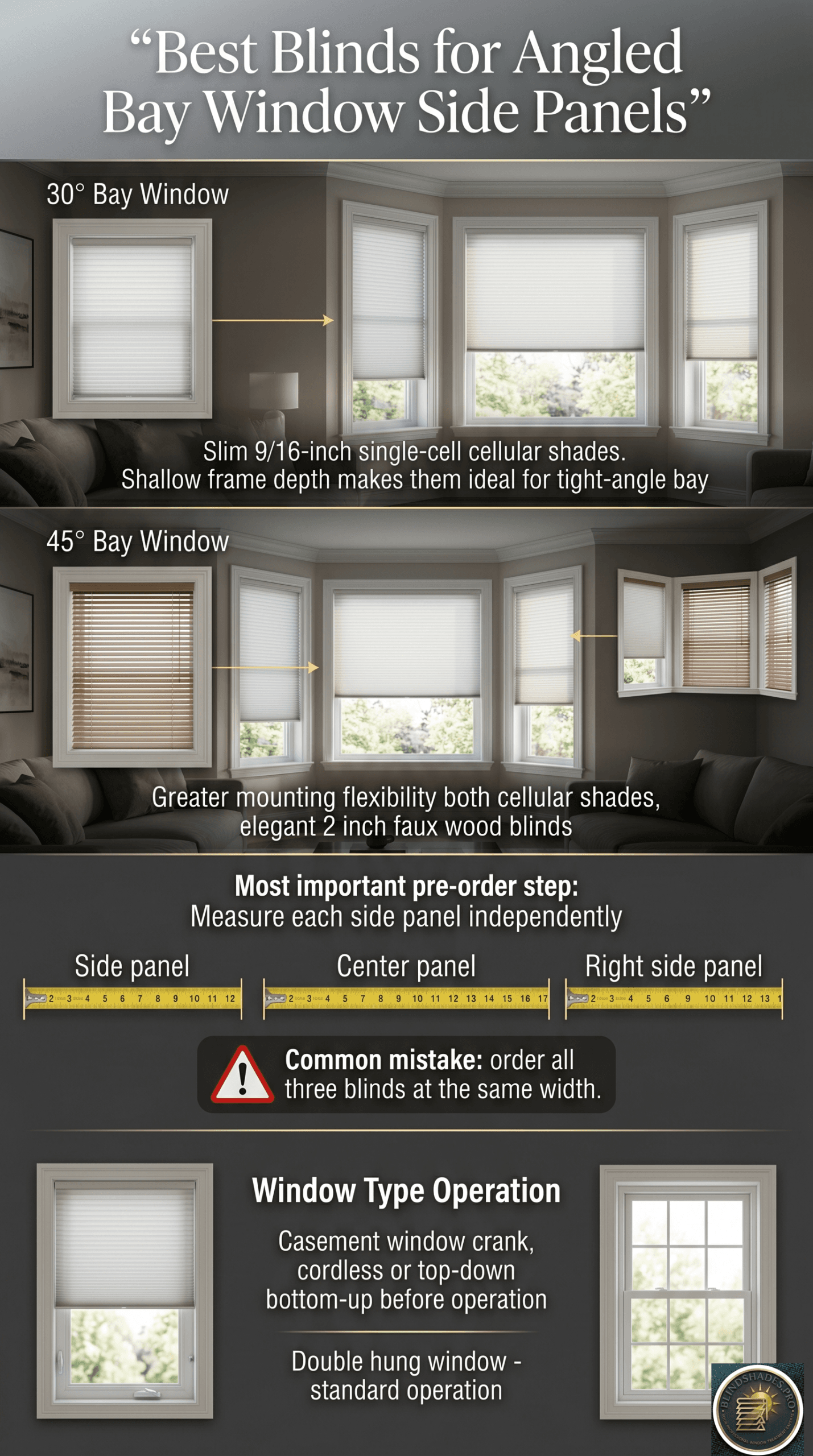
Key Takeaways:
- Bay window side panels are narrower than the center panel; never order all three panels at the same width; a homeowner who measures the center panel at 36 inches and orders three identical 36-inch blinds will have side panel blinds that are too wide to fit in the narrower side panel frames; measure each panel individually and record three separate width measurements
- The treatment depth constraint at the side panels depends on the bay angle: at a 30-degree bay, the side panel frame depth is typically only 1.5 to 2 inches, limiting treatment options to 1-inch aluminum mini blinds (30mm headrail depth) and slim single-cell cellular shades (35 to 40mm headrail depth); standard 2-inch faux wood blinds with a 55 to 70mm headrail do not fit in most 30-degree bay side panels; at a 45-degree bay, the frame depth is typically 2 to 3.5 inches and cellular shades, Roman shades, and most faux wood blinds are viable
- Bay window side panels are typically casement windows that open by cranking outward; an inside-mount treatment on a casement side panel must be raised or retracted before the casement can be cranked open; specify cordless lift or top-down bottom-up cellular shades for any bay window side panel that must open for ventilation; permanently mounted or inoperable treatments on casement side panels prevent the window from opening
- When measuring angled bay window side panels, deduct the mullion width from each side of the measurement; a mullion is the vertical structural framing member between adjacent bay panels; if measured mullion-center to mullion-center, the blind will be ordered too wide by the mullion width and will not fit inside the frame; measure from the inside edge of one frame member to the inside edge of the opposite frame member
- A panel track system specifically designed for bay windows uses angle bracket connectors set to 135 degrees for a 45-degree bay (because 180 minus 45 = 135 degrees interior angle) or 150 degrees for a 30-degree bay; this is the only continuous-track treatment that spans all three bay window panels in one coordinated system while accommodating the angle change at each side panel junction
⭐ Quick Answer — What Blinds Work Best for Angled Bay Window Side Panels?
- The 30-Degree vs 45-Degree Depth Guide — Which Blinds Actually Fit: The correct specification for angled bay window blinds depends on the bay angle because the angle determines the available frame depth at the side panel positions. 30-degree bay side panels: frame depth typically 1.5 to 2 inches (35–61 cm confirmed by Dimensions.com); only 1-inch aluminum mini blinds (30mm headrail depth) and 9/16-inch single-cell cellular shades (35–40mm headrail depth) fit reliably; 2-inch faux wood blinds (55–70mm headrail) do NOT fit in most 30-degree bay side panels. 45-degree bay side panels: frame depth typically 2 to 3.5 inches; cellular shades, Roman shades (45mm rail), and standard 2-inch faux wood blinds are all viable after confirming headrail clearance with the cardboard test. LazBlinds confirms: “buy standard off-the-shelf blinds with thick headrails and the top headrails will bump into each other in the corners, leaving you with crooked blinds and massive light gaps”
- The Most Common Ordering Mistake — Never Order All Three at the Center Panel Width: For angled bay window blinds, the most costly ordering error is measuring the center panel and ordering all three blinds at that width. Bay window side panels are narrower than the center panel. The center panel (typically a large fixed picture window) may be 36 to 48 inches wide. The side panels angle away from the wall and are typically only 12 to 24 inches wide. A homeowner who measures 36 inches at the center and orders three identical 36-inch blinds will receive side panel blinds that cannot fit in the narrower side panel frames. LazBlinds confirms each panel must be measured separately. Also confirm height: side panels are often 4 to 12 inches shorter than the center panel; ordering all three at center panel height produces side blinds too tall for the frame
- The Mullion Deduction and the Casement Rule: Two measurement and specification details essential for angled bay window blinds. (1) Mullion deduction: at each junction between the center panel and a side panel, a mullion (vertical structural frame member, typically 3/4 to 1.5 inches wide) separates the glass areas. Measure from the inner face of the mullion to the inner face of the outer frame member — not from the mullion centerline. Rebarts confirms: “you must account for the vertical framing parts between panels (mullions) or you’ll end up with gaps or overlapping.” Measuring from the mullion center adds approximately half the mullion width to the measurement, resulting in a blind ordered too wide. (2) Casement rule: bay window side panels are typically casement windows that crank outward; an inside-mount angled bay window blind must be raised before the casement can open; specify cordless lift or TDBU cellular shades; a stationary treatment prevents ventilation
- The Slat Tilt Visual Inconsistency for Faux Wood Blinds in Side Panels: When a 2-inch faux wood horizontal blind is installed in a 45-degree bay window side panel, the entire blind is mounted at 45 degrees to the main wall — because the side panel frame faces 45 degrees. From inside the room, the slats of the side panel blind appear to face at a different angle than the slats of the center panel blind, even when all three blinds are set to the same nominal tilt position. The side blinds appear visually rotated relative to the center blind. Treatments that avoid this visual inconsistency: cellular shades (no slats to compare); Roman shades (fabric panels; no slat angle); vertical blinds (slats hang vertical regardless of panel orientation); roller shades (flat fabric; no tilt). For rooms where visual uniformity from the primary seating position is important, specify cellular or Roman shades for the side panels rather than faux wood blinds
- The Panel Track 135-Degree Angle — The Only Continuous-Track Treatment for All Three Panels: For angled bay window blinds in a coordinated continuous system, panel track is the only treatment spanning all three sections in one unified track. The Shade Store confirms: “a panel track system designed especially for bay windows features a center section and two side sections installed at a 135-degree angle to the center. This setup fits most bay window applications.” The angle calculation: 45-degree bay = interior angle at side panel junction = 180 minus 45 = 135 degrees. 30-degree bay = 180 minus 30 = 150 degrees. 90-degree box bay = 180 minus 90 = 90 degrees. This bracket angle connects the center track and side tracks so vertical vane panels traverse continuously across all three sections, eliminating the corner gap problem of individual treatments
- Best Sources: Inside mount strategy with headrail collision prevention guide → LazBlinds bay window guide · Professional measurement including mullion accounting → Rebarts bay window shades · Panel track 135-degree system for bay windows → The Shade Store bay window blinds
⚠️ The Complete Treatment Selection Chart for Angled Bay Window Side Panels: For angled bay window blinds by bay angle: 30-degree side panel (frame depth 1.5 to 2 inches) — best specification: 9/16-inch single-cell cellular shade (35 to 40mm headrail); acceptable: 1-inch aluminum mini blind (30mm) and pleated shade (35mm); not recommended: 2-inch faux wood blind (55 to 70mm; does not fit), Roman shade (45mm; tight), vertical blind (70mm; too deep), plantation shutter (90 to 120mm; far too deep). 45-degree side panel (frame depth 2 to 3.5 inches) — best specification: 9/16-inch cellular shade or 2-inch faux wood blind; acceptable: Roman shade (45mm), double-cell cellular (50mm), pleated shade (35mm); check before ordering: double-hung vs casement (casement requires TDBU or cordless); plantation shutter (90 to 120mm; unlikely to fit most 45-degree side panels); not recommended: vertical blind (70mm; check depth). 90-degree box bay side panel (frame depth 3 to 5 inches) — any treatment works including plantation shutters; no angle-related depth constraint. Double-hung vs casement side panel note: if the side panels are double-hung windows (sashes lift upward), any treatment is compatible with window operation. If the side panels are casements (crank outward), specify TDBU or cordless lift only to ensure the treatment can be raised before the window opens. For the cardboard headrail clearance test that verifies whether the intended treatment will fit at the angled bay window corner, see What Are the Best Blinds for Bay Windows. See the full depth chart below.
💡 The Measurement Protocol for Angled Bay Window Side Panels: Measuring angled bay window blinds correctly requires five steps specific to side panels. (1) Identify the bay angle (30, 45, or 90 degrees) to determine which treatments fit the available depth. (2) Measure each panel width independently at top, middle, and bottom of the frame; use the narrowest reading; the side panels will be a different width than the center panel. (3) Deduct for the mullion: measure from the inner face of the mullion to the inner face of the outer frame member, not from the mullion centerline; the mullion is typically 3/4 to 1.5 inches wide. (4) Measure each panel height independently; side panels may be 4 to 12 inches shorter than the center panel. (5) Confirm the casement or double-hung type: if casements, specify TDBU or cordless lift; if double-hung, any standard treatment is compatible. Record all six measurements (three-point width and height per panel) for all three panels separately before ordering. Do not assume any two panels are the same size. BuyHomeBlinds confirms “center panel and side panel may have different depths of sill; do not ever think they are alike.” The complete cardboard template method for confirming headrail clearance, the obstruction addition formula, and the four-template vs two-template accuracy comparison are in the full measuring protocol article: How Do You Measure a Bay Window for Blinds. See the full measurement protocol below.
📖 Read the complete guide below for: the 30-degree vs 45-degree bay side panel depth comparison (30-degree: 1.5 to 2 inches, slim cellular or mini blind only; 45-degree: 2 to 3.5 inches, faux wood and Roman viable), the full headrail depth chart by treatment type (mini blind 30mm through plantation shutter 90 to 120mm), the side panel width ordering error and why panels are narrower than the center, the mullion deduction step (inner face measurement; 3/4 to 1.5-inch mullion width correction), the side panel height difference (may be 4 to 12 inches shorter than center), the casement vs double-hung treatment compatibility distinction, the slat tilt visual inconsistency for faux wood blinds in angled side panels, the panel track 135-degree angle bracket specification (180 minus bay angle), and the treatment selection summary by 30/45/90-degree bay angle.
Angled Bay Window Blinds — The 30-Degree vs 45-Degree Treatment Guide
The specific installation parameters that differ between the two most common bay angles — absent from all competitor guides.
Bay window side panels sit at either 30 or 45 degrees from the main wall of the house. This angle determines the available frame depth for inside-mount treatments — and the frame depth is the single most limiting factor for angled bay window blind selection.
The 30-degree bay side panel:
- Interior angle between center panel and side panel: 150 degrees
- Side wall projection depth: approximately 1’2″ to 1’6″ (35–46 cm) based on Dimensions.com
- Frame recess depth at the corner: typically 1.5 to 2 inches — the tightest of any bay configuration
- Treatment options: slim-profile treatments only
The 45-degree bay side panel:
- Interior angle between center panel and side panel: 135 degrees
- Side wall projection depth: approximately 1’6″ to 2′ (46–61 cm)
- Frame recess depth at the corner: typically 2 to 3.5 inches — wider than 30-degree bays
- Treatment options: broader range available
Why depth differs by angle: A shallower bay angle (30 degrees) projects less far from the wall, producing a narrower side wall and a tighter corner junction between adjacent treatments. A steeper bay angle (45 degrees) projects further, producing a wider side wall and more corner clearance for adjacent headrails.
The Treatment Depth Guide by Bay Angle
The specific headrail depth compatibility chart by bay angle — absent from all competitor guides.
Swift Direct Blinds confirms the headrail depths for common treatment types: aluminum Venetian (1-inch) = 30mm rail; Roman blind = 45mm rail; pleated blind = 35mm rail; vertical blind = 70mm rail.
| Treatment | Headrail Depth | 30° Side Panel | 45° Side Panel | Center Panel |
|---|---|---|---|---|
| 1-inch aluminum mini blind | 30mm (1.2 inches) | ✅ Most reliable fit | ✅ | ✅ |
| 9/16-inch single cell cellular shade | 35–40mm (1.4–1.6 inches) | ✅ Fits most 30° bays | ✅ | ✅ |
| Pleated shade | 35mm (1.4 inches) | ✅ | ✅ | ✅ |
| Roman shade | 45mm (1.8 inches) | ⚠️ Tight; check depth first | ✅ | ✅ |
| 3/4-inch double cell cellular shade | 50mm (2 inches) | ⚠️ Tight; check depth first | ✅ | ✅ |
| 2-inch faux wood blind | 55–70mm (2.2–2.8 inches) | ❌ Does not fit most 30° bays | ✅ Fits most | ✅ |
| Vertical blind | 70mm (2.8 inches) | ❌ | ⚠️ Check depth | ✅ |
| Plantation shutter | 90–120mm (3.5–4.5 inches) | ❌ | ❌ Most bays | ✅ with sufficient depth |
The conclusion: For 30-degree bay window side panels: specify 9/16-inch cellular shades or 1-inch aluminum mini blinds only. Do not specify 2-inch faux wood blinds — they will not fit the corners. For 45-degree bay window side panels: cellular shades, Roman shades, and standard 2-inch faux wood blinds are all viable. Run the cardboard headrail test (Article 43-2) before ordering to confirm.
The Side Panel Width Measurement Error
The most common angled bay window blind ordering mistake — absent from all guides.
A bay window side panel is narrower than the center panel. The center panel is typically the largest glass area in the bay (often 24 to 48 inches wide). The side panels angle away from the wall and are typically narrower in glass width (often 12 to 24 inches wide).
The mistake: A homeowner measures the center panel at 36 inches wide and assumes all three panels are the same size. They order three identical 36-inch blinds. The side panels are 20 inches wide. The 36-inch blinds do not fit in the 20-inch side panel frames.
The correct protocol: LazBlinds confirms: “Inside mount prevents the headrails from protruding and colliding… each panel needs to be measured separately.”
Measure each panel independently:
- Left side panel: measure at top, middle, and bottom inside the frame; use narrowest reading
- Center panel: measure at top, middle, and bottom inside the frame; use narrowest reading
- Right side panel: measure at top, middle, and bottom inside the frame; use narrowest reading
Order each panel at its own measured width. The three panels will typically be different sizes.
The Mullion Deduction Step
The measurement step that prevents side panel blinds from being ordered too wide — absent from all guides.
Rebarts confirms: “You must also account for the vertical framing parts between panels (mullions), or you’ll end up with gaps or overlapping.”
A mullion is the vertical structural framing member between adjacent bay panels. It has a specific width — typically 3/4 to 1.5 inches. When measuring the side panel width, measure from the INSIDE edge of the mullion (the edge that contacts the glass on the center panel side) to the INSIDE edge of the outer frame member.
The common measurement error: Measuring from the centerline of the mullion to the outside frame: this adds approximately half the mullion width to each side measurement.
Example:
- Mullion width: 1 inch
- Measurement taken from mullion center to outer frame: 21 inches
- Correct inside-frame measurement: 21 – 0.5 (half of 1-inch mullion) = 20.5 inches
- If ordered at 21 inches: blind is 0.5 inch too wide; does not fit flush in inside mount
The correct measurement: Place the tape measure at the inner face of the mullion (the edge facing the glass area) and measure to the inner face of the outer frame. This is the usable inside-mount width.
The Side Panel Height Difference
The height measurement difference that causes misaligned bottom rails — absent from all guides.
Bay window side panels are frequently shorter in glass height than the center panel. The center panel (a picture window or large fixed panel) may be 48 to 60 inches tall. The side panels (casement or double-hung windows) may be only 36 to 48 inches tall.
The consequence: A homeowner orders all three panels at 48 inches (center panel height). The side panels are only 40 inches tall. The 48-inch blinds cannot fit in the 40-inch frame. They must be cut down or replaced.
The correct protocol: Measure the height of each panel independently. Never assume all three panels are the same height. If heights differ:
- Order each panel at its own height
- Confirm with the supplier that mixed-height orders within a set are acceptable
The Casement vs Double-Hung Side Panel Distinction
The operational constraint specific to casement bay window side panels — absent from all guides.
Bay window side panels are typically one of two window types:
- Casement windows: hinged on the outer edge; open by cranking outward away from the room
- Double-hung windows: sashes that slide up and down vertically in the frame
Why this matters for treatment selection:
For casement side panels: An inside-mount treatment must be raised or retracted before the casement sash can be cranked open for ventilation. A stationary or inoperable treatment prevents the window from opening at all.
- Specify: cordless lift cellular shade, TDBU cellular shade, or motorized shade
- Do NOT specify: stationary treatments, permanently mounted valances without operable blinds beneath
For double-hung side panels: The sash lifts upward inside the frame. An inside-mount treatment mounted at the top of the frame does not obstruct the sash — the sash lifts past the treatment rail.
- Any standard treatment works for double-hung side panels
- The blind remains in place during window operation
How to confirm which type the side panels are: Casement side panels have a crank handle (typically at the bottom or side of the frame) and a hinge along one vertical edge. Double-hung side panels have a lift rail at the bottom and a locking mechanism at the center meeting rail.
The Slat Tilt Visual Inconsistency
The aesthetic issue with faux wood blinds in angled side panels — absent from all competitor guides.
When a 2-inch faux wood horizontal blind is installed in a 45-degree bay window side panel, the entire blind is mounted at 45 degrees to the main wall — because the side panel frame is at 45 degrees to the wall.
The visual effect from inside the room: The slats of the side panel blind face toward the angled wall direction (45 degrees from the main room axis). When the slats are “closed” in the side panel position, they close perpendicular to the 45-degree glass plane.
The slats of the center panel blind face straight forward (0 degrees). When the center panel slats close, they close perpendicular to the center glass.
The result: From inside the room, the side panel blinds and the center panel blind appear to have slats at different angles even when all three blinds are set to the same nominal tilt position. The side blinds appear rotated relative to the center blind.
Treatments that avoid this visual inconsistency:
- Cellular shades (no slats to compare angles)
- Roman shades (fabric panels; no slat angle)
- Vertical blinds (the slats hang vertical regardless of panel orientation)
- Roller shades (flat fabric; no tilt)
For rooms where visual uniformity is important: Specify cellular or Roman shades rather than faux wood blinds for the angled bay window side panels to avoid the slat angle inconsistency from the primary viewing position.
The Panel Track Angle System
The only continuous-track treatment for all three bay window panels — absent from all guides.
The Shade Store confirms: “Vertical Blinds are made of panels of material that run on a track system for easy functionality. To use them as bay window blinds, you can choose a panel track system designed especially for bay windows, which features a center section and two side sections installed at a 135-degree angle to the center. This setup fits most bay window applications.”
The angle calculation:
- For a 45-degree bay window: interior angle between center and side section = 180° – 45° = 135 degrees
- For a 30-degree bay window: interior angle between center and side section = 180° – 30° = 150 degrees
- For a 90-degree box bay: interior angle = 180° – 90° = 90 degrees
How panel track connects the angled side sections: The panel track system uses adjustable angle bracket connectors at each junction between the center track and each side track. These brackets are pre-set or adjustable to the required interior angle. The vane panels (fabric louvers) traverse across all three sections in a continuous path.
The key advantage: Panel track is the only treatment that provides a single coordinated track system across all three panels of a bay window. Each panel operates continuously with the others. For rooms where unified bay window treatment is the priority, panel track achieves this without the corner gap issues of individual treatments.
The limitation: Panel track vertical vanes cannot be tilted the same way horizontal blind slats can. Light control is primarily through the open/closed traverse position rather than through slat tilt angle.
Treatment Selection Summary by Bay Angle
| Bay Type | Best for Side Panels | Acceptable | Not Recommended |
|---|---|---|---|
| 30-degree bay side panel | 9/16″ single-cell cellular shade; 1″ mini blind | Pleated shade (35mm rail) | 2″ faux wood blind; Roman shade (tight) |
| 45-degree bay side panel | 9/16″ cellular; 2″ faux wood blind; Roman shade | Double cell cellular; plantation shutter (check depth) | Vertical blind (70mm rail; often too deep) |
| 90-degree box bay side panel | Any treatment; full range | All options | None (no angle depth constraint) |
Where to Order
For inside mount bay window blinds with collision-prevention guide: LazBlinds at lazblinds.com/the-ultimate-guide-to-dressing-bay-windows-stop-the-awkward-gaps-and-collisions — definitive inside mount strategy; headrail collision prevention; individual panel measurement protocol.
For professional bay window measurement including mullion accounting: Rebarts at rebarts.com/blog/discover-blinds-and-window-shades-for-bay-windows — mullion accounting; custom measurement per panel; treatment fitting guidance for narrow angled side panels.
For panel track bay window system with 135-degree angle bracket: The Shade Store at theshadestore.com/blog/bay-window-blinds — panel track system designed for bay windows; 135-degree angle for most bay window applications; layering shades with drapery.
Frequently Asked Questions
What blinds work best for angled bay window side panels? The best blinds for angled bay window side panels depend on the bay angle. For 30-degree bay side panels where the frame depth is typically only 1.5 to 2 inches: 9/16-inch single-cell cellular shades with a 35 to 40mm headrail are the primary correct specification; 2-inch faux wood blinds with a 55 to 70mm headrail do not fit in most 30-degree bay side panel frames. For 45-degree bay side panels where the frame depth is typically 2 to 3.5 inches: cellular shades, Roman shades, and standard 2-inch faux wood blinds are all viable after confirming headrail clearance with the cardboard test.
Why should you never order all three bay window panels at the same size? Bay window side panels are typically narrower than the center panel, and often shorter in height as well. The center panel is the largest glass area in the bay and may be 36 to 48 inches wide. The side panels angle away from the wall and are typically 12 to 24 inches wide. Ordering all three panels at the center panel width produces side panel blinds that are too wide to fit in the narrower side panel frames. LazBlinds confirms each panel must be measured separately because the dimensions differ across the three sections.
What is the mullion deduction when measuring angled bay window side panels? A mullion is the vertical structural framing member between adjacent bay panels. When measuring the side panel width for inside-mount blinds, measure from the inner face of the mullion to the inner face of the outer frame member, not from the centerline of the mullion outward. Measuring from the mullion centerline adds approximately half the mullion width to the measurement, causing the blind to be ordered too wide. Rebarts confirms that failing to account for the mullion results in gaps or overlapping at the junction between adjacent panels.
Does the bay window side panel being a casement affect blind selection? Yes. Bay window side panels are often casement windows that open outward by cranking. An inside-mount blind on a casement side panel must be raised or retracted before the casement can open. Specifying cordless lift or top-down bottom-up cellular shades ensures the treatment can be moved out of the casement’s operating path. A permanently mounted stationary treatment on a casement side panel prevents the window from opening for ventilation.
What is the panel track angle for a bay window? For a 45-degree bay window, the panel track angle bracket at each side panel junction is set to 135 degrees — calculated as 180 degrees minus 45 degrees. For a 30-degree bay window, the bracket is set to 150 degrees. The Shade Store confirms the 135-degree angle bracket setup fits most bay window applications. This angle bracket allows the panel track’s center section and side sections to connect at the correct interior angle, creating a continuous track system across all three panels of the bay.
Related Guides on BlindShades.pro
- The Best Bay Window Blinds & Shades Buying Guide
- What Are the Best Blinds for Bay Windows
- How Do You Measure a Bay Window for Blinds
- Can You Put One Blind Across a Bay Window
- Are Cellular Shades Good for Bay Windows
By Michael Turner | 30 Years Home Improvement Expertise | Updated 2026 | BlindShades.pro
