How Do You Measure a Skylight for Blinds?

Authored By Michael Turner -30 Years Home Improvement Expertise | Updated 2026 | BlindShades.pro
Updated on June 5, 2026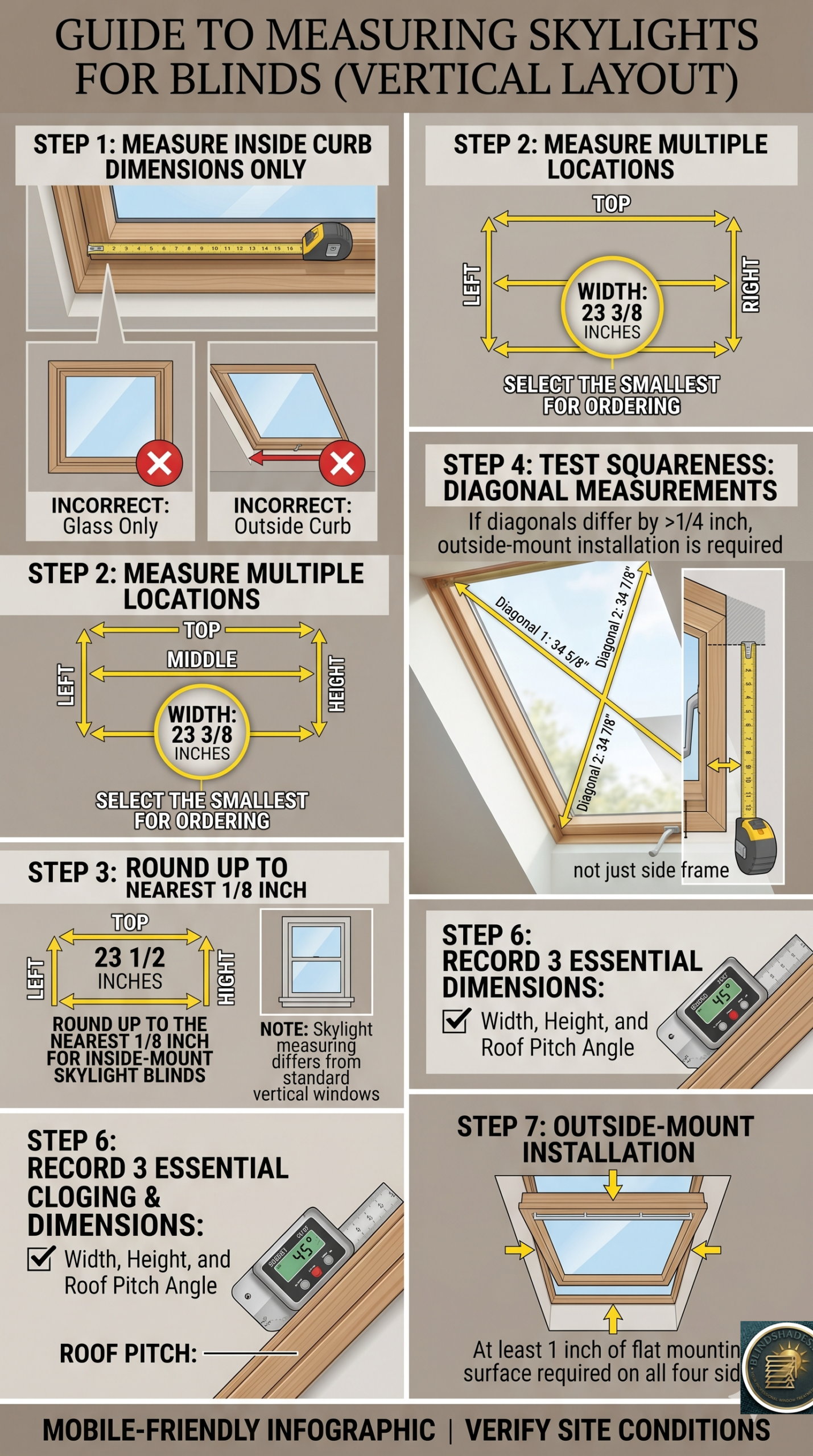
Key Takeaways:
- For skylight inside mount, round UP to the nearest 1/8 inch — this is the OPPOSITE of the rule for standard vertical window blinds where you round down; Home Depot’s skylight measurement guide confirms this reversal because the factory takes deductions from skylight shades for the rail seal foam tape; rounding down produces a shade that is too small after factory deductions are applied
- Three dimensions are required when ordering a skylight blind — not two; in addition to width and height, you must include the roof pitch angle in your order; the shade’s side track mechanism and tension calibration are configured for the specific installation angle; ordering without angle information produces a shade that cannot be correctly set up; common angles: 4/12 pitch = 18 degrees; 6/12 pitch = 27 degrees; 8/12 pitch = 34 degrees; 12/12 pitch = 45 degrees
- When measuring a skylight, always measure the inside curb dimensions (from the inner face of the frame on one side to the inner face on the opposite side) — not the visible glass area and not the outside curb size; the visible glass is inset within the frame and measures smaller than the inside curb by 0.5 to 2 inches per side; the outside curb is used for skylight replacement and is larger than the inside curb by 1 to 3 inches per side
- Run the diagonal squareness check before ordering: measure from the top-right corner to the bottom-left corner, then from the top-left corner to the bottom-right corner; if the two measurements differ by more than 1/4 inch, the skylight frame is out-of-square and the side track system will not fit inside the frame; specify outside mount or shim the frame before installing an inside-mount shade
- When measuring inside frame depth for a ventilating skylight, measure at the window crank or handle position, not just at the frame sides; a window crank typically protrudes 0.5 to 1.5 inches into the frame from the sill; the effective available depth is the frame depth minus the crank protrusion; if this leaves less than 1.25 inches available, neither manual nor motorized inside-mount shades can be installed without modification
⭐ Quick Answer — How Do You Measure a Skylight for Blinds?
- Measure the Inside Curb — Not the Visible Glass or the Outside Curb: When measuring skylight blinds, always measure the inside curb dimensions — from the inner face of the frame on one side to the inner face on the opposite side. A skylight has three distinct measurable sizes that are easily confused. (1) Visible glass (too small): the glass is inset within the frame; a shade ordered at glass size will leave visible gaps between the shade edge and the frame. (2) Inside curb dimensions (correct): the opening from inner frame face to inner frame face — typically 0.5 to 2 inches larger per side than the visible glass; this is the correct measurement for inside-mount skylight blinds. (3) Outside curb size (too large): the external dimensions of the raised curb structure used for skylight replacement orders — typically 1 to 3 inches larger per side than the inside curb. Blinds.com confirms: “measure from edge to edge inside the window opening at the spots where you plan to place the mounting brackets”
- Round UP — Not Down — for Skylight Inside Mount (Opposite to Standard Windows): The critical rounding rule for skylight blind measurement is the reverse of every other window blind: round UP to the nearest 1/8 inch for skylight inside mount. Home Depot’s measurement guide confirms: “While most other inside mounted products requires you to round down, you should round skylight measurements for inside mounts up to the nearest 1/8 inch. Deductions will be taken from your product that will allow for the rail seal, the foam tape that will be on the outside of the rails.” The factory deducts the rail seal foam tape width from the ordered dimension. Rounding down before ordering produces a shade that is too small after the factory deduction. Do NOT apply any further deductions yourself — the factory applies the standard deduction automatically
- The Three-Dimension Order and the Diagonal Squareness Check: Skylight blind measurement requires three dimensions in the order — not two. Width and height alone are insufficient; you must also provide the roof pitch angle. The shade’s side track mechanism and tension calibration are configured for the specific installation angle. Include the pitch angle in all orders: 4/12 pitch = 18 degrees; 6/12 = 27 degrees; 8/12 = 34 degrees; 12/12 = 45 degrees. And before ordering inside mount: run the diagonal squareness check. Measure from the top-right corner to the bottom-left corner of the inside frame, then from the top-left corner to the bottom-right corner. American Blinds confirms: if the two diagonal measurements differ by more than ¼ inch, the frame is out-of-square and you must outside-mount the shade (the side track system will not fit a frame that deviates beyond this tolerance). Skylights are more likely to be out-of-square than vertical windows because they are cut and framed on-site rather than factory-manufactured
- Measure Depth at the Window Crank Position — Not Just at the Sides: When measuring skylight blinds for mounting depth, measure at the window crank or handle position in addition to the four frame sides. For operable (venting) skylights, the crank mechanism protrudes into the frame from the lower sill — typically 0.5 to 1.5 inches — reducing the effective mounting depth at that position. If the frame depth at the sides is 2.5 inches but the crank protrudes 1.5 inches, the effective usable depth = 1.0 inch — insufficient even for manual operation (which requires 1.25 inches minimum). Blinds.com confirms: “when assessing mounting depth, take into account any obstacles that may be in the window opening, such as window cranks or handles.” If the crank creates a depth conflict: specify the shade to mount above the crank level, or specify a motorized shade with the motor positioned away from the crank
- The Access Methods and the Outside Mount Addition Formula: Four methods for measuring skylight blinds: (1) Room-side ladder — most common; position below the skylight; have a second person stabilize. (2) Attic access — measure from above for steep-pitch roofs. (3) VELUX product code — for VELUX and Fakro skylights with a model code on the frame (CK04, FK06, UK08); code maps directly to standard shade dimensions; no custom measuring required for standard installations. (4) Photo method — VELUX recommends “snap a picture of your tape measure showing the lengths, widths, and heights” as a reference. For outside mount: add 4 inches to the ordered width (2 inches per side) and 4 inches to the ordered height (2 inches top and bottom). Confirm 1 inch of flat surface exists on all four sides of the opening for bracket mounting, and confirm no flashing, trim, or curb edges fall within the 2-inch extension zone on any side
- Best Sources: Full squareness check protocol, outside mount formula, and no-deduction confirmation → American Blinds skylight measurement · Three-point protocol, depth/obstacle check, and width × height format → Blinds.com skylight measurement · Diagonal squareness check with ¼-inch tolerance and shimming guidance → Symphony Shades skylight measuring guide
⚠️ The Width vs Height Orientation Convention and the Complete 8-Step Protocol: For skylight blind measurement, the width vs height orientation must be explicitly confirmed before recording dimensions. For a standard vertical window, width and height are visually obvious. For a skylight overhead, your personal orientation while measuring changes which direction appears to be “width.” The industry convention: width = the dimension measured left to right as viewed from the interior looking up, where left and right are determined by the horizontal axis of the room (perpendicular to the roof slope); height = the dimension along the roof slope (from the lower edge of the frame to the upper edge). Mark your measurements as “WIDTH — across slope” and “HEIGHT — along slope” before recording. The complete 8-step measurement record for skylight blinds: (1) Establish access method (ladder, attic, product code, or photo method). (2) Identify three sizes and confirm measuring inside curb. (3) Confirm orientation (width perpendicular to slope; height along slope). (4) Run diagonal squareness check (within ¼ inch for inside mount). (5) Three-point width measurement; use smallest. (6) Three-point height measurement; use smallest. (7) Round UP to nearest 1/8 inch (not down). (8) Measure depth at frame sides AND at crank/handle position; use shallowest. Record all with pitch angle. For how the measured inside curb dimensions relate to the correct product selection including cellular vs pleated choices and minimum depth requirements, see What Are the Best Blinds for Skylights. See the full three-sizes explanation below.
💡 The Pitch Angle Conversion Table and the Squareness Response Protocol: When measuring skylight blinds, the pitch angle can be determined from the roof framing specification or by direct measurement with a digital angle gauge. Pitch notation to angle conversion: 3/12 pitch = 14 degrees; 4/12 = 18 degrees; 5/12 = 23 degrees; 6/12 = 27 degrees; 7/12 = 30 degrees; 8/12 = 34 degrees; 9/12 = 37 degrees; 10/12 = 40 degrees; 11/12 = 42 degrees; 12/12 = 45 degrees; 14/12 = 49 degrees; 16/12 = 53 degrees. The squareness response protocol when >¼ inch diagonal difference is detected: Option A (most practical) — specify outside mount; shade brackets mount to the flat surface outside the frame; no squareness requirement for outside mount installation; add 4 inches to width and 4 inches to height; confirm 1 inch of flat surface on all four sides. Option B (carpentry required) — install shimming material on the shorter diagonal side to bring the frame into square before ordering inside mount; requires measuring how much correction each corner needs. Option C (specialty order) — contact the shade supplier; some suppliers accommodate custom out-of-square frames with modified side track lengths; confirm availability and additional cost before proceeding. VELUX product codes for standard shade matching: CK01 = 55×70cm; CK02 = 55×78cm; CK04 = 55×98cm; CK06 = 55×118cm; FK04 = 66×98cm; FK06 = 66×118cm; MK04 = 78×98cm; MK06 = 78×118cm; UK08 = 94×140cm. For the Velux-specific buying guide covering Velux-compatible vs third-party skylight shades and the model code lookup method, see What Are the Best Velux Skylight Blinds. See the full squareness check protocol below.
📖 Read the complete guide below for: the three sizes of a skylight (visible glass too small; inside curb correct; outside curb for replacement only), the width vs height orientation convention for overhead skylights (width perpendicular to slope; height along slope), the round-UP not round-down rule for skylight inside mount (factory deducts for rail seal foam tape), the diagonal squareness check with ¼-inch tolerance and three response options (outside mount / shim / custom), the three-point width and height measurement protocol, the pitch angle requirement as a third order dimension with conversion table (3/12 through 16/12), depth measurement at crank and obstruction positions (crank protrudes 0.5-1.5 inches; effective depth = frame depth minus protrusion), the four access methods (ladder/attic/product code/photo), the outside mount addition formula (+4 inches width; +4 inches height; 1-inch flat surface requirement), and VELUX product code reference for standard shade sizing.
How to Measure Skylight Blinds — The 8-Step Protocol
Tools required:
- Steel tape measure (not fabric tape — fabric stretches and sags against an angled ceiling surface)
- Pencil and measurement recording sheet (with W × H × angle format)
- Level or angle gauge (to confirm roof pitch if not known)
- Ladder tall enough to reach the skylight frame from the room interior
- Camera or phone (for the photo documentation method)
Step 1 — Establish the Access Method
The systematic approach to reaching a skylight for measurement — absent from all competitor guides.
Skylights are overhead and often at ceiling height (8 to 14 feet from the floor). Before measuring, choose the access method:
Option A — Room-side ladder: The most common approach. Position a ladder below the skylight so you can reach the inside frame from the room side. A standard 6-foot step ladder reaches ceilings up to approximately 9 feet; an 8-foot ladder reaches approximately 11 feet. Have a second person stabilize the ladder.
Option B — Attic access: If the skylight is accessible from an attic space above, measuring from the attic side gives clear access to the full inside frame. Recommended for skylights in steep-pitch roofs where ladder access from the room side is difficult.
Option C — VELUX product code method: For VELUX and Fakro skylights manufactured from approximately 1975 onward, a model code is printed on the frame or the header bar. The code directly corresponds to standard shade dimensions. Make My Blinds confirms this is the simplest approach for these brands. Common VELUX codes: CK02 (55 × 78 cm glass), CK04 (55 × 98 cm), FK06 (66 × 118 cm), UK08 (94 × 140 cm). If the code is found, order shades by code rather than by measured dimensions.
Option D — Photo documentation: For any measurement method, VELUX recommends: “snap a picture of your tape measure showing the lengths, widths, and heights.” The photo confirms measurement accuracy and can be shared with the supplier to verify the order.
Step 2 — Understand the Three Sizes of a Skylight
The most common measurement error for skylight blinds — measuring the wrong dimension.
A skylight has three distinct measurements that are often confused:
Glass size (visible glass area): The area of visible glass inside the frame. This is what appears as the “window” when looking up. It is smaller than the inside curb because the glass is inset within the frame.
- Do NOT measure this for blind ordering — a shade ordered at the visible glass size will leave a visible gap between the shade edge and the frame.
Inside curb dimensions (frame opening): Measured from the inner face of the frame on one side to the inner face on the opposite side. This is the dimension of the opening through the frame.
- This is the correct measurement for inside-mount skylight blinds.
- Blinds.com confirms: “measure from edge to edge inside the window opening at the spots where you plan to place the mounting brackets.”
- The inside curb is typically 0.5 to 2 inches larger per side than the visible glass.
Outside curb size: The external dimensions of the raised curb structure around the skylight, measured from outside edge to outside edge.
- Used for skylight REPLACEMENT — not for blind ordering.
- The outside curb is typically 1 to 3 inches larger per side than the inside curb.
Summary: For inside-mount blinds: measure the inside curb dimensions. For outside-mount blinds: measure the inside curb dimensions, then add 2 inches per side.
Step 3 — Orientation: Which Dimension Is Width and Which Is Height?
The orientation confusion specific to overhead skylights — absent from all guides.
For a vertical window, width and height are visually obvious: width is horizontal (left to right); height is vertical (bottom to top). When looking at an overhead skylight, your personal orientation can create confusion about which dimension is “width” and which is “height.”
The convention: Width = the dimension measured LEFT to RIGHT as viewed from the interior looking UP at the skylight, where “left” and “right” are determined by the HORIZONTAL axis of the room (perpendicular to the slope of the roof). Height = the dimension along the ROOF SLOPE (the longer dimension in most residential skylights), measured from the lower edge of the frame to the upper edge.
The practical method: Stand below the skylight and look up. Determine which direction the roof slopes (from lower edge to upper edge of the skylight opening). The dimension along this slope is the HEIGHT. The dimension perpendicular to this slope is the WIDTH.
Mark your measurements clearly: “WIDTH = __ inches (across slope)” and “HEIGHT = __ inches (along slope)” before recording. Always confirm which measurement was taken in which direction before ordering.
Step 4 — The Squareness Check
The diagonal measurement that prevents track installation failure — absent from all guides.
American Blinds confirms: “All corners of the window must be 90 degrees. If the window is out of square by ¼” or more, you will have to outside mount your skylight shade.”
Why skylights are more likely to be out-of-square than vertical windows: Skylights are installed in a roof opening that is cut and framed on-site under construction conditions. Unlike manufactured window units produced to precise factory tolerances, skylight rough openings are cut and framed by hand, creating greater potential for out-of-square dimensions.
The diagonal squareness check:
- Measure from the top-right corner to the bottom-left corner of the inside frame opening
- Measure from the top-left corner to the bottom-right corner
- Symphony Shades confirms: if both measurements are within ¼” of each other, the frame is square and the track system will fit
- If the measurements differ by more than ¼”: the frame is out-of-square
Response options when out-of-square:
- Option A (Outside mount): specify outside mount; the shade bracket mounts to the flat surface around the outside of the frame rather than inside; no squareness requirement
- Option B (Shimming): add thin shimming material to the shorter diagonal side to bring the frame into square; requires carpentry skill
- Option C (Custom accommodation): contact the shade supplier; some suppliers can custom-fabricate out-of-square shades
Step 5 — The Three-Point Width and Height Measurement
The standard multi-point measurement protocol for skylights.
Width measurement: Measure the inside curb width at three horizontal positions:
- Near the top of the frame
- At the middle
- Near the bottom of the frame
Record all three measurements. Use the SMALLEST as your order width.
Select Blinds Canada confirms: “Measure the exact width of the inside edge of the window frame in three places (top, middle, and bottom). Take the smallest of the three measurements.”
Height measurement: Measure the inside curb height at three positions:
- Near the left side
- At the center
- Near the right side
Record all three. Use the SMALLEST as your order height.
Step 6 — The Round UP Rule for Skylight Inside Mount
The opposite rounding rule for skylights — absent from all guides.
For standard vertical window blinds: round DOWN to the nearest 1/8 inch (ensures the blind fits inside the frame without being too wide).
For skylight blinds (inside mount): round UP to the nearest 1/8 inch.
Home Depot’s measurement guide confirms: “While most other inside mounted products requires you to round down, you should round skylight measurements for inside mounts up to the nearest 1/8 inch. Deductions will be taken from your product that will allow for the rail seal, the foam tape that will be on the outside of the rails.”
The reason: Skylight cellular shades use a rail seal — a foam tape applied to the outside edges of the side tracks — to create a light-blocking seal against the frame. The factory deducts the width of this foam tape from the ordered dimensions to arrive at the final shade dimensions. If you round down before ordering, the shade is already smaller; after the factory deduction, it becomes too small and will not seal properly against the frame.
The rule:
- Order at nearest 1/8″ UP from your smallest measured dimension
- Do NOT deduct anything further — the factory applies its standard deduction
Step 7 — Depth Measurement at Obstruction Positions
The measurement step that prevents post-installation conflicts with window hardware — absent from all guides.
Measure the inside frame depth at multiple positions — not just at the sides of the frame.
For operable (venting) skylights: These skylights have a crank mechanism or handle at the lower sill of the frame. This hardware protrudes into the frame opening and reduces the available mounting depth at that position.
The measurement protocol:
- Measure frame depth at all four sides (top, bottom, left, right)
- Measure frame depth at the window crank or handle position
- Record the shallowest measurement across all positions — this is the true available depth for the shade
Typical crank protrusion: 0.5 to 1.5 inches from the frame surface. If the frame depth at the sides is 2.5 inches but the crank protrudes 1.5 inches, the usable depth = 2.5 – 1.5 = 1.0 inch — insufficient for manual operation.
When crank conflicts with depth:
- Specify the shade to mount at the top of the frame ABOVE the crank level (requires measuring the usable height above the crank)
- Specify a motorized shade with the motor unit positioned away from the crank
- Contact the skylight manufacturer for a crank-compatible hardware kit
Blinds.com confirms: “When assessing mounting depth, take into account any obstacles that may be in the window opening, such as window cranks or handles.”
Step 8 — Record Three Dimensions: Width, Height, AND Pitch Angle
The third required measurement dimension absent from all guides.
For a standard vertical window: two dimensions (width × height) define the order. For a skylight: three dimensions are required: width × height × pitch angle.
Home Depot’s measurement guide confirms: “On your order, please include the angle of the window, in addition to its measurements.”
Why the angle matters: The side track mechanism and tension calibration of a skylight shade are engineered for the specific installation angle. A shade ordered without angle information cannot be correctly configured. The tension required to hold the shade fabric against the glass at 20 degrees is different from the tension required at 45 degrees.
Determining the pitch angle:
- Check the skylight model number and look up the manufacturer’s specification for the roof pitch at which it was installed
- Measure directly with a digital angle gauge (inclinometer) by placing it on the skylight glass or frame
- Calculate from the roof pitch: multiply the pitch ratio × the angle factor (4/12 = 18°; 5/12 = 23°; 6/12 = 27°; 8/12 = 34°; 10/12 = 40°; 12/12 = 45°)
The complete measurement record:
SKYLIGHT MEASUREMENT RECORD

Skylight model code (if found): __
Access method used: __
Inside curb width: __ / __ / __ → smallest = __ (round UP to nearest 1/8")
Inside curb height: __ / __ / __ → smallest = __ (round UP to nearest 1/8")
Squareness diagonal 1 (top-right to bottom-left): __ inches
Squareness diagonal 2 (top-left to bottom-right): __ inches
Difference (must be under ¼" for inside mount): __ inches
Frame depth at sides: __ inches
Frame depth at crank/handle position: __ inches
Usable depth (use smallest): __ inches
Mount type (inside / outside): __
Pitch angle: __ degrees (or pitch ratio: __)
The Outside Mount Addition Protocol
For outside mount skylight shades (required when frame depth is insufficient or frame is out-of-square):
American Blinds confirms the formula: Add 2 inches per side to width (4 inches total) and 2 inches per side to height (4 inches total).
The outside mount checklist:
- Measure inside curb width and height (baseline measurement)
- Add 4 inches to width (2 inches each side) for outside mount width
- Add 4 inches to height (2 inches top and bottom) for outside mount height
- Confirm at least 1 inch of flat surface exists on all four sides of the skylight opening for bracket mounting
- Confirm no obstructions (trim, flashing, curb edges) within the 2-inch extension zone on any side
Where to Order
For the most complete inside vs outside mount skylight measurement protocol: American Blinds at americanblinds.com/help/how-to-measure/skylights — full squareness check protocol; inside and outside mount dimensions; no-deduction confirmation; 2-inch outside mount addition formula.
For three-point measurement protocol and depth confirmation: Blinds.com at blinds.com/measure/how-to-measure-for-skylights — minimum depth check; steel tape requirement; width × height format; obstacle/crank depth warning; side mount not available for cellular skylights.
For squareness check and track system compatibility: Symphony Shades at symphonyshades.com/content/224-skylight-measuring-guide — diagonal squareness measurement; ¼” tolerance for track fit; shimming guidance when out-of-square; track system design for any ceiling pitch.
Frequently Asked Questions
How do you measure a skylight for blinds? To measure a skylight for blinds, first identify the inside curb dimensions by measuring from the inner face of the frame on each side — not the visible glass area and not the outside curb. Measure width at three positions and height at three positions; use the smallest reading for each. Run the diagonal squareness check to confirm the frame is within ¼-inch of square for inside mount. Measure depth at the window crank position as well as at the frame sides. Round UP to the nearest 1/8 inch for inside mount (opposite to standard windows). Include the pitch angle as a third dimension in the order.
Why do you round up instead of down for skylight blinds? You round up instead of down for skylight inside mount because the factory applies a deduction to the ordered dimensions for the rail seal foam tape on the outside edges of the side tracks. Rounding down before ordering means the shade will be too small after the factory deduction is applied. Home Depot’s measurement guide confirms this reversal, specifying that while most inside-mounted products require rounding down, skylight measurements should be rounded up to the nearest 1/8 inch so the ordered size accounts for the factory’s deduction.
What is the squareness check for skylight blind measurement? The squareness check measures both diagonals of the skylight opening and compares them. Measure from the top-right corner to the bottom-left corner, then from the top-left corner to the bottom-right corner. If both diagonal measurements are within ¼ inch of each other, the frame is square and a side track system will fit. If the measurements differ by more than ¼ inch, the frame is out-of-square and inside mount with side tracks will not fit properly. Options for out-of-square frames include outside mount, shimming the shorter diagonal side to square the frame, or contacting the supplier for a custom out-of-square accommodation.
Why must you include the pitch angle when ordering skylight blinds? The pitch angle is required when ordering skylight blinds because the side track mechanism and tension calibration of a skylight shade must be engineered for the specific installation angle. The tension needed to hold the shade fabric against the glass at 20 degrees is different from the tension at 45 degrees. A shade ordered without angle information cannot be correctly configured. Common pitch angles converted from roof framing notation: 4/12 pitch = 18 degrees; 6/12 = 27 degrees; 8/12 = 34 degrees; 12/12 = 45 degrees.
What is the difference between glass size, inside curb, and outside curb for skylight measurement? The glass size is the visible glass area inside the frame, which is smaller than the inside curb because glass is inset within the frame. The inside curb dimensions are measured from the inner face of the frame to the inner face of the opposite side — the correct measurement for inside-mount blinds. The outside curb size is the external dimension of the raised curb structure, used for skylight replacement orders. For inside-mount blinds, always measure the inside curb dimensions. A shade ordered at the visible glass size will be too small and leave visible gaps at the frame edges.
Related Guides on BlindShades.pro
- The Best Skylight Blinds & Shades Buying Guide
- What Are the Best Blinds for Skylights
- How Do You Install Skylight Blinds
- What Are the Best Velux Skylight Blinds
- Are Motorized Skylight Blinds Worth the Cost
By Michael Turner | 30 Years Home Improvement Expertise | Updated 2026 | BlindShades.pro
