Can You Put Blinds Between Skylight Glass?

Authored By Michael Turner -30 Years Home Improvement Expertise | Updated 2026 | BlindShades.pro
Updated on June 7, 2026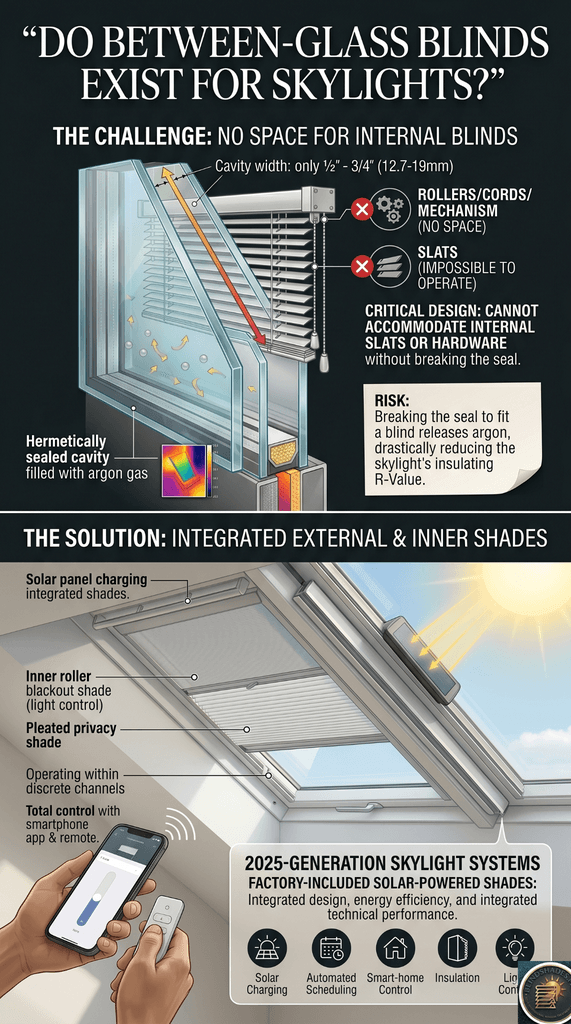
Key Takeaways:
- True between-glass blinds — where the blind mechanism is sealed inside the insulating glass unit (IGU) cavity between the two glass panes — essentially do not exist for residential skylights; the standard IGU cavity is only approximately 1/2 to 3/4 inch wide and filled with argon gas in a hermetically sealed unit; a blind mechanism requires approximately 1.5 to 3 inches of space; breaking the IGU seal to insert a blind destroys the argon gas insulation and eliminates the R-value
- Factory pre-installed skylight shades (from Velux, Fakro, and other manufacturers) are NOT between-glass in the same sense as Pella’s Slimshade for vertical windows; factory shades on skylights mount to the sash frame on the room side of the inner glass pane — they are between the glass and the room interior, not within the sealed IGU cavity; they look integrated but remain accessible independent shades that can be replaced or serviced
- As of 2025, VELUX has changed its residential skylight product line so that every residential glass skylight — fixed or venting — now ships with a factory-installed solar-powered shade as a standard feature; Restoration Roofing confirmed this in June 2025; this bundled approach provides the closest practical equivalent to between-glass convenience (seamless appearance, no separate ordering or installation) without being true between-glass
- The VELUX Pick&Click! system provides bracket hardware built into the sash frame of every Velux skylight; Velux-compatible shades snap into these pre-installed brackets in minutes without drilling; this is the practical equivalent of between-glass integration for Velux owners — the shade appears fully integrated and requires no additional hardware for installation
- True between-glass skylight blinds are available in commercial applications with specialty triple-glazed skylight units designed with a wider middle cavity to accommodate a blind mechanism; these are used in large glazed roofs, atria, and commercial skylight systems; they are not available as standard residential products from any major manufacturer
⭐ Quick Answer — Can You Put Blinds Between Skylight Glass?
- Why True Between-Glass Blinds Are Not Available for Residential Skylights: True blinds between skylight glass — where the blind mechanism is physically sealed inside the insulating glass unit (IGU) cavity between the two glass panes — essentially do not exist for standard residential skylights. Three reasons: (1) The IGU cavity is too narrow: a standard double-pane skylight IGU cavity is only approximately 1/2 to 3/4 inch wide, filled with argon gas; a blind mechanism requires approximately 1.5 to 3 inches of space — the cavity is 2 to 6 times too narrow. (2) Breaking the seal destroys the R-value: the IGU is hermetically sealed; cutting into it to insert a blind allows the argon gas to escape, eliminating the insulating performance of the double-pane unit and causing condensation between the panes. (3) Gravity causes sagging even in a narrow cavity: a vertical window blind lies flat under gravity; a horizontal or angled skylight blind in the same tiny cavity would sag away from the inner glass surface even in 1/2 inch of space — unlike vertical windows where the blind hangs straight. All three problems combine to make between-glass integration impractical for residential skylights
- Factory Pre-Installed Shades vs True Between-Glass — The Critical Distinction: Skylight blinds that are “factory pre-installed” are NOT the same as true between-glass blinds. Pella’s Slimshade for vertical windows is a true between-glass blind: sealed inside the IGU cavity, protected from dust, operated through magnetic coupling on the glass exterior — Pella confirms “integrated blinds and shades are tucked between panes of glass, where they are protected from dust and damage.” A factory pre-installed Velux skylight shade is fundamentally different: the shade mounts to the sash frame on the room side of the inner glass pane, between the glass and the room interior — NOT inside the sealed IGU cavity. The shade is an independent unit that can be accessed, serviced, and replaced. It looks integrated because it was factory-installed, but it is not sealed within the glass. The two concepts achieve similar aesthetics but use completely different construction and provide different levels of protection from dust
- The 2025 VELUX Skylight System — Solar Shade Now Included Standard with Every Skylight: For homeowners wanting the closest practical equivalent to blinds between skylight glass, Restoration Roofing confirmed in June 2025 that VELUX changed its product line: “every residential glass skylight — fixed or venting — now ships with factory-installed solar-powered shades as a standard feature.” The bundled shade is a white room-darkening pleated design with a solar-powered motor charged by the skylight’s own overhead solar exposure. Previously, skylights and shades were sold and installed separately. The new system ships as a single turn-key unit — skylight plus shade in one box — with travel limits pre-calibrated for the specific skylight. Restoration Roofing notes 90 percent of homeowners want skylight shades and 91 percent would pay for them; the bundled approach eliminates the friction of separate purchase and installation
- The Pick&Click! System — The Closest Practical Integration for Existing Velux Skylights: For existing Velux skylights that came with the Pick&Click! bracket system pre-installed in the sash, the Velux skylight shade installation is the closest residential equivalent to between-glass convenience. VELUX confirms: “VELUX skylights include brackets built right in to make shade installation a snap; VELUX shades are sized to fit, so installation requires only a few screws, with no cutting or adjustment of the shades required.” The Pick&Click! process: hold the Velux-compatible shade up to the skylight opening; the shade’s clip attachments engage the pre-installed sash brackets with a click; a few supplementary screws complete the installation in approximately 5 to 10 minutes. The shade appears completely integrated with the sash — the same visual result as between-glass but at aftermarket pricing. VELUX also confirms: “Pick&Click! shades will not fit older VELUX skylights or skylights manufactured by other companies”
- Commercial Between-Glass Skylights and the Full Cost Comparison: True between-glass skylight blinds DO exist — but only in commercial applications. Commercial glazed roofs and atria can use specialty triple-glazed units with a wider middle cavity (approximately 3 to 5 inches) designed to accommodate a motorized blind mechanism sealed within the glass. These specialty commercial products cost approximately $800 to $2,500 per skylight unit for the glazing alone. For residential buyers, the full cost spectrum: new VELUX Skylight System (2025) = solar shade included in skylight price; factory shade add-on at order = approximately $100 to $250 per shade; Pick&Click! Velux aftermarket (official) = $100 to $350; third-party Pick&Click! compatible = $30 to $120; standard aftermarket skylight shade = $150 to $400 installed; commercial between-glass = $800 to $2,500 per unit (not available through residential retailers). For most residential buyers, the new VELUX Skylight System or the Pick&Click! aftermarket shade provides the desired integrated appearance at 5 to 10 times lower cost than commercial between-glass
- Best Sources: New VELUX Skylight System with factory-included solar shade (fixed and venting 2025+) → VELUX USA skylights · Pella’s true between-glass IGU blind for vertical windows (comparison reference) → Pella between-the-glass blinds · Full 2025 VELUX Skylight System change with 90% homeowner demand data → Restoration Roofing VELUX shades review
⚠️ The Full Comparison Table: Factory Pre-Installed vs True Between-Glass vs Pick&Click!: Blinds between skylight glass comparison: True between-glass IGU blind (Pella vertical windows only) — location: inside sealed IGU cavity between panes; dust protection: YES fully sealed; replaceable: must replace IGU; standard for skylights: NO not available. Factory pre-installed Velux skylight shade — location: room side of inner glass pane within sash frame; dust protection: partial (enclosed but accessible); replaceable: YES independently; standard for skylights: YES from Velux and Fakro. New VELUX Skylight System (2025) — location: same as factory pre-installed; included: YES standard with every residential skylight; shade type: solar-powered white room-darkening pleated. Pick&Click! aftermarket Velux shade — location: same as factory pre-installed; installation: 5 to 10 minutes; brackets: pre-installed in sash from factory; cost: $30 to $350 depending on third-party vs official Velux. Commercial between-glass triple-glazed unit — location: inside wide middle cavity of triple-glazed commercial IGU; available for residential: NO; cost: $800 to $2,500 per unit. The frame depth issue: a factory-integrated skylight shade cassette requires approximately 3 to 4 inches of sash depth to accommodate the shade mechanism — much more than the 1/2 to 3/4 inch standard IGU gas cavity. This physical space requirement confirms why true between-glass is impossible with a standard IGU. For the Pick&Click! bracket system details and all Velux blind product codes including DKL blackout vs FSC solar types, see What Are the Best Velux Skylight Blinds. See the full technical explanation below.
💡 Practical Recommendations by Installation Scenario: For buyers asking about blinds between skylight glass and what to actually specify: New skylight purchase (2025 Velux): the VELUX Skylight System now includes a factory solar-powered shade as standard — no additional specification needed; the shade ships installed on the skylight. New skylight purchase (older Velux model or other brand): specify a factory-installed shade at the time of order ($100 to $250 per shade); the shade mounts to the sash at the factory before shipping. Existing Velux skylight with Pick&Click! brackets: order a Velux-compatible shade with Pick&Click! attachment clips; installation in 5 to 10 minutes without drilling. Existing Velux skylight without Pick&Click! (older model): order a standard Velux shade and install with a few screws into the sash frame; confirm the model is compatible before ordering. Existing non-Velux skylight: custom cellular or pleated shade from Blindsgalore, Blinds Chalet, or similar; measure inside curb dimensions; specify pitch angle; follow the installation protocol. Commercial glazed roof requiring true between-glass: consult a specialist commercial glazing fabricator for triple-glazed units with integrated blind mechanism; these are bespoke products not available through retail channels. EZ Snap confirms for any skylight where maximum heat reduction is the priority: “outdoor mounted skylight shades proven by DOE to be up to 7 times more effective than interior blinds.” For the measurement protocol (inside curb vs visible glass, round-UP rule, pitch angle as third dimension), see How Do You Measure a Skylight for Blinds. See the full cost comparison below.
📖 Read the complete guide below for: why true between-glass blinds are impossible for residential skylights (IGU cavity 1/2 to 3/4 inch; blind mechanism needs 1.5 to 3 inches; hermetic argon seal destroyed; gravity sag in horizontal application), the factory pre-installed vs true between-glass distinction (Velux shade = room-side of inner glass; Pella Slimshade = inside sealed IGU), the new VELUX Skylight System 2025 (solar shade standard with every residential fixed or venting skylight; 90% homeowner demand), the Pick&Click! bracket system (pre-installed in sash; snap-in 5 to 10 minutes; no drilling), commercial between-glass skylights (triple-glazed with 3 to 5 inch middle cavity; $800 to $2,500; commercial only), the frame depth comparison (3 to 4 inch sash depth for factory cassette vs 1/2 inch IGU cavity), and the full cost spectrum from included to commercial.
Blinds Between Skylight Glass — Why True IGU Integration Is Not Standard
The definitive technical explanation absent from all competitor guides.
The concept of “blinds between the glass” comes from vertical window products — most notably Pella’s Slimshade integrated blind, which is genuinely sealed inside the insulating glass unit (IGU) between two panes. For vertical windows, this works well.
Why it does not work the same way for skylights:
1. The IGU cavity is too narrow: A standard double-pane insulating glass unit has a cavity between the panes of approximately 1/2 to 3/4 inch. This cavity contains the inert gas (typically argon or krypton) that provides the insulating R-value. A blind mechanism — even a very slim one — requires approximately 1.5 to 3 inches of space to operate.
Wikipedia confirms: “Contemporary skylights typically use sealed insulating glass units (IGU) made with two panes of glass” with inert gas in the cavity between them.
2. Breaking the IGU seal destroys the R-value: If the IGU seal were broken to insert a blind, the argon or krypton gas would escape. Without the gas, the IGU’s R-value drops significantly — eliminating the primary thermal performance benefit of double-pane glass. The broken-seal unit would also be prone to condensation between the panes.
3. Gravity causes sagging in horizontal applications: For vertical windows, a between-glass blind hangs straight under gravity — the fabric lies flat against the inner glass face. For a skylight, which is installed horizontally or at an angle, any blind fabric within the IGU cavity would sag away from the inner glass under gravity — creating a visible and non-functional droop even in a tiny space. The tension systems that prevent sagging in standard skylight blinds cannot be accommodated within the 1/2-inch IGU cavity.
The conclusion: True between-glass blinds as a factory-integrated sealed unit do not exist for standard residential skylights. The option that achieves similar results is factory pre-installed shades — a different, but practical, approach.
What Factory Pre-Installed Skylight Shades Actually Are
The critical distinction absent from all competitor guides — pre-installed is NOT the same as between-glass.
Pella’s between-the-glass blind (for vertical windows): the blind mechanism is sealed INSIDE the IGU cavity between the two glass panes. The glass unit is factory-assembled with the blind already inside. The blind is operated through a magnetic coupling mechanism on the glass exterior — no cord, no wand, fully protected from dust and damage. Pella confirms: “integrated blinds and shades are tucked between panes of glass, where they are protected from dust and damage, but can still be accessed if any issues arise.”
A factory pre-installed Velux skylight shade: the shade is mounted to the SASH FRAME of the skylight, on the room side of the inner glass pane. The shade is between the glass and the room interior — NOT inside the sealed IGU cavity between the two glass panes. The shade is an independent unit that can be accessed, serviced, and replaced. It appears integrated because it was installed at the factory and ships as part of the skylight unit.
The practical differences:
| Feature | True Between-Glass (Pella vertical) | Factory Pre-Installed (Velux skylight) |
|---|---|---|
| Location | Inside the sealed IGU cavity | Room side of inner glass pane (inside sash) |
| Protected from dust | YES — fully sealed | Partially — enclosed in sash but accessible |
| Replaceable | Must replace IGU unit | YES — shade can be replaced independently |
| Requires frame depth | 3–4″ for blind mechanism inside IGU | 3–4″ sash depth for shade cassette |
| Standard for skylights | NO — not available | YES — from Velux, Fakro, others |
| Available for retrofit | NO — new skylight required | YES — can add to existing skylight |
The New VELUX Skylight System — Every Skylight Now Includes a Shade
The 2025 major change in Velux product policy — absent from all guides.
Restoration Roofing confirmed in June 2025: “VELUX’s new Skylight System: premium skylights now come bundled with solar-powered shades as a standard feature. No more afterthought purchases or mismatched styles — just seamless integration, smarter energy use, and unmatched living comfort. Every residential glass skylight — fixed or venting — ships with factory-installed solar-powered shades (white, room-darkening pleated design).”
What this means: Before 2025: skylights and shades were sold separately; buyers had to choose and order a shade after purchasing the skylight, then install it separately.
From 2025 onward: the Velux Skylight System ships as a complete unit — skylight plus shade in one box. The shade is factory-installed on the sash before shipping. Installation is turn-key.
Restoration Roofing notes: “90 percent of homeowners express a strong desire for skylight shades — and 91 percent would pay for them.” The bundled approach addresses this by eliminating the friction of separate purchase and installation.
The bundled-shade specification: The standard factory-included shade with the new Velux Skylight System is a white room-darkening pleated shade with solar-powered motor operation. This provides:
- Automated shade operation from a remote or VELUX ACTIVE app
- No wiring required (solar-powered motor charges from the skylight’s own overhead solar exposure)
- Factory color match to the skylight frame
- Pre-calibrated travel limits (already set for the specific skylight)
The Pick&Click! System — The Closest Practical Equivalent to Between-Glass
The snap-in bracket system absent from all between-glass discussions.
For existing Velux skylights without factory-installed shades, VELUX’s Pick&Click! system provides the closest equivalent to between-glass convenience:
VELUX FAQ confirms: “VELUX skylights include brackets built right in to make shade installation a snap. VELUX shades are sized to fit, so installation requires only a few screws, with no cutting or adjustment of the shades required.”
How Pick&Click! works:
- Every Velux skylight manufactured with Pick&Click! compatibility has bracket hardware pre-installed inside the sash during factory manufacturing
- A compatible Velux shade has matching clip attachments on the sides of the shade cassette
- Installation: hold the shade up to the skylight opening; the clips engage the pre-installed brackets with a click; a few supplementary screws secure the shade fully
- The result: a shade that appears completely integrated with the skylight sash, with no visible external mounting hardware
The practical experience: Owners with Pick&Click! skylights describe shade installation as taking approximately 5–10 minutes and requiring no measurement, no drilling, and no special tools. The shade appears as though it came with the skylight — similar to the between-glass appearance benefit.
VELUX also notes: “VELUX shades will perfectly fit VELUX skylights that come with our Pick&Click! brackets and will not fit older VELUX skylights or skylights manufactured by other companies.”
Commercial Between-Glass Skylights — Where It Does Exist
The commercial application of between-glass for skylights — absent from all residential guides.
True between-glass blind systems for skylights DO exist — but exclusively in commercial applications with specialty triple-glazed skylight units.
The commercial approach: Commercial glazed roofs, atria, and large skylight systems use triple-glazed units in which the MIDDLE cavity between the second and third glass layers is manufactured to be significantly wider (approximately 3 to 5 inches) than the standard IGU gas cavity. This wider middle space accommodates a blind mechanism — typically a slim roller blind or venetian slat system.
Characteristics of commercial between-glass skylight systems:
- Custom-manufactured IGU with a specially designed wide cavity for the blind mechanism
- The blind mechanism is sealed within the triple-glazed unit at the factory
- Operation: typically motorized through an electrical connection through the frame
- Maintenance: the blind and IGU are a single unit; replacement of a failed blind requires replacing the full triple-glazed unit
- Cost: specialty commercial product; approximately $800–$2,500 per skylight unit for the glazing alone, plus installation
Why not available for residential: The specialty manufacturing cost and the need for a custom-width IGU cavity make commercial between-glass skylight units impractical for residential applications. Standard residential skylight manufacturers (Velux, Fakro, Sun-Tek) do not offer true between-glass blind systems.
The Cost Comparison
The full cost spectrum from no blind to commercial between-glass — absent from all guides.
| Solution | Description | Approximate Cost |
|---|---|---|
| New VELUX Skylight System (2025) | Shade included with skylight purchase; solar-powered; factory-installed | Included in skylight price |
| Factory-installed shade (add-on at order) | Shade installed at factory before shipping; Velux, Fakro | $100–$250 per shade (added to skylight cost) |
| Pick&Click! Velux aftermarket shade | Official Velux shade installed by homeowner using pre-installed brackets | $100–$350 per shade (official); $30–$120 (third-party compatible) |
| Standard aftermarket skylight shade | Custom cellular or pleated shade installed independently; any brand | $150–$400 per shade installed |
| Commercial between-glass skylight unit | True IGU-integrated blind; specialty commercial product | $800–$2,500 per skylight unit (glazing only) |
The verdict: For residential buyers wanting the closest experience to “blinds between the glass” — the seamless, integrated appearance with no visible hardware — the new VELUX Skylight System (2025) with included factory shade, or the Pick&Click! system with an aftermarket Velux shade, provides this experience at standard residential pricing. True between-glass at the commercial level costs 5–10 times more and is not available through residential skylight retailers.
Where to Order
For the new Velux Skylight System with factory-included solar-powered shade: VELUX USA at veluxusa.com/products/skylights — the new residential skylight system with bundled factory shade as standard; fixed and venting options; LoE3-366 glass standard; Pick&Click! bracket system for compatible shades.
For Pella between-the-glass blinds (vertical windows only — for reference comparison): Pella at pella.com/ideas/windows/features-options/between-the-glass-blinds — the definitive between-glass IGU blind for vertical windows; Slimshade integrated cordless design; protected from dust; Lifestyle Series products; for comparison to skylight factory-installed shade options.
For full context on the 2025 Velux Skylight System with bundled shade: Restoration Roofing at restorationroofing.com/velux-skylight-systems-now-include-shades — full explanation of the 2025 product change; 90% homeowner desire for shades; factory-bundled approach; solar-powered standard shade specification.
Frequently Asked Questions
Can you put blinds between skylight glass? True between-glass blinds — where the blind mechanism is sealed inside the insulating glass unit (IGU) cavity between the two glass panes — essentially do not exist for standard residential skylights. The IGU cavity is only approximately 1/2 to 3/4 inch wide, which is far too narrow for any blind mechanism, and is hermetically sealed with argon gas. Breaking the seal to insert a blind would destroy the gas insulation and eliminate the R-value. What does exist for residential skylights are factory pre-installed shades, which mount on the room side of the inner glass within the sash frame, and the new VELUX Skylight System, which ships with a solar-powered shade as standard.
What is the difference between a factory-installed skylight shade and a between-glass blind? A factory-installed skylight shade mounts to the sash frame on the room side of the inner glass pane — it is between the glass and the room interior, not inside the sealed IGU cavity. It looks integrated because it was installed at the factory but remains an independent, replaceable unit accessible from the room side. A true between-glass blind (available from Pella for vertical windows) is sealed inside the IGU cavity between the two glass panes, fully protected from dust, and operated through magnetic coupling on the glass exterior. The two concepts are similar in appearance but fundamentally different in construction.
What is the new VELUX Skylight System with included shades? The new VELUX Skylight System, confirmed by Restoration Roofing in June 2025, ships every residential glass skylight — fixed or venting — with a factory-installed solar-powered shade as a standard feature. Previously, skylights and shades were sold separately. The bundled system includes a white room-darkening pleated shade with solar-powered motor operation, factory color-matched to the skylight frame, with pre-calibrated travel limits. This provides the closest residential equivalent to between-glass convenience — a seamlessly integrated shade with no separate purchase or independent installation required.
What is the VELUX Pick&Click! system? The VELUX Pick&Click! system has bracket hardware pre-installed inside the sash frame during skylight factory manufacturing. Compatible Velux shades have matching clip attachments that engage the pre-installed brackets with a click, requiring only a few supplementary screws for a complete installation in approximately 5 to 10 minutes. The shade appears completely integrated with the skylight sash with no visible external mounting hardware, providing an experience similar to between-glass aesthetics at standard aftermarket shade pricing.
Do true between-glass skylight blinds exist anywhere? Yes, but only in commercial applications. Commercial glazed roofs, atria, and large skylight systems can use specialty triple-glazed units with a wider middle cavity (approximately 3 to 5 inches) designed to accommodate a blind mechanism sealed within the glass unit. These are custom-manufactured products costing approximately $800 to $2,500 per skylight unit and are not available through residential skylight retailers. Standard residential skylight manufacturers including Velux, Fakro, and Sun-Tek do not offer true between-glass blind systems.
Related Guides on BlindShades.pro
- The Best Skylight Blinds & Shades Buying Guide
- What Are the Best Blinds for Skylights
- What Are the Best Velux Skylight Blinds
- Are Motorized Skylight Blinds Worth the Cost
- How Do You Install Skylight Blinds
By Michael Turner | 30 Years Home Improvement Expertise | Updated 2026 | BlindShades.pro
