How Do You Stop French Door Blinds From Swinging?

Authored By Michael Turner -30 Years Home Improvement Expertise | Updated 2026 | BlindShades.pro
Updated on July 15, 2026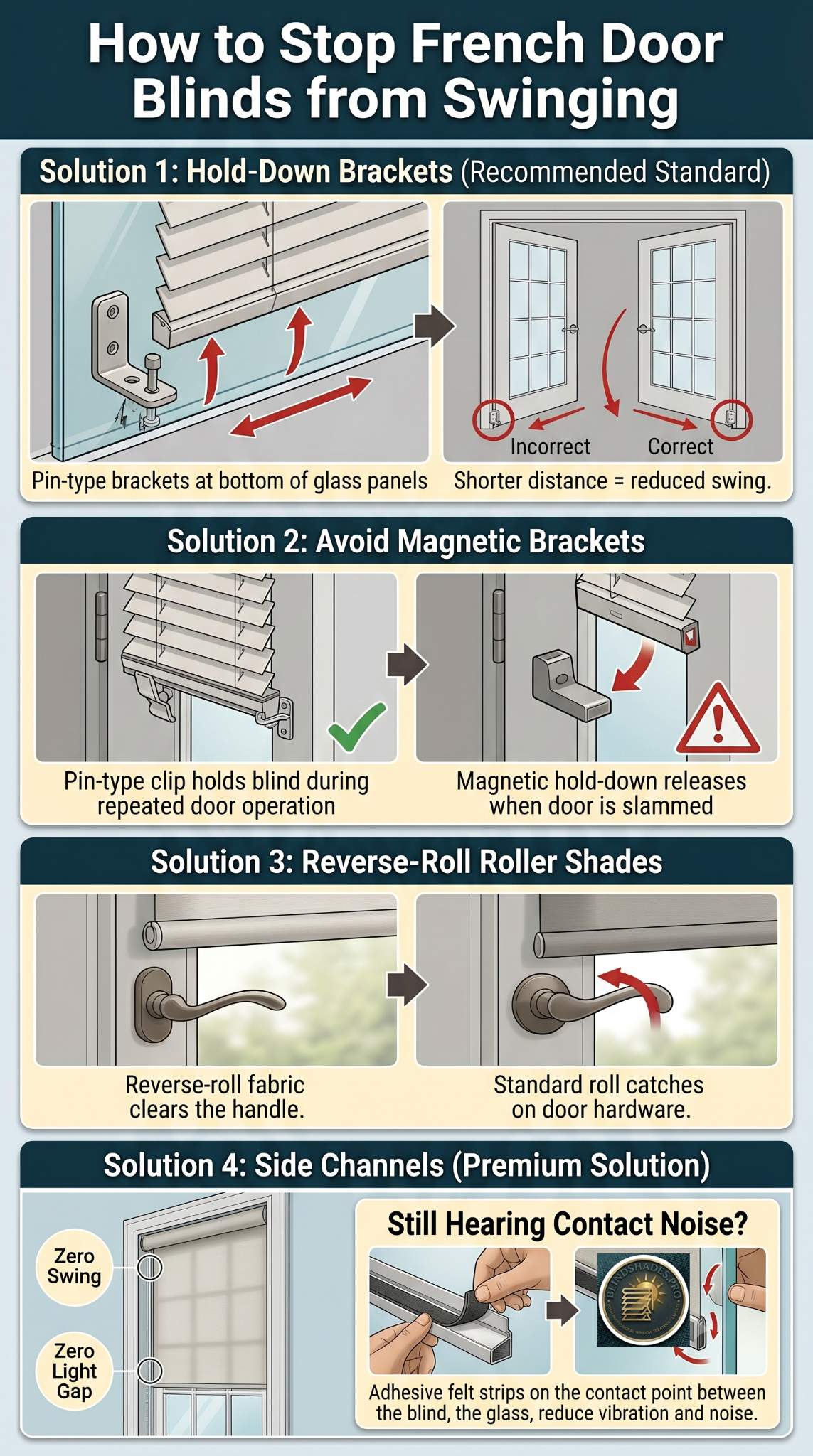
Key Takeaways:
- Hold-down brackets at the bottom corners of the blind are the universal solution to stop French door blinds from swinging; the brackets clip the bottom rail flat against the door face; for standard cordless blinds, specify pin-type (physical clip) hold-downs rather than magnetic hold-downs; Weffort (March 2025) documents that magnetic hold-downs fail when the door is slammed — “if the door is slammed even slightly, the magnet breaks contact, and the shade flaps around anyway — I eventually had to swap the magnets for physical plastic clips”; magnetic hold-downs work for motorized blinds (motor torque releases the magnet cleanly) but not for manually operated blinds on doors that see frequent or forceful use
- The vertical position of the hold-down bracket determines the pendulum length of the blind — and pendulum length determines how much force it takes to make the blind swing; brackets at the bottom of the door (below the glass panel) create a long pendulum = more swinging with less force; brackets at the glass bottom edge create a short pendulum = more stable; always position hold-down brackets at the bottom edge of the glass panel, not at the door bottom rail
- The reverse roll specification for roller shades prevents catching on the door handle at zero cost: standard back-roll means the fabric falls directly behind the lever handle and can catch on it when raised or lowered; Canisteo Blinds (March 2026) confirms that “reverse roll allows the fabric to drop from the front of the roller, creating a natural bridge over the handle — for any pull-down shade on a door, this front-rolling orientation is a must”; specify reverse roll on any roller shade order for a French door with a lever handle
- Side channels are the premium combined solution: they simultaneously prevent swinging (the channel physically constrains horizontal movement = zero swing) and eliminate the side light gap (the channel edge seals the 0.5–1 inch gap between fabric edge and door stile); Canisteo Blinds (April 2026) confirms side channels “turn a standard blind into a high-end, integrated system that feels solid and silent”; side channels are the single installation that replaces both hold-down brackets and blackout side seals
- If hold-down brackets are installed and functioning but the blind still makes a contact noise when the door opens, the problem is impact noise not swing; the fix is adhesive-backed felt strips applied to the back surface of the bottom rail; the felt cushions the rail’s momentary contact with the glass surface as the door moves before the hold-down catches it; Weffort (March 2025) confirms this exact fix; adhesive felt strips cost $3 to $8 at any hardware store
⭐ Quick Answer — How Do You Stop French Door Blinds From Swinging?
- The Universal Solution — Hold-Down Brackets, and Why Pin Clips Beat Magnets Every Time: The standard solution to stop French door blinds from swinging is hold-down brackets at the bottom corners of the glass panel. Two brackets clip the bottom rail flat against the door face. The critical specification: use pin-type physical clip brackets, not magnetic hold-downs for manually operated blinds. Magnetic hold-downs have a fixed magnetic force of approximately 2 to 5 lbs. When a French door is opened quickly or slammed, the brief air pressure spike exceeds this force — the magnet breaks contact and the blind swings free. Weffort (March 2025) documents this failure directly from real-world installation: “If the door is slammed even slightly, the magnet breaks contact, and the shade flaps around anyway — I eventually had to swap the magnets for physical plastic clips.” Pin-type clip brackets engage mechanically regardless of air pressure — the only way to release them is the deliberate manual unclip action. Magnetic hold-downs work reliably for motorized blinds only (the motor’s torque releases the magnet cleanly without slam forces). VelaBlinds (October 2025) confirms magnetic hold-downs offer “a cleaner look as there are no visible clips” — but for manual blinds on any actively used French door, that aesthetic advantage comes at the cost of mechanical reliability
- The Bracket Position Rule — Glass Bottom Edge, Not Door Bottom, Minimizes Pendulum Length: The vertical position of the hold-down bracket determines the pendulum length of the blind — and pendulum length determines how much force it takes to make the French door blind swing. A shorter pendulum requires more force to swing and returns to position faster. A longer pendulum swings with less force and with a wider arc. Hold-down brackets must be positioned at the bottom edge of the glass panel — not at the door bottom rail below the glass. French doors have a lower horizontal wood rail below the glass panel. If brackets are mounted at the door bottom (below the glass), the blind must extend below the glass area — the portion of the blind below the glass hangs free with no glass behind it, creating a longer pendulum with more tendency to swing. With brackets at the glass bottom edge, the blind covers only the glass panel, the pendulum is as short as possible, and the physics work in your favour. This bracket positioning rule is also correct for the measurement protocol — [How Do You Measure French Doors for Blinds](/guide/how-to-measure-french-door-blinds/) confirms hold-down brackets at the glass bottom edge as the standard position
- The Reverse Roll Specification — Zero-Cost Roller Shade Handle Fix Ordered at Purchase Time: For roller shades specifically, the reverse roll specification prevents French door blind swinging caused by handle catching — at zero additional cost, specified when ordering. Canisteo Blinds (March 2026) confirms: “A reverse roll allows the fabric to drop from the front of the roller. This creates a natural bridge over the handle. For any pull-down shade for door applications, this front-rolling orientation is a must. It gives the fabric the breathing room it needs to hang perfectly flush without catching on the hardware.” Standard back-roll means the fabric runs directly behind the lever handle as it descends — the fabric edge catches the handle when raised or lowered, causing the shade to jerk sideways and swing. Reverse (front) roll creates a small clearance arc over the headrail before the fabric descends, so the fabric falls in front of the lever handle rather than behind it. Catching on the handle is eliminated entirely. How to specify: when ordering any roller shade for a French door with a lever handle, look for “reverse roll” or “front roll” in the operating system options — it is a no-cost selection at most major retailers; always confirm the roll direction before completing the order
- Side Channels — The Premium Combined Solution That Simultaneously Stops Swinging and Seals Light Gaps: Side channels are the premium solution for stopping French door blinds from swinging — they make horizontal movement mechanically impossible rather than merely resisting it. Canisteo Blinds (April 2026) confirms: “Side channels are particularly great for full-light doors because they create a track for the blind to slide up and down in, providing total light blockage and zero movement. It turns a standard blind into a high-end, integrated system that feels solid and silent.” Two aluminum or PVC channel tracks are mounted vertically on the door face, one each side of the glass panel. The fabric edges of the blind slide inside these channels. The channels physically prevent horizontal movement in any direction — unlike hold-down brackets which resist the swing force, side channels make horizontal movement impossible. The dual benefit: (1) zero swing in any direction, regardless of door speed or air pressure; (2) zero side light gap — the channel edge contacts the door stile, eliminating the 0.5 to 1 inch light gap that exists on each side in standard outside-mount installations. Side channels replace both hold-down brackets and blackout side seals in one installation. Motorized blinds with side channels: Weffort (May 2025) confirms the motor torque specification must exceed the friction added by the channels — typically 1.1 Nm or higher is required
- The Swing Physics by Door Direction and the Weight Threshold by Blind Type: Two additional French door blind swinging specifications absent from all guides. (1) Physics by swing direction: inswing French doors (opens into room) create an air compression wave that pushes the bottom rail outward (away from the door face) — the blind swings toward the room; outswing French doors (opens away from room) create a suction low-pressure zone that pulls the bottom rail inward (toward the glass) — the blind swings toward the glass. Hold-down brackets resist both directions. Understanding the swing direction helps diagnose which surface the blind is contacting and why. (2) Weight threshold by blind type: Canisteo Blinds (April 2026) confirms: “avoid heavy vertical slats or thick faux-wood blinds — they are too heavy and too loud.” The weight determines pendulum force: 3/8-inch aluminum or cellular shades (0.5 to 1.2 lbs) = excellent for French doors; 1-inch faux wood (1.5 to 2.5 lbs) = acceptable with strong hold-downs; 2-inch faux wood or real wood (2.5 to 5 lbs) = not recommended — excessive pendulum force risks bracket screw pull-out from the door face with repeated daily operation. The rule: if you cannot raise and lower the blind comfortably with one hand, it is too heavy for a French door application
- Best Sources: Reverse roll = “front-rolling orientation is a must”; side channels = “zero movement and total light blockage” confirmed → Canisteo Blinds roller blind on door glass guide · Magnetic hold-downs fail on door slam; smart home vibration sensor automation; felt-lined bottom bars reduce noise 15dB; side channel motor torque 1.1Nm → Weffort stop blinds banging smart fixes · Pin-type vs magnetic hold-down comparison; mark pin positions; screw brackets at marks → VelaBlinds stop roller blinds from swinging
⚠️ The Felt Strip Noise Fix and the Smart Home Vibration Sensor Automation: Two solutions for French door blind swinging problems absent from all standard guides. (1) Felt strip noise fix: if hold-down brackets are correctly installed and the blind passes the swing test but still makes a contact noise when the door opens, the problem is impact noise rather than swing. The brief moment of fabric movement before the hold-down pins engage causes the bottom rail to tap against the glass. The fix: adhesive-backed felt strips (approximately 1/2-inch wide) applied to the back surface of the bottom rail; the felt cushions the rail’s momentary contact with the glass. Weffort (March 2025) confirms this exact retrofit: “the bottom rail makes a noticeable thwack against the glass if I pull the door open too fast — I ended up gluing a small strip of felt to the back of the aluminum rail, which solved the noise.” Weffort (May 2025) confirms felt-lined bottom bars reduce impact noise by approximately 15 dB. Cost: adhesive felt strips at any hardware store = $3 to $8. Alternative: clear adhesive rubber bumper pads used on cabinet doors, applied to the bottom rail corners. (2) Smart home vibration sensor automation: for motorized French door blinds in smart home systems, Weffort (May 2025) describes: “If the sensor detects rapid movement (banging), a routine in Alexa or Home Assistant can trigger the blind to raise halfway, moving it out of the direct draft zone.” A Z-Wave or Zigbee vibration sensor mounted on the door frame triggers an automation rule that raises the blind to 50% on rapid movement detection, moving the bottom rail above the door handle and out of the maximum air displacement zone. Response delay of 0.5 to 2 seconds means a fast slam may complete before the blind raises — this works best as a preventive deployment rather than a reactive fix. See the full smart home automation protocol below.
💡 The 4 Hold-Down Failure Mode Diagnostics — When Brackets Are Installed But Still Not Working: When hold-down brackets are installed and the French door blind is still swinging, one of four specific failure modes is responsible. (1) Magnetic hold-downs failing on door slam: the bracket appears to work on slow opens but fails on fast opens or slams; replace magnetic hold-downs with pin-type physical clip brackets; Weffort confirmed this is the most common magnetic hold-down failure mode. (2) Bracket mounted too far from the door face: if the bracket screw is on raised molding rather than the flat door face, the bracket sits proud of the flat surface at an angle; the bottom rail pins cannot engage at the correct angle; fix: mount on the flat door face; if raised molding requires spacer blocks, see [How Do You Install Blinds on French Doors](/guide/install-french-door-blinds/) for spacer block placement. (3) Bracket installed at wrong height: if brackets were installed with the blind at anything other than fully lowered, the pins and bracket heights are misaligned; when the blind is raised slightly and re-lowered, the pins travel above the brackets; fix: remove brackets, lower blind fully, and reinstall brackets at the exact pin position. (4) Pin missing from bottom rail end cap: hold-down brackets require a pin pre-inserted into the bottom rail end cap hole; some blinds ship without the pin inserted; the bracket has nothing to receive and the blind rests loosely near the bracket rather than clipping in; Blinds Chalet confirms: “make sure you have a pin in the bottom rail of the door blinds — if the pin is not already inserted, using a mallet or hammer insert the pin.” Check both end caps of the bottom rail before assuming the bracket is faulty. For the complete French door blind installation protocol from first bracket screw to final swing test, see How Do You Install Blinds on French Doors. See the full failure mode diagnostics below.
📖 Read the complete guide below for: the physics of French door blind swinging (inswing = air compression = outward swing; outswing = suction = inward swing toward glass), hold-down bracket position (glass bottom edge = minimum pendulum = most stable; door bottom = longer pendulum = more swing), pin-type clips vs magnetic hold-downs (magnetic fails on slam; pin clips engage mechanically regardless of air pressure), reverse roll specification for roller shades (front-roll creates clearance arc over handle; zero cost at order time), side channels (physically prevents horizontal movement; simultaneously seals side light gap; combined solution replacing both hold-downs and blackout seals), felt strip noise fix ($3-8; 15dB reduction; back of bottom rail), smart home vibration sensor automation (raise to 50% on rapid movement; Weffort confirmed), weight threshold table (3/8-inch excellent; 1-inch faux wood acceptable; 2-inch faux wood/real wood not recommended), and 4 hold-down failure mode diagnostics (magnetic on slam; bracket angle; wrong height; pin missing).
Why French Door Blinds Swing — The Physics Absent from Every Guide
Understanding the force behind the swing helps you choose the correct fix.
French door blinds swing because of a pendulum physics problem unique to door-mounted treatments.
A blind mounted on a French door face is secured at the top (headrail fixed to door face) and free at the bottom (bottom rail hangs loose). This creates a pendulum: a fixed pivot at the top and a free-swinging mass at the bottom.
When the door opens, two things happen:
For inswing French doors (opens into the room): the door face moves toward the room interior, pushing a compression wave of air ahead of it. This air mass pushes against the blind surface — specifically against the bottom rail and lower fabric — forcing the bottom rail away from the door face (outward swing, toward the room). The bottom rail swings outward, away from the glass. Without hold-downs, the rail can swing 3 to 6 inches from the door face and smack the door frame or jamb on closing.
For outswing French doors (opens away from the room): the door face moves away from the room, creating a low-pressure zone (suction) on the room side. This suction pulls the blind bottom rail toward the door face (inward swing, toward the glass). The bottom rail swings inward, toward the glass panel.
The practical consequence of this physics difference:
- Inswing: blind swings OUTWARD → risk of contact with door frame, jamb, furniture, or people
- Outswing: blind swings INWARD → risk of contact with the glass itself; the “thwack” against the glass
Hold-down brackets resist both directions of swing by physically fixing the bottom rail to the door face. But the force they experience is different:
- Inswing hold-downs: resist outward pull
- Outswing hold-downs: resist inward pull (toward glass)
This physics understanding also explains why Weffort (March 2025) found that magnetic hold-downs fail on door slam — the slam creates a brief but intense air pressure wave that exceeds the magnetic force, causing the bottom rail to break free.
How Do You Stop French Door Blinds From Swinging — The 4 Solutions Ranked
From most-used to most-effective, with the honest trade-offs each solution carries.
Solution 1 — Hold-Down Brackets (Universal; Correct First Specification)
Hold-down brackets are the standard and correct first solution for stopping French door blinds from swinging. Two brackets are mounted on the door face at the bottom corners of the glass panel. The bottom rail of the blind clips into these brackets when the blind is lowered.
How they work: Blinds Chalet confirms the installation sequence: “make sure you have a pin in the bottom rail of the door blinds. This pin is inserted in a hole on each side of the bottom rail. Once the blinds have been mounted to the door, the hold down brackets may be installed. Lower the blinds to the desired length. The hold down bracket is mounted with two screws in the shorter side of the bracket. The hold down pin that is in the bottom rail of the blinds sits in the hole on the longer side of the bracket.”
The critical position — glass bottom, not door bottom: Hold-down brackets must be positioned at the bottom edge of the glass panel, not at the door bottom rail. This is the shortest possible pendulum length. Brackets mounted at the door bottom (below the glass panel) allow a longer pendulum — the blind extends below the glass area and has more free-hanging length, creating more swing with less force.
Pin-type vs magnetic hold-downs:
| Type | How it holds | Best for | Failure mode |
|---|---|---|---|
| Pin/clip (physical) | Bottom rail pins physically clip into bracket | Manual blinds, standard daily use, any door speed | Requires deliberate manual release — must unclip before raising |
| Magnetic | Magnet in bottom rail attracts to metal plate in bracket | Motorized blinds (motor torque releases automatically) | Fails on door slam — brief air pressure spike exceeds magnetic force; Weffort confirmed: “swap magnets for physical plastic clips” |
VelaBlinds (October 2025) confirms the distinction: “A small magnet is installed on the window frame, and a corresponding metal plate or magnet is fitted into the blind’s bottom rail. When the blind is lowered, the magnets connect and hold it securely. They offer a cleaner look as there are no visible clips.” The cleaner aesthetic of magnetic hold-downs is real — but the mechanical reliability of pin-type clip brackets is superior for manual blinds on frequently used doors.
The correct specification:
- Manual cordless blinds: pin-type physical clip hold-down brackets
- Motorized blinds: magnetic auto-release hold-down brackets (motor torque releases cleanly; no manual intervention needed)
Solution 2 — Reverse Roll Specification for Roller Shades (Zero-Cost at Order Time)
If the blind is a roller shade, the reverse roll specification addresses both swinging and handle catching — at zero additional cost, specified at order time.
Canisteo Blinds (March 2026) confirms: “A reverse roll allows the fabric to drop from the front of the roller. This creates a natural bridge over the handle. For any pull down shade for door applications, this front-rolling orientation is a must. It gives the fabric the breathing room it needs to hang perfectly flush without catching on the hardware.”
Standard roll (back-roll): The fabric falls from the back of the roller tube. As the shade descends, the fabric runs directly down the door face — passing directly behind the lever handle. When raised, the fabric must travel behind the handle; when lowered, the same. Any slight misalignment causes the fabric edge to catch the lever, creating a catching failure that also causes the shade to swing to one side.
Reverse roll (front-roll): The fabric falls from the front of the roller tube. The fabric makes a small arc over the top of the headrail before descending in front of it — creating a natural clearance arc over the door handle. The bottom rail hangs in front of the handle rather than behind it, eliminating handle catching entirely.
How to specify: When ordering a roller shade for a French door, look for “reverse roll” or “front roll” in the operating system options. This is a no-cost option at most retailers. Always confirm the roll direction before completing the order.
Solution 3 — Side Channels (Premium Combined Solution: Zero Swing + Zero Light Gap)
Side channels eliminate the blind swinging problem entirely and simultaneously seal the side light gap — one installation that addresses what hold-down brackets and blackout side seals address separately.
Canisteo Blinds (April 2026) confirms: “Side channels are particularly great for full-light doors because they create a track for the blind to slide up and down in, providing total light blockage and zero movement. It turns a standard blind into a high-end, integrated system that feels solid and silent.”
How side channels work: Two aluminum or PVC channel tracks are mounted vertically on the door face, one on each side of the glass panel. The fabric edges of the blind slide inside these channels as the blind raises and lowers. The channels physically constrain the fabric edges — the blind cannot move horizontally because the channels prevent horizontal movement entirely.
The dual benefit:
- Zero swing: The channels physically prevent the bottom rail and fabric from moving side-to-side or away from the door face — not just resisting the swing force but making horizontal movement mechanically impossible
- Zero side light gap: The channel edge makes contact with the door stile, eliminating the 0.5 to 1 inch side gap that exists between the fabric edge and the door face in standard outside-mount installations
Weffort (May 2025) confirms the motor torque requirement for side channels with motorized blinds: “Ensure motor torque handles the friction of side channels (usually 1.1Nm or higher).” For motorized blinds with side channels, confirm the motor’s torque specification exceeds the friction added by the side channel fabric contact.
For our full guide to installation, including side channel bracket placement, see How Do You Install Blinds on French Doors.
Solution 4 — Smart Home Vibration Sensor Automation (For Motorized Smart Blinds)
For motorized French door blinds integrated with a smart home system, a vibration sensor automation provides a proactive swinging prevention approach.
Weffort (May 2025) confirms: “If the sensor detects rapid movement (banging), a routine in Alexa or Home Assistant can trigger the blind to raise halfway, moving it out of the direct draft zone.”
How the automation works:
- A Z-Wave or Zigbee vibration sensor is mounted on the French door frame
- An automation rule is created in Alexa, Home Assistant, Apple Home, or Google Home: “if door vibration sensor reports rapid movement, raise blind to 50%”
- At 50% raised, the fabric panel is above the door handle and above the zone of maximum air displacement — remaining fabric still provides privacy but is not subject to the full pendulum force of a fully lowered blind
The limitation: Weffort notes: “A smart trigger — vibration sensors (Zigbee/Z-Wave) or wind speed sensors (outdoor) — provide a system that responds dynamically.” The 0.5 to 2 second delay between sensor detection and motor response means a fast door slam may complete before the blind raises. This automation works best for anticipatory deployment (raising before a known door-open event) rather than reactive deployment after the slam.
Best for: Homes with smart home automation systems where the convenience of motorized blinds is already established and hold-downs are not preferred for aesthetic reasons.
The Felt Strip Fix — Solving the Noise When Hold-Downs Are Already Working
The $3–8 retrofit that separates the swing problem from the noise problem.
Hold-down brackets stop the swing. But a correctly installed, correctly functioning blind can still make a contact noise when the door opens and closes — not from swinging, but from the brief moment of movement before the hold-down clips catch and hold.
Weffort (March 2025) documents this exact sequence from real-world installation: “The bottom rail makes a noticeable ‘thwack’ against the glass if I pull the door open too fast. I ended up gluing a small strip of felt to the back of the aluminum rail, which solved the noise, but it is an aesthetic compromise I wasn’t expecting.”
The felt strip application:
- Lower the blind to the fully closed position
- Identify the back surface of the bottom rail — the side that faces the door face and glass
- Cut adhesive-backed felt strips (approximately 1/2 inch wide) to the full width of the bottom rail
- Apply the felt strips to the back surface of the bottom rail
- Re-lower the blind into the hold-down brackets and test
The felt cushions the rail’s momentary contact with the glass surface during the brief swing arc before the hold-down pins engage. The result is a soft contact rather than an aluminum-to-glass “thwack.”
Weffort (May 2025) confirms the noise reduction: “Felt-lined bottom bars reduce impact noise by approximately 15dB.”
Alternative: Clear adhesive rubber bumper pads (used on cabinet doors) applied to the bottom rail corners achieve the same cushioning with less visible profile than felt strips.
The DIY Retrofit — When Hold-Downs Are Installed But Still Failing
The diagnostic for the four specific failure modes that prevent hold-down brackets from working.
Failure Mode 1 — Magnetic Hold-Downs Breaking Free on Door Slam
Symptom: Hold-downs appear to work when the door opens and closes slowly but fail when the door is pulled or pushed quickly.
Cause: Magnetic hold-downs have a fixed magnetic force (typically 2–5 lbs pull strength). A fast door opening creates a brief but intense air pressure spike that exceeds this force.
Fix: Replace magnetic hold-downs with pin-type physical clip brackets. Weffort’s direct experience: “I eventually had to swap the magnets for physical plastic clips.” The physical clip engages mechanically regardless of air pressure.
Failure Mode 2 — Bracket Installed Too Far from the Door Face
Symptom: Bottom rail does not clip into the bracket correctly — the pin engages partially or falls out when the door moves.
Cause: If the bracket is screwed into the raised molding or a surface that sits proud of the flat door face, the bracket sits at an angle or distance from the flat door surface; the bottom rail (which hangs flat against the door face) cannot reach the bracket at the correct angle.
Fix: Mount the bracket on the flat door face surface (not on raised molding). If raised molding exists around the glass, use spacer blocks equal to the molding projection height so the bracket sits level with the flat door face surface. See How Do You Measure French Doors for Blinds for spacer block sizing.
Failure Mode 3 — Bracket Installed at Wrong Height Relative to Blind Length
Symptom: When blind is fully lowered, pins don’t reach the brackets. Or: blind clips in when fully lowered but pops free when raised slightly.
Cause: If the blind is raised even 0.5 to 1 inch from its fully lowered position before the hold-down brackets are released, the pins travel above the bracket openings. If the brackets were installed based on the blind in a non-fully-lowered position, the bracket height and pin height are misaligned.
Fix: Always install hold-down brackets with the blind in its fully lowered (fully closed) position. Lower the blind completely, note where the bottom rail pins sit on the door face, and mount the brackets at exactly that height.
Failure Mode 4 — Pin Missing from Bottom Rail End Cap
Symptom: Bracket is correctly installed but the bottom rail simply rests in or near the bracket without engaging.
Cause: The hold-down bracket works by receiving a pin that must be pre-inserted into the bottom rail’s end cap hole. Some blinds ship without the pin inserted.
Fix: Blinds Chalet confirms: “The first step is to make sure you have a pin in the bottom rail of the door blinds. This pin is inserted in a hole on each side of the bottom rail of the blinds. If the pin is not already inserted in the blinds, using a mallet or hammer insert the pin.” Check both end caps of the bottom rail for the pin before concluding the bracket is faulty.
The Weight Threshold — Blind Types That Should Not Be on French Doors
The weight recommendation absent from all French door blind guides.
Canisteo Blinds (April 2026) confirms: “Avoid heavy vertical slats or thick faux-wood blinds for these areas. They are too heavy and too loud.” Weffort (March 2026) adds about 1-inch faux wood: “A motor that works for a tiny aluminum blind will stall on 1 inch faux wood blinds.”
The weight of the blind determines the pendulum force:
| Blind Type | Approximate Weight (Full Door Height) | French Door Suitability |
|---|---|---|
| 3/8-inch aluminum mini-blind | 0.5–0.8 lbs | ✅ Excellent — minimal pendulum force |
| 3/8-inch cellular shade (single cell) | 0.8–1.2 lbs | ✅ Excellent |
| Roller shade (standard polyester) | 0.8–1.5 lbs | ✅ Excellent |
| 1-inch faux wood blind | 1.5–2.5 lbs | ⚠️ Acceptable with strong hold-downs |
| 2-inch faux wood blind | 2.5–4 lbs | ❌ Too heavy — excessive pendulum force; hold-down screw pull-out risk |
| Real wood blind (2-inch slat) | 3–5 lbs | ❌ Too heavy |
| Heavy Roman shade (unlined) | 2–4 lbs | ❌ Too heavy for active inswing door |
| Thick woven Roman shade | 3–6 lbs | ❌ Not recommended |
The rule: if you cannot comfortably raise and lower the blind with one hand without significant effort, the blind is too heavy for a French door application. The hold-down bracket screws will experience excessive force with every door opening and will eventually pull out from the door face.
Related guides: the flap is one gate of three — the full Swing-Style-System decision is in the best French door blinds and shades guide.
Frequently Asked Questions
How do you stop French door blinds from swinging? Install hold-down brackets at the bottom corners of the glass panel. The brackets clip the bottom rail flat against the door face. Position the brackets at the glass bottom edge (not at the door bottom) to minimize the blind’s pendulum length. Use pin-type physical clip brackets for manually operated blinds — magnetic hold-downs fail when the door is slammed. For roller shades, also specify reverse roll at order time to prevent handle catching.
Why do magnetic hold-down brackets fail on French doors? Magnetic hold-down brackets have a fixed magnetic force, typically 2 to 5 lbs. When a French door is opened quickly or slammed, the brief air pressure spike can exceed this force, causing the magnet to break contact and the blind to swing free. Weffort (March 2025) documents this failure and solution: replacing magnetic hold-downs with physical pin-type clip brackets. Magnetic hold-downs work reliably only for motorized blinds where the motor torque releases and resets the magnet cleanly.
What is the reverse roll specification for roller shades on French doors? Reverse roll, also called front roll, means the fabric falls from the front of the roller tube rather than the back. This creates a natural clearance arc over the door handle as the fabric descends, preventing the fabric from running directly behind the lever handle. Canisteo Blinds (March 2026) confirms this is essential for roller shades on French doors. Specify reverse roll when ordering any roller shade for a French door with a lever handle — it is typically a zero-cost option.
What are side channels and how do they stop French door blinds from swinging? Side channels are vertical aluminum or PVC tracks mounted on each side of the blind on the door face. The fabric edges slide inside these channels, which physically prevent any horizontal movement of the blind. Unlike hold-down brackets which resist the swing force, side channels make horizontal movement mechanically impossible. They also simultaneously seal the side light gap between the fabric edge and the door stile. Canisteo Blinds (April 2026) confirms side channels create “zero movement AND total light blockage.”
Why does my blind still make a noise after I installed hold-down brackets? If hold-down brackets are correctly installed and functioning, but the blind still makes a contact sound when the door opens, the problem is impact noise rather than swing. The brief moment of fabric movement before the hold-down pins engage causes the bottom rail to tap against the glass. The fix is adhesive-backed felt strips applied to the back surface of the bottom rail. Weffort (March 2025) confirms this fix; the felt cushions the rail’s momentary glass contact and reduces impact noise. Felt strips cost $3 to $8 at any hardware store.
Related guides: For complete buying advice, see our no-drill, tension and magnetic blinds guide.
Related Guides on BlindShades.pro
- The Best French Door Blinds & Shades Buying Guide
- What Are the Best Blinds for French Doors
- How Do You Install Blinds on French Doors
- How Do You Measure French Doors for Blinds
- Are Cellular Shades Good for French Doors
- What Window Treatments Give French Doors the Most Privacy
By Michael Turner | 30 Years Home Improvement Expertise | Updated 2026 | BlindShades.pro
