How Do You Add Privacy to Arched Windows Without Blocking Light?

Authored By Michael Turner -30 Years Home Improvement Expertise | Updated 2026 | BlindShades.pro
Updated on June 2, 2026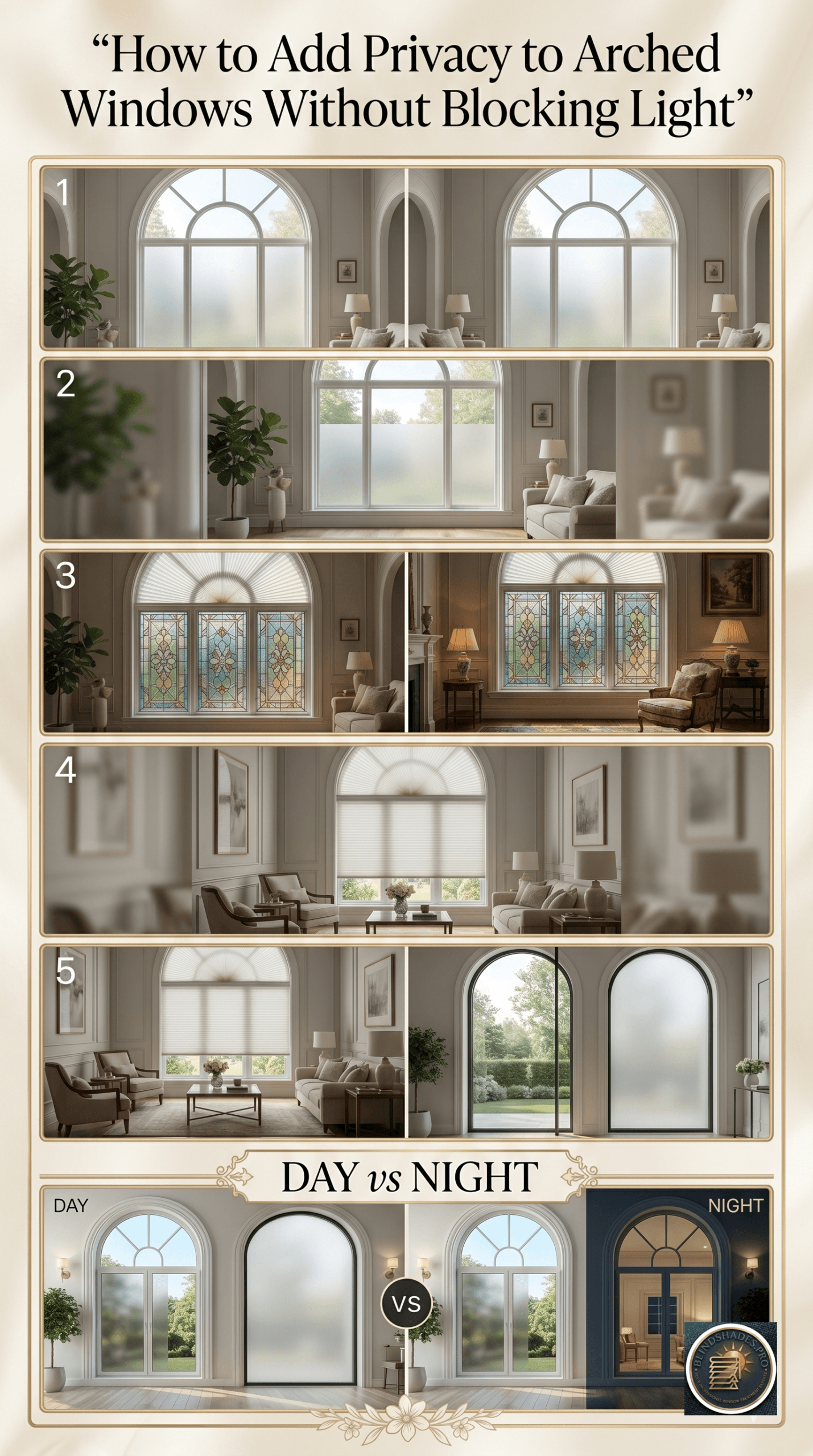
Key Takeaways:
- Before treating any arched window for privacy, assess its height: arched windows above 8 feet from the floor have naturally limited exterior visibility because a standing observer at ground level looks upward at a steep angle (30 to 60 degrees) through curved glass; for most residential arched windows positioned above the first-floor ceiling line, no privacy treatment is needed; only ground-floor arched windows at or near eye level in close proximity to street-facing positions need active privacy treatment
- Frosted film preserves significantly more natural light than light-filtering cellular arch shades while providing equivalent or better privacy; frosted film transmits 60 to 80 percent of visible light as soft diffused illumination (VLT 60-80); a light-filtering cellular arch shade transmits only 25 to 35 percent; for arched windows where natural light is valued, frosted film is the superior privacy-plus-light option
- Reflective or mirrored window film on arched windows provides daytime privacy only; at night when interior lights are on, the mirror effect reverses and exterior observers can see INTO the home through the arch more clearly than through untreated glass; for any arched window on the primary facade of the home that is visible from the street, reflective film creates a false sense of security at night; frosted film (which scatters light by a physical mechanism not dependent on light balance) provides consistent day-and-night privacy
- The partial coverage approach for arched windows applies frosted film or treatment to only the lower half of the arch from the base to approximately the midpoint or centerline; the primary ground-level sightline into an arch from an exterior observer enters through the LOWER portion of the arch (below the spring line); covering only the lower half blocks this sightline while leaving the upper arch entirely clear as a light source; this preserves approximately 50 percent more natural light than full arch coverage
- The edge gap in custom cellular arch shades creates a light leakage halo at night; Yoolax confirms that slight light enters around arched window edges even in blackout cellular arch shade installations; at night with interior lighting, this edge glow outlines the arch frame; specify outside-mount cellular arch shade (extending beyond the frame edges) to eliminate the edge gap, or use frosted film applied directly to the glass as an alternative with no edge gap
⭐ Quick Answer — How Do You Add Privacy to Arched Windows Without Blocking Light?
- Assess the Arch Height First — Most Arched Windows Above 8 Feet Need No Treatment: Before selecting any arched window privacy without light option, assess whether the arch actually needs treatment. Arched windows above approximately 8 feet from the floor have naturally limited exterior visibility. A standing observer at ground level must look upward at 30 to 60 degrees above horizontal to see through a second-story or gable arch; the steep upward sightline through the curved glass limits interior visibility to the ceiling and upper wall rather than the living space. For most residential arched windows at the top of a tall wall, above the first-floor ceiling line, or in a gable end: no privacy treatment is needed. Only ground-floor arched windows at or near eye level in street-facing positions and arched bathroom windows at any height require active privacy treatment
- The 5 Options Ranked by VLT — Frosted Film Preserves the Most Light: Arched window privacy without blocking light depends on choosing the treatment with the highest Visible Light Transmission (VLT). (1) Frosted film (full arch): VLT 60–80% — day-and-night privacy; no hardware; cut to arch shape; most light preserved. (2) Partial coverage frosted film (lower half only): VLT 100% in upper clear zone — blocks ground-level sightline while upper arch stays clear; approximately 50% more light than full-arch frosted coverage. (3) Decorative or stained glass film: VLT 60–80% — privacy as colored diffuse light; architecturally appropriate for Victorian, Georgian, and craftsman homes. (4) Light-filtering cellular arch shade: VLT 25–35% — privacy plus R-3 to R-4 insulation; significantly less light than frosted film. (5) Switchable smart film: VLT 60–80% when frosted; 100% when clear — clear to frosted on demand; premium option
- Reflective Film Fails at Night — The Critical Warning for Front-Facade Arched Windows: Many homeowners install reflective or mirrored window film on arched windows expecting consistent privacy without blocking light. Reflective film provides daytime privacy only. During the day, exterior light exceeds interior light and the film mirrors the exterior back, obscuring the interior view. At night with interior lights on, the light balance reverses: the interior becomes brighter, the mirror effect reverses, and exterior observers can see INTO the home more clearly than through untreated glass. This is particularly significant for arched windows on the primary facade visible from the street at night. Window Film Depot confirms: “a standard reflective tint creates a mirror finish on the side with greater light intensity; at night the mirror effect reverses.” For any front-facing arched window: specify frosted film only — its privacy mechanism is physical light scattering that is constant regardless of lighting conditions
- Partial Coverage and the Cellular Arch Shade Edge Gap: The partial coverage approach for arched window privacy without blocking light: apply frosted film to only the lower half of the arch (from the base to approximately the midpoint). The primary ground-level sightline from an exterior observer enters through the lower glass zone — above the midpoint, the arch is above the observer’s direct sightline. The lower-half treatment blocks the privacy-critical zone while the upper arch remains clear glass, transmitting full-intensity natural light. This preserves approximately 50 percent more natural light than full-arch frosted coverage. And the cellular arch shade edge gap warning: Yoolax confirms “slight light may enter around arched window edges” in cellular arch shade installations. At night, interior light leaks through the edge gap between the fabric and the curved frame, creating a visible halo outline of the arch. Solution: specify an outside-mount cellular arch shade (extending beyond the frame edges) to eliminate the edge gap
- Decorative Film and Switchable Smart Film — The Premium and Architectural Options: For arched window privacy without blocking light in period-style homes: decorative or stained glass film with period-appropriate patterns (jewel-toned stained glass for Victorian and Georgian; geometric amber and green art nouveau for craftsman) transmits 60 to 80 percent of light as colored diffuse illumination — the arch becomes a decorative light source. And the premium solution: switchable smart film changes from optically clear to frosted with a button, wall switch, smartphone, or voice command. When clear: full natural light; arch architectural form fully visible. When frosted: VLT 60 to 80 percent as soft diffuse light; complete day-and-night privacy. Smart Glass Country confirms their switchable film works on curved glass surfaces — no custom shade hardware needed. Cost: $4 to $15 per square foot installed vs $0.50 to $2 per square foot for standard frosted film
- Best Sources: Frosted vs reflective film day-and-night privacy guide (includes VLT ratings and night reversal mechanism) → Window Film Depot privacy film guide · Switchable smart film that works on curved and arched glass → Smart Glass Country frosted smart film · Custom cellular arch shades with outside mount to eliminate edge gap → Blindsgalore arched windows
⚠️ The Room-Type Privacy Guide and the VLT Comparison Table: Arched window privacy without blocking light needs differ significantly by room type and position. Foyer and entry (street-facing arch at eye level): frosted film full arch — most vulnerable to street-level visibility; frosted film consistent day and night. Living room arch at first floor: partial coverage frosted film on lower half only — preserves upper arch for light; lower half provides privacy. Living room arch at second floor above 8 feet: leave uncovered — height provides natural privacy. Bathroom arch (any height): frosted film full arch — no fabric treatments in moisture-prone spaces; frosted film is moisture-resistant. Bedroom arch at eye level: frosted film or outside-mount cellular arch shade — night privacy essential; frosted film preferred for consistent 24/7 coverage without edge gap. Gable window above 12 feet: leave uncovered — too high for any meaningful exterior sightline. Staircase landing arch: assess orientation; if facing a neighbouring building at the same height, frosted film; otherwise leave uncovered. VLT comparison: Frosted film standard: 60 to 80 percent. Decorative and stained glass film: 60 to 80 percent as colored light. Light-filtering cellular arch shade: 25 to 35 percent. Room-darkening cellular arch shade: 5 to 15 percent. Blackout cellular arch shade: 0 to 1 percent. Reflective tinted film (darkest): 7 percent. All-around tinted film: 35 percent. The conclusion: frosted film provides the best light transmission of any privacy treatment — substantially better than any cellular shade option for arched windows specifically. For the full arch treatment selection guide by orientation, cost per year, and the perfect vs non-perfect arch measurement protocol, see What Are the Best Blinds for Arched Windows. See the full height assessment guide below.
💡 The Frosted Film Application Protocol for Arched Windows and the Stained Glass Film Options: Applying frosted film to an arched window for privacy without blocking light does not require custom fabrication. For a perfect half-round arch: cut a rectangle of frosted film slightly larger than the arch dimensions; apply the film sheet to the glass; trim flush to the curved frame edge using a straightedge and utility knife; the film follows the glass contour automatically. For a non-perfect arch with an asymmetric or shallower curve: apply the film sheet and trim in place following the exact frame edge — the curved glass surface accepts standard frosted film without any arch-specific sizing. Standard frosted film cost: $20 to $80 per arched window. Decorative and stained glass film options for period homes: Victorian and Georgian homes: jewel-toned stained glass patterns (cobalt, amber, ruby) at $30 to $120 per window; the arch transmits colored ambient light that complements period architectural elements. Craftsman and arts and crafts homes: geometric art nouveau patterns with amber and green tones. Colonial revival: frosted with subtle etched border. Contemporary and modern: plain frosted in the highest available VLT for maximum light preservation with privacy. The partial coverage application: measure the arch height; divide by 2 to find the midpoint; apply frosted film from the arch base upward to this midpoint only; leave the upper half clear. This is the same partial application protocol used for sidelight privacy (the upper 30 to 40 percent of sidelights from Article 45-9) adapted for the arch geometry where the ground-level sightline enters the lower glass zone. For the sidelight parallel and the lux quantification by treatment type, see How Do You Add Privacy to Sidelights Without Blocking Light. See the full five-option VLT ranking below.
📖 Read the complete guide below for: the height assessment protocol (arched windows above 8 feet; 30 to 60 degree upward sightline; curved glass deflection; most arched windows at elevation need no treatment), the 5 options ranked by VLT (frosted film 60-80% / partial lower-half 100% in upper zone / decorative film 60-80% colored / cellular 25-35% / switchable smart film 60-80% frosted to 100% clear), the frosted film day-and-night physical diffusion mechanism vs reflective film’s night reversal failure, the partial coverage calculation (arch height divided by 2 = midpoint; lower half treated; upper half clear; 50% more light than full coverage), the decorative and stained glass film options by architectural style, the cellular arch shade edge gap halo at night and the outside-mount solution, the room-type privacy guide with correct treatment by position, and the switchable smart film specification (curved glass compatible; $4-$15/sq ft installed).
The Height Assessment — Most Arched Windows Do Not Need Privacy Treatment
The single most important step before ordering any arched window privacy treatment — absent from all competitor guides.
The most common arched window position in residential homes is at the top of a tall wall, above a rectangular window, or in a gable end — typically 8 to 16 feet from the floor. At these heights, the exterior observer’s sightline physics change fundamentally.
The sightline geometry at height: A standing adult at the exterior of a home at standard sidewalk or yard distance (10–20 feet away) looking toward a second-story arched window must look upward at approximately 30 to 60 degrees above horizontal. At this steep upward angle:
- The glass surface is viewed at a highly oblique angle (not perpendicular)
- The curved glass of an arched window further deflects the sightline away from interior content
- The interior of the room visible through the arch is mostly the ceiling and upper wall — not the living space
The practical result: For arched windows positioned above approximately 8 feet from the interior floor: exterior visibility into the home through the arch is minimal from any normal exterior observer position. Ground-floor neighbors, passersby on the sidewalk, and visitors approaching the front door typically cannot see meaningful interior content through a second-story or gable arch.
When arched window privacy treatment IS needed:
- Ground-floor arched windows at or near eye level (standing observer can look straight through)
- Arched windows in close proximity to adjacent buildings (a neighbor’s window at the same height)
- Arched windows in bathrooms where the privacy requirement is absolute
- Arched windows on the primary facade at a height where holiday decorations, furniture tops, or standing occupants are visible from the street
The check: Stand at the street or public access point nearest the arched window and look toward it. If you can see meaningful interior content through the arch, treatment is warranted. If you see primarily ceiling, sky, or upper wall, the window’s height provides natural privacy.
Arched Window Privacy Without Blocking Light – The 5 Options Ranked
Ranked by visible light transmission preserved (most light to least):
Option 1 — Frosted Film on the Full Arch (60–80% VLT; Best Light Preservation)
The primary recommendation for arched window privacy without blocking light.
Frosted window film applied to arched glass transmits 60 to 80 percent of visible light (VLT 60–80) as soft diffused ambient illumination while completely obscuring interior visibility at all angles and at all times of day — including at night.
The VLT comparison:
| Treatment | Visible Light Transmission (VLT) | Light Quality | Privacy Level |
|---|---|---|---|
| No treatment (clear glass) | 100% | Direct; sharp shadows | None |
| Frosted film (standard) | 60–80% | Soft diffused ambient | Full — day and night |
| Decorative/stained glass film | 60–80% | Colored diffuse light | Full — day and night |
| Light-filtering cellular arch shade | 25–35% | Filtered ambient | Full when down |
| Room-darkening cellular arch shade | 5–15% | Very dim | Full when down |
| Blackout cellular arch shade | 0–1% | None | Full when down |
Why frosted film outperforms cellular shades for light preservation with privacy: A frosted film preserving 70% of incoming light through an arched window provides substantially more interior illumination than a light-filtering cellular shade preserving 30%. For arched windows that serve as secondary daylight sources in a room, this difference is noticeable: the frosted film arch remains a meaningful light contributor; the light-filtering cellular shade significantly dims the arch’s contribution.
The frosted film mechanism — day and night: Window Film Depot confirms the mechanism: “a frosted or decorative film is not opaque, it is translucent — it allows light to pass through but diffuses it in the process. This diffusion effectively obscures the view by breaking up the light that forms a clear image, leaving only a blurred impression of color and movement. This physical property is constant, providing a privacy shield that works day and night.”
Installation on arched windows: Film is cut to the arch glass shape and applied directly. No custom fabrication beyond a straightedge trim at the arch frame. For perfect half-round arches: cut a rectangle of film, apply to glass, and trim flush to the curved frame edge with a utility knife. For non-perfect arches: cut slightly oversized and trim in place.
Cost: $20–$80 per arch window
Option 2 — Partial Coverage Frosted Film on Lower Arch Only (Best Light Preservation; Ground-Level Privacy)
The approach absent from all competitor guides — covering only the portion that actually needs privacy.
The primary ground-level sightline into an arched window from an exterior observer enters through the LOWER portion of the arch. An observer standing outside at ground level looking up toward an arch looks through the lower glass zone first — the upper portion of the arch (above the arch’s midpoint or spring line) is above the observer’s direct sightline.
The partial coverage implication: Applying frosted film to only the LOWER HALF of the arch (from the base of the arch to approximately the midpoint or spring line) blocks the primary ground-level sightline while leaving the upper arch entirely clear.
The result:
- The lower half of the arch provides privacy from ground-level observers
- The upper half of the arch remains clear glass — transmitting full-intensity unobstructed natural light
- Total light preserved: approximately 50% more than full-arch frosted film coverage
The calculation: For a 36-inch-tall arch with frosted film on the lower 18 inches (lower half):
- Lower frosted zone (18 inches, 50% of arch): approximately 40–55% light output (diffused)
- Upper clear zone (18 inches, 50% of arch): approximately 50% of total arch light output (direct)
- Total: approximately 90–105% of the light output of the frosted-film-only approach — effectively preserving all the light while providing ground-level privacy
Best for: Living room arches, entry arches, and any arch where ground-level privacy matters but full arch coverage would noticeably reduce room brightness.
Option 3 — Decorative or Stained Glass Film (60–80% VLT; Architecturally Appropriate)
The privacy-plus-design option absent from all arched window privacy guides.
Decorative film with stained glass, frosted geometric, or etched glass patterns transmits 60–80% of visible light as colored or patterned diffuse illumination while providing the same full-time privacy as standard frosted film.
The architectural appropriateness: Arched windows are predominantly found in Victorian, Georgian, craftsman, and colonial revival homes. A plain frosted film in these architectural contexts looks clinical — the modern flat frosting conflicts with the period character of the arch.
Stained glass film with period-appropriate patterns:
- Victorian and Georgian: jewel-toned stained glass (amber, cobalt, ruby) — the arch transmits colored ambient light that enhances the period character
- Craftsman and arts and crafts: geometric art nouveau patterns with amber and green tones
- Colonial revival: frosted with subtle etched border pattern
The interior light effect: Unlike plain frosted film that transmits neutral white diffuse light, stained glass film transmits the arch’s daylight as warm, colored illumination. The arch becomes a decorative light source — contributing interior ambience beyond its privacy function.
Cost: $30–$120 per arch window (film material; higher for premium stained glass film types)
Option 4 — Light-Filtering Cellular Arch Shade (25–35% VLT; Insulation Plus Privacy)
The option that adds R-3 to R-4 insulation — at the cost of significantly more light reduction than frosted film.
A stationary custom cellular arch shade provides privacy and insulation simultaneously — no other treatment option combines both. The light-filtering fabric transmits 25–35% of incoming light as filtered ambient illumination.
The critical edge gap warning — absent from all guides: Yoolax confirms: “slight light may enter around arched window edges” even in blackout cellular arch shades. At night with interior lighting:
- The cellular shade fabric blocks interior light from transmitting through the fabric
- But at the edges where the fabric meets the curved arch frame, small gaps allow interior light to leak outward
- This creates a visible glow or “halo” around the arch frame at night — revealing to exterior observers that the interior is lit even when the cellular shade is fully deployed
The solution: Specify an OUTSIDE MOUNT cellular arch shade that extends beyond the arch frame on all sides. The extended shade covers the frame edges, eliminating the gap. Alternatively, combine frosted film (applied to glass) with a cellular arch shade for full layered coverage with no edge gap.
Best for: South-facing and west-facing arched windows where the insulation benefit (R-3 to R-4) justifies the additional cost and the greater light reduction; homes where energy efficiency is a priority alongside privacy.
Option 5 — Switchable Smart Film (Premium; Clear to Frosted On Demand)
The premium arched window privacy option absent from all buying guides.
Switchable smart film (also called PDLC film or electrochromic film) changes from optically clear to frosted with an electrical signal — at the touch of a button, a wall switch, a smartphone, or a voice command via Alexa or Google Home.
When clear: Full natural light transmission; full view in and out; no visual obstruction of the arch’s architectural form. When frosted: 60–80% VLT as soft diffuse light; complete privacy in both directions; daytime and nighttime reliable.
Why it suits arched windows particularly well:
- Film applies to the glass surface and follows the curved arch — no custom shade fabrication needed
- No hardware, headrail, or frame modification
- The arch’s architectural character is fully preserved in the clear state — the treatment is invisible when privacy is not needed
- Smart Glass Country confirms their switchable film works on curved glass surfaces
The cost: Switchable smart film costs approximately $4–$15 per square foot installed — significantly more than standard frosted film ($0.50–$2/sq ft). For a 36×18-inch arch (approximately 2.4 sq ft of glass): switchable film = $10–$36 per window at material cost; installed cost higher.
Best for: Premium installations; large feature arched windows in living rooms, home offices, or primary bedrooms where the on-demand privacy control justifies the cost.
The Night Privacy Warning for Front-Facade Arched Windows
The reflective film reversal problem — particularly significant for arched windows on a home’s primary exterior.
Many homeowners install reflective or mirrored window film thinking it provides consistent privacy. It does not.
The daytime mechanism: During the day, exterior light intensity exceeds interior light intensity. The reflective film acts as a one-way mirror from outside: the exterior surface reflects sunlight and obscures the view into the home. Privacy is effective.
The nighttime reversal: At night with interior lights on, interior light intensity exceeds exterior light intensity. The reflective film reverses its effect: the interior surface now appears as a mirror to the homeowner (they see their own reflection) while the exterior surface becomes transparent — exterior observers can see INTO the home with enhanced clarity.
Window Film Depot confirms: “many people mistakenly believe that the standard reflective tint providing daytime privacy will work effectively after dark. A standard reflective tint creates a mirror finish on the side of the glass with the greater intensity of light. At night, the mirror effect reverses.”
Why arched windows are particularly vulnerable: Arched windows on the primary facade of a home — above a front door, in a foyer, or as a feature element of the front elevation — are prominently visible from the street at night. An occupied, illuminated foyer or living room with a reflective-tinted arched window becomes MORE transparent to exterior observers at night than an untreated arch would be.
The specification: For any arched window on the primary facade visible from the street at night: specify frosted film only. Frosted film provides consistent day-and-night privacy through its physical diffusion mechanism — it does not rely on a light level differential.
The Room-Type Privacy Guide for Arched Windows
Privacy treatment decisions by room type — absent from all guides.
| Room Type | Privacy Need | Recommended Treatment | Notes |
|---|---|---|---|
| Foyer / Entry (street-facing arch at eye level) | High | Frosted film or decorative film (full arch) | Most vulnerable to street-level visibility; frosted film consistent day + night |
| Living room arch at first floor | Moderate | Partial coverage frosted film (lower half only) | Preserves upper arch for light and view; lower half provides privacy |
| Living room arch at second floor (above 8 ft) | Low to none | Leave uncovered or Redi Shade if desired | Height provides natural privacy |
| Bathroom arch | Very high | Frosted film (full arch) | No fabric treatments in moisture-prone spaces; frosted film moisture-resistant |
| Bedroom arch at eye level | High | Frosted film or cellular arch shade | Night privacy essential; frosted film preferred for consistent coverage |
| Gable window above 12 feet | None | Leave uncovered | Too high for any meaningful exterior sightline; see Gap #1 analysis |
| Staircase landing arch | Low to moderate | Assess orientation and adjacent buildings | If facing a neighboring building at same height: frosted film; otherwise leave uncovered |
| Office arch (south or west-facing) | Moderate | Light-filtering cellular shade or frosted film | Solar glare control as important as privacy; cellular shade provides insulation |
Where to Order
For frosted and decorative privacy film (including day-and-night privacy explained by VLT): Window Film Depot at windowfilmdepot.com/blog/day-and-night-privacy-window-film — the most detailed published guide on frosted vs reflective vs smart film for day-and-night privacy; explains the night reversal mechanism; product selection guidance for 24/7 privacy.
For switchable smart film (clear to frosted on demand for arched and curved glass): Smart Glass Country at smartglasscountry.com/news/frosted-smart-film — switchable film that works on curved glass surfaces; retrofit to existing glass; smart home integration; available for arched window applications.
For custom cellular arch shades with outside mount option to eliminate edge gap: Blindsgalore arched windows at blindsgalore.com/arched-windows — Blindsgalore Select Light Filtering and Blackout Arch Cellular; fabric clips for arch structure; coordinating standard cellular shades for lower rectangular sections.
Frequently Asked Questions
How do you add privacy to arched windows without blocking light? The best ways to add privacy to arched windows without blocking light are frosted window film (which transmits 60 to 80 percent of visible light as soft diffused illumination while providing full-time privacy day and night), partial coverage frosted film on the lower half of the arch only (blocks the primary ground-level sightline while leaving the upper arch clear for maximum light), and decorative or stained glass film (transmits 60 to 80 percent as colored diffuse light while being architecturally appropriate for period homes). Light-filtering cellular arch shades transmit only 25 to 35 percent of light, making frosted film substantially better at preserving natural light while providing equivalent or better privacy.
Do most arched windows need privacy treatment? Most arched windows positioned above 8 feet from the floor do not need privacy treatment. The steep upward sightline angle (30 to 60 degrees above horizontal) from a ground-level observer combined with the curved glass surface limits interior visibility through arched windows at elevation. Only ground-floor arched windows at or near eye level, bathroom arched windows where privacy is absolute, or arched windows in close proximity to adjacent buildings at the same height typically need active privacy treatment.
Why does reflective window film fail for arched window privacy at night? Reflective window film provides privacy by mirroring exterior light back toward the observer during the day when exterior light is brighter than interior light. At night when interior lights are on, the light intensity reverses: the interior becomes brighter than the exterior, and the mirror effect reverses so exterior observers can see INTO the home with greater clarity than through untreated glass. This is particularly significant for arched windows on the primary facade of a home that are visible from the street at night. Frosted film provides reliable day-and-night privacy because its privacy mechanism is physical light diffusion, not a light level differential.
What is the partial coverage approach for arched window privacy? The partial coverage approach applies frosted film or treatment to only the lower half of the arch, from the arch base to approximately the midpoint or spring line, while leaving the upper arch clear glass. The primary ground-level sightline from an exterior observer into an arched window enters through the lower portion of the arch because the observer must look upward through the lower glass zone to see into the room. Covering only the lower half blocks this sightline while the upper clear arch continues to transmit full-intensity unobstructed natural light. This approach preserves approximately 50 percent more natural light than full-arch frosted film coverage while providing effective ground-level privacy.
What is switchable smart film for arched window privacy? Switchable smart film changes from optically clear to frosted when an electrical signal is applied — activated by a button, wall switch, smartphone, or voice command. When clear, it transmits full natural light and the arch is completely visible. When frosted, it transmits 60 to 80 percent of light as soft diffuse illumination while providing complete privacy in both directions. Switchable smart film applies to the glass surface and follows the curved arch without requiring custom shade hardware. Smart Glass Country confirms their switchable film works on curved glass surfaces. The cost at approximately 4 to 15 dollars per square foot installed is significantly higher than standard frosted film at 0.50 to 2 dollars per square foot.
Related Guides on BlindShades.pro
- The Best Arched & Specialty Windows Buying Guide
- What Are the Best Blinds for Arched Windows
- Can You Put Shutters on an Arched Window
- Is a Custom Arch Shade Worth the Cost
- How Do You Measure Arched Windows for Blinds
By Michael Turner | 30 Years Home Improvement Expertise | Updated 2026 | BlindShades.pro
