Best Basement Window Blinds & Shades (2026): The Below-Grade Guide

Authored By Michael Turner -30 Years Home Improvement Expertise | Updated 2026 | BlindShades.pro
Updated on July 21, 2026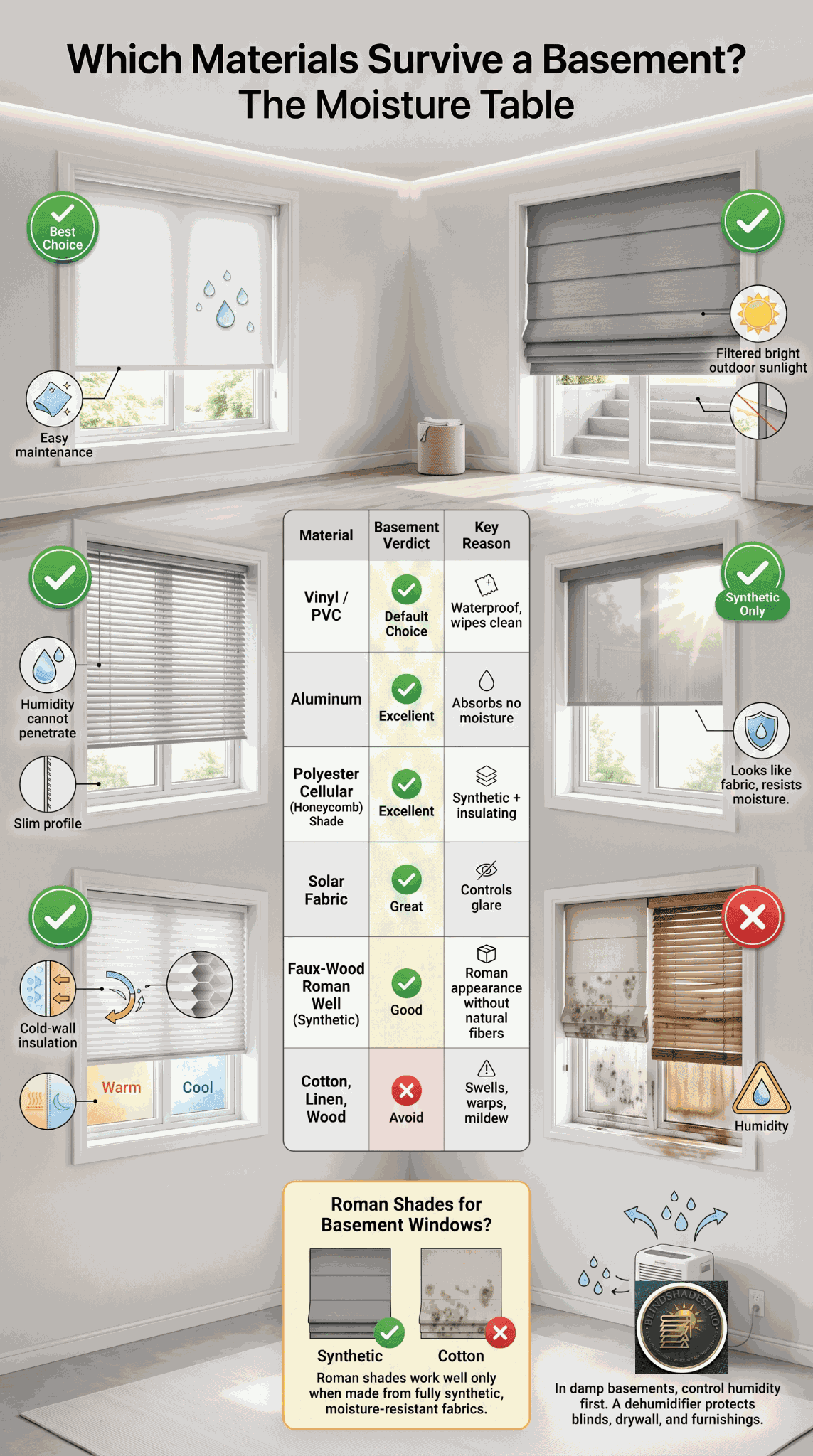
By Michael Turner — 30 years in the window treatment industry
Basement windows are the house’s hardest brief in its smallest frame: damp air that swells natural fibers, hopper sashes that tilt inward and crush ordinary blinds, deep concrete recesses, and — on any bedroom window — a legal escape route your treatment must never block. Every guide in this market lists the same product types; none engineers those four constraints. This one does, with the Below-Grade Test: Moisture (synthetics only — the market’s own advice is vinyl roller or synthetic cellular, and the sharpest answer in any community thread says it in one line: plastic or aluminum slats absorb no moisture), Mount (the hopper problem, solved three ways), and Means of Escape (the egress rule, promoted from a buried comment to the section it always deserved). Small glass, big physics — here’s the whole below-grade playbook.
Key Takeaways
- Synthetics or nothing: vinyl, faux wood, aluminum, PVC, and polyester cellular survive basement humidity; cotton and natural fibers don’t — the market’s own guidance says avoid natural materials, and the moisture table below shows why.
- Hopper windows defeat normal blinds. A sash that tilts inward crushes an inside-mounted shade or is blocked by it — the fixes are outside-mounting above the recess, sash-mounted shallow shades that travel with the tilt, or the deep-recess honeycomb play.
- The egress rule outranks style on exactly one window per bedroom: basement bedroom windows are legal escape routes, and the treatment must lift, release, or swing clear in the dark — the checklist below is the section no competitor wrote.
- Small glass wants light-filtering by default: below grade, every lumen is rationed — save true blackout for the theater wall and the bedroom, let the rest of the basement keep its daylight, and give the sweating cold-glass windows the standoff air gap that lets them dry.
- The review arithmetic is enormous and clear: the category’s workhorses carry bases of five thousand seven hundred, five thousand five hundred, and twenty-one thousand — basement buyers are settled, and the value picks are proven.
⭐ Quick Answer — The Best Basement Window Blinds & Shades
The best basement window blinds pass the Below-Grade Test — Moisture (synthetics only), Mount (the hopper strategy first), Means of Escape (egress windows keep a fast, clear exit):
- Best Overall: cordless light-filtering cellular in the fifty-seven-hundred-review class, about thirty-eight — recess-friendly, insulating, and the small-hopper classic; the honeycomb rules live in the cellular and honeycomb shades guide.
- Best for damp rooms: the cordless faux-wood workhorse at four point six across roughly twenty-one thousand reviews — the moisture rule in product form, per the faux wood blinds guide.
- The materials law: plastic, vinyl, and aluminum absorb no moisture; avoid cotton and naturals — the professional framing (humidity, insulation, privacy) at Blinds To Go and the basement collections at Factory Direct Blinds follow the same rule.
- The hopper problem, solved: tilt-in sashes defeat inside mounts — mount above the recess, on the sash, or deep-recess after the arc test; the long-standing deep-recess honeycomb answer lives in the community threads at Houzz.
- The egress rule outranks style: bedroom basement windows are escape routes — cordless quick-lift or swing-clear only, nothing across the opening, and true blackout saved for the theater wall per the blackout blinds guide.
Quick Specification Reference
| Specification | Below-grade reality (2026) |
|---|---|
| The window formats | Hopper (tilts in), awning, small sliders, glass block, walkout full-size |
| The moisture rule | Synthetics only — vinyl, faux wood, aluminum, PVC, poly cellular; no cotton, no natural fibers |
| The hopper rule | Inside mounts and tilting sashes are enemies — mount outside, on the sash, or shallow in a deep recess |
| The egress rule | Bedroom basement windows are escape routes — treatments must clear the opening fast, in the dark |
| The light strategy | Light-filtering default; blackout only where sleep or screens demand it |
| The operation default | Cordless — for reach-over-appliance windows, for kids, and for the market’s own advice |
| The size shape | Small and wide-short — thirty-to-thirty-six by twelve-to-twenty-four inches is the classic hopper |
| The price band | About twenty (mini) to one twenty-nine (custom small blackout); most winners under sixty |
| The recess bonus | Deep recessed windows in concrete reveals hide full honeycomb stacks entirely — the one luxury basements grant, measured with the arc test first |
Read the complete guide below for: the six picks with their giant honest review bases, the Below-Grade Test, the moisture-materials table with the community’s sharpest answer credited, the hopper problem solved three ways, the egress checklist this category owed its readers, the light-strategy and sizing tables, every buying lane, and the warning table.
What Are the Best Basement Window Blinds & Shades in 2026? — Our Picks
Review volumes are stated exactly as the market shows them — and in this category they are enormous, because basements are where America actually buys its practical blinds.
| Pick | Product | Rating / reviews | Price (words) | The lane |
|---|---|---|---|---|
| Best Overall | Home Decorators Cordless Light-Filtering Cellular | 4.4 across ~5,700 (sibling size 4.5 across ~5,500) | About thirty-eight | The classic small-window answer — soft light, cordless reach, recess-friendly |
| Best for Damp Rooms | Cordless Faux Wood Blind (2-inch, the category workhorse) | 4.6 across ~21,000 | About thirty-five | Laundry, utility, workshop — the moisture rule in product form |
| Best Theater-Dark | Guard Total Blackout Shade | 4.9 across 854 | About one fifty-three | The media-wall cave maker |
| Best Budget Roller | IKEA SANDVEDEL Roller | 4.2 across 958 | About forty | The walkout slider’s clean answer |
| Best Custom Small-Size | Blindster Blackout Cellular | 4.5 across 843 | About one oh four | Basements collect odd sizes; this lane sews them |
| Best Big-Box Slat | allen+roth 2-in Room-Darkening Faux | 4.2 across 219 | About fifty-six | The Lowe’s aisle’s honest pick |
Two honesty notes. The huge bases deserve their explanation: basement-format products are the same SKUs America buys for every small window, so their arithmetic is the most settled on this site — trust it. And one famous name lands in the warning table instead of here: the trim-at-home big-box system scoring three point six across five hundred fifty-seven — the trim-kit convenience is real, and so is the score; the custom small-size lane above costs little more and measures once.
The Below-Grade Test: Moisture · Mount · Means of Escape
Three questions in order — what the damp allows, what the window’s mechanics allow, and what the fire code requires — and the third is non-negotiable on bedroom glass.
| Below-Grade Test step | The question | The failure it prevents |
|---|---|---|
| Moisture | Is every material in the product synthetic? | The swollen cotton roman rotting quietly against cold glass |
| Mount | Does the sash tilt, and how deep is the recess? | The hopper that crushes its own blind on the first airing |
| Means of Escape | Is this window a bedroom egress? | The screwed-down treatment between a sleeper and the exit |
Which Materials Survive a Basement? The Moisture Table
The sharpest answer in this market came from a community thread, and this guide credits it: plastic or aluminum slats absorb no moisture — that one sentence is the whole materials chapter, expanded below.
The market’s professional guidance agrees from every side: the October 2025 dealer advice is vinyl roller shades or synthetic cellular, cordless for easy operation — and avoid natural materials like cotton; the design-blog roundups converge on light-filtering cellular, roller, roman, or solar formats in synthetic fabrics. The table:
| Material | Basement verdict | The note |
|---|---|---|
| Vinyl / PVC (rollers, minis, faux) | ✓ The default | Wipes clean; shrugs at humidity — the whole case from our faux wood blinds guide applies at full strength |
| Aluminum (minis) | ✓ | The community answer’s second half — absorbs nothing, fits shallow; the format lives in our mini blinds guide |
| Polyester cellular / honeycomb | ✓ | Synthetic fabric + insulation against cold concrete walls — the family’s rules are in our cellular and honeycomb shades guide |
| Solar and screen fabrics | ✓ | The walkout slider’s glare answer |
| Faux-wood roman styles | ✓ if fully synthetic | The roman look without the roman fiber — check the fabric line before assuming |
| Cotton, linen, natural romans, wood | ✗ | Swell, mildew, warp — the same exclusion our bathroom window blinds guide enforces, for the same air |
The roman-shades-for-basement-windows question gets its honest answer here: yes, in fully synthetic fabrics only — the silhouette is fine; the traditional cotton isn’t. And for chronically damp or musty basements, treat the treatment as step two: a dehumidifier protects the blinds, the drywall, and everything else at once.
How Do You Mount Blinds on Hopper Windows? The Hopper Problem
The basement’s signature window tilts inward from the top — straight into the space where a blind hangs — and no other guide in this market solves it. Three ways, mapped:
| Strategy | How it works | Choose it when |
|---|---|---|
| Outside-mount above the recess | Bracket to the wall or joist ABOVE the opening; the shade hangs proud of the recess, and the sash tilts freely behind it | The default — works with any product, hides the recess, and adds visual height to short windows |
| Sash-mounted shallow shade | A slim cordless cellular or mini mounted ON the tilting sash itself, traveling with it | You air the basement daily; the shade and sash move as one — keep total depth under an inch |
| Deep-recess inside mount | In concrete reveals four-plus inches deep, a honeycomb sits fully inside and the sash tilts beneath it | The deep-recess honeycomb play — the community’s own long-standing answer for recessed basement windows — measure the tilt arc first |
Basement hopper window blinds are this category’s most-asked mounting question for good reason: get the strategy wrong and the product choice never matters — the blind and the sash will fight, and the sash always wins. The arc test before any inside mount: open the hopper fully, measure the clearance between the tilted sash’s top edge and the recess head — that number, minus half an inch, is your maximum shade-stack depth. Masonry note for all three strategies: concrete and block take the same anchor discipline as any masonry mount — hammer drill, sleeve anchors, never the mortar joint — and where drilling is forbidden or dreaded, the tension and adhesive toolbox from our no drill blinds guide covers small hoppers well, since these are the lightest shades in the house.
What About Egress Windows? The Rule That Outranks Style
Any basement bedroom window is a legal escape route — and one buried community comment said what every guide skipped: choose the treatment because this is an egress in case of fire. Promoted, expanded, and made a checklist:
| Egress checklist item | The rule | Why |
|---|---|---|
| Operation | Cordless quick-lift, or hinged panels that swing fully clear | One motion, no fine motor skills, in the dark |
| Mounting | NOTHING screwed, tensioned, or framed ACROSS the opening | The window must open to its full clear dimension |
| Well covers | The window well’s cover lifts from inside without tools | The second half of the exit is outside the glass |
| The product shortlist | Cordless cellular/roller (lifts fast), or shutters sized to swing clear | The community pick — a hinged shutter — works BECAUSE it swings away whole |
| The nighttime test | Every occupant clears the window in the dark, once | Codes size the opening; only practice sizes the person |
| The honest line | Style loses this one window, every time | Decorate the other windows |
The context that makes this real: modern codes require basement sleeping rooms to have emergency escape and rescue openings of a minimum clear size, and a treatment that blocks, slows, or complicates that opening defeats the code’s whole purpose. This guide isn’t your inspector — sizes and specifics vary by jurisdiction, so verify locally — but the checklist above keeps any treatment on the right side of the principle. High small bedroom windows also raise the reach question, and the thread that surfaced the egress insight also carried the modern answer: remote and motorized shades for high placements — with the egress caveat applied (motorized on the fixed windows freely; the escape window itself wants a manual, instant, power-independent lift). Two scenarios that trip real buyers, resolved by the checklist: the finished-basement guest room that “isn’t really a bedroom” — if anyone sleeps there, treat its window as egress, because inspectors, insurers, and fires all will; and the beautiful blackout cave built for a teenager — keep the darkness, but hang it as a quick-lift cordless with nothing bridging the frame, and put the sealed side-channels on the theater wall instead, where nobody sleeps behind them. The rule costs one window some style; it can pay back a life.
The Cold-Wall Chapter: Insulation and Condensation Below Grade
Basements run cold off the concrete, and the glass sweats — two below-grade physics facts that quietly pick your product for you.
The insulation half first. A basement wall is earth-cooled masonry, and its small windows are single-glazed more often than any others in the house — which makes the honeycomb’s dead-air cells worth more per square inch here than anywhere upstairs. Cellular fabric’s insulating R-value is the spec the whole category trades on, and below grade it does double duty: softening the cold radiating off the glass in winter and keeping walkout-level heat out in summer — the full winter science lives in our thermal and insulating blinds guide, and it argues hardest exactly here. The condensation half is the trap: cold glass plus damp basement air equals a sweating pane, and a shade pressed close against it becomes the wick. Three rules keep the physics friendly. First, favor the outside-mount-above-the-recess strategy from the hopper section for chronically sweaty windows — the standoff air gap lets the pane dry instead of feeding the fabric. Second, raise the shades on laundry days and after showers vent through the basement; twenty minutes of open glass beats a season of trapped damp. Third, watch the bottom rail: it’s the condensation collection point, which is one more argument for the all-synthetic rule — a vinyl or aluminum rail shrugs at a puddle that would swell a wooden one. And the standing footnote from the moisture chapter applies double on cold glass: a dehumidifier is the cheapest window treatment in this whole guide, because it protects every other one.
How Much Light Should You Keep? Below-Grade Light Strategy
Small glass rations every lumen — so the basement default is filter, not blackout, and the exceptions are named rooms.
| Zone | The strategy | The routing |
|---|---|---|
| Living/rec areas | Light-filtering cellular or solar — privacy with every lumen kept | The daylight-first default |
| Home theater | Total blackout, sealed edges | The Guard-class cave — full science in our blackout blinds guide, and the seven-year hometheater forum consensus agrees |
| Basement bedrooms | Room-darkening to blackout — WITH the egress checklist | Sleep dark, exit fast |
| Laundry/utility | Faux or aluminum, privacy-first | The twenty-one-thousand-review answer |
| Walkout sliders | Solar or roller for glare; vertical logic for the big glass | The one full-size window basements get |
| Day-night wish | The dual-fabric compromise | Our day-night blinds guide — one cassette, both moods |
The pictures-and-ideas searches this market runs on — basement window treatments pictures, basement window treatment ideas — deserve one honest sentence: the eighty-one-idea boards are real inspiration, but every pretty picture still has to pass the three tests above; this guide is the caption those boards are missing. And the walkout basement earns its own paragraph, because it is really two floors wearing one name: the buried side runs the small-window playbook above, while the walkout wall — full sliders, sometimes a whole glazed elevation — plays by upstairs rules with a below-grade twist: afternoon sun off a patio hits LOW and glares hard across screens and floors, which is why solar fabrics and rollers with real openness math beat sheer prettiness there, and why the slider’s treatment should stack fully clear of the door path — the traffic-flow rule every walkout family learns the first summer. Treat the two elevations as two projects sharing a paint color, and both get solved properly.
What Sizes Do Basement Windows Take? The Small-Window Table
Wide-and-short is the below-grade signature — and small basement window blinds are mostly a stock-size game with one custom escape hatch.
One naming sweep before the table, because this category’s searches are wonderfully literal: cellular shades for basement windows are the classic small-hopper answer (the Best Overall pick above), faux wood blinds for basement windows own the damp utility rooms (the twenty-one-thousand-review case), roman shades for basement windows pass only in fully synthetic fabrics (the moisture table’s verdict), and hopper window shades are less a product than a mounting strategy — the three-way solution two sections up. Every phrasing lands in the same three-test framework.
| Format | Typical size class | The play |
|---|---|---|
| Classic hopper | Thirty-to-thirty-six wide × twelve-to-twenty-four tall | Stock widths cut down; cordless cellular or mini |
| Awning/slider pair | Similar, side by side | Two narrow shades beat one wide — independent light control |
| Glass block | No treatment needed | The one free pass in the house |
| Egress casement | Code-sized, larger | The checklist window — cordless quick-lift or swing-clear |
| Walkout slider | Full patio size | The big-glass rules apply |
| The odd sizes | Everything basements collect | The custom small-size lane (the eight-forty-three-review pick) — measured with the same three-times discipline as our made to measure blinds guide |
Where Should You Buy — and the Warning Table
The lanes: the big-box aisles carry the giant-base workhorses (the cellular and faux picks live there, with the basement-collection specialists running about fifty-six to one twenty-nine on thirty-day terms), IKEA holds the roller floor, the custom small-size lane sews the odd ones, and the specialist framing this category best — moisture resistance, insulation, privacy — is exactly the three-test logic this guide formalized.
| Warning | The listing | The rule |
|---|---|---|
| The trim-kit score | 3.6 across 557 on the famous trim-at-home system | Convenience real, score real — custom-cut costs little more |
| One-review five-stars | 5.0 across 1 waterproof and specialty listings | Anecdotes, as always |
| Natural-fiber “basement” listings | Cotton romans marketed below grade | The moisture table vetoes the marketing |
| Per-count pricing | Multi-window packs shown per-blind | Divide before comparing |
| Egress-blocking hardware | Tension frames and screwed screens ACROSS bedroom openings | The checklist’s hard no |
Best Sources on Basement Window Blinds & Shades
- The community moisture answer — plastic or aluminum slats absorb no moisture; the sharpest single sentence in this market, credited and expanded here.
- The dealer guidance (October 27, 2025) — vinyl roller or synthetic cellular, cordless, avoid natural materials like cotton; the professional confirmation.
- The egress comment — choose the shutter because this is an egress in case of fire; the buried insight this guide promoted to a section.
- The deep-recess honeycomb thread (2019) — the community’s long-standing answer for recessed basement windows.
- The blackout authorities — the Wirecutter roundup (May 27, 2025) and the seven-year hometheater consensus, routed to the theater wall where they belong.
Related Buying Guides
- Best Cellular & Honeycomb Shades — the deep-recess and insulation answer
- Best Faux Wood Blinds — the moisture workhorse
- Best Mini Blinds — aluminum’s no-moisture case
- Best Bathroom Window Blinds — the site’s other humidity room
- Best Blackout Blinds & Shades — the theater wall’s science
- Best No Drill Blinds — when concrete says no
- Best Thermal & Insulating Blinds — cold-wall comfort
- Best Day-Night Blinds — both moods, one cassette
- Best Zebra & Banded Blinds — the modern rec-room look
- Best Made to Measure Blinds — the odd-size discipline
FAQ
What are the best blinds for basement windows? Cordless synthetic products chosen by the Below-Grade Test: light-filtering cellular for the classic small window (the fifty-seven-hundred-review pick), faux wood for damp utility rooms (the twenty-one-thousand-review workhorse), blackout only for theater and bedroom — with hopper mounting solved before any product is ordered.
What materials survive basement humidity? Synthetics only: vinyl, PVC, faux wood, aluminum, and polyester cellular fabrics. The community’s sharpest answer says it whole — plastic or aluminum slats absorb no moisture — and the professional guidance adds the exclusion: avoid natural materials like cotton.
How do you put blinds on a hopper window? Three ways: outside-mount above the recess so the sash tilts freely behind the shade (the default), mount a slim shade on the tilting sash itself so they travel together, or use a deep concrete recess to inside-mount a honeycomb above the tilt arc — measured with the arc test: fully open the sash, and the clearance to the recess head minus half an inch is your stack budget.
Can you put blinds on an egress window? Yes — with the rule that outranks style: the treatment must clear the opening fast, in the dark, without tools. Cordless quick-lift shades and hinged panels that swing fully clear pass; anything screwed, tensioned, or framed across the opening fails. Verify your jurisdiction’s specifics, and run the nighttime test once.
Should basement blinds be blackout? Only where sleep or screens demand it. Below grade, every lumen is rationed — light-filtering is the whole-basement default, total blackout belongs to the theater wall and the bedroom, and the bedroom’s blackout still follows the egress checklist.
Do basement windows need special sizes? Mostly wide-and-short stock sizes (the thirty-something-by-teens hopper class), cut-down or ordered narrow — with the custom small-size lane handling the odd dimensions basements collect, measured three times with the smallest figures governing.
The Bottom Line
Run the three tests in order and the basement furnishes itself. Moisture: synthetics, full stop — the one-sentence community answer and the dealer guidance agree, and the giant review bases show basement America already shopping accordingly. Mount: solve the hopper before the product — above the recess by default, on the sash when you air daily, inside only after the arc test. Means of Escape: on bedroom glass, the code outranks the catalog — quick-lift or swing-clear, nothing across the opening, one nighttime drill. Then spend the savings where basements reward it: light-filtering everywhere daylight is scarce, true dark where the movie plays, honeycomb air against the cold concrete, a dry pane behind a standoff gap, and the deep recess — the below-grade window’s single luxury — hiding a full stack like it was built for it. Small windows, solved whole.
