Are Roller Shades Good for Sliding Glass Doors?

Authored By Michael Turner -30 Years Home Improvement Expertise | Updated 2026 | BlindShades.pro
Updated on June 13, 2026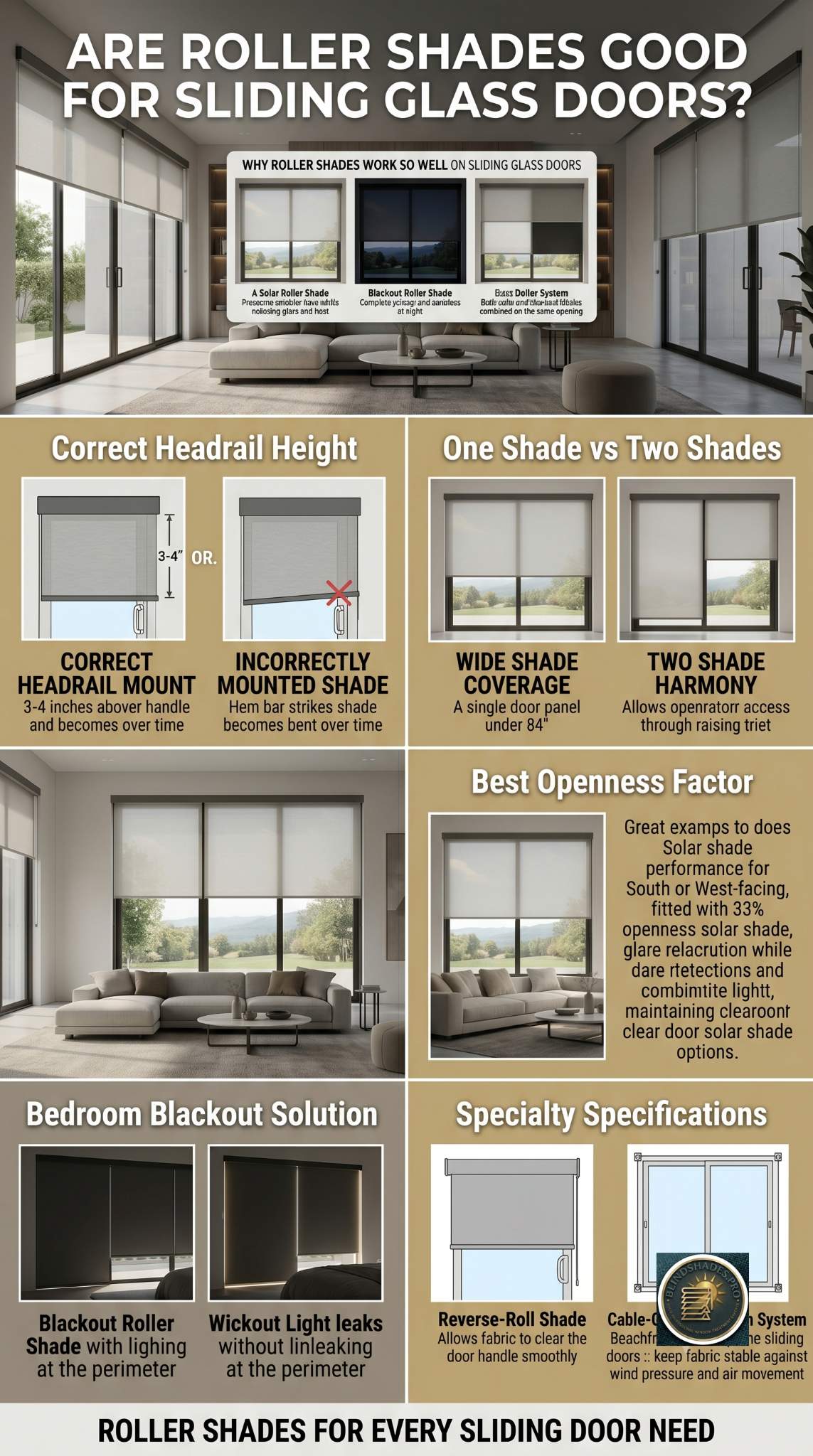
Key Takeaways:
- Roller shades are excellent for sliding glass doors in most residential scenarios — SenseBlinds (February 2026) confirms they offer “space-efficient design with minimal stacking height, unobstructed operation above the door track, clean modern aesthetics, and superior light control from sun-filtering to total blackout”; the hem bar (the weighted bottom bar) condenses entirely into the slim 1 to 3-inch headrail when raised, taking up effectively zero space above the door and leaving the full glass visible; this is the most compact raised-position profile of any sliding glass door treatment
- The single most common roller shade installation mistake on sliding glass doors: mounting the headrail too low, causing the hem bar to contact the door handle as the shade raises; the door handle projects from the door face and the hem bar rolls up past it; if the hem bar hits the handle, it bends at the contact point and the shade no longer hangs flat when lowered; the fix is a minimum headrail mounting height of door handle height plus 3 to 4 inches clearance; SenseBlinds confirms: “Ensure the headrail is mounted high enough that the shade clears the door handles in all positions”
- The one shade vs two shades decision for a sliding glass door: one continuous shade (covering both the fixed and sliding panel from a single headrail) provides a seamless appearance and is the correct specification when both panels are used together as a complete opening and the opening is under 84 inches; two separate shades (one per panel) are the correct specification when the sliding door is frequently operated with just one panel open and the user wants the shade over the fixed panel to remain fully lowered for privacy while the shade over the active panel is raised for entry and exit — otherwise raising the single shade exposes both panels when only one needs to be open
- For solar shades on south or west-facing living room patio sliding glass doors, specify 3 percent openness factor: 1 percent OF provides maximum glare reduction and privacy but reduces view clarity through the fabric; 3 percent OF is the correct balance for most living room applications — adequate glare and UV reduction while preserving an outward view; 5 percent OF is appropriate for east-facing doors with gentler morning sun or for doors where the outdoor view is the primary value and glare is only a secondary concern; 10 percent or higher OF is too sheer for direct-sun sliding glass doors
- Side guide tracks are the correct additional specification for bedroom patio sliding glass doors where roller shades must provide genuine blackout conditions: standard outside-mount roller shades have 0.5-inch fabric-edge-to-wall gaps on each side that allow light to enter even with blackout fabric; side guide tracks are L-shaped aluminum channels that receive the fabric edges and hem bar as the shade lowers, sealing the side gaps; for a living room patio door where some side light is acceptable, standard mounting without tracks is adequate; for a bedroom where true blackout is required, side guide tracks are the correct additional specification
⭐ Quick Answer — Are Roller Shades Good for Sliding Glass Doors?
- Yes — The Most Compact Sliding Glass Door Treatment Available, With One Critical Mounting Rule: Roller shades for sliding glass doors are excellent — they offer the most compact raised-position profile of any sliding glass door treatment; SenseBlinds (February 2026) confirms: “When fully raised, a roller shade condenses into a compact roll housed in a slim headrail, typically 1 to 3 inches tall — this minimal stacking height means it hardly protrudes into your living space or blocks any part of the glass or frame when not in use.” Unlike vertical blinds (13 to 16 inches of lateral wall stack) or panel track (20 to 22 inches), roller shades take zero lateral wall space when raised. The door slides freely beneath the shade at all positions — SenseBlinds confirms “a properly mounted roller shade sits above the door track, allowing the door to slide freely without any contact or interference, unlike vertical blinds or drapes that can get caught.” The critical mounting rule: the headrail must be mounted at a minimum height of the door handle measurement from the floor plus 3 to 4 inches clearance; the hem bar (the weighted bottom bar that rolls up with the fabric) contacts the door handle as it rises if the headrail is too low; repeated contact bends the hem bar permanently at the contact point and the shade no longer hangs flat when lowered; SenseBlinds confirms: “Ensure the headrail is mounted high enough that the shade clears the door handles in all positions”; also specify reverse roll (front roll) which creates a forward fabric arc that provides additional clearance from the door face and handle during raising
- One Shade vs Two Shades — The Decision Rule No Guide Provides: Most guides mention that roller shades on sliding glass doors can use one continuous shade or two separate shades; none provides the specific decision rule. One continuous shade: a single fabric spans the full outside-mount width covering both the fixed and sliding panels from one headrail; both panels slide freely beneath it independently; when the shade is raised, both panels are exposed; the correct specification when both panels are used together as a complete opening (entertaining, furniture moving, wide passage), for openings under 84 inches where a single-tube shade is mechanically reliable, and when the seamless single-fabric appearance is the aesthetic priority. Two separate shades: one shade per panel, each raising and lowering independently; the correct specification when the door is frequently used with just the sliding panel open for daily entry and exit while the fixed panel should remain covered for privacy — with a single shade, raising it exposes both panels; with two separate shades, only the shade over the active sliding panel is raised while the shade over the fixed panel stays fully lowered; also the correct specification for openings 84 inches and wider where two narrower shades avoid the tube diameter and fabric telescoping concerns of a single super-wide shade. For the full width-based specification guide, see [What Are the Best Blinds for Large Sliding Glass Doors](/guide/best-blinds-for-large-sliding-glass-doors/)
- The Solar Shade Openness Factor Matrix for Sliding Glass Door Direction: Every guide recommends “solar shade” for sliding glass door roller shades without specifying which openness factor (OF) is correct for the door’s orientation. The openness factor is the percentage of the fabric that is open weave — higher OF = more light and view transmitted. The correct OF by door direction: south-facing door (maximum direct sun for most of the day) = 1% or 3% OF; 3% is the standard specification that balances UV and glare reduction with outward view preservation; west-facing door (intense afternoon sun 3 to 6 PM) = 1% OF for maximum protection, 3% acceptable if afternoon glare is not the primary concern; east-facing door (morning sun 6 to 10 AM only; lower sun angle) = 3% or 5% OF; 5% often adequate for east-facing morning sun; north-facing door (no direct sun in northern hemisphere) = light-filtering or sheer fabric; solar shade not needed for glare control on north-facing doors. Never specify 10% or higher OF for direct-sun sliding glass doors — the fabric is too sheer to provide meaningful glare reduction and the privacy performance is poor in bright conditions. Window Expressions confirms: “Solar shades are ideal for hot, sunny climates” — but the specific OF that makes them effective depends on the door’s orientation
- The Draft and Flutter Problem and the Cable-Guided Tension System Solution: Standard roller shades on sliding glass doors hang as a single free-hanging fabric panel weighted by the hem bar. When the sliding door is opened, air displacement pushes the fabric outward in an arc of 3 to 6 inches — the hem bar swings, the fabric billows, and if the door is opening, the door panel can contact the billowing fabric. For most standard suburban residential patio doors, this minor fabric movement is not a functional problem. For beachfront or lakefront homes with frequent wind exposure, open-plan spaces where HVAC creates significant air pressure differentials through the door zone, or homes where the sliding glass door is in the same air path as an exterior entry door: specify a cable-guided tension system. Two stainless steel cables run vertically from the headrail to the floor, one each side; the fabric hem bar is threaded through rings on the cables; as the shade lowers and raises, the hem bar follows the cable guides and cannot billow outward or inward; the cables simultaneously seal the 0.5 to 1-inch side light gaps that standard outside-mount roller shades leave at each fabric edge. For the complete installation protocol including cable anchor placement, see [How Do You Install Blinds on Sliding Glass Doors](/guide/install-sliding-glass-door-blinds/)
- Side Guide Tracks for Genuine Blackout and the Dual Roller System for Day and Night: Two roller shade sliding glass door specifications absent from all competitor guides. (1) Side guide tracks for genuine blackout: standard outside-mount roller shades with blackout fabric block up to 99% of light from the fabric itself, but leave 0.5 to 1-inch side gaps between the fabric edge and the wall where light enters; in a bedroom at night, these side gaps admit visible light from exterior sources; side guide tracks are L-shaped aluminum channels mounted vertically beside the shade on each side; the fabric edges and hem bar ends fit inside these channels, sealing the side gaps; for a living room patio door where some side light is acceptable, standard mounting is adequate; for a bedroom patio door where genuine blackout sleeping conditions are required, side guide tracks are the necessary additional specification. (2) Dual roller system: a dual roller shade places two fabrics — solar or light-filtering for day and blackout for night — on one shared headrail; combined headrail depth is 3 to 5 inches (versus 1.5 to 2 inches for single shade); the deeper dual headrail requires recalculating the minimum mounting height above the door handle — increase the clearance to 4 to 5 inches above the handle (versus 3 to 4 inches for single shade) to ensure both the headrail and both fabric hem bars clear the handle at all positions. For the complete blackout blind specification for patio sliding glass doors, see [What Are the Best Blackout Blinds for Sliding Glass Doors](/guide/blackout-blinds-sliding-glass-doors/)
- Best Sources: “Space-efficient design with minimal stacking height”; “only safe choice for children and pets is cordless or motorized”; “ensure headrail clears door handles in all positions”; 100% waterproof material for moisture; block up to 99% of light → SenseBlinds best roller shades for sliding glass doors guide (February 2026) · “Modern and sleek aesthetic”; “practically disappear in the fully open position”; roller shades as stylish alternative to vertical blinds for sliding glass doors → Blinds To Go roller shades on sliding glass doors (October 2025) · Solar shades for hot climates and UV; blackout for bedrooms; sheer for living rooms; insulating barrier; solar with reflective backing for energy efficiency → Window Expressions roller shades for sliding glass doors
⚠️ Wide Hem Bar Weight and the Worth-It Verdict by Scenario — Two Specifications Most Buyers Overlook: (1) Hem bar weight on wide sliding glass door roller shades: the hem bar at the bottom of a roller shade weights the fabric flat and acts as the manual pull handle; standard hollow aluminum hem bars are sized proportionally to the shade width; for shades 10 feet (120 inches) and wider, a standard hollow aluminum hem bar spanning the full width bows slightly at the center under its own weight — the center of the shade hangs 0.25 to 0.5 inches lower than the shade edges when fully lowered and the bottom edge is not perfectly horizontal; for wide sliding glass door roller shades at 10 feet and wider, specify heavy-duty solid aluminum hem bars that provide greater structural rigidity against center bowing; alternatively, specify a tandem two-shade system (two shades at approximately 5 feet each) where each half-width shade’s hem bar is within the standard reliable sizing range. (2) Worth-it verdict by scenario: EXCELLENT for modern living room patio door (3% OF solar shade; reverse roll; compact profile); bedroom patio door with blackout priority (blackout fabric plus side guide tracks); pool-adjacent door (100% waterproof vinyl or coated polyester); south/west facing intense sun (1 to 3% OF solar). MANAGEABLE for 10+ foot openings (tandem shades; heavy-duty hem bar; reinforced tube). LESS IDEAL for frequent single-panel-only access without two-shade system; beachfront/high-draft without cable guides. NOT SUITABLE for adjustable partial privacy without raising or lowering — only vertical blinds provide vane-angle variable privacy that does not require raising the entire treatment. Blinds To Go (October 2025) confirms roller shades offer “a clean, minimalist look that makes them the ideal fit for modern and contemporary spaces” — the operative qualifier being modern and contemporary, not all sliding glass door applications universally. See the full 9-scenario worth-it table below.
💡 The Complete Roller Shade Specification Checklist for Sliding Glass Doors: Before ordering any roller shade for a sliding glass door, confirm five specifications. (1) Mounting height: measure door handle height from floor; add 3 to 4 inches for single shade or 4 to 5 inches for dual roller; this is the minimum headrail position; also confirm the shade will clear the top of the door frame when fully lowered. (2) One shade or two: one shade if both panels used together and opening under 84 inches; two shades if daily single-panel access is needed or opening is 84+ inches. (3) Roll direction: always specify reverse roll (front roll) for sliding glass door applications; the forward arc creates clearance between the fabric and the door face and handle. (4) Fabric type by use: solar 3% OF for south/west living room doors; solar 5% for east-facing; blackout with side guide tracks for bedroom doors; 100% waterproof vinyl or coated polyester for pool-adjacent or humid outdoor-facing doors; dual roller for rooms used at all hours needing both daytime solar control and nighttime blackout. (5) Cable guides or side tracks: cable-guided tension system for beachfront, high-draft, or HVAC-turbulent environments; side guide tracks for bedroom blackout doors where the standard outside-mount side gap would compromise darkness. Top brands: Blindsgalore (custom solar and blackout roller shades for patio doors; reverse roll standard); SmartWings (motorized roller for smart home integration); Yoolax (motorized with Alexa/Google/Apple HomeKit); SelectBlinds (MeasureSafe guarantee; custom sizing). For the complete measurement protocol including handle height and headrail position, see How Do You Measure Sliding Glass Door Blinds. See the one shade vs two shades decision guide below.
📖 Read the complete guide below for: the hem bar contact problem and minimum mounting height (handle height + 3-4 inches; reverse roll creates clearance; permanent bend from repeated contact), one continuous shade vs two separate shades decision rule (one = aesthetics/under 84 inches/complete opening; two = daily single-panel access/84+ inches/independent light control), solar shade openness factor matrix by door direction (1% west; 3% south/west standard; 5% east; 10% not for direct-sun), the cable-guided tension system for draft and flutter (fabric billows 3-6 inches; cables constrain hem bar; seals side gaps simultaneously), dual roller headrail depth (3-5 inches combined vs 1.5-2 single; 4-5 inches above handle required), wide hem bar weight at 10+ feet (standard hollow aluminum bows 0.25-0.5 inches; heavy-duty solid aluminum required or tandem shades), side guide tracks for genuine blackout (0.5-1 inch side gaps sealed; L-shaped aluminum channels; required for bedroom patio blackout), and the full 9-scenario worth-it verdict table.
Are Roller Shades Good for Sliding Glass Doors — The 2026 Verdict
The honest evaluation — when roller shades are the best choice and when they are not.
<strong>Roller shades for sliding glass doors</strong> have replaced vertical blinds as the preferred treatment in modern and contemporary homes over the past five years. Blinds To Go (October 2025) confirmed: “In the quest for a more modern and sleek aesthetic, roller shades have emerged as a stylish alternative to vertical blinds for sliding glass doors.”
The case for roller shades on sliding glass doors rests on four structural advantages over vertical blinds:
1. Minimal raised-position footprint: When fully raised, a roller shade compresses to a compact roll inside a 1 to 3-inch slim headrail. SenseBlinds (February 2026) confirms this “space-efficient design with minimal stacking height means it hardly protrudes into your living space or blocks any part of the glass or frame when not in use.” Vertical blinds stack 13 to 16 inches to one side; panel track stacks 20 to 22 inches. Roller shades take zero lateral wall space.
2. Zero contact with the sliding door mechanism: A correctly mounted roller shade sits above the door track with the hem bar clearing the door top edge. The door slides freely beneath the shade at all positions. SenseBlinds confirms: “A properly mounted roller shade sits above the door track. This allows the door to slide freely beneath it without any contact or interference, unlike vertical blinds or drapes that can get caught.”
3. Single-fabric panel — no individual component failure: Unlike vertical blinds (17 to 22 individual vanes with carrier stems that break) or panel track (4 to 5 panels with carrier sliders), a roller shade is one fabric piece. There are no individual components to break, bend, or misalign except the headrail mechanism.
4. Full blackout achievable: Blackout roller shades can achieve up to 99% light blockage with blackout-coated fabric. SenseBlinds confirms: “Block up to 99% of light.” Even with side guide tracks (see below), roller shades can deliver genuine blackout performance on a bedroom patio sliding glass door.
The Hem Bar Contact Problem — The Most Common Roller Shade Sliding Glass Door Mistake
The installation error absent from every roller shade guide that permanently damages the shade.
SenseBlinds (February 2026) states: “Ensure the headrail is mounted high enough that the shade clears the door handles in all positions.”
What happens when this rule is not followed — and why it matters more on sliding glass doors than on windows:
The mechanics: When a roller shade is raised, the fabric rolls up onto the roller tube. The hem bar (the weighted metal bar at the fabric bottom) rolls up with the fabric — it rises as the fabric gathers on the tube. As the shade approaches the fully raised position, the hem bar rises to approximately 6 to 12 inches below the headrail.
On a standard window, the door handle is not present — the hem bar rises freely. On a sliding glass door, the recessed handle projects from the door face typically 2 to 3 inches. If the headrail is mounted at the same height as the door handle, the hem bar contacts the handle as it rises past it.
The consequence: The hem bar bends at the contact point — a small deformation of 2 to 5 degrees. After the shade is lowered, the bent hem bar hangs at an angle rather than horizontally. The fabric is no longer flat across its full width — it pools slightly at the bend point. After repeated contact (raising and lowering the shade over weeks of use), the bend becomes permanent.
The fix — minimum mounting height:
- Measure the door handle height from the floor
- Add 3 to 4 inches of clearance above the handle’s highest point
- This is the minimum headrail mounting position
For a standard sliding glass door with an 80-inch door frame and a handle at 36 inches from the floor: minimum headrail height = 36 + 4 = 40 inches from the floor (approximately 40 inches above the floor, which is approximately 40 inches above the door track, leaving adequate clearance).
Also specify reverse roll: The reverse roll (front roll) specification creates a forward arc in the fabric as it descends from the roller tube, providing additional clearance from the door face and the handle. SenseBlinds confirms this as the standard specification for roller shades on doors. For the full measurement protocol to determine correct headrail height, see How Do You Measure Sliding Glass Door Blinds.
One Shade vs Two Shades — The Decision Rule for Sliding Glass Doors
The when-to-split decision absent from every roller shade buying guide.
Most guides mention that a sliding glass door can use “one large shade or two separate shades.” None provides the decision rule.
One Continuous Shade (Covers Both Panels from Single Headrail)
How it works: A single shade spans the full outside-mount width of both the fixed and sliding panels. Both panels slide freely beneath the shade independently. When the shade is raised, both panels are exposed. When the shade is lowered, both panels are covered.
Correct for:
- Doors where both panels are used together as a complete opening (entertaining, moving furniture, wide passage)
- Openings under 84 inches where a single-tube shade is mechanically reliable (see tube diameter discussion in Article 40-1)
- Applications where a seamless single-fabric appearance is the aesthetic priority — no center seam visible
- Motorized roller shades where a single motor controls a single shade cleanly
The operational limitation: If the door is used daily for routine entry and exit through only the sliding panel, the single shade must be fully raised (exposing both panels) or fully lowered (covering both panels). There is no way to raise only the portion of the shade over the sliding panel while keeping the fixed panel covered.
Two Separate Shades (One Per Panel)
How it works: Two independent shades are mounted side by side on the same wall, each covering one panel. Each shade raises and lowers independently. A center join cover can conceal the gap between the two headrails.
Correct for:
- Doors where the sliding panel is frequently used for daily entry and exit while the fixed panel should remain covered for privacy — the shade over the fixed panel stays fully lowered; the shade over the sliding panel is raised for entry and lowered on return
- Openings 84 inches and wider where two narrower shades avoid the tube diameter and fabric telescoping concerns of a single super-wide shade (see What Are the Best Blinds for Large Sliding Glass Doors)
- Applications where independent light control over each panel is the priority (example: the fixed panel faces a neighbor’s window while the sliding panel faces an open yard)
The operational consideration: Two shades require two operations (raise/lower each shade) instead of one. For motorized two-shade systems, this means two motors — a slight cost increase but full independent automation.
The Draft and Flutter Problem — When Standard Roller Shades Fail on Sliding Glass Doors
The structural limitation of free-hanging roller shade fabric on sliding glass doors — and the cable-guided solution.
A standard roller shade fabric panel hangs freely from the roller tube, weighted at the bottom by the hem bar. This works on windows where the glass creates a barrier against air movement. On sliding glass doors, opening and closing the door creates a significant draft.
The flutter sequence:
- Occupant opens the sliding glass door
- Air displacement from the opening creates a pressure difference
- The roller shade fabric billows outward (if interior pressure is higher than exterior) or inward (suction)
- The hem bar swings in an arc — up to 3 to 6 inches from the door face
- If the door is opening, the door panel may contact the billowing fabric and the fabric catches between the door and the frame
The cable-guided tension system solution: Two stainless steel cables run vertically from the headrail to the floor, one on each side of the shade. The hem bar is threaded through small rings on the cables. As the shade lowers and raises, the hem bar follows the cable guides — it cannot billow outward or inward. The cables hold the fabric flat against the door face regardless of air movement.
Cable-guided systems simultaneously address two problems:
- Draft/flutter eliminated (fabric constrained to flat position)
- Side light gap sealed (cables run close to the door frame edges, eliminating the 0.5-inch side gaps)
When to specify cable-guided roller shade on sliding glass doors:
- Beachfront, lakefront, or high-wind-exposure homes where outdoor air pressure changes are frequent
- Open-plan living areas where the HVAC system creates air pressure differentials through the open sliding glass door zone
- Homes where the sliding glass door is adjacent to or facing an exterior door — two door openings in the same air zone create cross-drafts
For most standard residential suburban patio doors, cable-guided systems are not required. Standard outside-mount roller shades perform adequately.
Solar Shade Openness Factor — The Correct Specification for Your Sliding Glass Door Direction
The solar shade openness factor decision matrix absent from all sliding glass door roller shade guides.
Solar shades filter light and UV while maintaining an outward view from the interior. The openness factor (OF) is the percentage of the fabric that is open weave — the higher the OF, the more light and view is transmitted.
| Openness Factor | Light Filtration | Daytime Privacy | Outward View | Best For |
|---|---|---|---|---|
| 1% OF | Maximum | Excellent | Moderate clarity | South/west doors with intense direct sun; maximum glare reduction |
| 3% OF | Good | Good | Good clarity | Standard specification for south/west living room patio doors |
| 5% OF | Moderate | Moderate | Excellent | East-facing doors; view-priority doors with moderate sun |
| 10% OF | Light | Fair | Maximum clarity | North-facing or shaded doors; view-priority only |
| 14%+ OF | Minimal | Poor | Glass-like | Not recommended for direct-sun sliding glass doors |
The sliding glass door direction guide:
South-facing door: Receives maximum direct sun for most of the day; specify 1% or 3% OF; 3% is the correct standard specification that balances UV protection with view preservation.
West-facing door: Receives intense afternoon sun (3–6 PM peak); the most challenging orientation for glare; specify 1% OF for maximum protection; 3% OF acceptable if afternoon glare is not the primary concern.
East-facing door: Receives morning sun (6–10 AM) only; sun angle is lower; specify 3% or 5% OF; 5% is often adequate for east-facing morning sun.
North-facing door: Receives no direct sun in the northern hemisphere; solar shade is not needed for glare; specify light-filtering fabric or sheer roller shade for daytime privacy without solar control.
Window Expressions confirms: “Solar shades are constructed with advanced technology to optimize light filtering and heat control for sliding glass doors — ideal for hot, sunny climates.” SenseBlinds confirms material selection is critical for patio door applications.
The Dual Roller System — Day and Night on One Headrail
The sliding glass door-specific dual roller specification absent from most guides.
A dual roller shade system places two independent fabrics — typically a solar or light-filtering fabric and a blackout fabric — on a single shared headrail. Each fabric rolls independently on its own roller tube within the same headrail assembly.
How it works on a sliding glass door:
- Daytime: extend the solar fabric; filter light and UV; maintain outward view; nighttime privacy is not provided
- Nighttime: retract the solar fabric and extend the blackout fabric; complete privacy and near-complete light blockage
- Combined: both fabrics extended simultaneously for maximum insulation; solar fabric faces room, blackout fabric faces glass; air pocket between fabrics adds insulation value
The sliding glass door-specific depth consideration: A dual roller headrail accommodates two roller tubes side by side. The combined headrail depth is approximately 3 to 5 inches from the wall, versus 1.5 to 2 inches for a single-shade headrail. On a sliding glass door with a door handle, the deeper dual headrail increases the height at which the headrail must be mounted to clear both the door handle and the hem bars of both fabrics. Recalculate the minimum mounting height:
Minimum dual roller headrail height = door handle height + 4 to 5 inches (increased from 3 to 4 inches for single-shade)
For the complete treatment option comparison for all roller shade types on sliding glass doors, see What Are the Best Blackout Blinds for Sliding Glass Doors.
Wide Hem Bar Weight — The Specification for 10+ Foot Sliding Glass Doors
The hem bar specification absent from all roller shade guides for wide openings.
The hem bar at the bottom of a roller shade serves two functions: it weights the fabric so it hangs flat and taut, and it acts as the handle for raising and lowering a manual shade. Standard hem bars are hollow aluminum or vinyl, sized proportionally to the shade width.
The sag problem on wide shades: For a 120-inch (10-foot) roller shade, a standard hollow aluminum hem bar spanning the full width can bow slightly at the center under its own weight. The bowing causes the center of the shade to hang 0.25 to 0.5 inches lower than the shade edges — the bottom edge of the shade is not perfectly horizontal when fully lowered.
The fix: Heavy-duty solid aluminum hem bars provide greater weight per unit length and greater structural rigidity against bowing. For sliding glass door roller shades at 10 feet and wider:
- Specify heavy-duty solid aluminum hem bar (not hollow aluminum or vinyl)
- The additional hem bar weight also improves the shade’s flat-hanging behavior in drafts
- Consider tandem/coupled shades (two shades at approximately 5 feet each) as an alternative to one 10-foot shade — each half-width shade’s hem bar is within the standard sizing range
For the full width-based specification guide for large sliding glass doors, see What Are the Best Blinds for Large Sliding Glass Doors.
Side Guide Tracks — The Additional Specification for Bedroom Blackout Patio Doors
The side light gap solution that converts standard roller shades into genuine blackout treatments.
Standard outside-mount roller shades on sliding glass doors have side gaps — the 0.5 to 1-inch space between the fabric edge and the wall surface on each side. Even with 3 to 4 inches of wall overlap, light enters from the gaps between the fabric edge and the wall molding or door frame.
For living rooms where some side light is acceptable, standard mounting without side guides is adequate.
For bedroom patio sliding glass doors where genuine blackout sleeping conditions are required, specify side guide tracks:
How side guide tracks work: Two L-shaped aluminum channels are mounted vertically on the wall beside the roller shade, one on each side. The fabric edges and hem bar ends fit inside these channels. As the shade lowers, the fabric edges slide inside the channels, which physically seal the side gaps. No light can enter at the fabric-to-channel interface.
Side guide tracks simultaneously:
- Seal side light gaps (genuine blackout performance)
- Constrain the fabric against draft/flutter (the channel prevents horizontal fabric movement)
- Keep the fabric hanging flat and parallel to the door (no fabric drift to one side)
The installation consideration: Side guide channels must be exactly aligned with the fabric edges — the channel opening must match the fabric width precisely. Most custom roller shade retailers offer matched side guide channels as an add-on option. For the complete installation protocol for roller shades with side guides on sliding glass doors, see How Do You Install Blinds on Sliding Glass Doors.
The Worth-It Verdict — Roller Shades for Sliding Glass Doors by Scenario
| Application | Roller Shade? | Correct Specification |
|---|---|---|
| Modern living room patio door | ✅ EXCELLENT | 3% OF solar shade; reverse roll; outside mount |
| Bedroom patio door, blackout priority | ✅ EXCELLENT | Blackout roller shade; side guide tracks; dual roller for day/night flexibility |
| Standard patio door, budget priority | ✅ GOOD | Single light-filtering roller; reverse roll; standard mount |
| Pool-adjacent patio door | ✅ GOOD | 100% waterproof vinyl or coated polyester; moisture-resistant mechanism |
| South/west facing, intense sun | ✅ EXCELLENT | 1–3% OF solar shade; heavy hem bar for wide opening |
| Wide 10+ foot opening | ⚠️ MANAGEABLE | Tandem/coupled system (two shades); heavy-duty hem bar; reinforced tube |
| Frequent single-panel entry/exit | ⚠️ CONSIDER TWO SHADES | Two separate shades for independent panel coverage |
| Beachfront/high-draft environment | ⚠️ CABLE-GUIDED | Tension cable system; hem bar constrained against flutter |
| Adjustable partial privacy without raising | ❌ NOT SUITABLE | Only vertical blinds provide vane-angle variable privacy; roller shades are up or down |
| True blackout without side guides | ❌ INCOMPLETE | Standard roller shade allows side light gaps; add side guide tracks for genuine blackout |
Frequently Asked Questions
Are roller shades good for sliding glass doors? Yes. Roller shades are excellent for sliding glass doors — they offer the most compact raised-position profile of any sliding glass door treatment (1 to 3-inch headrail height), zero lateral wall space usage, and a modern single-fabric aesthetic. SenseBlinds (February 2026) confirms roller shades allow the door to slide freely beneath them without any contact, unlike vertical blinds or drapes. They are available in solar, light-filtering, blackout, and dual-roller day/night configurations.
Should I use one roller shade or two for a sliding glass door? Use one continuous shade when both panels of the sliding glass door are used together as a complete opening and the aesthetics of a seamless fabric are the priority. Use two separate shades (one per panel) when the door is frequently used with just the sliding panel open — two shades allow the shade over the fixed panel to remain lowered for privacy while the shade over the active panel is raised for entry and exit. Two shades are also the correct specification for openings wider than 84 inches.
What is the minimum mounting height for a roller shade on a sliding glass door? The minimum headrail mounting height on a sliding glass door is the door handle height plus 3 to 4 inches. This clearance ensures the hem bar (the bottom weighted bar of the shade) rises past the door handle without contacting it during raising. If the hem bar contacts the door handle, it bends permanently at the contact point and the shade no longer hangs flat. SenseBlinds confirms: “Ensure the headrail is mounted high enough that the shade clears the door handles in all positions.”
What openness factor should I choose for a solar shade on a sliding glass door? Specify 3 percent openness factor for south or west-facing living room patio sliding glass doors — the standard specification that balances UV and glare reduction with outward view preservation. Specify 1 percent for maximum glare reduction on intensely sun-exposed west-facing doors. Specify 5 percent for east-facing doors with moderate morning sun where the outward view is the primary value. Avoid 10 percent or higher openness factor on direct-sun sliding glass doors.
Do roller shades provide true blackout on a sliding glass door? Blackout roller shades block up to 99% of light from the fabric itself, but standard outside-mount installations have 0.5 to 1-inch side gaps between the fabric edges and the wall where light enters. For genuine blackout performance on a bedroom patio sliding glass door, specify side guide tracks alongside the blackout roller shade. The aluminum channel tracks seal the fabric edges to the wall and eliminate the side light gaps, achieving genuine blackout conditions.
Related Guides on BlindShades.pro
- The Best Sliding Glass Door Blinds & Shades Buying Guide
- What Are the Best Blinds for Large Sliding Glass Doors
- Are Vertical Blinds Still Good for Sliding Glass Doors
- What Are the Best Panel Track Blinds for Sliding Glass Doors
- What Are the Best Blackout Blinds for Sliding Glass Doors
- How Do You Install Blinds on Sliding Glass Doors
By Michael Turner | 30 Years Home Improvement Expertise | Updated 2026 | BlindShades.pro
