What Are the Best Roller Blinds for a Bathroom?

Authored By Michael Turner -30 Years Home Improvement Expertise | Updated 2026 | BlindShades.pro
Updated on July 14, 2026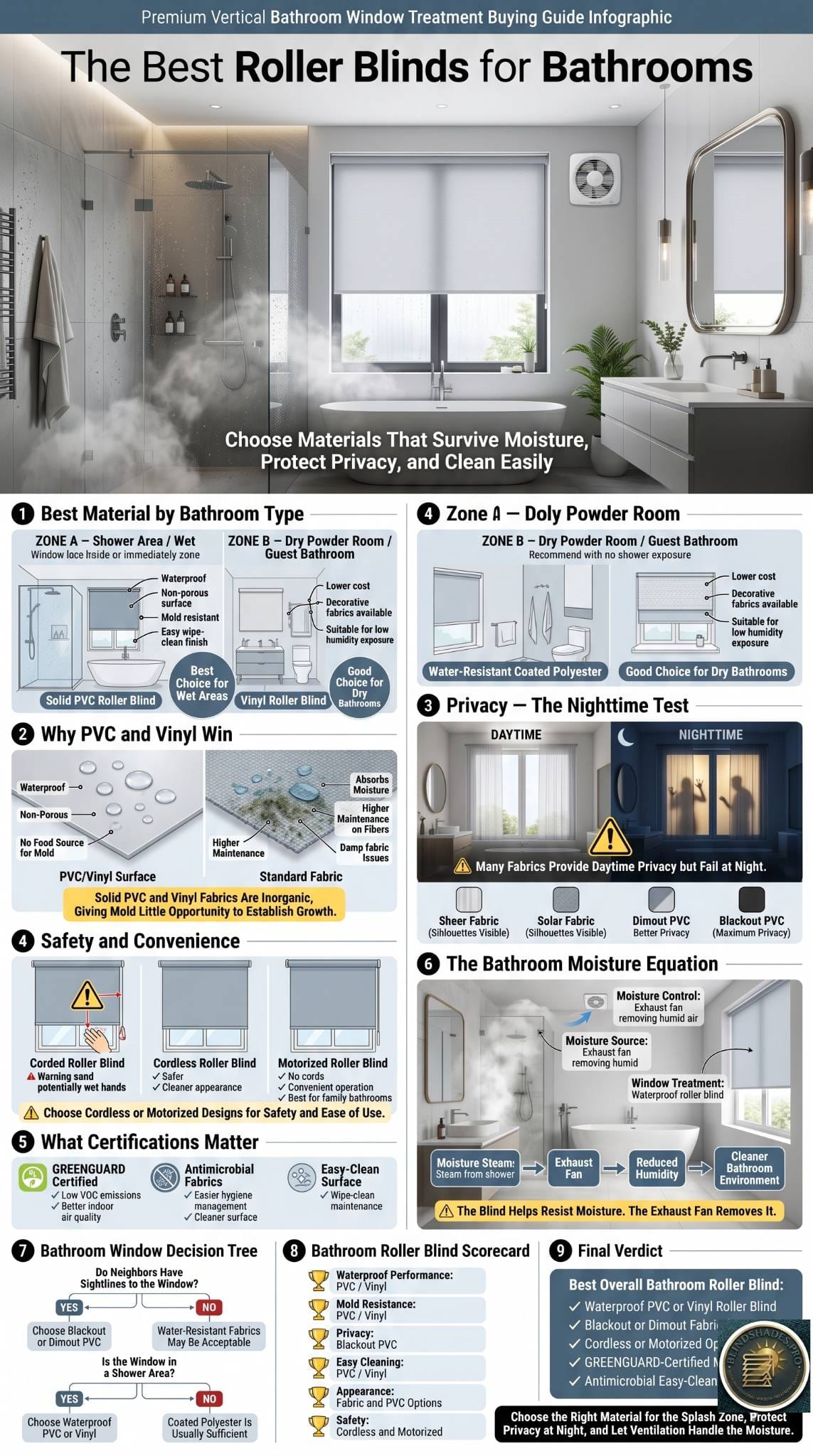
Authored by Michael Turner — 30 Years of Home Improvement Expertise | Updated 2026 | BlindShades.pro
The best roller blinds for a bathroom are made of solid PVC or vinyl, because mold needs an organic food source and plastic gives it none. Here’s how to pick the right one for your window’s splash zone, plus real product picks and the night-privacy detail most guides miss.
Key Takeaways
- The best roller blinds for a bathroom are made of solid, non-porous PVC or vinyl, because the real enemy in a bathroom is mold, and mold needs a food source you can deny it. As VelaBlinds explains, mold needs three things to grow: moisture, warmth, and a food source. Your bathroom supplies the first two no matter what you do; the food source is the variable you control. Natural materials like wood, cotton, and even some polyester fabrics are organic and feed mold, while solid PVC, vinyl, and faux-wood composites are inorganic plastic that offers zero nutrients. Choosing an inorganic material is the single most important decision.
- Match the material to where the window actually is, because “waterproof” and “water-resistant” are not the same. A solid, non-porous PVC roller can be submerged and survive, making it right for a window in or beside the shower. A water-resistant coated polyester only handles splashes and humidity, so it suits a dry guest powder room but will eventually break down in a steamy main bathroom. Specify by splash zone, not by guesswork.
- Bathrooms have a night-privacy problem that opacity solves, and most guides ignore it. A sheer or solar fabric that looks private by day shows clear silhouettes at night once the bathroom light is on. For a bathroom window overlooked by neighbors, choose a dimout or blackout PVC fabric for genuine round-the-clock privacy; reserve sheer and solar fabrics for high or unoverlooked windows where you want light and view.
- Go cordless or motorized, both for safety and for wet hands. Cordless and motorized roller blinds keep operating cords away from children and away from your dripping hands after a shower, and motorization is genuinely useful for the awkward window above a bathtub. SenseBlinds and others build bathroom rollers specifically as cordless or motorized for this reason.
- The blind is only half the solution; ventilation is the other half. Even a perfect inorganic blind needs a dry-ish environment to stay pristine. Run the exhaust fan during and after every shower, crack a window where you can, and wipe a wet sill. Material choice removes mold’s food; ventilation removes its moisture, and together they keep the window pristine.
⭐ Quick Answer
The best roller blinds for a bathroom are made of solid, non-porous PVC or vinyl: waterproof, wipe-clean, and inorganic, so mold has no food source to grow on.
- Why PVC wins: VelaBlinds notes mold needs moisture, warmth, and a food source. Your bathroom supplies the first two; an inorganic plastic blind denies the third. Wood, bamboo, cotton, and untreated fabric are organic and feed mold — avoid them.
- Match the material to the splash zone: fully waterproof solid PVC for a window in or beside the shower; water-resistant coated polyester only for a dry guest powder room, where its coating won’t break down under daily steam.
- The night-privacy detail most guides miss: sheer and solar fabrics show clear silhouettes once the light is on. For any overlooked window, choose a dimout or blackout PVC fabric for round-the-clock privacy — see are blackout roller blinds worth it.
- Real picks: a GREENGUARD-certified waterproof PVC roller from a maker like SenseBlinds for the shower zone, a Hestia or Bali vinyl solar roller for a sunny dry window, and a motorized PVC roller for the awkward window above the tub.
- Two more musts: go cordless or motorized to keep cords from children and wet hands (see are motorized roller blinds worth it), and run the exhaust fan — the blind is only half the solution, ventilation is the other. Full spec in the Roller Blinds Buying Guide.
What Makes a Roller Blind Bathroom-Proof?
A bathroom-proof roller blind does two things: it shrugs off water, and it gives mold nothing to eat. The water part is obvious; the mold part is the one that decides whether your blind still looks good in a year. VelaBlinds frames the science clearly: mold needs moisture, warmth, and a food source, and since a bathroom hands it moisture and warmth for free, the food source is the only variable you control.
That is why material is everything. Real wood, bamboo, cotton, linen, and many standard polyester fabrics are organic — they contain the cellulose and natural matter that mold spores feed on, so in a steamy bathroom they warp, stain, and grow black spots within months. Solid PVC, vinyl, and faux-wood PVC composites are inorganic: they are essentially plastic, offering zero nutrients. Choose one of these and you have removed a leg of the mold-growth triangle entirely, which is the most effective single step you can take. The best bathroom roller fabrics go further with an antimicrobial additive and GREENGUARD certification, and because they are non-porous, SenseBlinds notes you can even wipe them down with diluted bleach without damage.
Waterproof vs Water-Resistant: Which Does Your Bathroom Need?
This is the distinction that determines whether your blind lasts, and it depends entirely on where the window is. The two are not interchangeable:
- Waterproof blinds are made from a material that is solid and non-porous all the way through. As VelaBlinds puts it, you could submerge a solid PVC roller blind and it would be perfectly fine. This is what you need for a window inside the shower enclosure or directly beside a bathtub, where it gets splashed and lives in constant steam.
- Water-resistant blinds use a coating — vinyl-coated polyester or a nano-coating — over a base material. They handle humidity and the occasional splash, but in a daily steamy shower that coating eventually breaks down and moisture reaches the core, ruining the blind. They are fine for a guest powder room with no shower, or a window well away from the splash zone.
The practical rule: if the window is in the wet zone, specify fully waterproof solid PVC or vinyl; if it is in a dry-ish part of the room or a powder room, water-resistant coated polyester is enough and gives you more fabric and color choice. Do not put a water-resistant blind over a bathtub and expect it to last.
Bathroom Roller Material Matrix
| Material | Water rating | Mold risk | Look | Best for |
|---|---|---|---|---|
| Solid PVC / vinyl | Fully waterproof | None (inorganic) | Smooth, modern, wipe-clean | Shower and tub windows |
| PVC-coated polyester (solar) | Water-resistant | Very low | Textured, lets in light | Sunny, dry-zone windows |
| Coated polyester (fabric) | Water-resistant | Low | Soft fabric look | Guest powder rooms |
| Faux-wood PVC composite | Waterproof | None (inorganic) | Real-wood appearance | Traditional bathrooms |
| Real wood / bamboo / cotton | Not suitable | High (organic) | Natural | Avoid in bathrooms |
Best Roller Blinds for a Bathroom — Our Picks
Here are real, bathroom-appropriate roller options by use case. Prices are indicative U.S. ranges for 2026 and vary by size and fabric; always request a sample and confirm the current spec.
| Pick | Product | Why it wins | Indicative price |
|---|---|---|---|
| Best Overall Waterproof | SenseBlinds Waterproof PVC Roller | Closed-cell PVC, GREENGUARD-certified, antimicrobial, cordless or motorized; built for showers | ~$60–$160 |
| Best Blackout / Privacy | English Blinds Mould-Resistant PVC Blackout Roller | Solid waterproof PVC with true blackout for round-the-clock privacy; wipe-clean | ~$50–$130 |
| Best Solar (light + view) | Hestia / Bali Vinyl Solar Roller | PVC-coated solar fabric cuts glare and UV while keeping a dry-zone window bright | ~$45–$120 |
| Best Motorized | SenseBlinds / SmartWings Motorized PVC Roller | Cordless battery motor keeps mechanisms away from wet hands; great for over-tub windows | from ~$160 |
| Best Faux-Wood Look | Faux-wood PVC composite roller (e.g., AffordableBlinds) | Real-wood appearance with no warping or mold; OEKO-TEX options | ~$45–$135 |
| Best Budget | SelectBlinds / AffordableBlinds Vinyl Roller | Custom-cut waterproof vinyl at a low price; wipe-clean | ~$25–$70 |
These are genuine products from established retailers, not fabricated specs. The common thread is an inorganic, waterproof or water-resistant fabric matched to the window, ideally GREENGUARD-certified and cordless. For the full product-selection framework, see the Roller Blinds Buying Guide.
What Opacity Should a Bathroom Roller Blind Be?
This is the detail almost every bathroom-blind guide misses: opacity is a privacy decision, and bathrooms have a night problem. During the day, a sheer or solar fabric gives you light and one-way privacy. But at night, the moment you switch the bathroom light on, that same fabric shows a clear silhouette to anyone outside — exactly the wrong outcome for the one room where privacy matters most.
So choose opacity by whether the window is overlooked:
- Overlooked window (faces a street, a neighbor, or a shared path): choose a dimout or blackout PVC fabric for genuine round-the-clock privacy. You lose some daytime brightness, but you gain real privacy at night.
- High or unoverlooked window (faces the sky, a private garden, or a wall): a solar or sheer fabric is fine and lets in welcome light, since no one can see in anyway.
For most main bathrooms with a window a neighbor could see, a waterproof PVC blackout or dimout roller is the right call. The mechanics of full privacy and sealing edge light are covered in are blackout roller blinds worth it and why light comes through the sides of a roller blind.
Why Do PVC and Vinyl Beat Fabric for Mold?
It comes back to the food source. Mold is a living organism that needs to eat, and in a bathroom the thing it eats is your blind. Organic materials — real wood, bamboo, cotton, linen, and untreated polyester — contain the cellulose and natural matter mold thrives on, so even with an anti-bacterial coating, constant moisture eventually overwhelms them and the black spots appear.
PVC, vinyl, and faux-wood PVC composites are inorganic. They are plastic, and plastic is not food. As VelaBlinds puts it, these materials offer zero nutrients for mold spores, so by choosing one you remove a key part of the mold-growth equation rather than just fighting it with coatings. This is why a wiped-down PVC roller stays pristine in a steamy bathroom for years while a fabric blind in the same spot fails within months. The best bathroom rollers add an antimicrobial additive on top, but the core advantage is simply that you cannot grow mold on a material it cannot eat.
Cordless or Motorized for a Bathroom?
Both are better than corded in a bathroom, for two reasons. The first is safety: cords are a strangulation hazard for children, which is why the industry’s child-safety standards push toward cordless, and bathrooms are no exception. The second is purely practical: after a shower your hands are wet, and a cordless or motorized blind lets you adjust the window without dripping all over a chain.
Motorization earns its place specifically on the awkward bathroom window — the one above the bathtub or behind the toilet that you cannot comfortably reach. A battery motor, kept dry inside the tube, lets you operate that window from across the room or on a schedule. SenseBlinds and similar makers build their bathroom rollers as cordless or motorized as standard. For the full motorized cost-benefit, see are motorized roller blinds worth it.
The Blind Is Half the Solution: Ventilation
Even a perfect inorganic, waterproof blind benefits from a drier room, and this is where buyers often stop too early. VelaBlinds makes the point well: the blind is only half the solution, and you have to address the environment too. Choosing an inorganic material removes mold’s food; managing moisture removes its water. Run a working exhaust fan during and after every shower, open a window for even fifteen minutes where you can, and wipe down a wet sill and any condensation on the blind. Do both halves — the right material and good ventilation — and the window stays clean and mold-free for years.
How Do You Measure and Mount a Bathroom Roller Blind?
Measuring a bathroom roller is the same as any roller, with one extra consideration: the splash zone. For a window in or beside the shower, an inside mount keeps the blind tucked in the recess and slightly more protected, but make sure you have the minimum mounting depth (around 2 inches for most rollers). For privacy on an overlooked window, an outside mount that overlaps the frame reduces the side light gap and the silhouette gap, at the cost of sitting proud of the wall. Take three width and height measurements and use the appropriate value for your mount type. The complete method is in how to measure for roller blinds.
Related guides: where rollers rank against faux wood, cellular, and film — zone by zone — is settled in the best bathroom window blinds and shades guide.
The Bottom Line
The best roller blind for a bathroom is a solid, non-porous PVC or vinyl roller, matched to the window: fully waterproof PVC for the shower and tub zone, water-resistant coated polyester for a dry powder room. Choose a dimout or blackout fabric for any overlooked window so you keep privacy at night, go cordless or motorized for safety and wet hands, prefer GREENGUARD-certified antimicrobial fabrics, and run the exhaust fan. Get the material and the ventilation right and the blind stays mold-free for years. The full fabric and specification framework is in the Roller Blinds Buying Guide.
Related guides: For complete buying advice, see our plastic and vinyl window covers guide.
Frequently Asked Questions
What are the best roller blinds for a bathroom?
Solid, non-porous PVC or vinyl roller blinds, because they are waterproof and inorganic, so mold has no food source to grow on. Match the material to the window: fully waterproof PVC for the shower and tub zone, water-resistant coated polyester for a dry powder room. Choose a dimout or blackout fabric for overlooked windows and a cordless or motorized lift.
Are PVC roller blinds good for bathrooms?
Yes, PVC roller blinds are one of the best choices for bathrooms. PVC is solid, non-porous, and waterproof, so it shrugs off steam and splashes, and because it is inorganic plastic it gives mold no food source to grow on. It wipes clean easily and many PVC bathroom rollers are GREENGUARD-certified and antimicrobial.
Will roller blinds go mouldy in a bathroom?
Not if you choose an inorganic material. Fabric, wood, and bamboo blinds grow mold because they are organic and feed it, but solid PVC, vinyl, and faux-wood PVC composites are inorganic and offer no nutrients. Combine an inorganic blind with good ventilation, running the exhaust fan and wiping wet sills, and it stays mold-free.
What is the difference between waterproof and water-resistant blinds?
Waterproof blinds are solid and non-porous all the way through, so they survive direct water and constant steam, making them right for shower and tub windows. Water-resistant blinds use a coating that handles humidity and splashes but eventually breaks down in a steamy main bathroom, so they suit only dry powder rooms or windows away from the splash zone.
Should bathroom roller blinds be blackout?
For an overlooked bathroom window, yes. Sheer and solar fabrics show clear silhouettes at night once the light is on, which defeats privacy in the room where you most want it. A dimout or blackout PVC fabric gives round-the-clock privacy. For a high or unoverlooked window, a solar or sheer fabric is fine and lets in more light.
This article is part of the Roller Blinds Buying Guide cluster on BlindShades.pro. Related: Are blackout roller blinds worth it? · Are motorized roller blinds worth it? · How to measure for roller blinds
