Best Plastic & Vinyl Window Covers 2026: The Complete Buying Guide

Authored By Michael Turner -30 Years Home Improvement Expertise | Updated 2026 | BlindShades.pro
Updated on July 17, 2026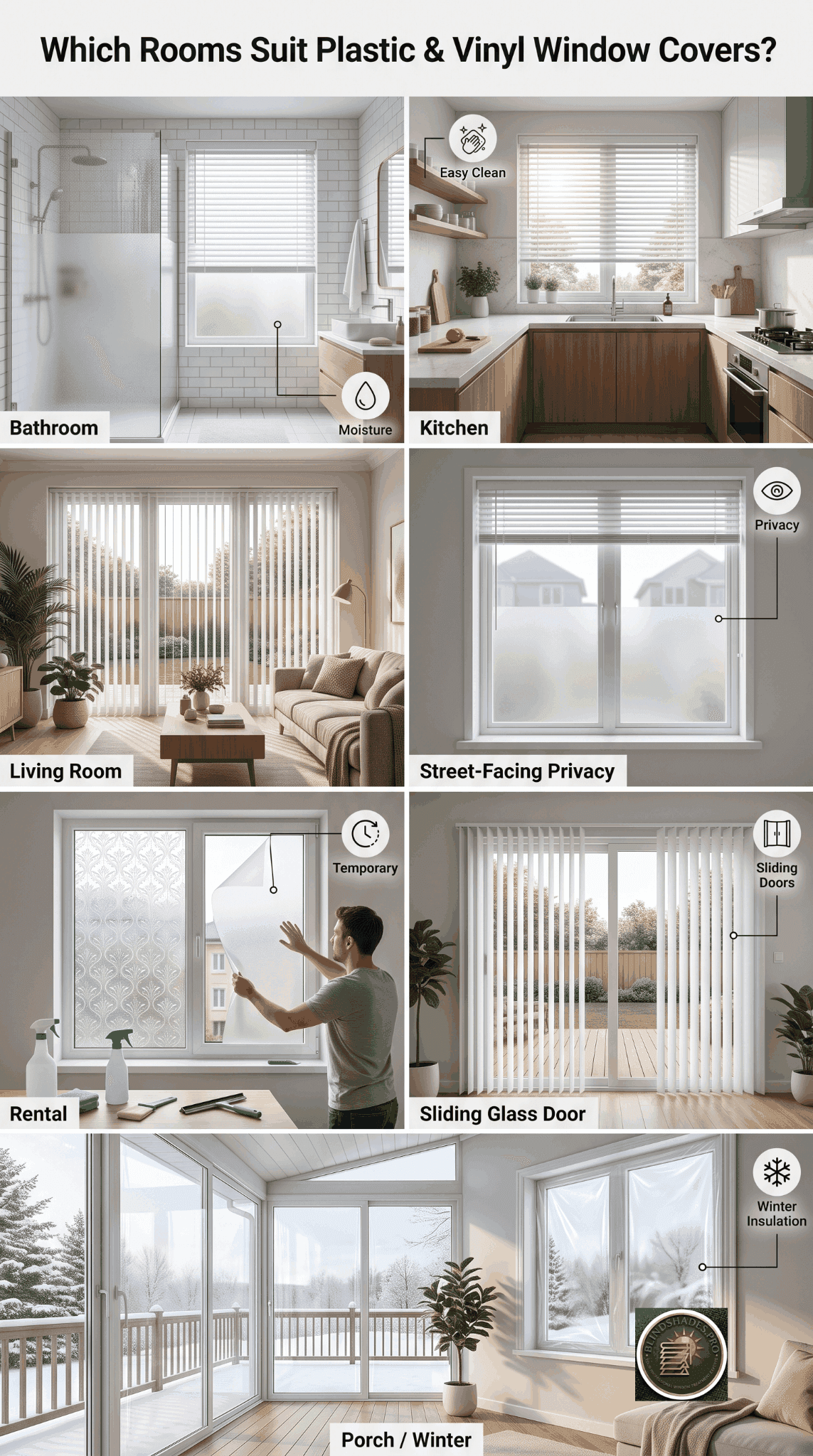
By Michael Turner, 30 years in the window treatment industry
“Plastic and vinyl window covers” is not one product — it is five: static-cling films, vinyl blinds and shades, winter insulation kits, outdoor clear-vinyl panels, and vinyl shutters. Google’s own answer box ends by asking which window you mean, because no ranked page has ever drawn the map. This guide draws it: the five-family taxonomy, the material decoder that finally answers vinyl-vs-PVC-vs-polyester, the winter truth behind the internet’s favorite three-point-one-star insulation kit, the nighttime privacy fact every mirror-film listing omits, and honest picks in every lane — from a four-dollar frosted cover to a fifteen-hundred-review blackout vinyl roller at sixteen dollars.
Key Takeaways
- Pick the family before the product. Film filters light, blinds cover glass, insulation kits seal air, clear panels enclose porches, shutters commit — five different jobs wearing one keyword.
- The material words matter. “Vinyl” is flexible PVC; “rigid PVC” is the vertical-vane grade; polyester is the fabric alternative — the decoder table answers the versus-questions people actually search.
- Winter plastic works — with the prepper’s rule. Insulation covered with plastic beats plastic alone, and the famous shrink-film kit’s three-point-one rating is an installation story, not a product failure.
- No static film gives nighttime privacy with the lights on. Mirror films run on brightness differential and reverse after dark — frost, blinds, or layers are the honest night answers.
- The value floor is remarkable. Four-dollar frosted covers, sixteen-dollar blackout vinyl rollers with fifteen hundred reviews, twenty-five-dollar films with eight hundred — this is the cheapest aisle in window treatments, and volume tells you where it’s safe.
⭐ Quick Answer — The Best Plastic & Vinyl Window Covers
The best plastic and vinyl window covers are chosen at three gates — Layer (filter, cover, seal, or enclose), Lane (five families: films, vinyl blinds, insulation kits, clear panels, shutters — plus the vinyl/PVC/polyester decoder), and Lifespan (permanent, seasonal, or temporary):
- The operable lane: Bali’s premium one-inch vinyl blinds from around fifty-seven dollars at The Home Depot, and the sixteen-dollar blackout vinyl roller with fifteen hundred reviews at Blindster — the wet-room workhorses; rigid-PVC vertical vanes for sliding doors are decoded in the vertical blinds guide.
- The film lane: Artscape’s rice-paper cling (four point six across seven hundred ninety-eight) leads privacy films — and the authority test criteria (transparency, scratch resistance, durability) come from Consumer Reports.
- The night truth: mirror one-way tint reverses after dark — frosted film, blinds, or layers are the honest nighttime privacy answers.
- The winter rule: insulation covered with plastic beats plastic alone — and the permanent version of that idea lives in the thermal insulated blinds guide.
- Vinyl’s home turf: humidity-proof rules, room by room, in the complete bathroom blinds guide.
| Specification | The Short Answer |
|---|---|
| Best vinyl blinds | Bali Essentials Premium 1-inch via Home Depot — from around fifty-seven, the store’s own best-seller |
| Best budget blackout | Blindster Blackout Vinyl Roller — around sixteen dollars, four point one across fifteen hundred |
| Best privacy film | Artscape Rice Paper — around twenty-five, four point six across seven hundred ninety-eight |
| Best winter approach | Insulation covered with plastic (the prepper’s rule) — kits alone are installation-sensitive |
| The five families | Films/clings · vinyl blinds & shades · insulation kits · outdoor clear panels · vinyl shutters |
| The material decoder | Vinyl = flexible PVC · rigid PVC = vertical-vane grade · polyester = the fabric alternative |
| The night truth | No static film gives after-dark privacy with interior lights on |
| The cost band | Four dollars (frosted covers) to seventy-six-plus (custom clear panels) |
Read the complete guide below for: six Diamond picks across every lane, the Layer-Lane-Lifespan Test, the five-family taxonomy Google’s own answer box couldn’t draw, the material decoder behind the versus-questions, the winter-insulation table with the three-point-one-star mystery solved, the film lane with the nighttime truth, room-by-room verdicts, and the sign-vinyl name-trap warning.
What Are the Best Plastic & Vinyl Window Covers? Our Picks
Six picks, one per family lane — the best plastic and vinyl window covers ranked by honest review volume, inversions explained rather than hidden.
The best plastic and vinyl window covers depend entirely on which of the five jobs your window needs — so here is one honest pick per lane:
Best Vinyl Blinds — Bali Essentials Premium 1-Inch Vinyl. Home Depot’s own best-seller, from around fifty-seven dollars, behind a four point six store rating across thirty-nine hundred — the wipeable, warp-proof workhorse the answer box itself crowns for high-moisture rooms: vinyl doesn’t warp or fade like wood. Blinds.com’s custom white vinyl blinds (around twenty-two at thirty percent off, four point one across three hundred forty-one) are the made-to-measure door into the same lane.
Best Budget Blackout — Blindster Blackout Vinyl Roller. Around sixteen dollars with four point one across fifteen hundred reviews — the biggest base on this entire SERP, and the wet-room blackout answer: vinyl face, wipe-clean, bathroom-and-kitchen rated. The roller family’s full mechanics live in the roller shades guide.
Best Privacy Film — Artscape Rice Paper. Around twenty-five dollars, four point six across seven hundred ninety-eight — the static-cling classic: installs with water, blocks UV, leaves no residue, per the consensus. The Sunset stained-glass film (around twenty-five, four point six across one hundred seventy-four) is the decorative sibling; Gila’s static film (around thirty, four point zero across eleven hundred) runs the same aisle at Home Depot.
Best Winter Kit — 3M Clear Plastic Insulation Kit, with the truth attached. Around twenty-four dollars and rated three point one across three hundred fifty-four — and that rating is the most instructive number in this guide, explained in full in the winter section: shrink-film success is ninety percent preparation and patience, not product. Frost King’s crystal-clear sheeting (around fourteen, four point zero across one hundred eleven) is the raw-material route for the tape-and-cut crowd.
Best Outdoor Clear — AKON Custom Clear Vinyl Panels. Around seventy-six dollars, made from premium weather-resistant clear vinyl by their own claim, cut to wrap any porch or window span — the marine-grade lane, with EZ-Screen’s ten-mil roll-up porch windows and Universal’s motorized clear retractables as the built-in alternatives. The whole exterior category lives in the outdoor & patio blinds guide.
Best Cheap Privacy — the One-Way Frosted Imitation Cover. Around four dollars via Walmart — non-adhesive frosted static film that delivers real daytime privacy for the price of a coffee. The honesty rides inside the pick: frosted film works day and night because it scatters light both ways; mirror-style one-way films do not — they reverse when your lights come on, and the night section below is the only place on this SERP that says so.
| Pick | Product | Approx. Price (as listed) | Rating / Reviews | Wins the lane for |
|---|---|---|---|---|
| Best Vinyl Blinds | Bali Essentials 1-inch (Home Depot) | From around fifty-seven | 4.6 store / 3.9K | The wipeable wet-room workhorse |
| Best Budget Blackout | Blindster blackout vinyl roller | Around sixteen | 4.1 / 1,500 | The SERP’s biggest base |
| Best Privacy Film | Artscape rice paper | Around twenty-five | 4.6 / 798 | Water-install, zero residue |
| Best Winter Kit | 3M insulation kit + Frost King sheeting | Twenty-four · fourteen | 3.1 / 354 — explained | Seasonal air-sealing, done right |
| Best Outdoor Clear | AKON custom panels | Around seventy-six | Marine-grade claim | Porch and sunroom enclosure |
| Best Cheap Privacy | One-way frosted cover (Walmart) | Around four | The value floor | Daytime privacy for pocket change |
How Do You Choose? The Layer-Lane-Lifespan Test
Three gates: the job, the family, and how long it should last.
Gate 1 — Layer. What is the plastic actually doing? Filtering light at the glass (film), covering the window operably (blinds and shades), sealing an air gap (insulation kits), or enclosing an outdoor space (clear panels)? Four different physics jobs — naming yours eliminates three-quarters of the market instantly, which is why even the answer box has to ask.
Gate 2 — Lane. The five-family routing table below, plus the material decoder — because half this keyword’s real searches are versus-questions: pvc vs polyester blinds, fabric vs vinyl vertical blinds, vinyl vs pvc. The decoder answers them once, properly.
Gate 3 — Lifespan. Permanent (blinds, shutters), seasonal (insulation film — up in November, down in March, by design), or temporary (static clings, frosted covers — and for renters, the whole temporary blinds lane). Matching lifespan to intent is the difference between a smart four-dollar solve and a regretted one.
| Gate | The question | Pass looks like | Fail routes to |
|---|---|---|---|
| Layer | Filter, cover, seal, or enclose? | One clear job named | Buying film when you needed blinds |
| Lane | Which family, which material? | The decoder’s answer | Sign-maker’s vinyl (see the trap below) |
| Lifespan | Permanent, seasonal, temporary? | Honest intent | Winter kits left up in July |
Five Products in a Trench Coat: The Family Map and the Material Decoder
The taxonomy Google’s answer box couldn’t draw — and the vinyl/PVC/polyester decoder its searchers keep asking for.
First, the naming sweep: plastic window covers, vinyl window covers, plastic window covering, vinyl window film, static cling film, privacy film, window insulation kits, clear vinyl panels, vinyl blinds, pvc blinds, and vinyl mini blinds all funnel into this one keyword — describing five genuinely different product families:
| Family | The job | Cost band (as listed) | Lifespan | The deep-dive |
|---|---|---|---|---|
| Static-cling films & privacy film | Filter light, add privacy at the glass | Four to thirty | Temporary-to-years; removes clean | The film-lane table below |
| Vinyl blinds & shades | Operable window covering, wipe-clean | Sixteen to sixty-plus | Permanent | Venetian and roller families |
| Winter insulation kits | Seal the air gap, seasonal | Fourteen to twenty-four | One winter, by design | The winter section |
| Outdoor clear vinyl panels | Enclose porches, block weather, keep the view | Seventy-six-plus custom | Years, outdoors | Outdoor & patio |
| Vinyl plantation shutters | The permanent, waterproof commit | Custom-quoted | Decades | The consensus notes vinyl is the most moisture-resistant shutter material |
Now the decoder — because the versus-questions are where this keyword’s real search demand lives:
| Material term | What it actually is | Where it wins | The honest trade |
|---|---|---|---|
| Vinyl | Flexible plasticized PVC — the film, roller-face, and mini-blind material | Wet rooms, budget lanes, wipe-downs | Reads as plastic because it is; heat can soften cheap grades |
| Rigid PVC | Stiffened PVC extrusion — the vertical-vane and shutter grade | Vertical blinds on sliding doors, shutters | Heavier, costlier than flexible vinyl; the grade “pvc vertical blinds reviews” searchers are vetting |
| Polyester (fabric) | Woven synthetic — the fabric-look alternative in verticals and rollers | Softer look, quieter sway, living spaces | Not wipe-clean; stains where vinyl shrugs |
| Faux wood (composite PVC) | PVC formed as slats with wood texture | The bathroom-venetian classic | The full case lives in the faux wood guide |
| Cast sign vinyl (the trap) | Adhesive craft/sign material — Avery, OraFol grades | Cutting machines and vehicle wraps — NOT windows | If the listing says “air release,” you are in the sign aisle, not the window aisle |
Three verdicts the decoder earns, matching the questions as searched: vinyl vs pvc blinds — same chemistry, different stiffness; the label difference is grade, not material, so compare vane thickness instead of names. Pvc vs polyester blinds (and fabric vs vinyl vertical blinds) — wet rooms and wipe-downs take PVC; living rooms wanting softness take polyester; the full vertical-vane decision, including rigid-PVC reviews territory and sliding-door sizing, lives in the complete vertical blinds guide with the door-specific fit in the sliding glass door guide. And vinyl bathroom roller blinds / pvc roller blinds for the bathroom — the waterproof roller lane is exactly where the sixteen-dollar Blindster pick lives, with the room’s full playbook in the bathroom hub.
The Film Lane: Privacy, Heat, Decoration — and the Nighttime Truth
Static clings ranked, the consumer-test criteria, and the sentence every mirror-film listing omits.
| Film type | What it does | The evidence | The honest note |
|---|---|---|---|
| Frosted / rice-paper static cling | Scatters light both ways — real privacy day AND night | Artscape rice paper 4.6/798; the four-dollar Walmart frosted class | The safe default for bathrooms and street-facing glass |
| Decorative / stained-glass cling | Décor plus partial privacy | Artscape Sunset 4.6/174; Walmart’s film aisle at eight-to-twenty-nine (4.3/3.7K store) | Pattern density decides privacy |
| One-way mirror tint | Daytime privacy via brightness differential | The “nighttime privacy tint” search’s target | Reverses after dark — see below |
| Heat-rejection / solar film | The best home window film for heat rejection cuts solar gain and UV at the glass | Consumer Reports’ criteria: transparency, scratch resistance, durability (four films tested, March 2025) | The window-treatment alternative is solar shades |
| Insulation shrink film | Seasonal air seal | The winter section | A different product than privacy film entirely |
The nighttime truth, stated plainly because nobody ranked will: mirror-style one-way film works by brightness differential — the brighter side sees a mirror, the darker side sees through. By day, outside is brighter, so you get privacy. After sunset, your lit room becomes the bright side and the film reverses: passersby see in, you see a mirror. This is the same after-dark physics that governs sheer weaves and unlined naturals, and it means the honest answer to “best home window tint for nighttime privacy” is: no static film provides it with interior lights on. Frosted film (which scatters both ways), operable blinds, or a layered treatment are the real night answers — which is why the four-dollar frosted cover out-performs thirty-dollar mirror tint for the privacy job most people actually have.
The Winter Section: Plastic, Properly
Why the internet’s favorite insulation kit rates three point one — and the prepper’s rule that beats it.
The 3M insulation kit’s three point one across three hundred fifty-four is this SERP’s most honest number, and the reviews split predictably: five stars from careful installers, one star from everyone whose film detached in January. Shrink-film sealing is an installation-sensitive product — the bond is double-sided tape on a frame that must be clean, dry, warm, and dust-free, and the film must be shrunk evenly with a hair dryer to drum-tightness. Done right, it adds a genuine still-air layer for around twenty-four dollars a season. Rushed, it fails by New Year’s. The three point one is the average of both stories.
The community’s upgrade — from a three-year-old prepping thread with the wisdom this market ignores — is the rule this section is named for: the best and cheapest is insulation covered with plastic; the insulation makes a massive difference over just plastic. Translated: on windows you can sacrifice for the season (spare rooms, north faces, outbuildings), put actual insulation — foam board, bubble insulation — against the glass first, then seal the plastic over it. The plastic stops air; the insulation stops conduction; together they do what neither does alone. (The famous seventeen-dollar plastic wraps that resurface every December — a five-hundred-fifty-two-post thread’s worth of debate — are the air-seal half only.)
| Winter approach | What it does | Cost class | The trade |
|---|---|---|---|
| Shrink-film kit (3M class) | Seals the air gap invisibly | Around twenty-four/season | Installation-sensitive; view preserved |
| Frost King sheeting + tape | Same seal, raw materials | Around fourteen | More effort, any window size |
| Insulation + plastic (the prepper’s rule) | Air seal AND conduction barrier | Lowest per degree saved | You lose the window for the season |
| Cellular/thermal shades | Permanent, operable insulation | The standing investment | The whole case in the thermal insulated guide |
| Clear vinyl panels | Outdoor-grade sealing for porches | Seventy-six-plus | The porch lane’s winter answer |
Which Rooms Suit Plastic & Vinyl Window Covers?
The best plastic and vinyl window covers for living room, bath, and porch use — each lane routed.
| Room / Setting | The verdict | The lane |
|---|---|---|
| Bathroom | Vinyl’s home turf | Vinyl mini blinds or the blackout vinyl roller; frosted film on the glass itself; steam rules in the bathroom hub |
| Kitchen | Strong | Wipeable vinyl blinds beat fabric near the stove; placement in the kitchen hub |
| Living room | The best plastic & vinyl window covers for living room use, answered | For living-room use, vinyl verticals and premium vinyl blinds carry the look; polyester vanes soften it — the decoder’s trade |
| Street-facing privacy | The cheap-way question, answered | Frosted static film from four dollars is the cheapest real privacy sold; blinds layer over it |
| Rental / temporary | Films and clings excel | How to cover windows temporarily without blinds: films and clings are the answer — zero-residue removal, and the fuller playbook is the temporary blinds guide |
| Sliding glass doors | Rigid-PVC verticals | The vinyl-vertical-for-sliding-door searches land here — sizing in the sliding glass door guide |
| Porch / sunroom | Clear vinyl panels | Marine-grade, custom-cut — the outdoor lane |
| Spare rooms in winter | The prepper’s rule | Insulation plus plastic, sealed till spring |
Where Should You Buy Plastic & Vinyl Window Covers?
Every lane’s retail door — with the sign-aisle trap flagged.
| Retailer / Route | The lane (as listed) | The note |
|---|---|---|
| Home Depot (4.6 store / 3.9K) | Bali vinyl blinds from fifty-seven; Artscape and Gila films; vinyl roller shades | The category’s walk-in spine |
| Blindster | The sixteen-dollar blackout vinyl roller (4.1/1.5K) | The biggest base on the SERP |
| Walmart (films 4.3 / 3.7K) | Rabbitgoo, clings, decals, eight-to-twenty-nine; the four-dollar frosted covers | Ninety-day returns on films |
| Blinds.com / Blindsgalore | Custom vinyl blinds (~twenty-two, 4.1/341); vinyl plantation shutters | The custom lanes |
| Wayfair | Artscape films (4.6/798) | The film-brand aggregator |
| Ace / hardware | 3M kits (~twenty-four), Frost King (~fourteen) | The winter aisle |
| AKON / EZ-Screen / Universal / Porch Enclosure Systems | Custom clear panels from seventy-six; ten-mil roll-ups; motorized clear retractables | The outdoor specialists |
| The sign aisle (the trap) | Avery MPI1105, OraFol cast vinyls | Sign-maker’s adhesive vinyl for cutters and wraps — a February 2025 sign-forum thread ranks on this keyword by accident; if the spec sheet says “air release” or “initial tack,” you have left window treatments entirely |
Related Buying Guides
- Best Vertical Blinds — the PVC-vane reviews territory
- Best Faux Wood Blinds — PVC shaped as slats, the bathroom classic
- Best Bathroom Window Blinds & Shades — vinyl’s home turf, fully mapped
- Best Roller Shades — the vinyl blackout roller’s family
- Best Outdoor & Patio Blinds — where clear panels and exterior systems live
Complete Plastic & Vinyl Guide Library
- Best Vertical Blinds — rigid-PVC vanes and the polyester alternative
- Best Faux Wood Blinds — the composite-PVC slat lane
- Best Bathroom Window Blinds & Shades — wet-room rules
- Best Roller Shades — vinyl-faced rollers in context
- Best Outdoor & Patio Blinds — the clear-panel enclosure lane
- Best Temporary Blinds & Shades — clings, covers, and the renter lane
- Best Solar Shades — the heat-rejection alternative to film
- Best Thermal Insulated Blinds — the permanent winter answer
Frequently Asked Questions
What are the best plastic and vinyl window covers? It depends on the job: Bali’s Essentials premium vinyl blinds (from around fifty-seven at Home Depot) lead the operable lane, Blindster’s blackout vinyl roller (around sixteen, four point one across fifteen hundred) owns budget wet-room blackout, Artscape’s rice-paper film (four point six across seven hundred ninety-eight) leads privacy films, and custom clear vinyl panels from around seventy-six enclose porches. The five-family map above routes the choice.
Are vinyl and PVC blinds the same thing? Chemically yes — vinyl is flexible plasticized PVC, while “rigid PVC” names the stiffer extrusion grade used in vertical vanes and shutters. The practical rule: compare vane or slat thickness rather than label words, take PVC grades for wet rooms and wipe-downs, and take polyester (the fabric alternative) where softness matters more than washability.
Does window privacy film work at night? Frosted and rice-paper films do — they scatter light in both directions, so privacy holds day and night. Mirror-style one-way films do not: they work by brightness differential and reverse after dark, so with your interior lights on, outsiders see in. For nighttime privacy, choose frosted film, operable blinds, or a layered treatment — never mirror tint alone.
Do plastic window insulation kits actually work? Yes — when installed with care: a clean, dry, warm frame, patient taping, and even hair-dryer shrinking give you a genuine still-air layer for around twenty-four dollars a season, which is why the famous kit’s reviews split between five stars and one. For maximum effect on sacrificial windows, follow the community rule: put foam-board or bubble insulation against the glass first, then seal plastic over it — insulation plus air-seal beats either alone.
What is the cheapest way to cover windows for privacy? Frosted static-cling covers from around four dollars deliver real, day-and-night privacy for less than any other product in window treatments — installed with water, removed without residue. One step up, twenty-five-dollar Artscape films add pattern and polish, and sixteen dollars buys a fifteen-hundred-review blackout vinyl roller when you need covering rather than coating.
Are vinyl blinds good for bathrooms and kitchens? They are the reference material for both: vinyl and rigid-PVC products shrug off humidity, wipe clean, and neither warp nor fade the way wood does — exactly why vinyl minis, PVC rollers, and faux-wood (composite PVC) venetians dominate wet-room recommendations. Match the format to the window and keep any fabric alternatives for drier rooms.
