Cellular vs Thermal Roller Blinds: Which Should You Choose?

Authored By Michael Turner -30 Years Home Improvement Expertise | Updated 2026 | BlindShades.pro
Updated on July 24, 2026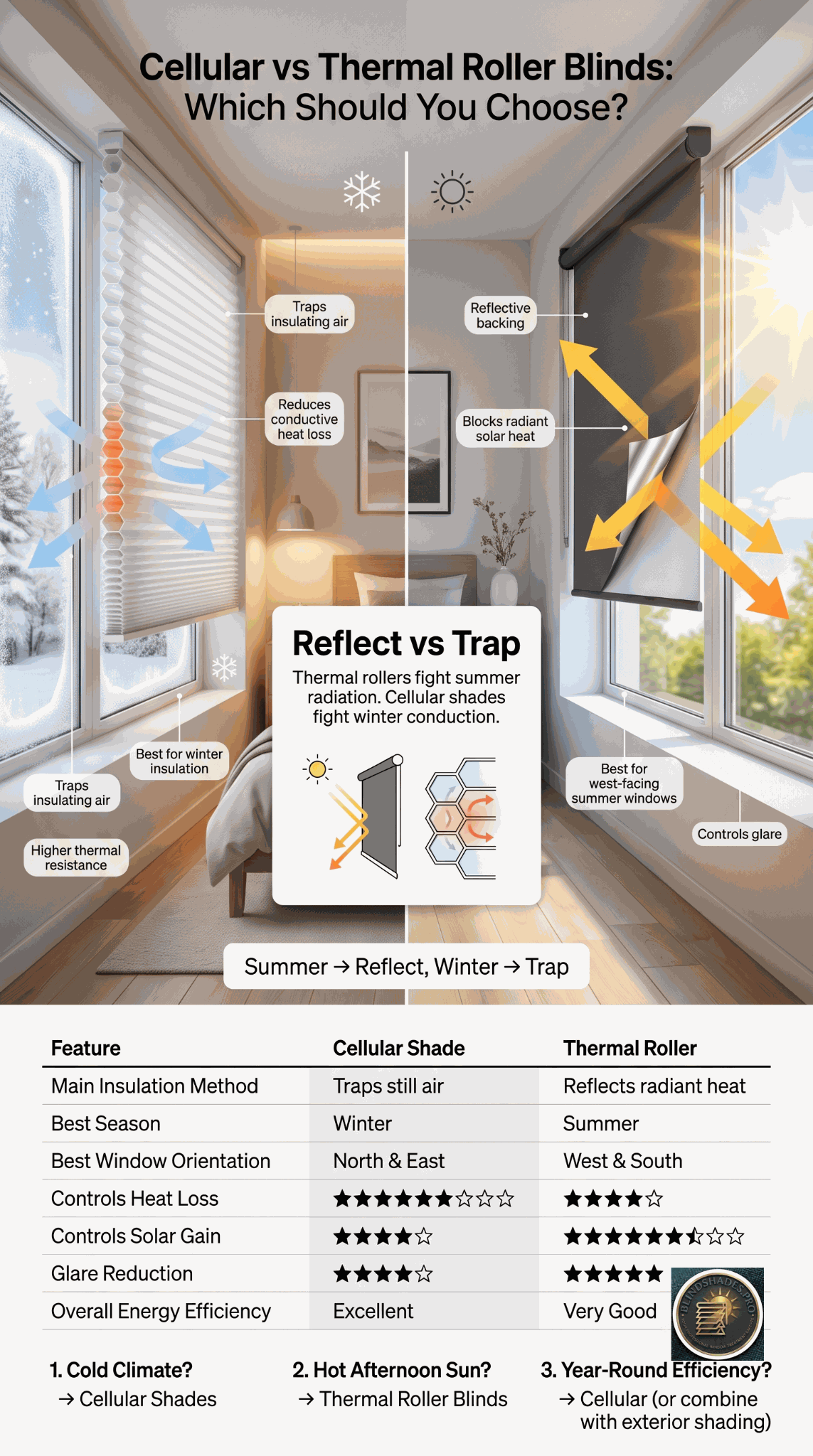
By Michael Turner — 30 years in window treatments
Cellular shades win winter and thermal roller blinds earn their keep in summer — because the two fight heat with different physics. A cellular shade traps still air in honeycomb pockets to slow conduction through cold glass; a thermal roller uses a reflective or blackout backing to bounce radiant sun before it cooks a room. Match the product to the season and orientation of the glass, not to the word “thermal” on the label.
Key Takeaways
- Cellular shades insulate roughly three to five times better on paper: typically R-3.5 to R-5.0 versus R-0.9 to R-1.5 for a thermal-backed roller, per ranges published by Joey’z Shopping and Zinga’s.
- “Thermal” on a roller means a coating, not a construction. A backing helps against direct sun, but no backing can add the trapped-air pockets that do the real insulating work in winter.
- Consumer NZ’s retention testing puts honeycomb blinds at 63 percent of heat retained — over heavy-lined curtains at 24 and thermal-labeled curtains at 16. No roller posts numbers in that league.
- Thermal rollers still have honest wins: summer glare, wet rooms, odd-shaped windows, and budgets — cellular is generally the pricier product, as Zinga’s states plainly.
- Fit decides more than the spec sheet. A snug mount beats a gappy one of either type; the U.S. Department of Energy’s cellular figures assume one.
⭐ Quick Answer — Cellular vs Thermal Roller Blinds
The cellular vs thermal roller blinds decision comes down to which heat problem you actually have — the two products fight with different physics:
- Winter cold picks cellular: honeycomb pockets trap still air against conduction through cold glass, and the U.S. Department of Energy credits insulated cellular shades with cutting window heat loss by forty percent or more.
- Summer sun picks the roller: a reflective or blackout backing bounces radiant heat and kills glare at a fraction of the cost — but that backing is a coating, not a construction, and it can’t add air pockets.
- The numbers aren’t close on insulation: cellular runs R-3.5 to R-5.0 against roughly R-0.9 to R-1.5 for thermal rollers, and Consumer NZ’s testing puts honeycomb blinds at sixty-three percent of heat retained — no roller posts numbers in that league.
- One honest limit for both: no interior covering stops summer heat that has already passed through the glass — the strongest version of that case lives in a Home Improvement Stack Exchange discussion, and extreme sun calls for exterior shading first.
- See the full rankings: the insulating side’s picks live in our Thermal & Insulated Blinds guide, the material ladder rung by rung in which blinds insulate best, and the honeycomb shortlist in the Cellular Shades guide.
Cellular vs Thermal Roller Blinds: Which Should You Choose?
Reflect vs Trap: thermal rollers fight summer radiation, cellular shades fight winter conduction — season and orientation pick your winner, not the label.
Start with what each product is, because the naming muddies it. A cellular shade — honeycomb, same thing — is built from rows of air pockets across the glass; still air is a poor conductor, so those pockets slow the bleed of warmth into cold glass all winter night. A thermal roller is an ordinary roller upgraded with a backing — reflective coating or dense blackout layer. Sense Blinds captures the split in one line: cellular shades trap insulating air to slow heat transfer, whereas rollers block and reflect heat without trapping much of anything.
That’s why the R-values diverge. The backing does real work against radiant energy — direct sun through west glass in July — but a single flat layer barely slows conduction. Joey’z Shopping says it from the roller’s own corner: a roller cuts the glare, but a cellular shade keeps the sun’s heat from ever building in the room.
The community verdict lines up: in a seventy-comment homeowners discussion, the recurring experience is that cellular blinds “easily save money in the winter,” and an efficient-home group’s thread runs heavily toward yes on whether cellular beats normal blinds — caveats living in fit, not the product.
One honest limit: no interior covering of any type can stop summer heat that has already passed through the glass — it can only manage it. For brutal sun, exterior shading beats both. Short of that, here’s how they stack.
The Head-to-Head Ledger
| Factor | Cellular shades | Thermal roller blinds |
|---|---|---|
| Insulation rating | R-3.5 to R-5.0 typical; community installs report around R-4 | R-0.9 to R-1.5 with thermal backing |
| Mechanism | Traps still air — resists winter conduction | Reflects radiant sun — cuts summer gain and glare |
| Attributed performance | DOE: forty percent-plus less window heat loss; Consumer NZ: 63 percent heat retained | No institutional retention figure published for the category |
| Single vs double cell | Marginal on paper — roughly R-4 to R-4.8; a foil-lined window-facing cell beats a plain double cell | Not applicable — one layer by design |
| Sound | Air pockets audibly muffle outside noise | No acoustic dampening — a flat sheet |
| Wet rooms and cleaning | Fabric cells hold dust and dislike moisture | Wipeable flat surface — the kitchen and bathroom pick |
| Measuring and odd windows | Needs precise measuring; unforgiving, per Arjay’s Window Fashions | Adapts easily to varied window shapes |
| Heat tolerance | Fabric handles trapped warmth well | Cheap PVC versions can warp or melt on hot west glass |
| Price | Generally the pricier product — internal strings mean a mis-sized shade can’t be trimmed, so most are made to order | The budget path; simple construction rolls cheap |
| Look | Soft accordion fold; top-down/bottom-up option | Minimalist tube, contemporary lines |
Which Wins in Your Room?
Two questions settle most cases: winter cold or summer sun, and does the room punish fabric?
| Your situation | The pick | Why |
|---|---|---|
| Cold winter glass, north- or east-facing | Cellular | Conduction is the enemy; trapped air is the cure |
| Harsh direct summer sun, west-facing | Thermal roller — or exterior shading first | Radiation is the enemy; reflection is the affordable interior answer |
| Bedroom facing a noisy street | Cellular | The only one of the two with any acoustic effect |
| Kitchen or bathroom | Thermal roller | Wipeable, moisture-tolerant, no cells to trap steam |
| Odd-shaped or out-of-square windows | Thermal roller | Forgiving of imperfect measurements |
Avoid These Mistakes
Buying the “thermal” label and expecting honeycomb performance. The backing is a sun tool; for a cold bedroom in January, the R-value ceiling is baked into the flat construction.
Layering your way into an oven. A blackout curtain over an existing blind on hot glass sandwiches it in a trapped-heat pocket — in one widely-shared homeowner account, that exact stack melted a set of vinyl blinds on a west window. If you layer, let the inner covering vent.
Cheap PVC on hot glass. The budget roller on a west window is the one that warps; community advice after the melted-blinds episode was blunt — invest in aluminum or quality fabric there.
Paying the double-cell premium blindly. Single to double moves roughly R-4 to R-4.8 — real, but marginal. Construction beats count: our guide to which blinds insulate best walks the full ladder.
Ignoring fit. A sealed single-cell beats a gappy double-cell; edge gaps turn insulation into decoration.
Who Should Buy Which?
Cellular shades ✔
- Cold-climate households where winter heating drives the bill
- Bedrooms needing dark plus quiet
- Buyers ready to measure precisely — or pay someone who will
Cellular shades ✖
- Steamy kitchens and bathrooms
- Tight budgets covering many windows at once
Thermal roller blinds ✔
- Sun-hammered west and south glass in cooling climates
- Wet rooms, rentals, odd windows, and budget whole-house jobs
Thermal roller blinds ✖
- Anyone whose real problem is winter heat loss — the construction can’t do that job
The Bottom Line
Cellular vs thermal roller blinds isn’t a quality contest — it’s two tools named confusingly. The honeycomb is an insulator: winter, conduction, institutional numbers. The thermal roller is a reflector: summer, radiation, glare, a friendlier price. Buy by season and orientation, mix freely across one house, and spend the premium where the physics pays it back. Our ranked picks for the insulating side live in the complete Thermal & Insulated Blinds guide, and the honeycomb shortlist is in the Cellular Shades guide — both updated as retail lines change.
FAQ
What’s the difference between cellular vs thermal roller blinds vs honeycomb shades? Cellular and honeycomb are the same product — interchangeable names for the air-pocket construction. The thermal roller is the different animal: a flat single-layer shade with a reflective or blackout backing. It’s a two-way comparison wearing three names, and the honeycomb side carries the insulation numbers.
What are the pros and cons of each? Cellular: superior insulation, noise muffling, soft look — but pricier, moisture-shy, and unforgiving to measure. Thermal roller: affordable, wipeable, glare-killing, shape-tolerant — but a weak insulator with zero sound benefit. Winter households lean cellular; sun-baked rooms lean roller.
Which costs more, cellular or thermal roller blinds? Cellular shades are generally the more expensive product, as Zinga’s states directly — multi-layer construction, made to order because internal strings prevent trimming. Thermal rollers are the budget path. Exact pricing shifts with sale cycles, so check current figures.
What do homeowners who’ve used both actually recommend? The long-running pattern: cellular owners report visible winter savings — “easily saves money in the winter” is the recurring phrasing in a homeowners thread with dozens of replies — while roller advocates defend glare, wet rooms, and price. Fit quality makes or breaks either.
Related Guides
- The Best Thermal & Insulated Blinds — the complete guide
- Which Blinds Insulate Best? — the full material ladder, rung by rung
- Are Thermal Blinds Worth It? — the numbers audit and payback math
- The Best Cellular Shades — the honeycomb shortlist
