Do Thermal Blinds Keep Heat Out?

Authored By Michael Turner -30 Years Home Improvement Expertise | Updated 2026 | BlindShades.pro
Updated on July 23, 2026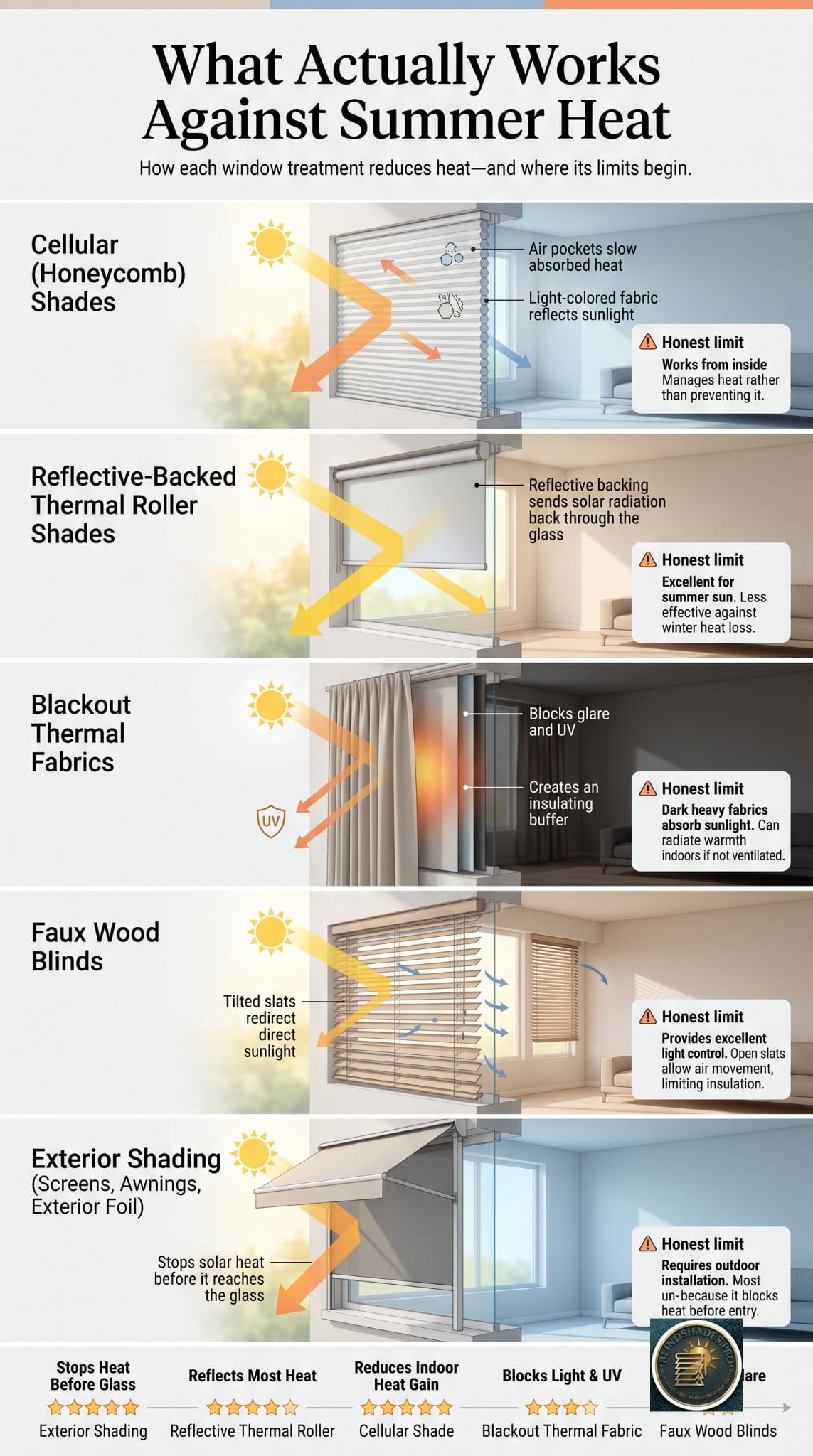
By Michael Turner — 30 years in window treatments
Yes — thermal blinds keep heat out, with two honest conditions the sales pages skip. First, an interior blind intercepts heat that has already passed through the glass: it manages summer heat, while exterior shading prevents it. Second, the tight-fit advice repeated everywhere is winter advice — seal a covering hard against sun-blasted glass in July and you build a heat pocket that warps cheap blinds and stresses sealed glazing. Keep the blind, learn the gap rule, and the summer numbers are real.
Key Takeaways
- The mechanisms are real: reflective backings bounce radiant sun back through the glass, honeycomb cells slow what gets past them, and Consumer Reports puts smart shade use at up to 77 percent of heat gain minimized.
- Watch the numbers being passed around: a seventy-eight-percent figure circulates with no named source, and one seller assigns a forty-percent heat-loss cut to roller blinds — a figure that belongs to the U.S. Department of Energy’s insulated cellular shades.
- Direction decides the ceiling. Interior coverings intercept; exterior shading prevents. In one documented conservatory case, moving the reflective layer outside the glass took panes from too hot to touch to room temperature within an hour.
- The summer gap rule: seal tight in winter, leave an air path in summer. A tightly sealed covering over hot glass has melted vinyl slats and cracked a sealed double-glazed unit in documented homeowner accounts.
- Answer by season, not by product: the same blind that keeps heat out in July keeps warmth in through January nights — the honeycomb family does both jobs.
⭐ Quick Answer — Do Thermal Blinds Keep Heat Out?
Yes — do thermal blinds keep heat out has a measurable yes behind it, with two honest rules the sales pages skip:
- The mechanisms are real: reflective backings bounce radiant sun back through the glass and honeycomb cells slow what gets past them — Consumer Reports puts smart shade use at up to seventy-seven percent of heat gain minimized.
- Direction decides the ceiling: an interior blind intercepts heat that has already crossed the glass, so brutal sun calls for exterior shading first — the consensus in every serious heat discussion, including Home Improvement Stack Exchange’s strongest threads.
- The summer gap rule: tight fit is winter advice — sealed coverings over sun-blasted glass have warped vinyl slats and cracked a sealed double-glazed unit in documented accounts, so leave summer coverings an air path.
- Mind the migrating numbers: the forty-percent heat-loss figure belongs to the U.S. Department of Energy’s insulated cellular shades — not to roller blinds, whatever a product page claims.
- Pick by season and room: the ranked picks live in our Thermal & Insulated Blinds guide, the reflect-vs-trap decision in cellular vs thermal roller blinds, and the budget rungs in the window insulation cost ladder.
Do Thermal Blinds Keep Heat Out?
Intercept vs Incubate: a blind that intercepts radiation before it soaks the room helps — one that seals a tight pocket over hot glass incubates the heat instead.
Start with what “keeping heat out” physically means. Summer heat arrives mostly as radiation — sunlight passing through glass and soaking into floors, furniture, and dark fabric. A thermal blind fights back two ways: a reflective or white backing bounces a share of that radiation back out through the glass before it’s absorbed — the honest mechanism behind reflective-backed rollers, as our cellular vs thermal roller comparison breaks down — and honeycomb cells trap still air, slowing absorbed heat from convecting into the room, the same construction the Thermal & Insulated Blinds guide ranks for winter.
The measured ceiling is high: Consumer Reports puts smart shade use at minimizing heat gain by up to 77 percent — the strongest attributed number in circulation. Be careful with its unattributed cousins: a seventy-eight-percent figure circulates across seller pages with no named study, and one retailer credits roller blinds with slashing heat loss by as much as forty percent — a number the Department of Energy publishes for insulated cellular shades, not rollers. When a statistic moves between product categories without its source, treat it as marketing.
Now the honest limit. An interior blind stands on the room side of the glass, so the radiation it reflects has already crossed the pane once, and some absorbed heat stays indoors regardless. That’s why serious heat threads run exterior-first: stop sun before the glass with awnings, screens, or reflective layers outside, then let the interior blind handle the remainder. The most vivid documented case: a homeowner whose tight interior coverings left conservatory panes too hot to touch moved a reflective bubble-foil layer outside the glass — about twenty pounds spent — and the glass dropped to room temperature within an hour, the room roughly ten degrees cooler.
What Actually Works Against Summer Heat
| Option | Mechanism | Honest limit |
|---|---|---|
| Cellular (honeycomb) shades | Air pockets slow absorbed heat; light colors reflect | Interior position — manages, doesn’t prevent; see the Cellular Shades guide |
| Reflective-backed thermal rollers | Backing bounces radiation back through the glass | Flat single layer — weak against winter conduction |
| Blackout thermal fabrics | Opaque layers stop glare and UV; buffer the glass | Dark heavy fabric absorbs sun and re-radiates it indoors if unvented |
| Faux wood blinds | Tilted slats deflect direct sun; PVC tolerates heat poorly, wood-composite better | Slats leak air freely — light control first, insulation last |
| Exterior shading (screens, awnings, foil) | Prevents heat reaching the glass at all | Needs outdoor access; the one tier that stops heat rather than managing it |
Cheap routes first if budget leads: the whole ladder from nearly free upward is in our window insulation cost ladder, and the material ranking rung by rung is in which blinds insulate best.
When Should Blinds Be Down — Summer, Winter, Night?
| Season · time | Blind position | Why |
|---|---|---|
| Summer day, sun-facing glass | Down and closed — with an air path (gap at frame or window cracked behind) | Intercept radiation without sealing a heat pocket |
| Summer night | Open, windows venting where safe | Dump the day’s absorbed heat; trapped indoor heat is the enemy after dark |
| Winter day, sun-facing glass | Open — let free solar gain in | Sunlight is free heating; close only shaded sides |
| Winter night | Down and sealed tight | Now the tight fit earns its keep — trapped air fights conduction all night |
The full open-or-closed choreography, orientation by orientation, gets its own dedicated guide.
Avoid These Mistakes
Sealing tight over hot west glass. The tight-fit advice everywhere online is winter advice. Sealed pockets over sun-blasted glass have warped vinyl slats and, in one conservatory case, cracked a sealed double-glazed unit. Frame-sealed-system manufacturers publish a required glass-to-blind distance for exactly this reason; almost nobody reads it. Summer rule: leave the covering an air path.
Layering into an oven. Adding blackout curtains over an existing blind on hot glass sandwiches the blind in the pocket. Vent between layers or un-stack the sunny side.
Trusting numbers with no name attached. The 77 percent figure has Consumer Reports behind it; the circulating 78 percent has nobody. Buy on attributed claims.
Buying dark, heavy, unvented fabric for summer. Dark mass absorbs solar load and re-radiates it into the room — homeowners describe such curtains as hot to the touch by afternoon. Reflective side out, light colors, or vent the pocket.
Skipping exterior options for brutal sun. If glass is painful to touch, no interior product is the first answer. Shade outside, then finish the job inside.
Who Should Buy Which?
Thermal blinds for summer heat ✔
- Renters and anyone without exterior access — the best interior-side play
- West- and south-facing rooms needing glare and gain control with the gap rule applied
- Households wanting one product for both seasons — cells earn winter keep too
Thermal blinds for summer heat ✖
- Glass that’s already scalding — exterior shading first, blind second
- Anyone planning to seal a perfect-fit system hard against hot panes without the manufacturer’s gap
The Bottom Line
Do thermal blinds keep heat out? Yes — measurably, with Consumer Reports’ 77 percent as the ceiling and reflective backing plus trapped air as the honest mechanisms. Just respect the two rules the ads skip: exterior beats interior when sun is brutal, and tight fit is a winter setting — in summer, give the heat somewhere to go. Pick reflective or light-colored products for sun-facing rooms, and let the same honeycomb earn its keep next January. The ranked picks live in our complete Thermal & Insulated Blinds guide, updated as retail lines change.
FAQ
Do thermal blinds keep heat out at night? Indirectly. After dark there’s no radiation to reflect; the job flips to releasing the day’s absorbed indoor heat. Open coverings and vent where safe on summer nights, then close them again before the morning sun returns. In winter, night is exactly when a sealed thermal blind works hardest.
Do thermal blinds keep heat out in the winter? The winter job is the reverse — keeping heat in — and it’s where the honeycomb construction shines: the Department of Energy credits insulated cellular shades with cutting window heat loss by forty percent or more. Same product, both seasons, opposite directions.
Do faux wood blinds keep heat out? Partially. Tilted slats deflect direct sunlight and the material shrugs off heat better than cheap vinyl, but slatted construction leaks air freely, so they’re light control first and insulation last. For genuine summer performance, cellular shades or reflective-backed rollers do more.
Do blinds keep cold out too? Yes — the same trapped-air principle works in both directions. Cellular shades slow warm indoor air from bleeding into cold glass exactly as they slow summer heat coming in. Seal them snug in winter; that’s the season the tight fit belongs to.
Related Guides
- The Best Thermal & Insulated Blinds — the complete guide
- Cellular vs Thermal Roller Blinds — the season test
- Cheapest Ways to Insulate Windows — the cost ladder
- Which Blinds Insulate Best? — the material ladder
