How to Stop Cold Air Coming Through Windows

Authored By Michael Turner -30 Years Home Improvement Expertise | Updated 2026 | BlindShades.pro
Updated on July 24, 2026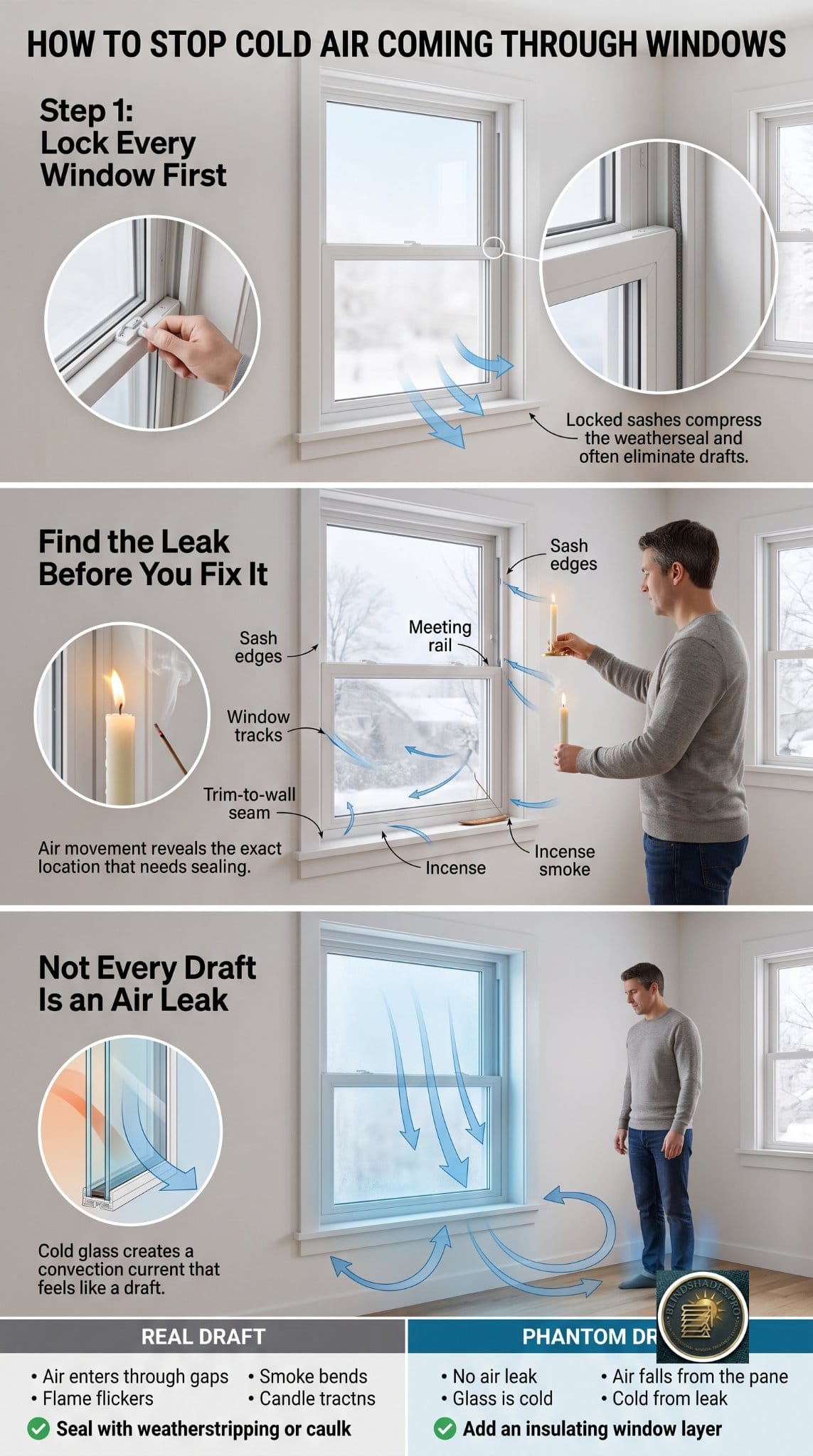
By Michael Turner — 30 years in window treatments
Stop cold air at a window in two moves: hunt the leak first, then match the seal to what you found. Weatherstripping fixes sashes, caulk fixes trim seams, film and coverings fix the glass itself — and locking the window is the free fix everyone skips. The catch nobody mentions: half of what feels like a draft at a closed window isn’t moving air at all, but room air chilling against cold glass and falling — a problem no caulk will cure. Diagnose before you buy anything.
Key Takeaways
- Diagnose before you seal: a candle or incense stick on a cold, windy day tells you in minutes whether you have a real leak (flame flickers at a spot) or a phantom draft (steady cold, no flicker) — two problems with entirely different fixes.
- Match the fix to the location. Foam or V-type weatherstripping seals operable sashes and tracks; silicone or acrylic caulk seals the seams where trim meets wall, as JustAnswer’s expert guidance confirms; the glass itself needs insulation, not sealant.
- Lock your windows. This Old House’s simplest tip is the most skipped: engaging the lock forces the sashes together into their factory seal — a real, free draft reduction.
- The renter’s tape doctrine, community-tested: blue painters tape on the frame first, HVAC tape — not duct tape — sealed over it; the whole seal peels away in spring without lifting paint.
- The phantom draft is a glass problem. Air chilling against a cold pane falls and spills into the room all night; the cure is an insulating layer over the glass, and the full film clinic lives in our cheapest ways to insulate windows guide.
⭐ Quick Answer — How to Stop Cold Air Coming Through Windows
Learning how to stop cold air coming through windows is a two-step discipline — hunt the leak first, then match the seal to the spot:
- Start free: lock every window — the lock cams the sashes into their factory weatherseal, the simplest fix in This Old House’s draft-stopping playbook and the one most cold rooms skip.
- Run the candle hunt: on a cold, windy day, trace a flame around sashes, tracks, trim seams, and sill — flicker means a real leak, and the location picks the fix: weatherstrip for moving parts, caulk for trim-to-wall seams, rope caulk for frame gaps.
- No flicker, still cold? That’s the phantom draft: room air chilling against cold glass and falling — a conduction problem no sealant cures. Insulate the pane with film or a snug covering, per the U.S. Department of Energy’s seal-then-insulate order.
- Renters have a full kit: painters tape laid first with HVAC tape sealed over it peels away in spring without lifting paint — the community-tested doctrine missing from method lists like GlassDoctor’s seven ways.
- Finish at the glass: the film clinic and every budget rung live in the window insulation cost ladder, the covering rankings in our Thermal & Insulated Blinds guide, and the falling-cold mechanism in blinds vs curtains for insulation.
How to Stop Cold Air Coming Through Windows
Hunt, Then Seal: you can’t fix a draft you haven’t located — and half of what feels like a draft isn’t one.
Every guide lists the same five fixes; almost none tells you which one your window needs. So start with the free move, then the hunt. First, lock every window — as This Old House demonstrates, the lock cams the sashes tight into their weatherseal, and many “drafty” double-hungs are simply unlatched. If the room still feels cold, run the hunt on the next cold, breezy day: move a lit candle or incense stick slowly around the frame — sash edges, meeting rail, track, the trim-to-wall seam, the sill. Where the flame dances or smoke kicks sideways, you’ve found moving air, and the location tells you the fix.
And if the flame never flickers while the window still pours cold? That’s the phantom draft — the case the method lists can’t solve. Room air touches the cold pane, chills, grows dense, and slides off the glass into the room, a convection current that feels exactly like a leak at ankle height. Indow, the window-insert maker, is the rare seller that even hints at this, noting that beating the cold feeling means raising insulation and the perceived temperature. It’s the same cold waterfall we mapped behind unsealed curtains in blinds vs curtains for insulation — and the cure is an insulating layer over the glass, not another tube of caulk.
Where Is the Cold Actually Getting In?
| What you observe | The test | Verdict | Your route |
|---|---|---|---|
| Flame flickers at sash edges or the track | Candle pass on a windy day | Real leak — operable parts | Weatherstripping row below |
| Flicker at the trim-to-wall seam | Candle pass + hand check | Real leak — construction gap | Caulk row below |
| Flicker at the frame or under the sill | Candle + flashlight for visible gaps | Real leak — frame gap | Rope caulk / foam row below |
| Cold pouring off the window, no flicker anywhere | Candle steady everywhere; glass cold to the touch | Phantom draft — conduction, not leakage | Insulate the glass: film or fitted covering |
| Draft persists behind closed blinds | Candle at the blind’s side edges | Air path around the covering | Side-channel fix below |
Which Fix Does Your Leak Need?
| Leak location | The fix | Effort and cost, in words | Renter-safe? |
|---|---|---|---|
| Operable sashes, tracks, meeting rails | Adhesive foam or V-type weatherstrip in the jamb — the vee springs against the sash, as Renewal by Andersen notes | Minutes per window, pocket change | Yes — peels off |
| Trim-to-wall seams | A clean bead of silicone or acrylic latex caulk where frame meets wall | An afternoon; one tube covers several windows | Ask first — semi-permanent |
| Frame gaps and sill under-leaks | Rope caulk pressed in for winter, removed in spring; expanding foam only for owners | Minutes, reversible in rope form | Rope yes, foam no |
| The whole opening, badly leaky | The tape doctrine: painters tape on the frame first, HVAC tape — not duct tape — over it | An hour per room, peels clean in spring | Yes — that’s the point |
| The glass itself (phantom draft) | Shrink film for the season, or a snug insulating covering — the full clinic lives in the window insulation cost ladder | From nearly free upward | Yes |
| Drafts sneaking around blinds | Side channels or u-channel strips at the blind’s edges — a sealed perimeter turns the covering into a still-air pocket, the principle behind which blinds insulate best | An evening | Usually |
| Doors in the same cold room | Sweeps at the bottom, weatherstrip at the jamb — same hunt, same logic | Minutes per door | Mostly |
Avoid These Mistakes
Caulking a window you open. Caulk is for joints that never move; sealing a sash shut costs you ventilation — and in older houses, fire egress. Operable parts get weatherstrip, period.
Duct tape on painted frames. It lifts paint and bakes on. The community doctrine exists for a reason: painters tape down first, HVAC tape over it, everything peels in spring.
Sealing harder when the problem is the glass. If the candle never flickered, more caulk changes nothing. Phantom drafts are conduction; insulate the pane.
Leaving reflective foil up into the warm season. In one RV owners’ thread on Reflectix covers, the top answer noted the owners took some down “because it got too hot” — a seasonal tool, and on sun-facing glass a sealed reflective layer builds real heat.
Skipping the lock. The one fix that costs nothing and takes one second is the one most cold rooms haven’t tried.
Who Should Buy Which?
Owner-grade fixes ✔
- Caulk at trim seams, foam at frame gaps, new sweeps and strips — permanent gains worth doing once
- Whole-window film kits each season on the worst glass
Owner-grade fixes ✖
- Anything that seals an operable sash shut
Renter-safe kit ✔
- The tape doctrine, rope caulk, shrink film, tension-fit coverings, side channels
- Everything reversible by spring — deposit intact
Renter-safe kit ✖
- Expanding foam and permanent caulk without written permission
The Bottom Line
How to stop cold air coming through windows comes down to one discipline: hunt first, seal second. Lock the sashes, run the candle, and let the flicker route you — weatherstrip for moving parts, caulk for fixed seams, tape or rope caulk for the renter’s winter, insulation for the glass when the “draft” is conduction in disguise. Sealing is the cheap half; the glass is where the remaining cold lives, and its complete ladder is in our cheapest ways to insulate windows guide, with covering rankings in the Thermal & Insulated Blinds guide.
FAQ
What can I put on my windows to stop the cold? In escalating order: weatherstrip on the sashes, caulk at the trim seams, rope caulk in frame gaps, shrink film across the glass, and a snug insulating covering over everything. Renters lean on the reversible tier — tape doctrine, film, tension-fit coverings — all removable in spring.
How do I stop cold air coming through the window frame itself? Hunt the exact gap with a candle and flashlight. Hairline trim-to-wall seams take a caulk bead; wider frame gaps take rope caulk; under-sill leaks often hide the biggest gap in the room. If the frame is sound but the glass runs cold, that’s conduction — insulate the pane instead.
Do I need to stop cold air in summer too? Same paths, opposite direction — the gaps that leak winter cold leak conditioned air out come July. Weatherstripping and caulk earn their keep year-round; just swap the glass strategy from heat-keeping film to reflective shading in the hot months.
What about cold air from windows and doors together? Run the same hunt on doors: sweeps for the bottom gap, weatherstrip at the jamb, the lock-tight test on the latch side. A cold room usually has two or three leak points splitting the blame — fix them as a set and the room changes character.
Related Guides
- Cheapest Ways to Insulate Windows — the full cost ladder, film clinic included
- The Best Thermal & Insulated Blinds — the complete guide
- Blinds vs Curtains for Insulation — the cold waterfall, mapped
- Which Blinds Insulate Best? — the material ladder
