Thermal Blinds and Condensation: Cause, Cure, or Both?

Authored By Michael Turner -30 Years Home Improvement Expertise | Updated 2026 | BlindShades.pro
Updated on July 24, 2026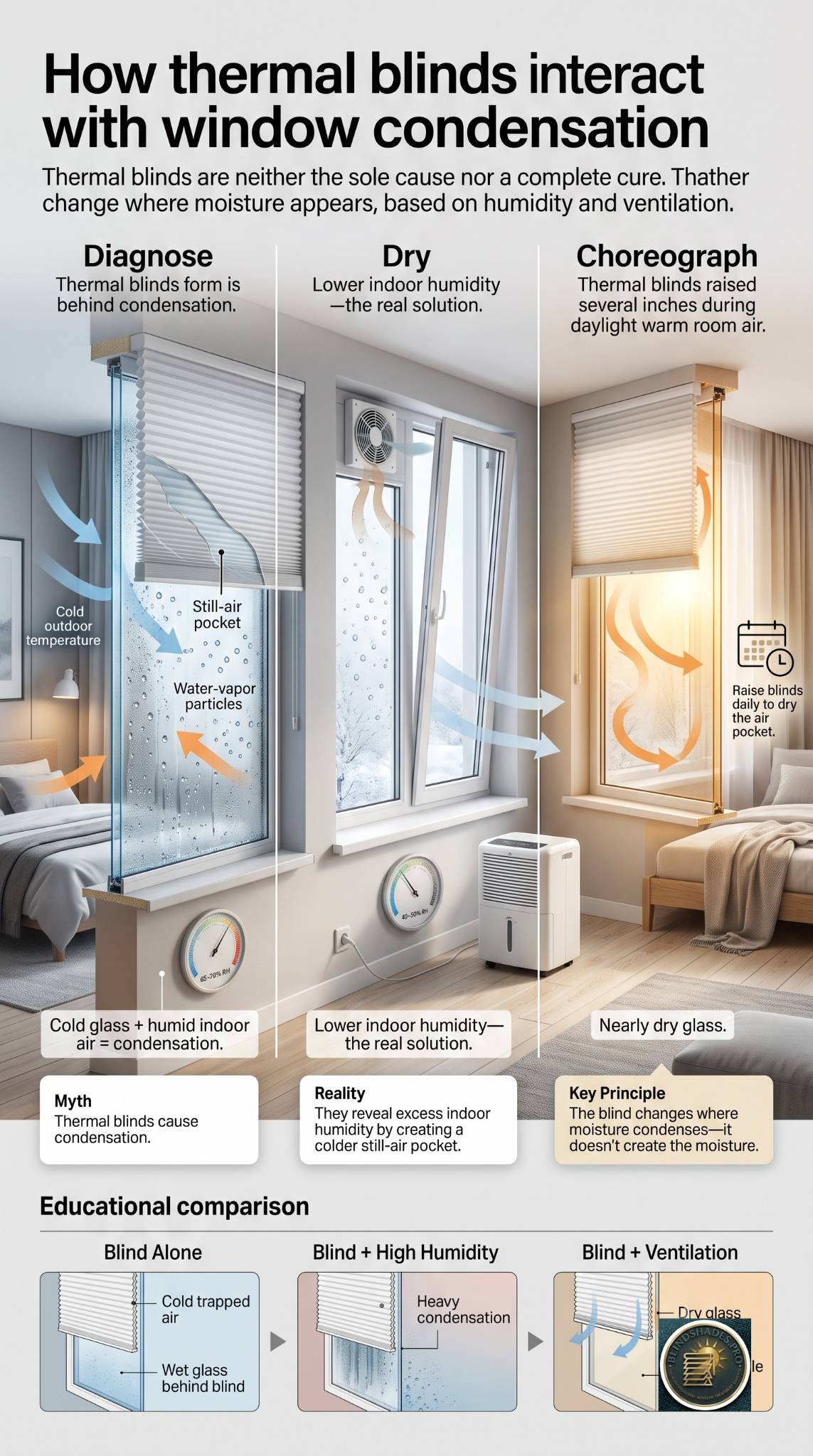
By Michael Turner — 30 years in window treatments
Thermal blinds don’t create the water on your glass — your air does. What a well-fitted blind changes is where that water shows up: by holding room heat away from the pane, it lets the glass run colder, so humidity that used to evaporate invisibly now beads where you can see it. That’s why one seller says blinds cause condensation, another says they cure it, and a third says they’re neutral — all three are describing different layers of the same physics. The fix is a sequence, not a product: diagnose which surface is wet, dry the air, then time the blind so the pocket airs out daily.
Key Takeaways
- The contradiction on this topic is resolvable. The blind cools the glass behind it (more visible beading) while insulating the room (less moisture generated by heating struggles elsewhere) — and the moisture itself was in your air before the blind arrived. Cause, cure, and neutral are all partial truths about layers.
- There’s a national-laboratory study on exactly this: a 2022 Pacific Northwest National Laboratory evaluation, published through the AERC energy-rating program, examined the thermal and moisture — that is, condensation — performance of shades and blinds against cellular shades. It’s the most authoritative document on the field, and almost nobody cites it.
- Diagnose in ten seconds: water on the room-side face is an indoor-humidity job and fixable; fog between the panes means the window’s sealed unit has failed — no blind caused it and no blind fixes it; moisture outside is harmless dew.
- A hygrometer costing about five pounds is step zero. Target 40 to 50 percent for the house’s health, capping toward 30 to 40 in genuinely cold climates before mold risk climbs — guessing at humidity is how the wrong fixes get bought.
- Fresh condensation behind a new thermal blind is usually proof it’s working: a still-air pocket formed, the glass got colder, and your existing humidity became visible. Manage the water; keep the blind.
⭐ Quick Answer — Thermal Blinds and Condensation
The thermal blinds and condensation connection runs through one mechanism — and the fix is a sequence, not a product:
- The blind reveals the water, it doesn’t brew it: an insulating blind lets the glass run colder, and cold glass sits below the dew point of humid indoor air — moisture that used to evaporate invisibly now beads where you can see it. Often that’s proof the still-air pocket is working — the position velablinds’ performance guide states plainly.
- Diagnose in ten seconds: room-side water is a fixable humidity job; fog between the panes is a failed window seal no blind caused; outside moisture is harmless dew — the full failure ledger sits in disadvantages of thermal blinds.
- A national lab studied this exact question: a 2022 Pacific Northwest National Laboratory evaluation published through the AERC energy-rating program examined the thermal and moisture performance of shades against cellular products — the field’s quiet authority.
- The fix ladder starts with a five-pound hygrometer: cut moisture sources, shock-ventilate a few minutes several times daily (it works even in rain — cold air holds less absolute moisture), add a dehumidifier where the climate demands, and raise the blind at the sunniest hour so the pocket dries — the insulation itself is backed by the U.S. Department of Energy’s cellular figures.
- Keep the blind: the picks worth the small routine are in our Thermal & Insulated Blinds guide, and the film fix for stubborn glass lives in the window insulation cost ladder.
Thermal Blinds and Condensation: Cause, Cure, or Both?
Diagnose · Dry · Choreograph: find which surface is wet, lower the water in the air, then time the blind so the pocket dries daily.
Read the published advice on this question and you’ll find a field arguing with itself. One camp says blinds worsen condensation by blocking warm air from the glass and trapping humid air behind the fabric. Absolute Blinds says the opposite — can blinds reduce condensation? “Yes, they can,” by insulating the warm room air from the cold pane — and velablinds agrees that cellular blinds “do not typically cause condensation” and often help significantly. AOSKY splits the difference: thermal blinds don’t prevent condensation; ventilation does. The refreshing thing is that the community settled this argument years ago. In the definitive 269-answer discussion of a homeowner’s “crazy amount of condensation” after installing a thermal blind, the top technical answer cuts straight through: if the water is on the inside, the indoor moisture level is too high — the problem existed before the blind made it visible.
All three seller camps are describing real layers. Yes, the glass behind an insulating blind runs colder — that’s the insulation working, and colder glass condenses more of whatever humidity touches it. Yes, blinds can reduce condensation elsewhere — a warmer room holds moisture in vapor form. And yes, the decisive variable is the air itself: cooking, showering, drying laundry, and breathing load a household’s air with liters of water a day, and that water condenses on the coldest surface it finds. The blind didn’t brew it; the blind picked where it lands. Even the best reframe in the thread belongs here: a wall of droplets behind a brand-new blind is evidence a still-air pocket formed — that’s how you know it’s working.
And there’s an arbiter above all the seller copy: the 2022 PNNL evaluation published through AERC — the window-covering industry’s own energy-rating body — which examined precisely this thermal-and-moisture performance question across shade types, including cellular shades. When a national laboratory studies whether insulating coverings manage condensation acceptably, the question has left the realm of marketing opinion. What follows is the sequence that study’s existence implies and the community record confirms.
Where Is the Water Sitting?
Ten seconds at the glass answers whose problem this is.
| Where the moisture is | What it means | Whose problem — and what next |
|---|---|---|
| Room-side face of the glass | Indoor humidity meeting a cold pane — the common case, and the whole subject of this guide | Yours, and fixable: the ladder below |
| Between the two panes | The sealed unit’s seal has failed and its insulating gas is gone — fog you can’t wipe from either side | The window’s. No blind caused it, none fixes it — the full failure story is in disadvantages of thermal blinds |
| Outside surface, cold mornings | Ordinary dew on efficient glazing | Nobody’s — it evaporates by itself |
What Should Your Indoor Humidity Be?
Step zero costs about five pounds: a digital hygrometer. Guessing at humidity is how households buy dehumidifiers they don’t need or wipe sills all winter when one habit change would end it.
| Reading | Verdict | Move |
|---|---|---|
| 40–50 percent | The house-safest band — comfort, health, and structure all happy | Maintain; choreograph the blind and carry on |
| 50–60 percent | Acceptable for living, but expect beading on cold glass behind snug blinds | Ventilation habits first; reassess in a week |
| Above 60 percent | Too wet — condensation is a symptom, and mold is the next tenant | The full ladder, starting at source control |
| Cold climates generally | Cap toward 30–40 percent in deep winter before mold risk climbs on cold surfaces | Desiccant dehumidifier territory; see the ladder |
The Fix Ladder
One buying note before the ladder, since many readers arrive here mid-purchase: the best thermal blinds for condensation-prone rooms are the ones you’ll operate — bottom-up models that crack elegantly overnight, in breathable rather than coated fabrics — and the ranked picks in our Thermal & Insulated Blinds guide note which is which.
Ranked the way the community ranked it — by what actually ended people’s condensation, cheapest habits first.
| Rung | The fix | The detail that makes it work |
|---|---|---|
| 1 — Source control | Vent fans run during and after cooking and showers; bathroom door closed while steam clears; laundry dried outdoors or vented | The sleeper: check the dryer’s vent tube — a detached tube dumps a damp house’s worth of moisture indoors, and it’s a fire hazard besides |
| 2 — Stoßlüften | The German shock-ventilation method: every window wide open, five to fifteen minutes, two to four times a day, then sealed again | Walls and furniture hold their heat, so the room rewarms in minutes — you exchange the wet air without cooling the house. And it works even in rain: cold outdoor air holds less absolute moisture than warm indoor air, even at high relative humidity |
| 3 — Dehumidifier | The most-repeated appliance answer; compressor types for mild climates, desiccant types below roughly twenty degrees | Community-computed running cost: a typical unit draws under two hundred watts — around thirty euros across a ninety-day winter at four hours a day. Cheaper than repainting a moldy reveal |
| 4 — Blind choreography | Raise the blind at the day’s sunniest hour to release the pocket’s moisture; crack it six to eight inches from the bottom overnight; adjust per orientation | The lived resolution from the crown thread: an occasional dehumidifier plus blinds cracked at night — solved |
| 5 — Glass-surface fixes | Weatherization film lifts the interior surface above the dew point — the honest mechanism behind Frost King’s dry-all-winter claim; trickle vents open; seal leaky sashes; storm windows | The film clinic and every budget rung live in cheapest ways to insulate windows; one sunroom testimonial after film: “I have none.” The fresh exterior witness belongs here too — external blinds kept single glazing warm enough for “next to no condensation” |
| 6 — Symptom tier (honestly labeled) | Window vacuum, squeegee, microfiber; moisture-absorber tubs and rice-sock sill snakes that absorb overnight and release in the sun | These manage water that already condensed. Useful, cheap — and not cures; in-thread pushback on rain-repellent coatings said the same |
| 7 — Structural | Heat-recovery ventilation, or positive-input ventilation from the loft | Continuous background air exchange at around a hundred watts — the endgame for chronically damp houses, with a satisfied in-thread testimonial behind it |
The Contractor’s Warning, Adjudicated
The strongest argument against insulating blinds ever posted on this subject came from contractors at a renewable-energy fair, quoted in the crown thread: window quilts and tight insulating coverings are “a terrible idea… no amount of dehumidification” will save you — you’ll save energy but spend far more replacing rotten windows. That warning deserves a straight answer, because water genuinely is the enemy of your house.
Here’s the adjudication: the warning is true for the household that adds tight insulation to humid air and changes nothing else. Seal a cold pocket over sixty-percent-humidity air all winter and the pocket becomes a condensation farm running against wooden sashes — rot is a fair prediction. But every variable in that sentence is controllable, and the ladder above controls them: the hygrometer proves the air is dry enough, source control and Stoßlüften keep it there, and choreography airs the pocket daily. The contractors’ scenario assumes the moisture stays; the entire method is that it doesn’t. Run the sequence and the blind delivers its insulation with the window drier than it was — skip the sequence, and the contractors are right. That’s not a reason to fear the blind; it’s a reason to buy the five-pound hygrometer first.
When Should the Blind Be Up or Down?
| Time | Position | Why |
|---|---|---|
| Sunniest hour of the day | Fully raised | The sun warms the glass and evaporates the pocket’s moisture — the daily reset |
| Daytime otherwise | Down on shaded sides, up where sun lands | Free heat in, per the winter logic in do thermal blinds keep heat out |
| Overnight | Down — cracked six to eight inches from the bottom in condensation-prone rooms | Insulation stays, the pocket breathes; bottom-up models make this elegant |
| Persistent-problem rooms | Follow the humidity, not the habit | Hygrometer above 55? Prioritize airflow over the last degree of insulation until the air dries |
The full season-by-season, orientation-by-orientation routine gets its own dedicated guide; this is the condensation-specific core.
Avoid These Mistakes
Blaming the blind before reading the air. The hygrometer verdict comes first. Most “the blind caused it” cases are sixty-plus-percent air finally meeting a surface cold enough to show it.
Wiping instead of drying. The squeegee tier manages symptoms. If the sill needs wiping daily, the air is wet — move up the ladder.
Sealing a humid house tighter. Draft-proofing plus insulating blinds plus unmanaged humidity is the contractors’ rot scenario assembled on purpose. Seal and dry together — the sealing half lives in how to stop cold air coming through windows.
Running the dehumidifier with the windows open. Pick the mode: exchange the air (Stoßlüften, minutes) or dry the air (machine, hours) — running both at once dries the whole outdoors on your electricity.
Treating between-pane fog as a blind problem. That’s a dead sealed unit. Wipe nothing, blame nothing, budget for the glass.
Who Should Buy Which?
Thermal blinds in a condensation-prone home ✔
- Anyone who’ll run the sequence — hygrometer, ventilation habit, morning raise
- Cold-climate bedrooms where the insulation payoff is largest; cellular picks in the Cellular Shades guide
- Bottom-up models for the overnight crack
Thermal blinds in a condensation-prone home ✖
- Households at sixty-plus percent humidity with no plan to lower it — dry the air first
- Between-pane fog cases hoping a covering fixes a dead seal
The Bottom Line
Thermal blinds and condensation meet at one cold pane: the blind insulates the room, the glass runs colder, and whatever humidity your household carries becomes visible where it always condensed invisibly. Diagnose the surface, read the air with a five-pound instrument, dry it with habits before machines, and choreograph the blind so the pocket resets daily — then the contractors’ rot warning stays hypothetical and the insulation is yours to keep. The blinds worth this small routine are ranked in our complete Thermal & Insulated Blinds guide, and the honest ledger of every other drawback sits alongside this one in disadvantages of thermal blinds.
FAQ
Can blinds cause condensation? Not by adding water — condensation needs moisture your household’s air already carries. What an insulating blind does is cool the glass behind it, which makes existing humidity condense there visibly. The MEEH community line states it precisely: blinds don’t cause condensation, but air trapped behind them will condense on cold glass.
How do I stop condensation on windows behind blinds? In order: read the humidity (hygrometer), cut the sources (vent fans, dryer tube, lids on pots), shock-ventilate two to four times daily, run a dehumidifier if the reading stays high, and raise the blind at the sunniest hour so the pocket dries. Persistent rooms get the overnight bottom crack — insulation kept, airflow restored.
How do I stop condensation on windows at night? Night is when glass is coldest and doors are shut, so lower the evening load: last shock-ventilation before bed, bedroom door ajar if privacy allows, and the blind cracked six to eight inches from the bottom. A bedroom dehumidifier on a timer handles the stubborn cases; morning sun and a raised blind finish the job.
Is condensation a sign my thermal blind is working? Often, yes. Fresh beading behind a new blind means a still-air pocket formed and the glass stopped being heated by the room — exactly the insulation you paid for. It’s a prompt to manage humidity, not to return the blind.
Does opening blinds make it colder in winter? Briefly and locally, yes — you release the trapped-air layer. That’s why the routine is targeted: raise for the sunny hour (the glass gains more from sun than it loses to the room) and for the moisture reset, then close for the cold hours. Net over a day, the choreographed blind keeps you warmer than either extreme.
Should I take thermal blinds down in winter? No — winter is when they earn their keep, and the crown thread’s own resolution was keeping them with two adjustments: occasional dehumidifier use and blinds cracked at night. Remove the moisture, not the insulation.
Related Guides
- The Best Thermal & Insulated Blinds — the complete guide
- Disadvantages of Thermal Blinds — the honest ledger this problem sits in
- Cheapest Ways to Insulate Windows — film and every budget rung
- Blinds vs Curtains for Insulation — the category verdict
