Are Motorized Blackout Blinds Worth It for a Bedroom — Cost, Convenience and Sleep Guide

Authored By Michael Turner -30 Years Home Improvement Expertise | Updated 2026 | BlindShades.pro
Updated on July 12, 2026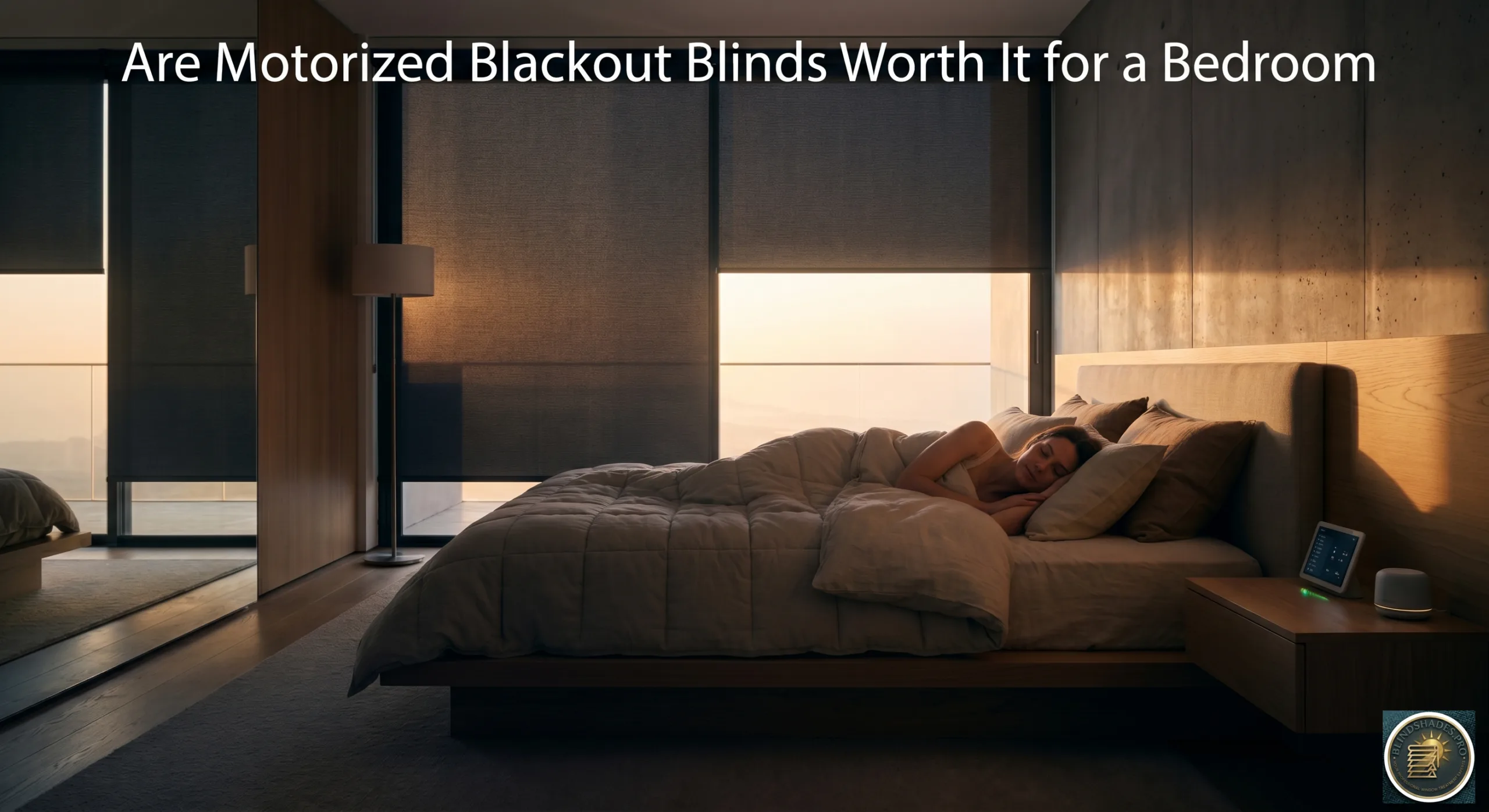
⭐ Quick Answer — Are Motorized Blackout Blinds Worth It for a Bedroom?
- The Real Value — Not Convenience: Motorized blackout blinds in a bedroom are worth it primarily for sleep inertia prevention via scheduled sunrise — not convenience. A manual blackout shade is equally dark during sleep. The motorized value is the programmed rise 30–45 minutes before your alarm, which moves you from deep sleep to lighter stages before waking. This reduces the 30–60 minute post-alarm grogginess that follows an abrupt wake from deep sleep
- Chronotype-Specific Programming: Larks (morning types): programme shade rise to begin 30 minutes before alarm, 20–30 minute gradual open. Owls (evening types): programme rise to begin 45–60 minutes before alarm, 40–50 minute gradual open — the extended pre-wake light is most valuable for those with the most severe morning sleep inertia
- Motor Noise — What dB Means at 3am: A quiet bedroom at night measures 20–25 dB ambient. At this level: Hunter Douglas PowerView (~30 dB) and Lutron Serena (28–32 dB) = borderline audible, non-intrusive · IKEA FYRTUR (42 dB) = clearly audible, may cause Stage 1 sleep arousal · Budget Chinese motors (45–55 dB) = disruptive. For light sleepers: specify PowerView or Serena
- The Cost-Per-Night Comparison: Budget motorized (~$179) = $0.06/night · Mid-range ($350) = $0.10/night · Premium ($600) = $0.16/night. Compare: a $500 mattress costs $0.14/night, a $1,000 mattress $0.27/night. Premium motorized blackout blinds bedroom cost less per night than a budget mattress — yet most people hesitate at blind cost while spending $1,000+ on the mattress
- Battery vs Hardwired — The Bedroom Risk: If a rechargeable battery depletes overnight, the shade does not lower at the programmed time — sunrise light enters at full intensity from dawn. For light-sensitive sleepers: specify hardwired if possible, or set a 4-month recharge calendar reminder for battery-powered motors
- Best Sources: Premium (sunrise + Pebble override) → Hunter Douglas PowerView · Quietest motor → Lutron Serena · Mid-range → Blindsgalore motorized roller
⚠️ The Partner Dynamic and Motor Cycle Lifespan Warning: When one partner needs motorized blackout blinds in the bedroom and the other prefers natural morning light — the Hunter Douglas PowerView Pebble remote allows the light-preferring partner to manually raise the shade to any position without disrupting the programmed schedule for subsequent events. This is the correct shared-bedroom solution. And on motor lifespan: a bedroom shade operates approximately 730 cycles per year (2× daily). Budget motors (5,000–7,000 cycle rating) = 7–10 year lifespan; mid-range (10,000–15,000 cycles) = 14–20 years; premium Hunter Douglas and Lutron (30,000+ cycles) = 40+ years. Motor failure in a bedroom is more disruptive than in any other room — the timing of failure matters when the shade is critical to your sleep environment. A mid-range or premium motor specification avoids an unexpected replacement at the worst possible time. See the full motor cycle table below.
💡 The Four Bedroom Smart Home Scenes Nobody Describes: For motorized blackout blinds in a bedroom, four specific automation scenes deliver the full sleep environment value. (1) Sleep scene: “Goodnight” command lowers shade + dims lights + activates phone Do Not Disturb — one trigger for the full pre-sleep environment. (2) Sunrise wake scene: shade rises gradually 30–45 min before alarm — room is naturally lit when alarm fires. (3) Nap mode: shade lowers for a set duration (30 min or 2 hr), then auto-raises — no manual raise needed at nap end. (4) Guest mode: pause the programmed schedule for 1–3 nights when guests prefer natural morning light, then resume without reprogramming. Available in Hunter Douglas PowerView (full scene control), Lutron Serena (Caséta/RadioRA), and IKEA Tradfri (basic scheduling). See the full smart scene guide below.
📖 Read the complete guide below for: why the primary motorized bedroom value is sleep inertia prevention (not convenience), the sleep science of scheduled sunrise (Stage 3 NREM to light sleep transition), the chronotype-specific programming guide (lark vs owl times), the full motor dB comparison table in bedroom ambient context, the battery failure risk and hardwired recommendation, the cost-per-night table vs mattress comparison, the four bedroom smart home scenes, the partner dynamic and Pebble remote override solution, and the motor cycle lifespan table with bedroom implications.
Related guides: the full picks and power-plan comparison live in the motorized & smart blinds guide.
Are Motorized Blackout Blinds Worth It for a Bedroom — The Honest Verdict
The short answer is yes — with one important reframing. Most “is it worth it” guides for motorized blackout blinds compare the upfront cost against convenience and energy savings. For a bedroom specifically, the correct comparison is: what does motorized scheduling do for sleep quality that manual blackout shades cannot?
Manual blackout shades achieve equal darkness during sleep. A perfectly specified manual blackout shade at 0–5 lux produces the same melatonin benefit as a motorized shade at the same darkness level. The manual shade is just as dark. The motorized shade is not darker.
The motorized bedroom advantage is exclusively in the wake phase: A motorized blackout shade programmed to rise gradually 30–45 minutes before your alarm provides progressive light exposure that moves you from deep sleep (Stage 3 NREM) toward lighter sleep stages (Stage 1 NREM and REM) before the alarm fires. When the alarm goes off, you are already in light sleep — the wake-up is natural and the post-wake grogginess (sleep inertia) is significantly reduced.
A manual blackout shade keeps the room at the same 0–5 lux darkness from midnight to whenever you physically raise it. If the alarm fires during deep sleep — which occurs regularly in a perfectly dark bedroom without morning light cues — sleep inertia can last 30–60 minutes. This is the primary motorized blackout bedroom value, not convenience.
The Sleep Inertia Problem — Why Motorized Sunrise Is a Sleep Science Tool
Sleep inertia — the severe grogginess and cognitive impairment that follows waking from deep sleep — is one of the most common and disruptive consequences of alarm-based waking. It is directly relevant to motorized blackout blinds in a bedroom.
What causes sleep inertia: The human body transitions through sleep stages in approximately 90-minute cycles. Stage 3 NREM (deep slow-wave sleep) occurs predominantly in the first half of the night, with more REM and Stage 1/2 light sleep in the second half. When an alarm fires during a Stage 3 NREM phase — which can occur in the early morning in a perfectly dark room where the body has no morning light cue to begin the transition to lighter sleep — the abrupt transition produces sleep inertia lasting 30–60 minutes.
What scheduled sunrise does: Morning light in the 30–60 minutes before the desired wake time triggers the body to begin transitioning from deep sleep toward lighter sleep stages. The cortisol awakening response — a natural cortisol surge in the 30 minutes before anticipated waking — strengthens with morning light exposure. When the alarm fires after a period of progressive morning light, the sleeper is already in light sleep and the transition to full wakefulness is significantly smoother.
The research: Multiple studies on light therapy for sleep inertia (Shochat et al., Viola et al.) document that gradual morning light exposure in the 30–60 minutes before desired wake time measurably reduces sleep inertia duration and improves morning alertness. A motorized blackout shade with a programmed rise is the most practical and aesthetically seamless method of delivering this light exposure.
The Chronotype Programming Guide — The Specific Setting Nobody Explains
All guides recommend “programme sunrise scheduling” without explaining that the optimal rise timing differs significantly between chronotypes.
Morning types (larks — natural early risers): Larks typically wake naturally at or before their alarm. Sleep inertia is less severe because the body has already begun the transition to lighter sleep before the alarm fires. The motorized shade programme for a lark:
- Rise beginning: 30 minutes before desired wake time (e.g., 5:30am for a 6am wake)
- Rise duration: 20–30 minutes gradual open to full daylight
- Full open: at desired wake time
Evening types (owls — natural late sleepers): Owls are most vulnerable to severe sleep inertia from early-alarm waking because deep sleep extends later into the morning. The motorized shade programme for an owl:
- Rise beginning: 45–60 minutes before desired wake time (e.g., 6:00am for a 7am wake)
- Rise duration: 40–50 minutes gradual open
- Full open: at desired wake time or slightly after alarm
This extended pre-wake light exposure is most valuable for owls who struggle with morning alertness — it does not make them feel like larks, but it meaningfully reduces the severity of sleep inertia.
How to programme this in practice: Hunter Douglas PowerView: set a “sunrise” scene that opens the shade in 20% increments over a specified period ending at the desired alarm time. Lutron Serena: uses location-aware sunrise scheduling that can be offset by a specified number of minutes before or after local sunrise. IKEA FYRTUR via IKEA Tradfri: set a routine that gradually opens the shade over 30–60 minutes ending at alarm time.
The Motor Noise Reality — What dB Levels Mean in a Bedroom
Every guide mentions motor noise. Nobody explains what the dB levels mean for a sleeping person in a quiet bedroom at 3am.
The ambient noise context: A quiet bedroom at night typically measures 20–25 dB ambient noise — roughly equivalent to a still forest or a soundproofed recording booth. At this ambient level, human hearing in light sleep (Stage 1 and 2 NREM) can detect sounds at or above approximately 30–35 dB.
The motor dB comparison:
| Motor Type | dB Level | Bedroom Impact |
|---|---|---|
| Hunter Douglas PowerView tube motor | ~30 dB | At the borderline — audible in very quiet rooms, non-intrusive for most sleepers |
| Lutron Serena | 28–32 dB | Quietest available residential motor — appropriate for light sleepers |
| IKEA FYRTUR | ~42 dB | Clearly audible in a quiet bedroom — 7dB above Serena is a significant perceptible difference |
| Mid-range commercial motors | 35–45 dB | Acceptable for most sleepers when programmed to operate before wake time |
| Budget Chinese retailer motors | 45–55 dB | Disruptive in a quiet bedroom — can cause arousal from Stage 1/2 sleep |
The practical specification: For light sleepers or anyone programming the shade to rise during sleep hours (e.g., rising at 6am when the sleeper wakes at 7am) — specify Hunter Douglas PowerView or Lutron Serena. Both operate below 35 dB. For the IKEA FYRTUR or mid-range motors — programme the rise to begin at the desired wake time rather than 30 minutes before, so the motor sound serves as a gentle wake signal rather than a sleep disturbance.
Battery vs Hardwired — The Bedroom-Specific Risk Nobody Discusses
All guides frame this as “battery is easier to install; hardwired is more reliable.” For a bedroom blackout shade, the consequence of battery failure is more significant than in any other room.
The bedroom battery failure scenario: A motorised blackout shade in an east or west-facing bedroom that relies on a rechargeable battery has a programmed schedule to lower at 5pm and rise at 6:30am. If the battery depletes overnight — the shade does not lower at 5pm and does not rise at 6:30am. The next morning, sunrise light enters the bedroom at full intensity from the first moment of dawn.
For a light-sensitive sleeper or shift worker who depends on the shade for sleep quality — this battery failure scenario produces the same outcome as having no shade at all, on the worst possible night (likely at the end of the battery’s charge cycle, which accelerates as the battery ages).
Battery lifespan comparison:
- IKEA FYRTUR: 6+ months per charge at 2 operations/day
- Mid-range rechargeable motors (most brands): 3–6 months
- Premium rechargeable (Hunter Douglas battery PowerView): 12+ months
- Hardwired: zero battery management, continuous power
The bedroom recommendation: For a primary bedroom blackout shade that is operationally critical — hardwired installation is strongly preferred if the bedroom has accessible electrical rough-in or if the home is under renovation. The cost of electrical work ($50–$150 for a single run in an existing wall) is justified by the reliability.
For battery-powered motorized blackout blinds in a bedroom — set a calendar reminder for recharging at 4-month intervals, and replace the battery one charge cycle before the estimated end of life.
The Cost-Per-Night Calculation Nobody Does
Every guide compares upfront costs of motorized vs manual. Nobody calculates what those costs mean per night of sleep.
| Product | Upfront Cost | Lifespan | Cost Per Night |
|---|---|---|---|
| Manual blackout shade | $80–$150 | 10 years | $0.02–$0.04 |
| Budget motorized blackout (IKEA FYRTUR) | $179 | 7–8 years | $0.06–$0.07 |
| Mid-range motorized blackout | $300–$400 | 10 years | $0.08–$0.11 |
| Premium motorized blackout (Hunter Douglas PowerView) | $500–$700 | 15 years | $0.09–$0.13 |
The mattress comparison: The average bedroom mattress costs $500–$2,000 and has a 7–10 year lifespan:
- $500 mattress over 10 years: $0.14/night
- $1,000 mattress: $0.27/night
- $2,000 mattress: $0.55/night
The conclusion: Premium motorized blackout blinds ($500–$700) cost $0.09–$0.13 per night — less than a budget mattress at $0.14/night, and far less than a mid-range or premium mattress. The sleep science case for motorized scheduled sunrise is as strong as the case for mattress quality. Yet most people spend $1,000+ on a mattress and hesitate at $500 for motorized bedroom blackout blinds that are, by cost-per-night, a lower investment for comparable sleep quality impact.
The Bedroom Smart Home Scenes Nobody Describes
All guides mention “Alexa/Google/HomeKit integration.” Nobody describes what this looks like specifically in a bedroom context.
The four bedroom automation scenes:
1. Sleep scene (“Goodnight” trigger): Triggered by voice command, app tap, or bedtime alarm. Shade lowers fully, bedroom lights dim to zero, phone Do Not Disturb activates. One interaction handles the entire bedroom pre-sleep environment.
2. Sunrise wake scene (programmed daily): Shade rises gradually starting 30–45 minutes before the alarm. By wake time, room is in natural diffused morning light. Alarm fires into a naturally lit room rather than total darkness.
3. Nap mode (2-hour auto-raise): For a 30-minute or 2-hour daytime nap: lower shade manually or by voice, set a timer. After the specified duration, the shade rises automatically. No manual raise required at the end of the nap.
4. Guest mode (schedule pause): When overnight guests who prefer natural morning light are sleeping in the bedroom: pause the programmed schedule for 1–3 nights from the app. Guests can raise and lower manually without disrupting the programmed schedule for subsequent nights.
Available in: Hunter Douglas PowerView (full bedroom scene control), Lutron Serena (Caséta or RadioRA integration), IKEA FYRTUR via IKEA Tradfri (basic routine scheduling).
The Partner Dynamic — One Light-Sensitive Sleeper, One Not
This bedroom-specific use case is absent from every competitor guide.
The scenario: Partner A is highly light-sensitive and relies on blackout for sleep quality. Partner B sleeps normally and prefers to wake naturally with morning light.
The challenge: A single motorized blackout shade programmed for Partner A’s sleep needs keeps Partner B in darkness longer than preferred. Partner B manually raising the shade disrupts the programmed schedule for subsequent programmed events.
The solutions:
Option 1 — Hunter Douglas PowerView Pebble remote: Partner B can manually override the shade to any position using the Pebble bedside remote without disrupting the programme schedule. The shade returns to its programmed behaviour on the next scheduled event. This is the correct shared-bedroom solution for asymmetric sleep light sensitivity.
Option 2 — Dual independent motorized shades on the same window: Two separate shade rolls on a double cassette headrail, each independently motorized. Partner A’s side of the bed has the blackout shade above, Partner B’s has a light-filtering shade. Each is programmed independently. This is the premium solution for a couple with strongly different light sensitivity profiles.
Option 3 — Manual override with voice command: Partner B uses “Alexa, open bedroom shade” to override the blackout shade when preferred. Partner A’s programmed schedule resumes on the next programmed event. Simple solution if the couple agrees on the protocol.
The Motor Cycle Lifespan — When Bedroom Timing Matters Most
All guides mention motorized shades are “durable” without giving specific cycle life data.
Motor cycle lifespan comparison:
| Motor Quality | Rated Cycles | Daily Bedroom Use (2×/day) | Approximate Lifespan |
|---|---|---|---|
| Budget (Amazon retailers) | 5,000–7,000 | 730 cycles/year | 7–10 years |
| Mid-range (Blindsgalore, SelectBlinds) | 10,000–15,000 | 730 cycles/year | 14–20 years |
| Premium (Hunter Douglas, Lutron) | 30,000+ | 730 cycles/year | 40+ years |
The bedroom failure timing implication: Motor failure in a bedroom is more disruptive than in a living room because the shade is operationally critical to the sleep environment. A failed motor on a hot summer evening means sleeping without blackout protection until the motor is replaced (typically 5–10 business days for a new motor). For a light-sensitive sleeper or shift worker — this is a significant quality of life disruption.
The recommendation: For a primary bedroom blackout application with daily 2× operation — mid-range or premium motor specification is worth the investment for the extended lifespan. The cost difference between a 10-cycle budget motor (7-year lifespan, replacement cost $150–$300) and a mid-range motor (20-year lifespan, no replacement in the period) is often less than the cumulative replacement cost.
Where to Order — By Budget and Priority
For the full sleep science specification (sunrise simulation, quiet motor, smart scenes): Hunter Douglas PowerView motorized shades — hunterdouglas.com/operating-systems/powerview-automation. Industry-leading ~30 dB motor, full scene control, alarm-time scheduling, partner override remote (Pebble). The complete motorized blackout bedroom specification.
Lutron Serena motorized shades — serenashades.com. Quietest available motor at 28–32 dB, location-aware sunrise scheduling, Caséta integration. Excellent mid-premium specification.
For mid-range value specification: Blindsgalore motorized roller shade — app-based scheduling, mid-range pricing, rechargeable battery. See the Blindster motorized guide for a good overview of the mid-range motorized specification.
For budget entry-level: IKEA FYRTUR Blackout Blind — 42 dB motor, 6+ month battery, good blackout performance, Tradfri hub scheduling. The most accessible motorized blackout bedroom entry point. Programme rise at wake time (not 30 minutes before) to avoid Stage 1 sleep disturbance from the 42 dB motor.
Related guides: For complete buying advice, see our blackout blinds and shades buying guide, motorized and smart blinds buying guide, and motorized curtains buying guide.
Frequently Asked Questions
Are motorized blackout blinds worth it for a bedroom? Yes — specifically because of scheduled sunrise simulation. The primary value of motorized blackout blinds in a bedroom is not convenience but the ability to programme a gradual rise 30 to 45 minutes before wake time. This progressive morning light moves the sleeper from deep sleep toward lighter stages before the alarm fires, significantly reducing sleep inertia grogginess. At $0.04 to $0.16 per night over a 10-year lifespan, motorized blackout blinds are a lower cost-per-night sleep investment than most mattresses.
What motor noise level is acceptable for a bedroom motorized blackout blind? For light sleepers — specify Hunter Douglas PowerView at approximately 30 decibels or Lutron Serena at 28 to 32 decibels. At the 20 to 25 decibel ambient noise level of a quiet bedroom at night, a 35 decibel motor is audible but non-intrusive for most sleepers; a 42 decibel motor such as the IKEA FYRTUR is clearly audible and may cause arousal from Stage 1 light sleep. For budget motorized blackout blinds with noisier motors — programme the shade to rise at the desired wake time rather than 30 minutes before, so the motor sound functions as a gentle wake cue rather than a sleep disturbance.
Should bedroom motorized blackout blinds be battery or hardwired? Hardwired is preferred for a primary bedroom blackout shade that is operationally critical. If the battery in a rechargeable motorized shade depletes overnight, the shade will not lower at the programmed time, and the sleeper wakes to full daylight at sunrise. For a light-sensitive sleeper or shift worker this is a significant failure. Hardwired installation eliminates this risk. For rechargeable battery motorized blackout blinds in a bedroom — set a calendar reminder to recharge at 4-month intervals and recharge before the battery reaches low-power warning.
How should morning types and evening types programme motorized blackout blinds differently? Morning types (natural early risers) benefit from a shade rise beginning 30 minutes before the desired wake time with a 20 to 30 minute gradual open. Evening types (natural late sleepers who struggle with early mornings) benefit most from a longer gradual rise beginning 45 to 60 minutes before the desired wake time. The extended pre-wake light exposure is most valuable for evening types who suffer the most severe sleep inertia from early alarm waking. Hunter Douglas PowerView supports scene timing to the minute; Lutron Serena uses location-aware sunrise offset scheduling.
How can motorized blackout blinds work when partners have different light sensitivities? Hunter Douglas PowerView’s Pebble bedside remote allows one partner to manually override the shade position without disrupting the programmed schedule for subsequent automated events. For stronger divergence in sleep light needs — a dual-layer system with two independent motorized shades on a double cassette headrail allows each partner’s preference to be programmed independently. The simpler voice command override (“Alexa, open bedroom shade”) also works if both partners agree on the protocol for manual override.
Related Guides on BlindShades.pro
- The Best Bedroom Blinds & Shades Buying Guide
- Are Blackout Blinds Worth It for Better Sleep — The Science and the Specification — the full sleep inertia and lux threshold science
- Blackout Roller Shades vs Blackout Cellular Shades — Which Is Better for a Bedroom — which product to motorize and why
- What Are the Best Blinds for a Shift Worker Bedroom — the shift worker motorized circadian management specification
- What Is the Best Window Treatment for a Bedroom That Faces East — the east-facing bedroom sunrise scheduling guide
By Michael Turner | 30 Years Home Improvement Expertise | Updated 2026 | BlindShades.pro
